Electric Vehicle Insurance: A California Driver's Guide
EV insurance in California typically costs 15% to 31% more than coverage for a comparable gas car. If you just bought an EV and your quote made you pause, that reaction is normal, and there are concrete reasons for the gap plus a few smart ways California drivers can manage it.
You finally picked the car. Maybe it's a Tesla Model Y, a Hyundai Ioniq 5, a Kia EV6, or another model you've been researching for months. You've already thought about charging at home, range, rebates, and whether your parking setup will support a Level 2 charger. Then the insurance quote arrives and suddenly the monthly math looks different.
That's where many first-time EV owners get stuck. They understand gas savings. They understand the purchase price. They don't always understand why electric vehicle insurance feels more expensive, what parts of the policy matter most, or how auto insurance connects to home insurance, renters insurance, and even life insurance planning in California.
Your New EV Is Here But So Is the Insurance Bill
A lot of California drivers have the same first week with a new EV.
They sign the papers, drive home in silence, test the regenerative braking, and show the car to friends. Then they update their car insurance and ask the same question: Why did my premium jump this much? That surprise isn't a sign that something went wrong. It usually means the insurer is pricing a vehicle with expensive components, specialized repair needs, and a different claims profile than a standard gas sedan.
The broader market shows why this has become a routine issue instead of a niche one. The EV insurance market was estimated at $93.94 billion in 2025 and projected to reach $676.14 billion by 2035, according to Market Research Future's EV insurance market outlook. Insurers aren't treating EV coverage like a side product anymore. They're building dedicated rating models and EV-specific options because more households now need them.
What that looks like for a California driver
Say you live in Glendale, Irvine, Sacramento, or San Diego. You may already know your car insurance rate depends on your driving history, ZIP code, mileage, and vehicle type. With an EV, the vehicle type matters more than many people expect because the battery, sensors, software, and body structure can all change how a claim is handled after a crash.
A simple fender bender can become more complicated if a repair shop has to inspect high-voltage components or recalibrate advanced driver-assistance systems. A cracked panel on some gas cars is body work. On some EVs, the same accident can involve sensors, camera alignment, or questions about whether the battery enclosure was affected.
Many new EV owners budget for the car payment and the charger, but not for the insurance difference that shows up right after delivery.
That's why a California EV policy shouldn't be treated like a basic commodity purchase. You want to know what the policy protects, how claims get paid, whether your home charger creates a related home insurance issue, and whether your renters insurance covers personal property tied to charging accessories or items kept in the vehicle.
The right mindset
Start with this idea: higher EV insurance doesn't automatically mean bad value. It means you need to shop more carefully.
A good policy should match how you use the car in California traffic, where you park it, whether you charge at home, and what other risks you're trying to protect against. For some households, the smart move is not only better auto insurance, but a coordinated plan that includes home insurance, renters insurance, and life insurance under one advisor so coverage gaps don't slip through.
Why EV Insurance Is a Different Beast
Insuring an EV is a little like insuring a high-performance laptop instead of a basic desktop computer. Both do the same broad job. One just packs more expensive hardware into a tighter, more specialized package, and fixing it often requires more training, more parts coordination, and more precise diagnostics.
That difference shows up in real claims experience. LexisNexis Risk Solutions reported that U.S. drivers who replaced an old gas vehicle with a new EV had 31% higher auto insurance claims loss costs, driven by a 17% higher likelihood of accidents and a 17% higher cost of accident repairs, as shown in its EV insurance claims analysis.
It's not only about expensive parts
A lot of people assume EV premiums are higher only because batteries cost a lot. Battery risk is part of the picture, but it's not the whole picture.
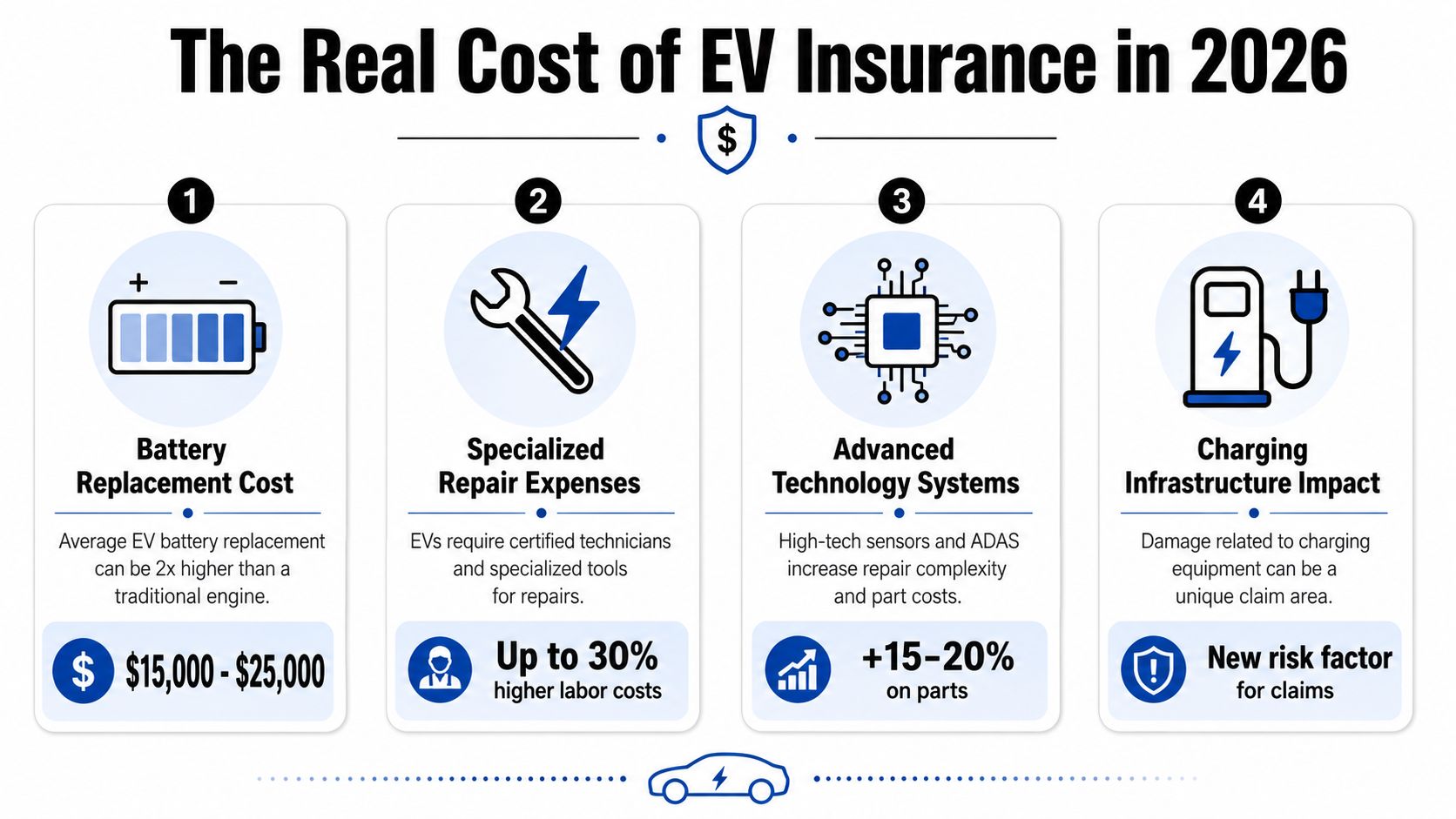
Claims costs rise when accidents happen more often, when repairs take longer, or when more parts have to be replaced and recalibrated. EVs often include dense packaging, integrated electronics, and model-specific repair procedures. That means insurers aren't just asking, “How much does one part cost?” They're asking, “How likely is this car to produce a large claim after an ordinary collision?”
If terms like deductible or OEM parts feel fuzzy, a plain-language insurance glossary for California drivers can help before you compare policies.
Three reasons insurers view EVs differently
- Battery exposure: The battery pack is the most obvious high-value component. Even when it isn't destroyed, an insurer may need a specialized inspection after impact.
- Repair complexity: EVs use high-voltage systems, sensors, and brand-specific parts that aren't handled the same way as older gas vehicles.
- Driving behavior and performance: Instant torque and quick acceleration can change how the vehicle is driven, which matters when insurers study accident frequency.
Practical rule: If a repair requires a certified technician, specialized tools, or a longer inspection process, the insurer usually prices that complexity into the premium.
Why California drivers feel this more sharply
California has a heavy concentration of EVs, dense traffic, expensive labor markets, and a wide mix of urban and suburban driving conditions. That combination can magnify repair timing, parts delays, and claim severity.
The result is simple even if the mechanics are not. EV insurance is different because the car itself is different. It contains costly systems, often needs specialized repairs, and produces loss patterns that don't always match traditional vehicles. Once you understand that, the quote starts to make a lot more sense.
Decoding Your EV Insurance Coverage Options
The basic structure of an EV policy still starts with familiar auto insurance pieces. You'll see liability, collision, and coverage for other types of damage just like you would on a gas vehicle. The trick is understanding how each one works when the car has a high-voltage battery, advanced electronics, and home charging equipment in the background.
Bankrate reports that EV coverage can cost up to $44 more per month because of specialized labor, numerous electronic components, and expensive or hard-to-source parts, including battery-related components, as explained in its guide to electric car insurance costs and coverage. That's why your coverage details matter so much.
The coverages most owners already know
Liability coverage pays for damage or injuries you cause to other people, up to your policy limits. This part doesn't become “EV-specific,” but it still matters because EVs can be heavier and more expensive than the cars around them, so many drivers choose stronger limits for peace of mind.
Collision coverage pays for damage to your EV after an impact, regardless of fault in many claim situations under your policy terms. If the battery housing, underbody, cameras, or integrated electronics are involved, collision becomes one of the most important parts of the policy.
Protection against non-collision damage handles losses such as theft, vandalism, falling objects, fire, and some weather-related damage. For California owners, this is often where wildfire smoke, ash, debris, and other non-crash risks become part of the conversation.
The EV-specific questions to ask
A standard policy may not answer every EV concern clearly. Ask about these points when you review options through a carrier or a broker using a California auto insurance quote process.
- Battery damage handling: Does the insurer treat battery inspection and battery-related damage clearly in the claim process?
- OEM parts availability: Will the carrier approve original manufacturer parts when they're needed, or could aftermarket substitutions become an issue?
- Charging equipment: Is your home charger covered under the auto policy, home insurance, or a separate endorsement?
- Labor standards: Does the carrier account for certified EV repair facilities if your model requires them?
If you keep records for your charger, accessories, or garage upgrades, it also helps to have a system for documenting assets for insurance. That's especially useful after a fire loss, theft loss, or a claim involving multiple policies.
EV Insurance Coverage Checklist
| Coverage Type | What It Covers | Is It Essential for an EV? |
|---|---|---|
| Liability | Injuries or property damage you cause to others | Yes |
| Collision | Damage to your EV after a crash or impact | Yes for most financed or newer EVs |
| Comprehensive | Theft, fire, vandalism, falling objects, certain non-collision losses | Yes for most California EV owners |
| Uninsured/underinsured motorist | Protection if another driver has too little or no insurance | Strongly recommended |
| OEM parts option | Original manufacturer parts for covered repairs when available under policy terms | Very helpful |
| Battery-related claim clarity | Clear treatment of inspection and damage issues involving the battery system | Very helpful |
| Charging equipment coverage | Protection for home charging equipment, usually coordinated with home coverage rather than auto alone | Important if you charge at home |
| Rental reimbursement | Transportation help while your EV is in the shop | Often worth it because repairs can take time |
Where people get confused
Some drivers assume “the battery is covered” in every possible situation. Insurance doesn't work that broadly. Coverage depends on the cause of loss and the policy terms. A collision claim, a manufacturer warranty issue, and gradual battery degradation are not the same thing.
If a problem comes from a crash, road debris, theft, or another covered peril, insurance may respond. If it's normal wear, policy language may not.
That distinction is one of the biggest reasons to slow down and read the coverage details before you accept the cheapest quote.
The Real Cost of Insuring an Electric Car in 2026
California drivers usually want one answer first. How much more should I expect to pay?
The clearest California-specific benchmark is this: in 2025, California drivers paid 15% to 31% more to insure an EV than a comparable gas-powered car, according to Aftermarket Matters' summary of 2025 EV premium data. Nationally, the same source reported an average annual premium of $4,058 for an EV versus $2,732 for a gas car, a 49% difference.
Why your quote lands where it does
The insurer is usually pricing several layers at once:
- Your specific model: A Tesla, Hyundai, Kia, Ford, Rivian, or Nissan won't be priced the same.
- Local repair economics: California labor rates and repair networks vary by region.
- Parts and downtime: Some EV parts take longer to source, which can increase claim costs.
- Technology density: Sensors, cameras, and software-related recalibration add work after an accident.
The last point catches many people off guard. A crash doesn't have to look severe to become expensive if the repair includes electronic diagnostics, specialized body procedures, or inspections related to high-voltage components.
Don't forget home charging in the total-cost picture
Insurance is only one part of EV ownership math. If you're also planning a home charger, it helps to understand installation variables like panel capacity, wiring path, and permitting before you estimate your total monthly and annual costs. A practical companion resource is this guide to understanding home EV charger expenses.
A realistic way to budget
If you're comparing an EV with a similar gas vehicle, assume the insurance line item may be higher, then verify with real quotes instead of guessing. Use a few carriers. Compare deductibles. Ask how claims are handled for battery inspections and certified repair shops. If you want broader context on policy questions and California coverage topics, the Mai & Associates insurance blog is a useful place to keep reading.
The key is not to panic over the first quote. Use it as a baseline, then test better policy structure and better shopping.
California-Specific Guidance for EV Owners
Owning an EV in California creates a different insurance conversation than owning one in many other states. The auto policy matters, but your risk doesn't stop at the car door. It extends to where the vehicle is parked, how it's charged, and what could happen to your home, condo, or rental unit in a wildfire or earthquake zone.
Wildfire risk changes the conversation
If you park and charge at home, wildfire exposure can affect more than the vehicle itself. A severe fire event can involve the car, the charging equipment, the garage, nearby structures, and personal property all at once. That's why EV owners in high-risk areas shouldn't think only in terms of car insurance.
A California household may need auto insurance plus home insurance that properly addresses attached structures, detached garages, and electrical improvements. Renters need to think differently, but the logic is similar. If you live in an apartment or rented home and rely on a private charger, your renters insurance and your landlord's property coverage may not protect the same things.
A home charger often sits at the intersection of auto insurance and property insurance. If no one reviews both policies together, gaps can appear.
Earthquakes don't hit the policy in obvious ways
Earthquakes usually make people think first about home damage, not vehicle coverage. But the key issue is coordination. If a quake damages the structure where your charger is installed, affects the garage, or causes related property loss, you don't want to discover too late that the car policy and the home policy were never evaluated as a pair.
That's one reason bundling can be more than a discount strategy. It can be an organization strategy. When one advisor can review auto insurance, home insurance, renters insurance, and life insurance together, it's easier to spot whether your EV charger, garage contents, liability limits, and household risks line up properly.
A practical California checklist
- Where is the EV parked most nights? A street-parked EV in a dense city raises different concerns than one kept in a private garage.
- Do you charge at home? If yes, review whether the charger is addressed by your property policy.
- Are you in a wildfire-prone area? If yes, make sure your broader household coverage has been reviewed recently.
- Do you own or rent? Homeowners and renters need different solutions, especially for installed equipment.
- Have you reviewed life insurance lately? Families who upgrade to a more expensive vehicle often overlook the larger financial plan around income protection and long-term obligations.
California insurance works best when it's treated as a connected system, not a stack of separate purchases.
How to Get the Right EV Policy and Lower Your Premiums
The cheapest EV quote isn't always the safest choice. A lower premium can hide weaker repair terms, limited parts flexibility, or claim handling that doesn't fit your vehicle. The better goal is lower cost for the right protection.
The good news is that the EV premium gap isn't fixed. The Zebra reported that for cars made in the last two years, the insurance difference was 18%, compared with 42% across all model years, as shown in its review of insurance rates for hybrid and electric cars. That tells you something useful: details matter. Model year, vehicle choice, and policy setup can move the price.
Questions to ask before you buy
Bring these questions to every quote conversation:
- How are battery-related claims handled? Ask for a plain-language explanation.
- Will the policy support OEM parts when needed? This matters for newer EVs.
- Which repair shops typically handle this model? The answer tells you a lot about claim logistics.
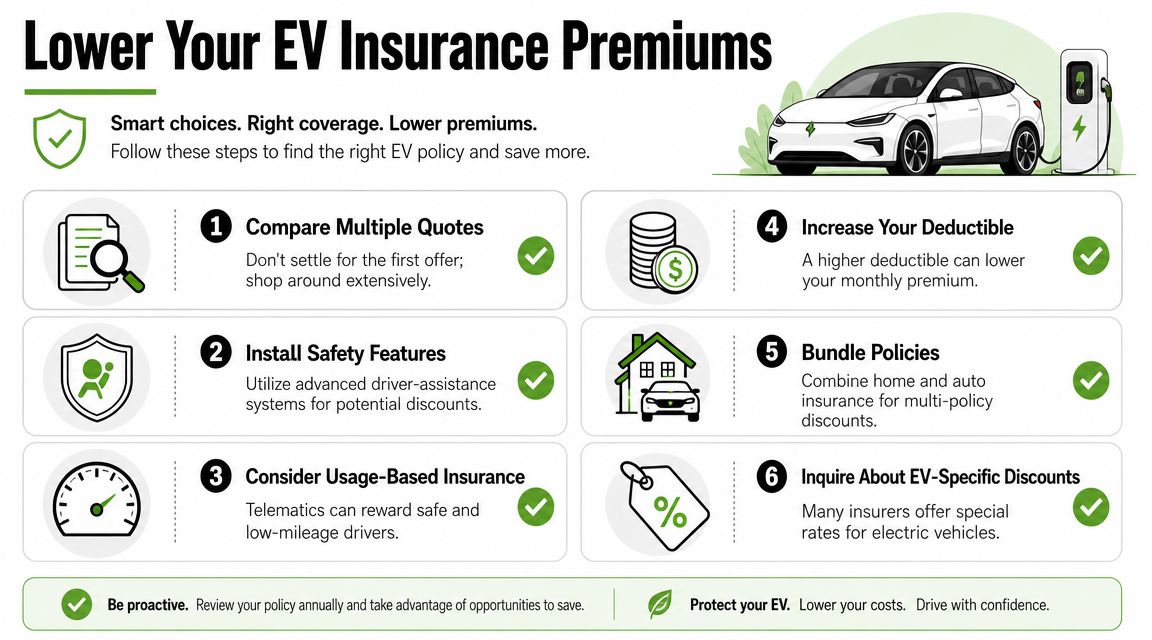
- How does a higher deductible change the premium? Sometimes the tradeoff is worth it, sometimes it isn't.
- Is telematics available? Usage-based programs can help safe or low-mileage drivers.
- Can I bundle this with home insurance, renters insurance, or life insurance? That can simplify billing and close gaps, not just reduce cost.
The strategies that usually help most
- Shop multiple carriers: EV pricing varies more than many people expect, so one quote rarely tells the whole story.
- Match the deductible to your savings: Don't raise it so high that a real claim becomes a financial problem.
- Ask about usage-based insurance: If you drive less or drive carefully, telematics may work in your favor.
- Review all household policies together: Bundling auto with home or renters can create a cleaner protection plan.
- Check newer-model pricing: Some newer EVs price more competitively than drivers assume.
One option for California shoppers is to request a personalized insurance quote through a broker that compares multiple carriers and can also review home, renters, and life insurance alongside auto coverage. Mai & Associates is one example of an agency that offers that type of cross-policy review in California.
Shop for the claim experience, not just the premium. A slightly better policy can save a lot of frustration when your EV is in the repair queue.
Your Next Steps and EV Insurance FAQs
If you're still sorting out the details, these are the questions I hear most often from California EV owners.
Common EV insurance questions
Is my home EV charger covered by homeowners insurance?
Often, it may be addressed under home insurance rather than auto insurance, but coverage depends on how the charger is installed and how the policy is written. Review both policies together.
What if I have an accident at a public charging station?
Your auto policy may respond to vehicle damage based on the cause of loss and your coverages. Liability questions can get more complex if property damage or another driver is involved.
Does battery degradation affect my insurance?
Normal wear and gradual degradation aren't the same as sudden accidental damage. Insurance and warranty issues should be treated separately.
Should renters think about EV coverage differently?
Yes. Renters often need to review both vehicle protection and personal property protection, especially if charging equipment or accessories are stored at home.
The next step is simple. Get quotes that reflect your actual EV, your parking setup, your charging habits, and your California property risks. Don't rely on a generic estimate. A policy for a Los Angeles condo owner, an Orange County homeowner, and a Sacramento renter shouldn't look identical.
If you want a California-focused review of your electric vehicle insurance, home insurance, renters insurance, car insurance, or life insurance, Mai & Associates can help you compare options from multiple carriers and look for gaps that affect EV owners, especially households dealing with wildfire exposure, earthquake concerns, or home charging setups.