Effective Date Insurance: When Your Coverage Begins
You bought a car in California, signed the paperwork, and drove off thinking the hard part was over. Or maybe you just picked up the keys to a new apartment and assumed your renters insurance kicked in the second you opened the door.
That's where people get burned.
With California insurance, one small detail decides whether a claim gets paid or denied: the effective date. If your car insurance, home insurance, renters insurance, or life insurance hasn't officially started yet, you may have no coverage for a loss that happens in the gap. A lot of people confuse the day they applied, the day they paid, and the day the policy begins. Those aren't always the same thing.
For California drivers especially, this matters more than is commonly understood. Between new car purchases, insurer changes, lender requirements, wildfire concerns, and tighter compliance expectations, you need to know exactly when your protection starts, not just assume you're covered.
Your Insurance Start Line Why the Effective Date Matters
A California driver buys a used sedan on a Saturday afternoon. The dealer says, “You'll want to call your insurance company.” He does. He gets a quote, agrees to the premium, and receives an email. He assumes that means he's fully covered on the drive home.
That assumption is risky.
The effective date works like the first official day at a new job. You may have accepted the offer, filled out forms, and even gotten your badge. But you're not on the clock until your start date arrives. Insurance works the same way. You can shop, apply, pay, and still need to verify the exact date and time your policy starts.
Where confusion usually starts
People often mix up several moments:
- The quote date: When you saw the price.
- The purchase date: When you agreed to buy the policy.
- The issue date: When the insurer generated paperwork.
- The effective date: When coverage begins.
That last one is the date that matters when there's an accident, theft, fire, or liability claim.
A renter can make the same mistake. You sign a lease, buy renters insurance online, and move boxes in that night. If water damage, theft, or a liability issue happens before the policy's effective date, you may be paying out of pocket. Home insurance and life insurance can create the same problem when buyers assume paperwork means protection is already active.
Practical rule: Never ask only “Did I buy the policy?” Ask “What is the exact effective date and when does coverage begin?”
If you manage client files, move-ins, or policy documents for a team, organized intake helps prevent these misunderstandings. Tools like Superdocu's insurance onboarding templates can help people collect the right documents and confirmations before they rely on coverage.
Why Californians need to pay closer attention
California consumers deal with timing pressure all the time. New vehicle purchases, lender deadlines, landlord requirements, and property risks don't wait for your paperwork to catch up. In wildfire-prone areas, homeowners may be coordinating multiple policies or reviewing FAIR Plan arrangements. In auto insurance, a one-day misunderstanding can become a denied claim and a DMV problem at the same time.
That's why effective date insurance isn't a technical footnote. It's the start line for your financial protection.
What Is an Insurance Effective Date in California
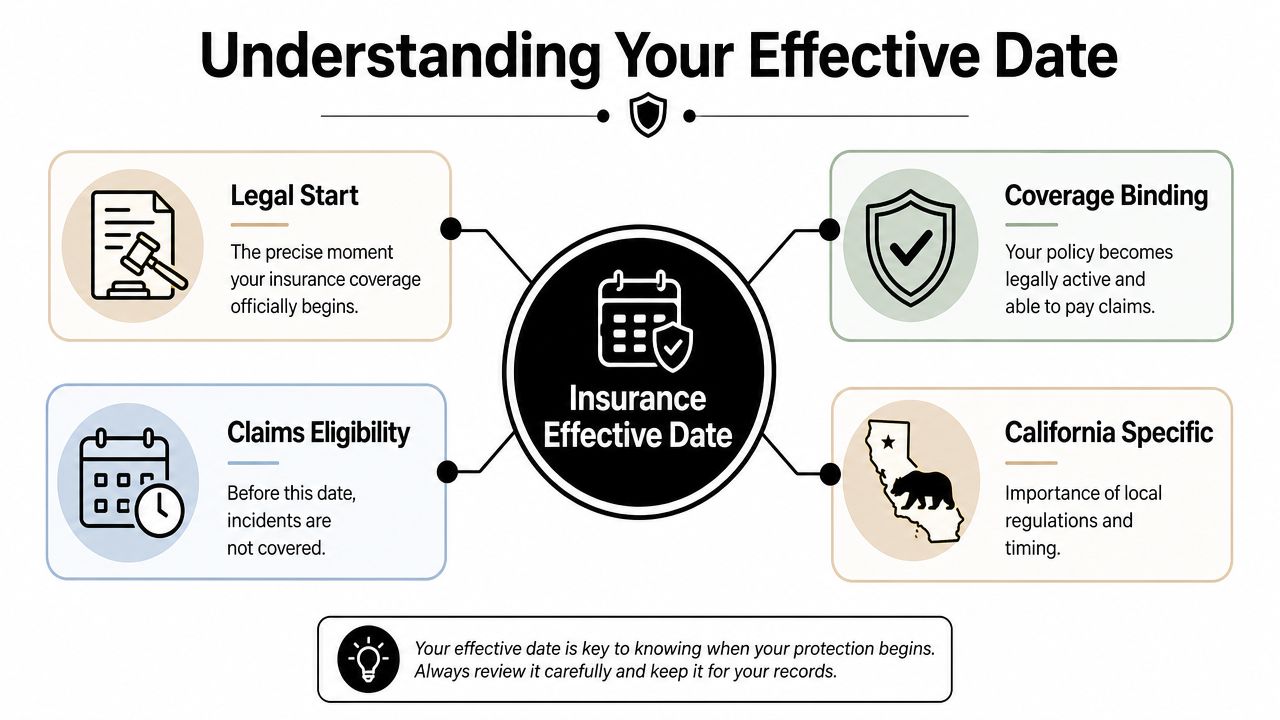
In plain English, an insurance effective date is the day your coverage becomes legally active.
If you want the simplest definition, use this: it's the day your insurer starts standing behind the policy. Before that date, there's no claim protection under that contract. On or after that date, covered losses may qualify for payment, subject to the policy terms.
The formal California meaning
California policyholders should treat the effective date as the controlling start date for coverage. As Pacific Specialty's explanation of an insurance effective date in California states, the effective date of an insurance policy is the specific day when coverage officially begins, meaning no benefits are available for any accidents or incidents occurring before that date. The same source explains that this date is formally recorded on the policy's declarations page and serves as the benchmark for claim eligibility.
That applies across major coverage types in the state:
- Auto insurance: A crash before the effective date isn't covered by that policy.
- Home insurance: A fire, theft, or liability event before the start date falls outside the coverage period.
- Renters insurance: Losses before the policy begins aren't payable just because you already applied.
- Life insurance: The legal start date still matters, even if the application process started earlier.
Where to find it
The first place to check is your declarations page. That page usually summarizes the policy period, named insureds, covered property or vehicles, and limits. If there's a dispute later, the declarations page becomes one of the first documents people review.
If you want more California policy basics in one place, the Mai & Associates insurance guides are a useful starting point for comparing how different policies work.
The date you received the quote is not proof of coverage. The date you received the email is not proof of coverage. The declarations page is what you should read.
Effective date versus issue date
Many people stumble at this point.
The date of issue is when the insurer creates or releases the policy documents. The effective date is when coverage starts. Those can match, but they don't have to. A policy can be issued today and start later. That's why effective date insurance deserves separate attention instead of being treated like routine paperwork.
If you remember one thing, remember this: the policy only protects you starting on its effective date.
The Different Types of Effective Dates Explained
You may see more than one important date in your insurance paperwork. They don't all mean the same thing. Some mark when permanent coverage starts. Others mark a temporary commitment, an ending date, or a restart after a lapse.
Understanding Different Insurance Dates
| Date Type | What It Means | Common Scenario |
|---|---|---|
| Policy effective date | The official start of coverage under the policy | You buy California car insurance and coverage begins on the date listed in the declarations page |
| Binder effective date | The start of temporary evidence of coverage before full policy issuance | A homebuyer needs proof of homeowners insurance before closing |
| Retroactive date | A date that affects how prior acts are treated under certain claims-made policies | A professional liability policy looks back to determine whether an earlier act can be considered |
| Cancellation effective date | The date coverage officially ends | An insurer or policyholder ends a policy and coverage stops on the listed day |
| Reinstatement effective date | The date coverage resumes after a lapse, if the insurer allows reinstatement | A driver misses a payment, then works with the carrier to restore the policy |
The standard policy effective date
This is the main one most California consumers care about. It's the date your auto insurance, home insurance, renters insurance, car insurance, or life insurance begins. If your loss happens before this date, the policy won't respond.
For example, if you schedule a new auto policy to begin Monday and get into an accident on Sunday night, Sunday is still uninsured under that new contract.
Binder dates and temporary proof
A binder is temporary evidence that coverage is being provided while final policy documents are completed. People often encounter binders during home purchases, especially when a lender wants proof before closing.
A binder can be useful, but don't assume it solves every timing problem. Read the document and confirm its start date, what it covers, and when the formal policy will replace it.
Retroactive dates
Retroactive dates are less common in personal insurance conversations, but they come up in certain claims-made policies. This concept matters because the policy may cover claims made during the active policy term only if the underlying act happened on or after the retroactive date.
For most personal auto insurance, home insurance, and renters insurance shoppers, this isn't the daily issue. Still, it helps to know that “effective date” isn't always the only date with legal weight.
End dates and restart dates
Cancellation and reinstatement can create confusion because they involve two separate moments: when old coverage stops and when new or renewed coverage begins.
Here are the practical questions to ask:
- If a policy was canceled, what exact date did coverage end?
- If it was reinstated, did coverage resume without a gap, or did it restart later?
- If you switched carriers, does the new policy begin before the old one ends?
Renters run into this too, especially after a move or missed payment. If that's your situation, reviewing California renters insurance basics can help you spot where a timing gap might show up.
Watch the paperwork: A reinstated policy doesn't always erase a lapse. Confirm whether the insurer restored continuous coverage or started you over on a new date.
Common Scenarios and Costly Pitfalls to Avoid
The biggest mistakes around effective date insurance usually come from assumptions. People assume payment means activation. They assume a new car is automatically covered. They assume an insurer can backdate a policy after something already happened.
Those assumptions can get expensive fast.
Trying to backdate coverage after a loss
A driver gets into a minor accident, then starts searching for a car insurance policy the same day and asks if the insurer can make it effective yesterday. A renter discovers stolen property and wonders if buying a policy now can cover what's already gone.
That's not how insurance works.
HealthInsurance.org's glossary explanation of effective dates notes that retroactive effective dates for health insurance are generally prohibited except in narrow qualifying life event situations such as childbirth, adoption, or natural disasters. The same discussion also warns that misrepresenting an effective date is considered fraudulent and illegal in most contracts. The plain takeaway for consumers is simple: you can't buy coverage after the fact and pretend the protection started earlier.
The one-day gap between policies
A California driver decides to switch insurers for a better rate. The old policy ends on Friday. The new one starts on Saturday because that looked close enough. Friday night, there's a collision in a parking lot.
One uncovered day is still an uncovered day.
This is one of the most common timing errors in car insurance. People focus on price and forget to line up dates exactly. If you're replacing auto insurance, home insurance, or renters insurance, overlap is usually safer than a gap.
If you're switching policies, line up the new effective date before the old policy ends. Don't rely on memory. Don't rely on assumptions.
Buying a new vehicle and relying on temporary coverage
California adds another layer here. According to Cost-U-Less Direct's explanation of California new car insurance timing, drivers must obtain auto insurance within 30 days of purchasing a new vehicle, and an existing policy may provide temporary coverage during that period. The same source warns that misunderstanding the effective date of new or updated coverage can lead to fines, license suspension, or vehicle impoundment if a gap occurs.
That means the phrase “you should be covered” isn't enough. You need to confirm whether your current policy extends to the newly purchased car, for how long, and under what conditions. Temporary coverage can depend on whether the vehicle replaces an old one or is added as another car.
If you're unsure how your policy handles a new car, the California insurance FAQ page is a practical place to review common questions before you drive assuming you're protected.
Home and renters timing mistakes
Homeowners can run into this around closing. Renters can run into it on move-in day. In both cases, the danger is the same: occupancy starts before the policy does.
In California, that timing can matter even more when property risks are heightened. A burst pipe, a theft during move-in, or a liability event involving guests doesn't care whether your insurer was “about to” start coverage. If the effective date hasn't arrived, the policy generally hasn't either.
How to Confirm Your California Insurance Effective Date
You don't need to guess. You need to verify.
The safest approach is a short checklist you can follow every time you buy, renew, replace, or reinstate a policy. This matters for auto insurance, home insurance, renters insurance, car insurance, and life insurance alike.
Your verification checklist
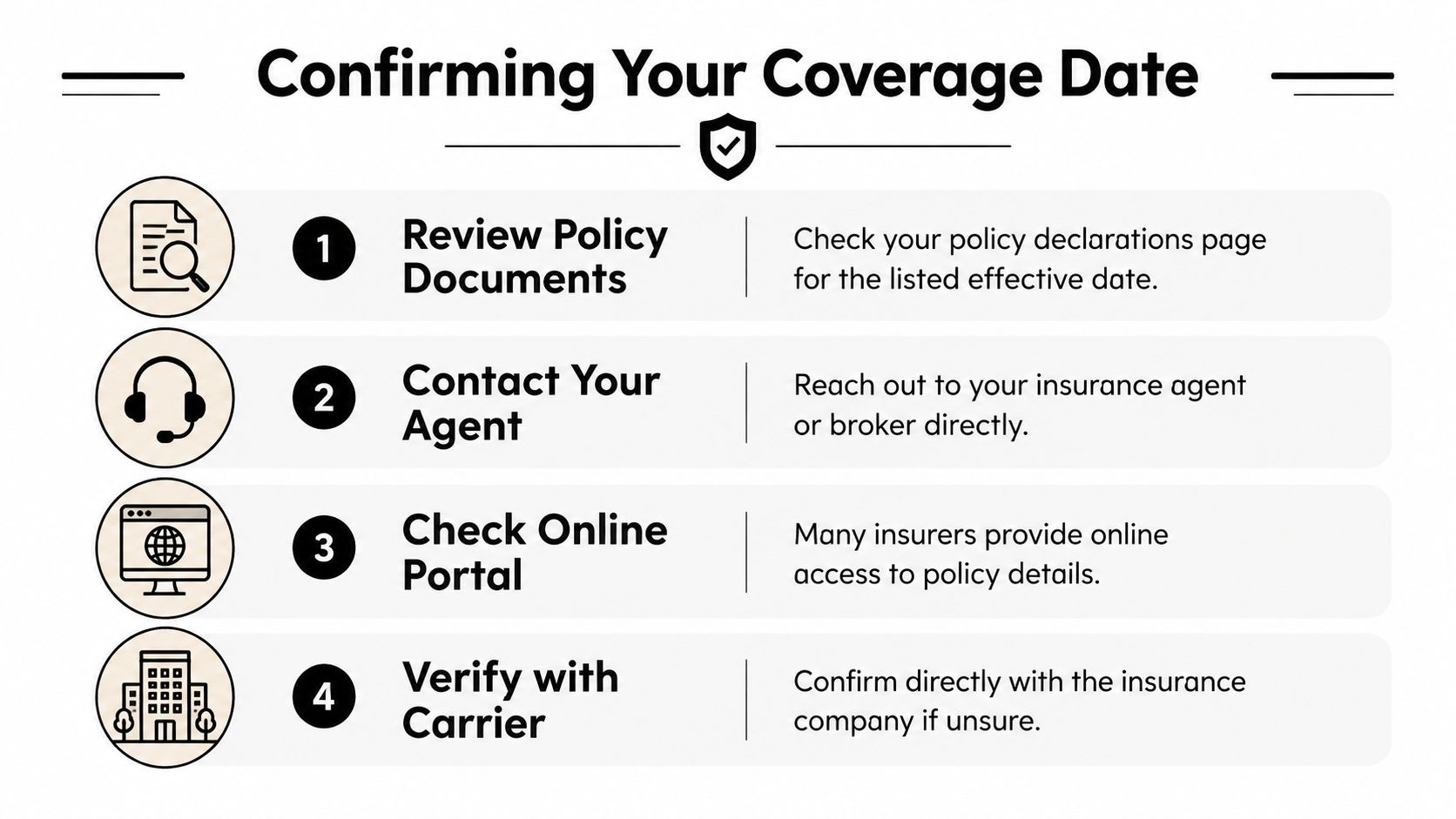
Read the declarations page first
Don't start with the marketing email or payment receipt. Open the declarations page and look for the policy period and effective date. If the date isn't where you expect, stop and ask questions before relying on the policy.Request your certificate of insurance if needed
A COI can help when a landlord, lender, employer, or property manager needs proof of coverage. It's also a practical way to confirm what date the insurer is using as the start of protection.Call and confirm the exact start date
If you're buying same-day coverage, changing carriers, or adding a car, call your agent or carrier directly. Ask for the exact effective date and whether coverage begins immediately or later.Save proof in more than one place
Keep a digital copy on your phone and email, and keep a printable copy if possible. That makes it easier to prove coverage if a police officer, lender, landlord, or claims adjuster asks.
Why this matters even more for California drivers
California drivers should pay especially close attention when updating liability limits. As Omega Law explains regarding Senate Bill 1107, as of January 1, 2025, California's new minimum auto insurance liability limits are $30,000 for bodily injury per person, $60,000 per accident for bodily injury, and $15,000 for property damage. If your policy change is intended to bring you into compliance, the date that compliant coverage begins matters. If the higher limits haven't taken effect yet, you may still be underinsured.
A simple confirmation script
When you call, keep it direct:
- Ask for the date: “What is my policy's effective date?”
- Ask for the timing: “Does coverage begin today or at a later date?”
- Ask about the vehicle or property: “Is this specific car, home, or rental unit included as of that date?”
- Ask for written proof: “Can you send the declarations page or confirmation today?”
If you want help reviewing policy timing or verifying documents before relying on coverage, you can contact a California insurance team for direct confirmation.
One good habit: Before you drive a new car, move into a rental, or close on a home, verify the date in writing and save the proof.
Secure Your Coverage Date with Mai & Associates
A policy's effective date looks small on the page. Financially, it isn't small at all. It decides whether a claim falls inside your protection or outside it.
That matters across California insurance. Auto insurance buyers need to avoid gaps when replacing a policy or adding a newly purchased vehicle. Home insurance buyers need coverage lined up with ownership and occupancy. Renters need protection active before move-in risk starts. Life insurance applicants need clarity about when the policy becomes effective.
Mai & Associates helps California clients solve exactly that kind of timing problem. The agency provides same-day quotes, compares options from multiple carriers, and helps clients avoid dangerous lapses when they're buying a car, moving into a rental, or updating an existing policy. For homeowners in higher-risk areas, the team also reviews existing coverage arrangements, including California FAIR Plan policies, to catch mismatched dates and related gaps before they become claim problems.
California clients also benefit from practical accessibility. Mai & Associates serves people through offices in Glendale, Westlake Village, Escondido, and Costa Mesa, and offers multilingual support in English, Spanish, Armenian, Russian, and Vietnamese. That matters because insurance timing gets much easier to confirm when the explanation is clear the first time.
If you remember one lesson from this article, make it this: never assume coverage has started just because you asked for it, paid for it, or received an email. Confirm the effective date. Read the declarations page. Save proof.
If you want help checking the start date on your auto, home, renters, or life insurance, Mai & Associates can help you compare options, confirm effective dates, and secure California coverage without avoidable gaps.