Best Earthquake Insurance Providers California: 2026 Guide

You're probably in one of two spots right now. You either just realized your homeowners policy doesn't handle earthquake damage, or you've been putting off the earthquake insurance decision because every quote looks different and every provider seems to sell it a different way.
That confusion is normal. California earthquake insurance isn't a simple add-on like roadside assistance on auto insurance. It sits in its own category, with different deductibles, different buying channels, and very different tradeoffs depending on whether you buy through a CEA-affiliated insurer, a private-market carrier, or an independent agency that can shop both.
If you want the short version, here it is. Don't shop earthquake coverage by brand name first. Shop it by provider channel, deductible design, and how it fits with the rest of your California insurance portfolio, including home insurance, renters insurance, car insurance, auto insurance, and life insurance.
Here's the quick comparison that matters most.
| Provider Channel | How You Buy It | Best For | Main Tradeoff |
|---|---|---|---|
| CEA-affiliated insurer | Through a participating homeowners insurer | Homeowners who want a standardized path tied to their existing home policy | Less flexibility in policy design |
| Private-market earthquake insurer | Through specialty carriers or insurers offering proprietary products | Homeowners who want more deductible and coverage structure options | More variation from one carrier to another |
| Independent insurance agency | Through an agency that can compare multiple markets | People who want side-by-side advice across home, renters, auto, car, and life insurance needs | Quality depends on the agency's market access and guidance |
Why Your Home Insurance Is Not Enough
Most Californians assume their home policy handles the big disasters. It usually doesn't handle earthquakes.
That gap catches people off guard because they're used to one policy doing a lot. Standard homeowners insurance and renters insurance can protect against many common losses, but earthquake damage sits outside that normal structure. If your home suffers quake damage, the cost to repair the structure, replace damaged belongings, or live somewhere else during repairs may fall on you unless you bought separate earthquake coverage.
What earthquake insurance is actually for
At its core, earthquake insurance is built around three jobs:
- Dwelling protection helps pay to repair or rebuild the home itself.
- Personal property coverage helps replace damaged belongings.
- Loss of use or Additional Living Expenses helps if you need temporary housing after a covered quake loss.
Those three parts matter because earthquake claims aren't just about cracked walls. They can affect where you live, what you own, and how long you're displaced. If you already carry California home insurance coverage, think of earthquake insurance as a separate layer that fills a specific hole in your protection plan.
The deductible is where most buyers get surprised
This is the part that changes the conversation. Earthquake insurance usually uses percentage deductibles instead of the fixed-dollar deductibles people know from home or auto policies. The Insurance Information Institute notes that earthquake deductibles commonly range from 2% to 20% of the insured property value, and it cites an average California cost of $3.54 per $1,000 of coverage, or about $2,478 per year for a $700,000 home, with meaningful variation by location and coverage choices in the same guide on earthquakes and tsunamis insurance facts.
Practical rule: If you don't understand the deductible in dollars, you don't understand the policy yet.
That's why I tell clients to stop obsessing over premium first. Start with the deductible you could realistically absorb after a serious loss. Then work backward.
A second issue gets missed too often. Your policy limit and your deductible only make sense when you understand how claim caps work across coverages. If you want a plain-English refresher on maximum insurance payout limits, read that before you compare earthquake quotes. It helps you see why a cheaper policy can still leave a major coverage gap.
The Two Main Paths for California Earthquake Insurance
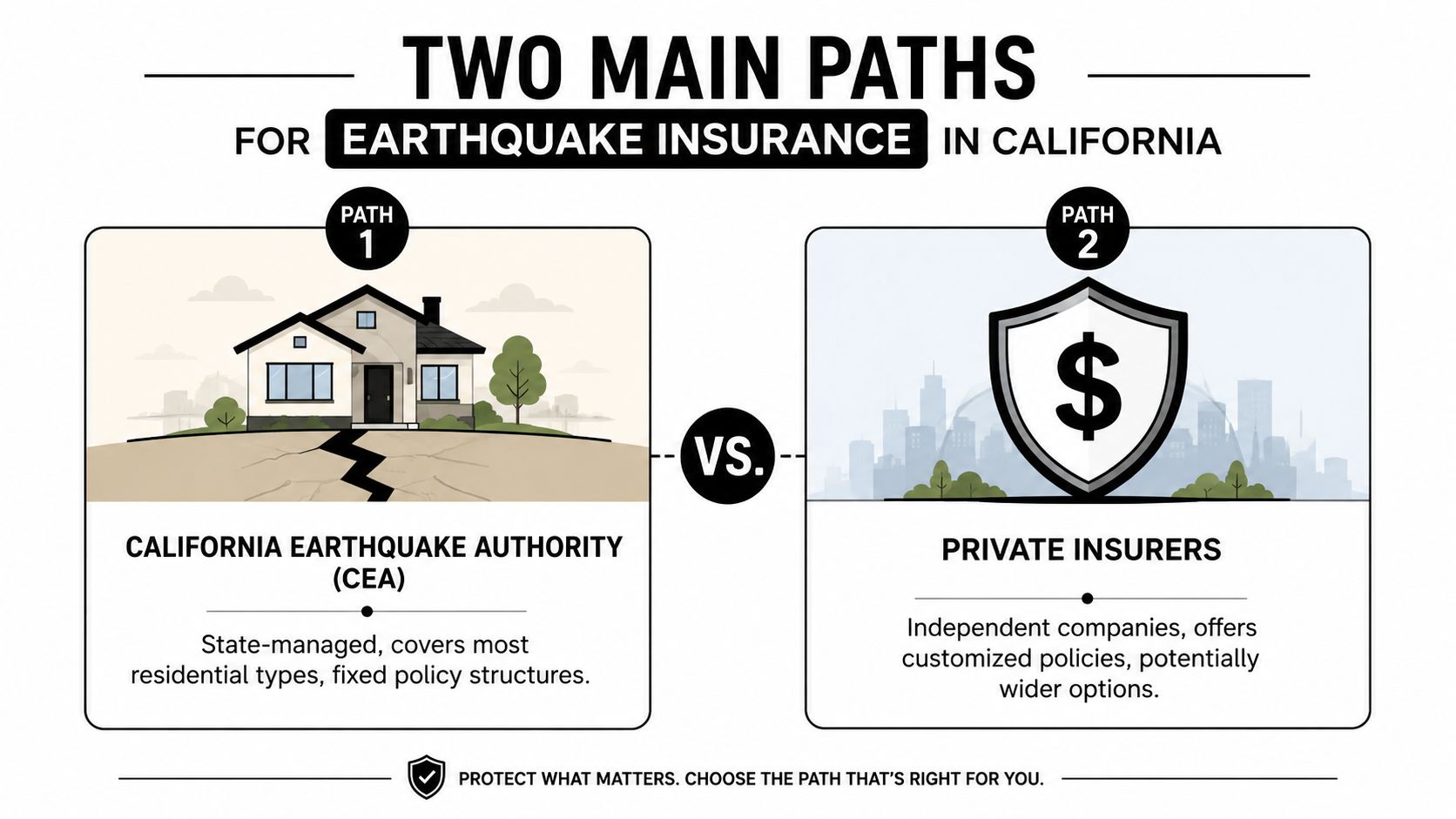
California's earthquake insurance market looks crowded from the outside, but for most consumers it narrows into two real paths. You either buy a policy connected to the California Earthquake Authority, or you buy from the private market.
That distinction matters more than the logo on the paperwork.
Path one is the CEA route
The California Earthquake Authority is the center of gravity in this market. United Policyholders reports that the CEA was created in 1996, issues about two-thirds of the residential earthquake policies sold in California, controls about 67% of California's residential earthquake insurance market, and has more than 1 million policies in force. The same consumer-focused analysis also notes an average CEA premium of $727.76 in 2019, compared with $874.51 for non-CEA residential earthquake coverage, in its overview of who the California Earthquake Authority is.
That dominance shapes how people shop for earthquake insurance providers in California. Even when buyers think they're just asking their home insurer about quake coverage, they may be entering the CEA channel through that insurer.
Path two is the private market
The private market includes specialty insurers and other carriers that offer their own earthquake products. These offerings often feature more variation in deductible choices, different packaging for personal property and temporary living expenses, and policy structures that don't mirror CEA forms.
That flexibility can be valuable. It can also create confusion if you compare only price and ignore how the policy is built.
The best private-market quote isn't the lowest premium. It's the one that makes the deductible, coverage options, and claim mechanics tolerable for your household.
My recommendation on where to start
If you want a clean baseline, start with the CEA path because it gives you a familiar reference point. Then compare it against at least one private-market option.
Do that in this order:
- Get the CEA-style option first so you understand the standard market structure.
- Pull a private-market comparison to see whether better deductible or coverage design is available.
- Decide based on fit, not on the assumption that one channel is always superior.
People searching for earthquake insurance providers in California often ask which company is “best.” That's the wrong question. The better question is which channel gives you the right balance of premium, deductible, and usable coverage.
How to Evaluate Earthquake Insurance Providers
Most buyers compare earthquake quotes the way they compare car insurance. That's a mistake. For earthquake coverage, the meaningful differences are usually inside the policy design.
Start with deductible structure
Bankrate notes that a key differentiator among providers is policy structure. It explains that CEA policies offer Standard Homeowners and Homeowners Choice, and that these handle personal property and loss-of-use differently. Standard includes personal property up to $25,000 and loss of use up to $100,000, while Homeowners Choice makes both optional up to those same limits. The same analysis says independent carriers often offer deductibles from 2.5% to 25%, which directly affects your out-of-pocket exposure in its guide to California earthquake insurance options.
That's where a real comparison starts. Ask what deductible options exist, and then calculate what each one means in actual dollars.
Then compare what's built in and what's optional
Some policies bundle more by default. Others let you strip coverage down and add it back selectively.
Use this checklist, not the premium alone.
| Evaluation Criteria | What to Look For | Why It Matters |
|---|---|---|
| Deductible band | Lowest and highest deductible options offered | This determines how much loss you retain before coverage responds |
| Dwelling coverage approach | Whether the policy aligns reasonably with rebuild needs | The structure is the largest financial exposure for most owners |
| Personal property treatment | Included automatically or optional | A cheaper quote may exclude belongings protection you expected |
| Loss of use coverage | Built in or elective | Temporary housing after a loss can become a major expense |
| Policy relationship to home insurance | Paired with the same insurer or placed separately | This affects convenience, billing, and claim coordination |
| Claims reputation | How clearly the carrier explains claim handling | Earthquake claims are stressful, and unclear processes make them worse |
| Financial strength review | Check current insurer ratings from recognized rating organizations | You want a carrier with the resources to handle catastrophe exposure |
If you want broader insurance comparison advice beyond earthquake coverage, a solid next step is to review practical California insurance guides before you request quotes.
The questions I'd ask every provider
Ask these directly:
- What deductible options do you offer?
- Is personal property included, limited, or optional?
- Is loss of use built in or separate?
- Will this sit alongside my current homeowners policy, or as a completely separate placement?
- How does the claim process work after a major quake?
Advisor view: A quote without a deductible discussion is incomplete advice.
My opinion is simple. If an agent can't explain the difference between a cheaper premium and a better policy design in plain English, keep shopping.
Finding the Right Provider Channel for You
Buying earthquake insurance isn't just about the policy. It's also about the channel you use to get it. In California, that buying path changes your options, your comparison process, and sometimes how smoothly your coverage fits with your homeowners, renters, auto, car, and life insurance planning.
CEA-affiliated purchase path
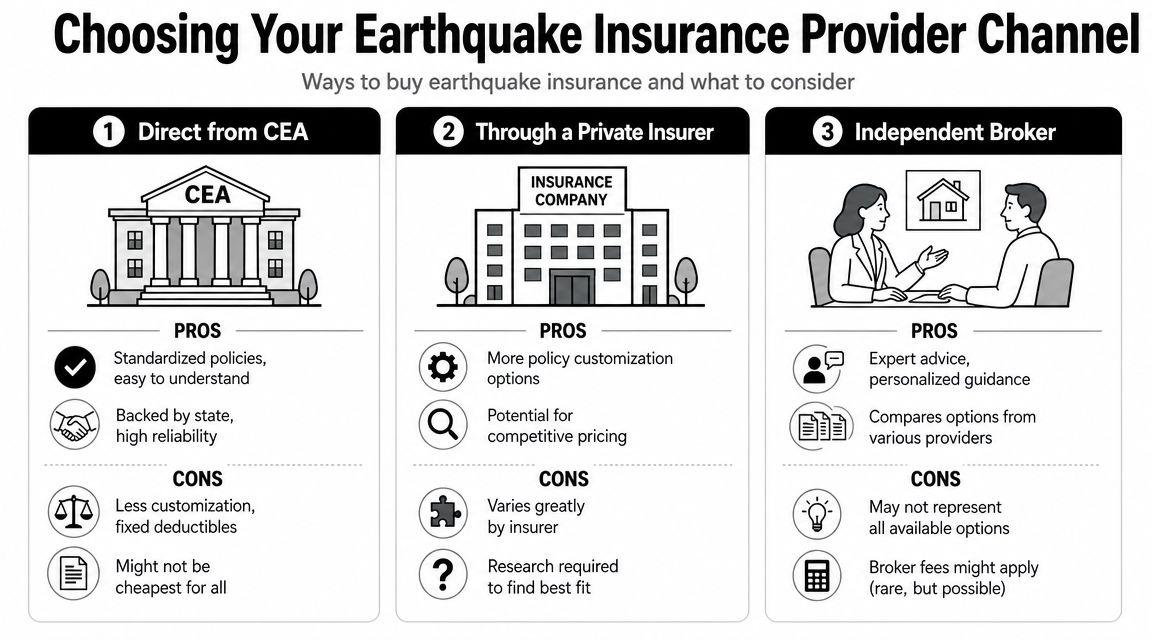
The California Department of Insurance says the CEA provides most earthquake insurance in the state, that consumers must buy CEA coverage through a participating insurer rather than directly from CEA, and that California law requires homeowners insurers to offer earthquake coverage in writing at least every other year with the notice spelling out coverage limit, deductible, premium, and a 30-day acceptance window in its consumer guide to residential earthquake insurance in California.
That means the CEA route is structured and predictable. If your homeowners carrier participates, this can be administratively convenient because the earthquake policy is tied to the underlying home policy relationship.
Good fit for:
- Homeowners who want a familiar process
- People who prefer a standardized product
- Buyers who don't want to hunt through many specialty markets themselves
Private-market direct or captive-agent path
Some non-CEA options come through carriers that sell their own earthquake products. If you access one through a company-specific agent, you may get a strong quote, but you're still seeing that carrier's menu, not the broader market.
That channel can work well if the insurer offers a policy design that clearly beats your baseline. It's less effective if you're trying to understand the full earthquake insurance providers California market.
Independent agency path
This is the most practical route for many households because it puts CEA-affiliated and private-market options on the same table. A strong independent agency can also help you spot overlap and gaps across multiple lines.
That matters in California because insurance doesn't live in silos. Your home insurance affects your earthquake decision. Your renters insurance may need review if you don't own. Your auto and car insurance should still be aligned with your asset protection plan. Your life insurance belongs in the same financial conversation if your family depends on your income.
Here's my blunt advice:
- Use a captive agent if you already trust that insurer and want a quick answer.
- Use direct carrier shopping if you're comfortable doing your own policy analysis.
- Use an independent agency if you want serious comparison and a more complete California insurance review.
The more policies you carry, the more value there is in having one advisor look for gaps across all of them.
Sample Provider Profiles in California
Naming a “best” carrier misses how people typically buy earthquake coverage. Most homeowners fit one of these provider profiles better than the others.
The CEA-affiliated major carrier
This is the household-name insurer that also gives you access to a CEA-backed earthquake option through its existing relationship with your homeowners coverage.
This profile works well for the homeowner who values convenience. One insurance relationship, familiar billing, and a cleaner administrative setup. The tradeoff is that the policy structure is more standardized, so if you want unusual deductible preferences or more tailoring, this path may feel rigid.
The specialty non-CEA insurer
This provider is built for earthquake coverage as a standalone specialty product rather than as an extension of your main home insurance account.
This is often the right fit for buyers who care less about convenience and more about policy design. If you own a higher-value home, want more customized choices, or dislike the standard setup available through a participating homeowners insurer, this profile deserves attention. Expect more variation. That's the opportunity and the burden.
The high-risk placement specialist
Some properties are harder to place. The home may have construction features, location issues, prior insurance complications, or a broader high-risk profile that pushes the case outside simple quoting.
That's where a specialist matters. Not because they're always cheaper, but because they know how to structure difficult placements and explain what's realistically available.
A hard-to-insure property shouldn't be matched with a generic quoting process.
Which profile usually wins
For the average California homeowner, the best starting point is still a comparison between the CEA-affiliated major carrier profile and the specialty non-CEA insurer profile. If your property is unusual, skip the generic route and go straight to a specialist or an independent agency that routinely handles tougher risks.
Your Action Plan to Get and Compare Quotes
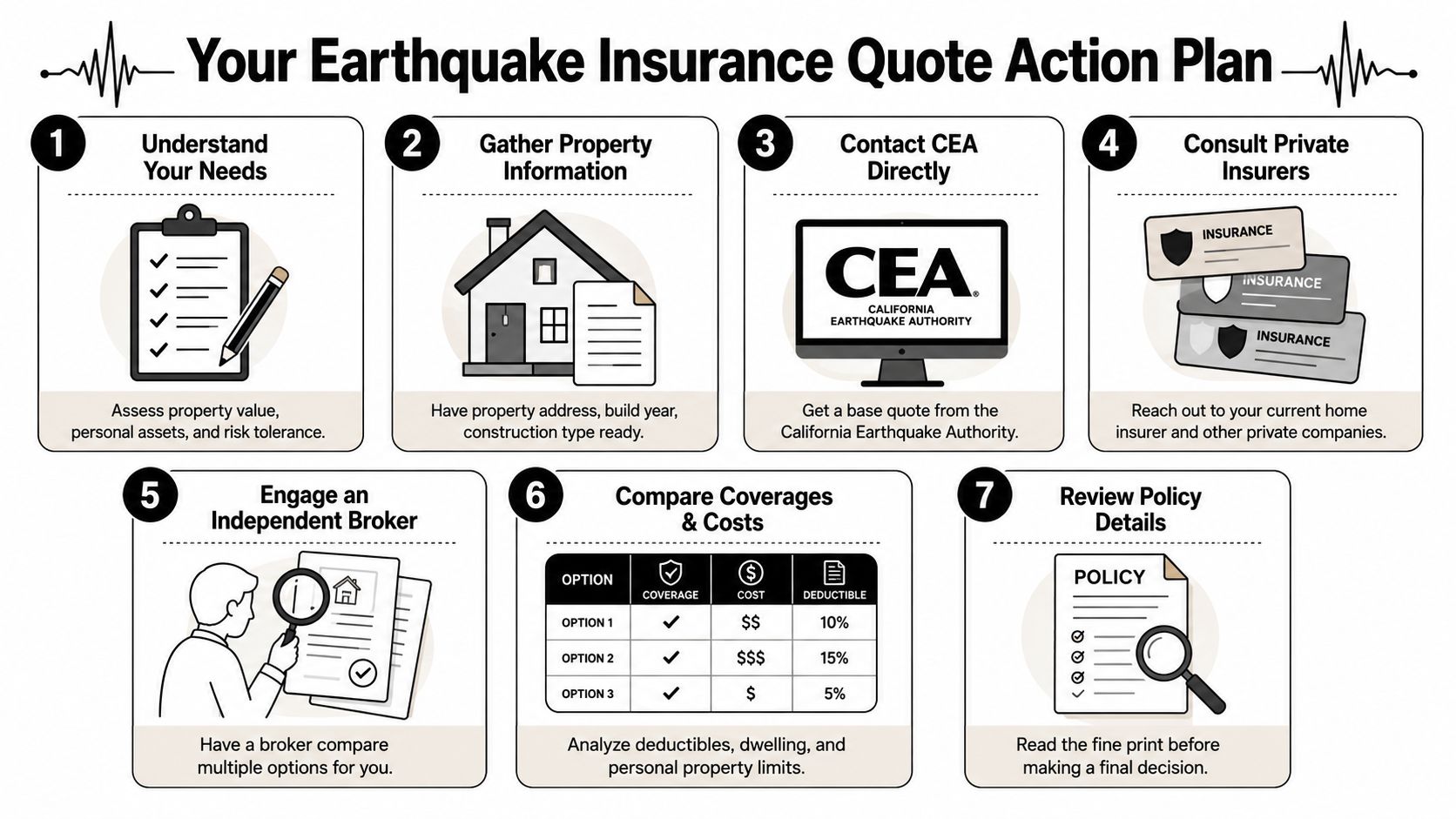
Shopping for earthquake insurance gets easier when you stop treating it like a mystery and turn it into a checklist. You don't need perfect expertise before you start. You need the right documents and the right questions.
Gather your file before you ask for pricing
Start with the basics:
- Your current declarations page for homeowners or renters insurance
- Property details such as address, year built, and construction type
- Any recent updates that could affect underwriting, like retrofits or major renovations
- A working budget range for what you'd realistically pay
If you want to move straight into quote collection, use a California insurance quote request form that lets you start the comparison process without guessing what information matters.
Decide your deductible before you compare premiums
The distinction between smart and frustrated buyers often comes down to this. Set your deductible comfort zone first.
If a policy only looks affordable because the deductible would be painful after a real loss, it isn't a good fit. It's just a lower premium.
Ask for quotes through more than one path
Don't rely on one source unless you already know exactly which channel you want.
Try this sequence:
- Request the option available through your current home insurer so you understand your existing path.
- Ask for a private-market alternative to test whether a different policy structure serves you better.
- Have an independent agency compare both worlds if you want the clearest side-by-side review.
Use a short decision worksheet
When the quotes come back, compare these items on one page:
| Quote Item | Quote A | Quote B | Quote C |
|---|---|---|---|
| Deductible | |||
| Dwelling coverage | |||
| Personal property | |||
| Loss of use | |||
| How policy is issued | |||
| Best fit notes |
Buy the policy you'll still respect after a claim, not the one you only liked before the earthquake.
If English isn't your first language, insist on clear explanations in the language you're most comfortable using. This is not the policy to buy based on half-understood terminology.
Building a Complete California Insurance Safety Net
Earthquake insurance is important, but it's still one piece of a larger plan. A household with a strong earthquake policy and weak liability protection, outdated auto insurance, or no life insurance can still be financially exposed in a major way.
That's why I recommend a full portfolio review instead of a one-policy fix. California homeowners should review home insurance, earthquake coverage, car insurance, auto insurance, and life insurance together. California renters should do the same with renters insurance, auto insurance, and life insurance if others depend on them financially.
What a complete review should cover
A real insurance review should answer these questions:
- Does your home or renters policy still match your current living situation?
- Does your earthquake coverage fill the specific gap your main property policy leaves open?
- Do your auto and car insurance limits still make sense for your assets and income?
- Would your family be financially stable if a major loss happened alongside an injury, lawsuit, or death?
For renters, don't assume earthquake risk is only a homeowner issue. Your structure may be someone else's problem, but your belongings, temporary housing needs, and overall budget resilience are still yours. If you haven't reviewed California renters insurance options, do that as part of the same conversation.
My closing recommendation
If you're shopping earthquake insurance providers in California, don't make it a one-line-item decision. Use it as the trigger for a broader insurance cleanup.
The right move is simple. Get your earthquake quotes, compare the channels, then step back and make sure every major part of your California insurance portfolio still works together.
Mai & Associates can help you do exactly that. The agency compares California insurance options across home, auto, renters, life, and earthquake coverage, with multilingual support and no-obligation guidance built around real coverage fit, not just the lowest premium. If you want help reviewing your choices and finding a practical path forward, contact Mai & Associates.