Earthquake Insurance Policy Guide for California

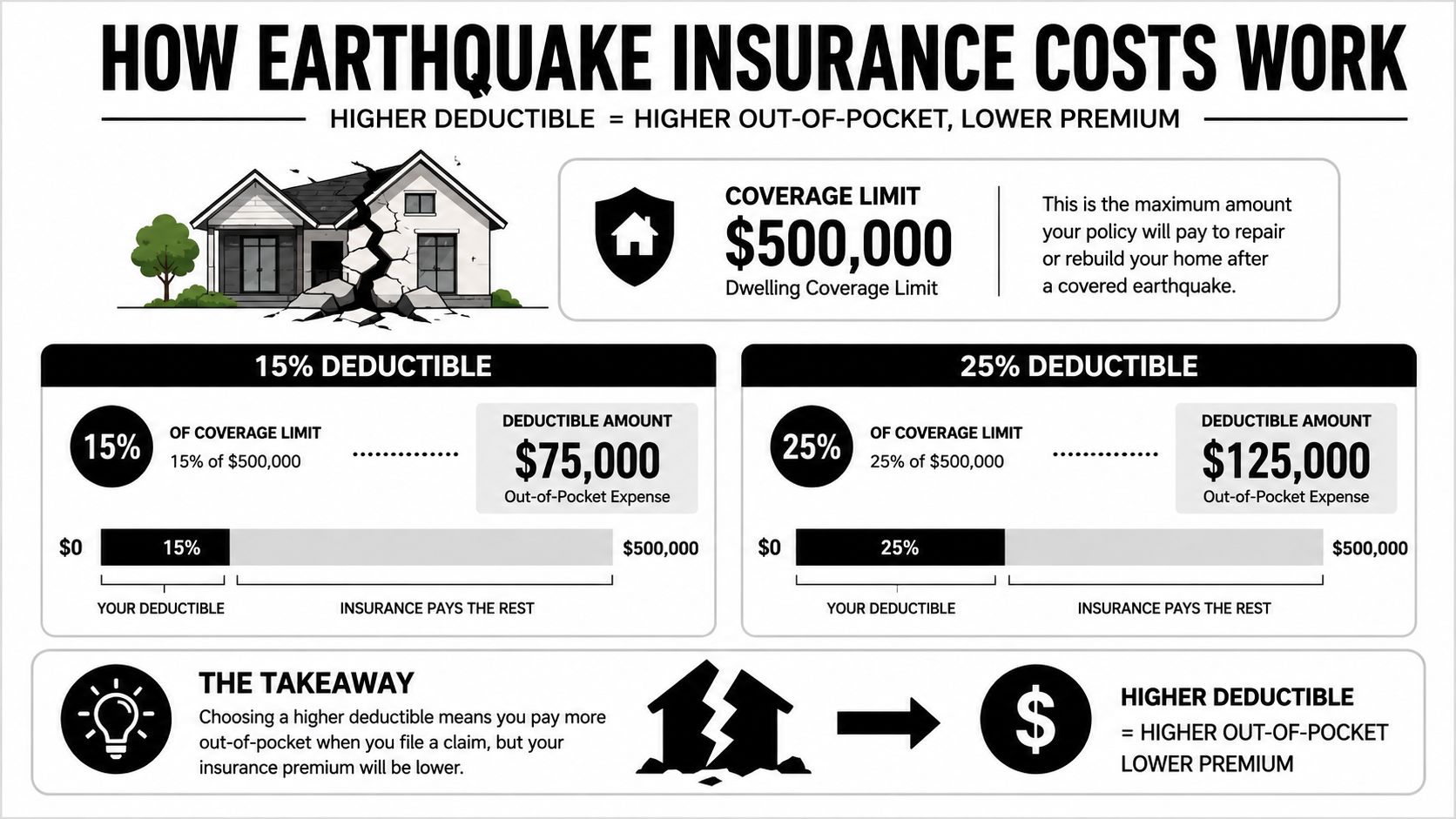
A California earthquake insurance policy can leave you with a 10% to 25% deductible applied to the dwelling limit, not the damage amount. With a $500,000 home and a 15% deductible, you'd pay $75,000 out of pocket before the policy pays for covered damage.
That's the shock many homeowners discover after the shaking stops. They've paid for a full homeowners policy, assume their roof, foundation, belongings, and temporary housing are protected, then learn that standard home insurance excludes earthquake damage. The premium was visible on the declarations page. The claim threshold was not.
California's earthquake coverage market has its own rules, limits, and participating insurers. The California Earthquake Authority, private carriers, deductibles, emergency repair provisions, and the 72-hour event rule can determine whether coverage meaningfully helps or merely exists on paper. If you're evaluating a policy today, focus less on the annual price and more on what you'd receive after a serious loss.
Why California Homeowners Need to Understand Earthquake Coverage
A homeowner can do everything that normally signals responsibility, maintain a homeowners policy, pay the mortgage, insure the structure, and keep detailed records, yet still have no coverage for shaking-related damage. Standard homeowners insurance generally excludes earthquake loss unless you add a separate earthquake policy or endorsement. That exclusion can apply to structural damage, contents, and the cost of living elsewhere while repairs take place.
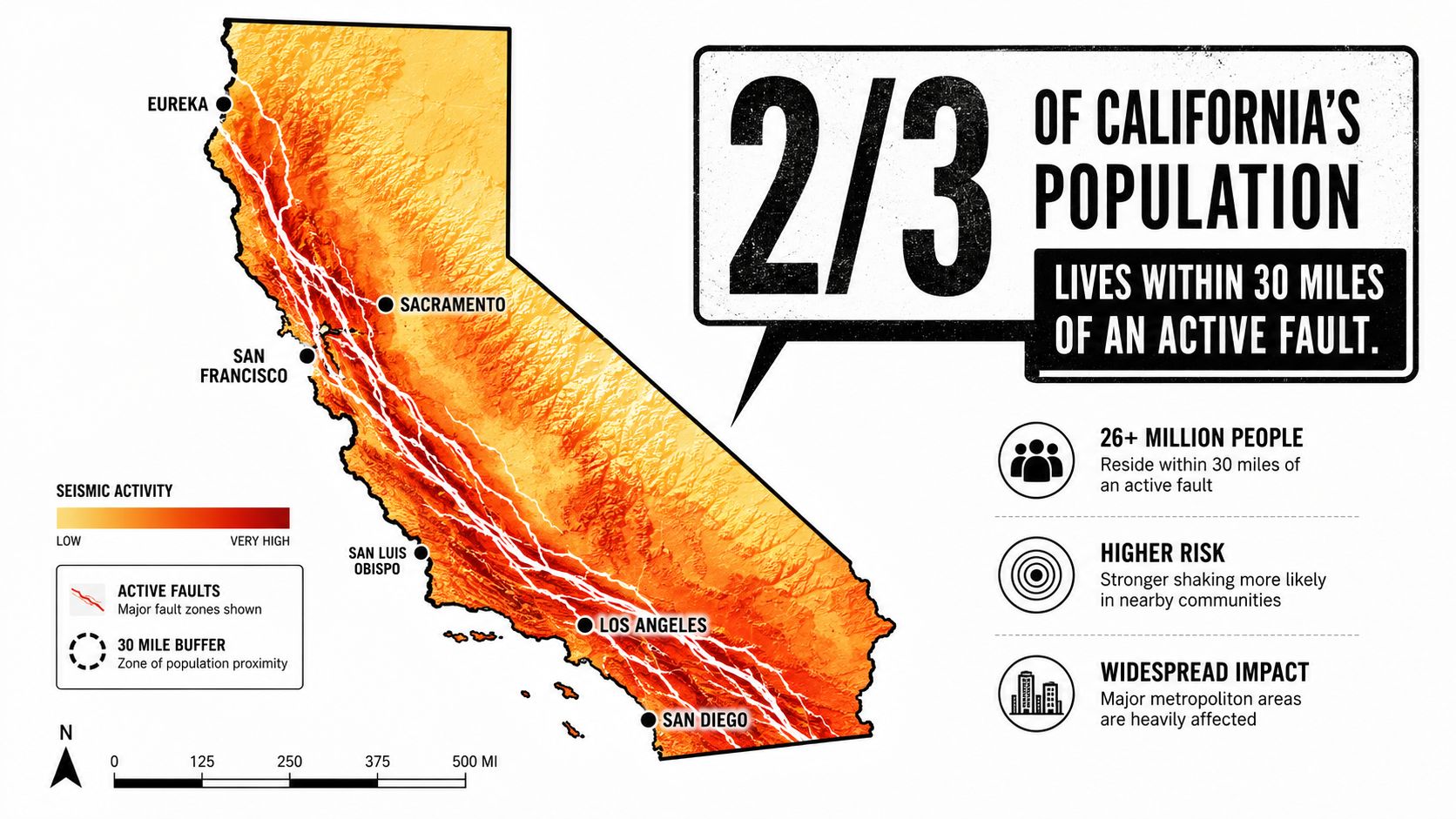
California's insurance history reflects the scale of the problem. In 1984 and 1985, the legislature passed AB 2865, requiring insurers selling residential property coverage to offer earthquake insurance in writing. The rule took effect on January 1, 1985, and required insurers to explain the coverage, deductible, and premium to policyholders. Later, California created a minimum “mini-policy” standard in 1995, followed by the California Earthquake Authority in 1996, after the Northridge earthquake produced estimated insured residential damage of $8.4 billion to $12.5 billion in 1994 dollars. The legislative and market history is summarized in this earthquake insurance presentation.
The policy structure matters more than the sales pitch
California homeowners often compare policies by premium first. That's backwards. Start with the dwelling limit, personal-property limit, deductible, loss-of-use protection, exclusions, and claim rules. A lower-priced policy can leave you carrying a deductible so large that moderate structural damage never reaches the payment threshold.
The California Earthquake Authority writes a substantial share of residential earthquake coverage through participating insurers. The market's low adoption reinforces the point. A 2015 analysis placed California's statewide residential earthquake take-up rate at 10.23%, while another source reported that only about 12% of California households buy coverage, despite the required offer. These adoption and market figures appear in the Society of Actuaries' analysis of the CEA.
Practical rule: Never say “I have full coverage” until you've confirmed whether earthquake is listed separately on the declarations page.
Homeowners researching fault exposure, soil conditions, and property hazards can also use a broader hazard real estate guide to add property-level context before requesting quotes. Your address, construction type, foundation, retrofit history, and proximity to seismic hazards all affect the decision.
What an Earthquake Insurance Policy Covers
A homeowner in San Jose files a claim after a 5.2 magnitude earthquake. The adjuster's first question is not about the roof. It is about the foundation. That question reflects how an earthquake policy works: coverage follows the policy's defined categories, limits, exclusions, and deductible, not every repair that follows a quake.
Dwelling coverage addresses the home's structure, including the foundation, walls, roof, and attached fixtures, subject to the policy terms. Attached structures may qualify, but a detached garage, retaining wall, pool, fence, or landscaping can receive different treatment or no coverage. Review those items before assuming the policy protects the entire property.
Personal property coverage applies to belongings such as furniture, clothing, appliances, and electronics when earthquake damage is covered. Its limit is separate from the dwelling limit, and it may fall well short of replacing everything in a high-value home. Renters should pay close attention to the CEA's defined limits. CEA renters coverage offers $5,000 or $25,000 personal-property limits, with emergency measures coverage capped at the lesser of $1,000 or 5% of the Coverage C limit. Review the CEA renters coverage structure before assuming your belongings are fully protected.
Loss of use, also called additional living expense coverage, can pay eligible costs when covered damage makes the residence uninhabitable. Debris removal and emergency repairs may qualify, but the wording and limits control. The CEA states that emergency repairs can receive coverage with no deductible on the first $1,500. Amounts above that are paid only after the applicable deductible is met. The CEA explains emergency measures and deductible treatment in its homeowners coverage guidance.
| Coverage Element | Standard Homeowners (HO-3) | Earthquake Policy |
|---|---|---|
| Dwelling | Covers listed property risks, but earthquake is generally excluded | Covers eligible earthquake-related structural damage |
| Personal property | Covers contents for covered causes of loss | Covers eligible earthquake-damaged belongings, subject to a separate limit |
| Additional living expenses | May apply to a covered loss | May apply when earthquake damage makes the home uninhabitable |
| Fire after an earthquake | Often covered under homeowners terms | Coordinate the loss carefully with the applicable policy |
| Flood, tsunami, sewer or drain backup | Subject to separate exclusions and coverage rules | Not covered as earthquake damage under California guidance |
| Vehicle damage | Usually handled through auto coverage | Not a substitute for auto insurance |
| Land, stabilization, and certain exterior items | Often limited or excluded | Review exclusions and endorsements closely |
The California Department of Insurance warns that earthquake insurance does not cover flood, tsunami, or sewer and drain backup water damage. Its consumer earthquake insurance guide explains these exclusions and deductible rules. Separate flood, water-backup, auto, or specialized endorsements may be necessary. A policy comparison should therefore examine how earthquake coverage fits with home, renters, auto, and other policies, rather than treating it as a standalone promise of full protection.
Deductibles, Limits, and the True Cost of a Claim
A homeowner can carry earthquake insurance and still face a large bill after the shaking stops. The reason is usually the deductible, which is calculated as a percentage of the insured dwelling limit rather than the repair invoice. California policies commonly offer 5%, 10%, 15%, 20%, and 25% deductibles. Homes over $1 million, along with pre-1980 raised or non-slab homes without a verified retrofit, are limited to a minimum 15% deductible under California Department of Insurance guidance. Review the rules before comparing premiums.
The dollar impact is easy to underestimate:
- A $400,000 dwelling limit with a 15% deductible means $60,000 must be absorbed before payment begins.
- A $750,000 dwelling limit with a 20% deductible means a $150,000 deductible.
- A $500,000 dwelling limit with a 25% deductible means $125,000, while a 15% deductible means $75,000.
A lower deductible generally raises the premium, while a higher deductible leaves more of the early repair cost with you. That tradeoff should be tested against accessible savings, not chosen from the quote page alone.
Condominium owners face the same percentage calculation on covered building limits. The deductible follows the policy's building limit, not the owner's estimate of a personal share of repairs. Review loss assessment coverage and the association's master policy together, since shared-structure damage can create costs outside the unit policy.
Limits determine what survives the deductible
Set the dwelling limit from realistic reconstruction needs, not market value. Personal property requires its own inventory, particularly for electronics, instruments, jewelry, collectibles, and specialty equipment. Test loss-of-use limits against mortgage payments, rent, food, transportation, and delays in finding contractors or materials.
Keep a California insurance glossary nearby when reviewing declarations pages, exclusions, and claim terms.
The 72-hour rule can materially affect the claim calculation. Earthquake losses within a 72-hour period are generally treated as one event, with one claim and one deductible. Aftershocks outside that period may produce a separate claim and deductible. Several damaging aftershocks inside the window can therefore fall under one deductible, while later shaking may restart the calculation.
Ask the carrier to explain how it applies the event period, deductible, and coverage limits before buying. Mai & Associates can help Californians compare carriers and coordinate earthquake coverage with auto, home, renters, and life policies, so the claim plan works across the household rather than on one policy in isolation.
Comparing CEA, Private Carriers, and Fair Plan Options
California homeowners usually have three practical paths, but they aren't interchangeable.
The California Earthquake Authority provides standardized earthquake policies through participating insurers. The CEA doesn't replace your homeowners carrier. Instead, your participating carrier offers and services the CEA policy. The structure gives homeowners a recognizable statewide option, though coverage choices, eligibility, limits, and deductibles still require careful review.
A private carrier may offer more customization. Depending on underwriting, you may find different dwelling limits, personal-property options, endorsements, deductible choices, and treatment of attached or detached structures. The tradeoff is tighter eligibility for older homes, certain construction types, retrofit conditions, or locations that the carrier considers difficult to insure. Private coverage can be broader, but “private” doesn't automatically mean better.
The FAIR Plan plus Difference in Conditions approach is more specialized. The California FAIR Plan is a state-backed market resource for harder-to-insure properties, primarily addressing basic property risks rather than replacing a complete homeowners package. A DIC policy can add broader protection, including earthquake-related coverage, where available. This structure requires coordination, because the FAIR Plan and DIC policy must be read together.
| Feature | CEA Policy | Private Carrier | FAIR Plan + DIC |
|---|---|---|---|
| Market role | Publicly managed program through participating insurers | Standalone private-market option | Layered solution for difficult-to-insure properties |
| Standardization | More standardized policy structure | More carrier-specific customization | Depends on both policies |
| Eligibility | Subject to CEA and participating-carrier rules | Underwriting can be more selective | Designed around hard-to-place property situations |
| Deductibles | Offered within CEA choices | May offer different structures | Depends on DIC terms and coordination |
| Flexibility | Defined coverage options | Potentially broader customization | Useful for filling major coverage gaps |
| Main concern | Limits and deductible economics | Underwriting and exclusions | Coordination between FAIR Plan and DIC |
Compare the claim mechanics, not just the premium
Ask whether the quote includes dwelling, other structures, contents, loss of use, emergency repairs, code upgrades, and loss assessment coverage. Confirm how the policy treats masonry veneer, land movement, water damage, and aftershocks. For a related education resource, understanding flood insurance claims can help clarify why water-related losses often require a separate coverage analysis rather than an assumption that earthquake insurance responds.
Your best option depends on the property, not the logo on the quote. A private policy can offer useful flexibility, while the CEA may be the more accessible route for a homeowner whose existing insurer participates. FAIR Plan households need a coordinated review rather than a standalone earthquake quote.
How Earthquake Claims Work After the Shaking Stops
The first claim decision happens before the adjuster arrives. Protect people, leave unsafe areas, and follow emergency instructions. Don't make extensive repairs until you've documented the condition, but take reasonable emergency measures to prevent additional damage when it's safe.
Follow a disciplined claim sequence
Check safety first. Look for structural instability, gas leaks, electrical hazards, broken water lines, and falling objects. Shut off utilities only when you can do so safely, and keep records of what you observed.
Report promptly. Contact the insurer or agent as soon as practical. If you need temporary housing or emergency repairs, ask how the policy handles those expenses and what receipts the adjuster will require.
Document before cleaning. Photograph and video every room, exterior elevation, foundation area, attached structure, and damaged item. Create a written inventory while details are fresh. Keep damaged property when possible, unless it creates a safety hazard.
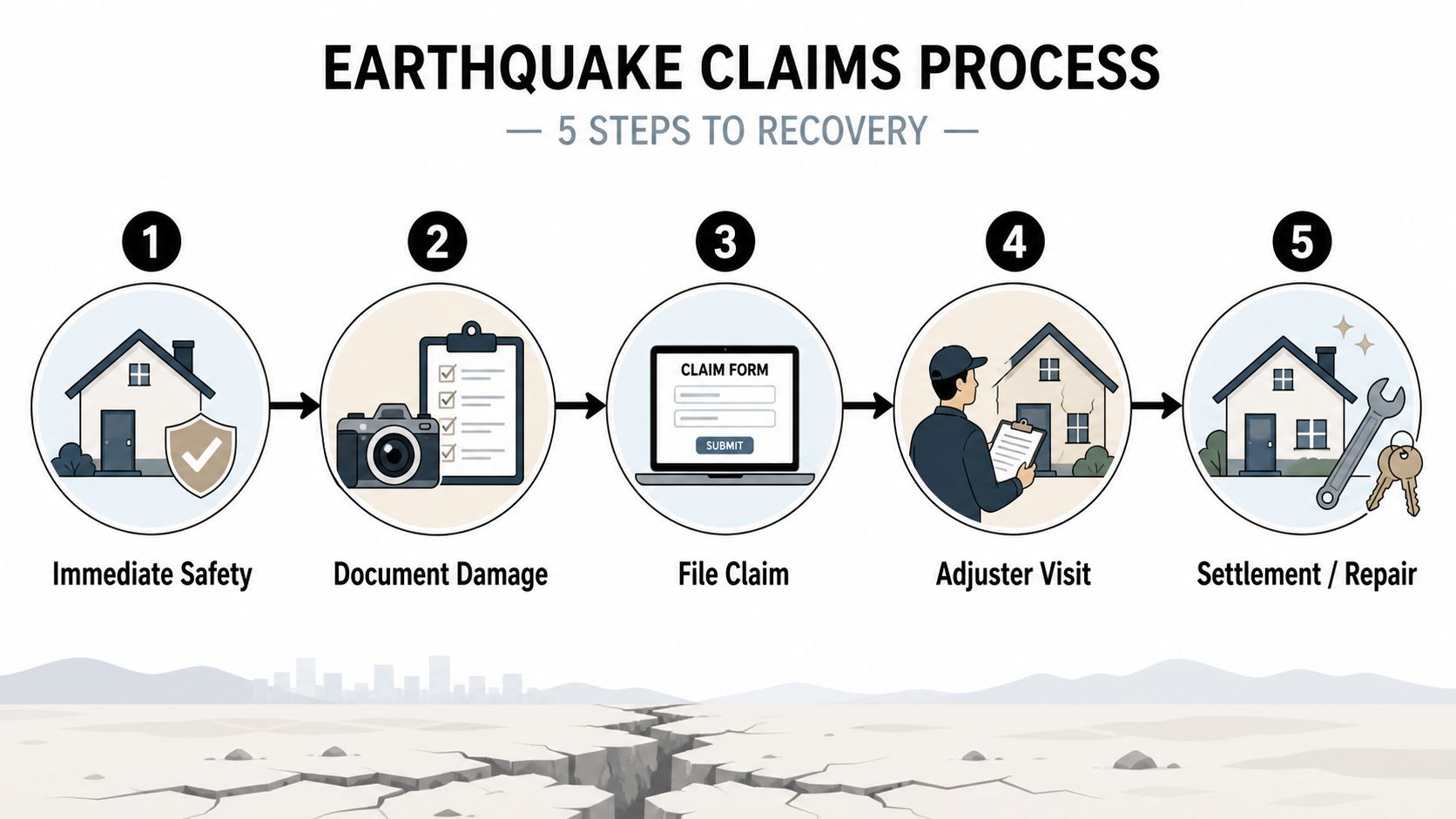
Prepare for the adjuster's focus. The adjuster will assess cause, scope, policy coverage, and the applicable limit. With percentage deductibles, the discussion centers on whether the covered loss exceeds the deductible tied to the coverage limit, not merely on the contractor's repair estimate.
Track repairs and supplement the claim. Hidden structural damage can appear after demolition. Submit new documentation, invoices, engineering reports, and contractor estimates as they become available. Don't sign a final release until you understand whether the payment resolves all known and reasonably discoverable damage.
Damage below the deductible is effectively uninsured under the earthquake policy, even when the repair bill feels substantial.
Code upgrades deserve special attention. Older homes may need work that brings them into compliance with current building requirements, but the base policy may provide limited or no protection for every upgrade. Ask about ordinance or law coverage before a loss, not after the city or contractor identifies required changes.
For a practical perspective on deciding whether a property claim makes financial sense, review this home insurance claim cost analysis. Keep a claim diary with dates, calls, names, estimates, receipts, temporary-housing costs, and payment records. That file gives you greater negotiating power when the initial settlement doesn't reflect the documented loss.
Retrofitting and Endorsements That Lower Your Risk
Raising the deductible is the fastest way to reduce a premium, but it also shifts more catastrophe risk back to you. I prefer a different order: strengthen the structure first, document the work, then use endorsements and deductible choices to shape the remaining exposure.
Structural work should come before price cutting
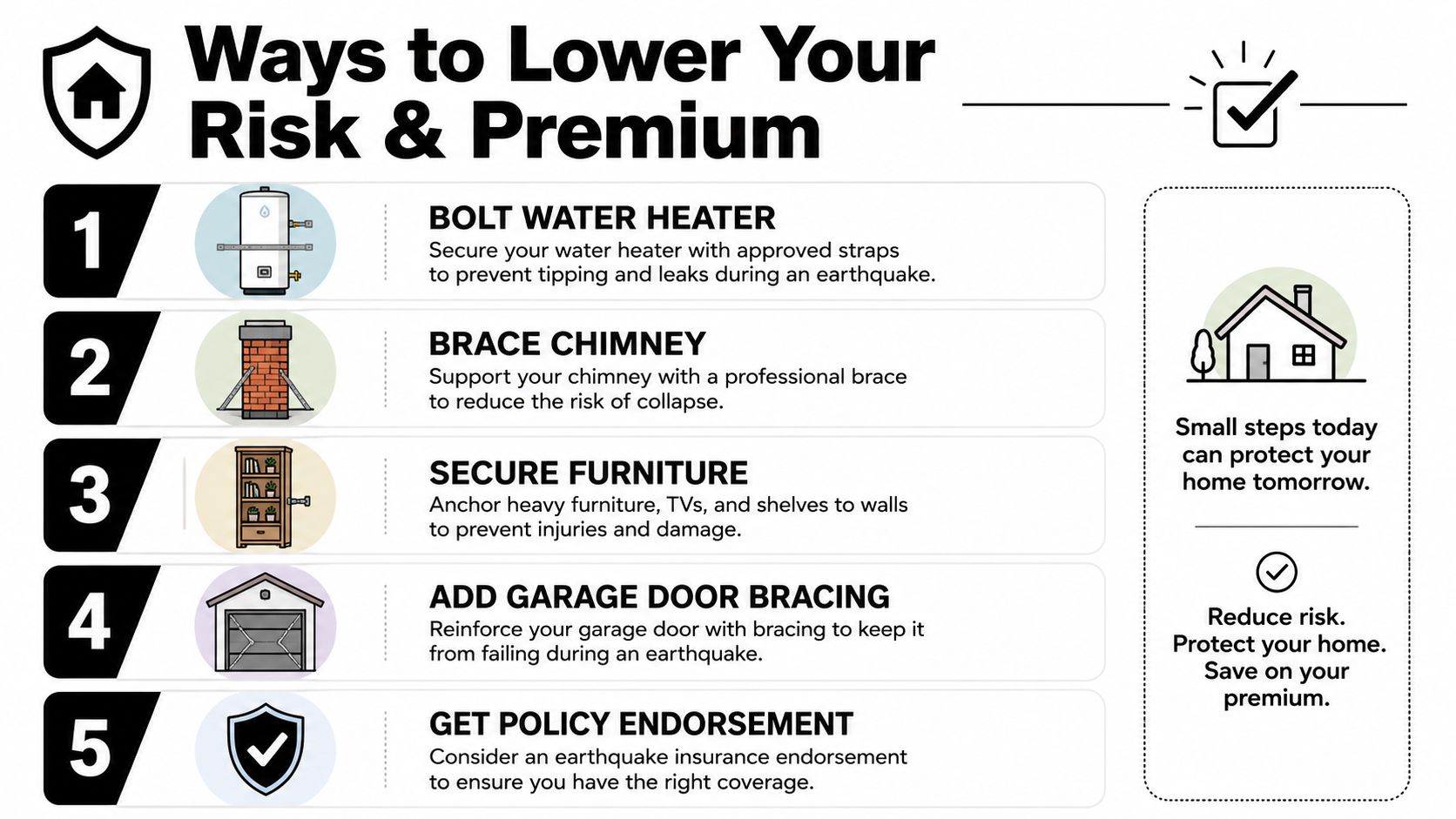
A qualified contractor or engineer can identify whether the home needs:
- Foundation bolting: Connects the wood-frame structure more securely to its foundation.
- Cripple-wall bracing: Reinforces short crawl-space walls that can buckle or collapse during shaking.
- Water-heater restraint: Reduces the chance that a tank breaks loose, damages plumbing, or creates a fire or water hazard.
- Automatic gas shutoff equipment: Helps limit gas-related hazards after strong movement.
- Chimney, garage, and furniture stabilization: Addresses common falling or overturning risks that can increase both damage and injury.
Retrofit documentation can matter for eligibility and pricing, including programs associated with Earthquake Brace + Bolt-style improvements. Don't rely on a contractor's verbal assurance that the work qualifies. Keep permits, invoices, photographs, engineering documents, and completion records.
Endorsements change the settlement
A well-designed policy can add or expand:
- Dwelling limits, when reconstruction costs exceed the existing homeowners limit.
- Replacement-cost contents, rather than a lower depreciated value.
- Code-upgrade coverage, for qualifying ordinance and law expenses.
- Loss-of-use extensions, when repairs take longer than expected.
- Off-premises personal-property coverage, for belongings stored away from the residence.
- Loss assessment coverage, especially important for condominium owners.
The right combination depends on the building and the household. An older raised-foundation home may need retrofit work and a careful deductible review. A newer home may need more attention to contents, temporary housing, and code provisions. A high-value household may need increased limits rather than a policy that looks inexpensive because it underinsures the contents.
Use the California home insurance guides to organize your declarations page, retrofit records, and endorsement questions before requesting a policy review.
Common Myths and Cost Misconceptions
Myth one: A standard HO-3 policy covers earthquake damage.
It generally does not. Fire, theft, and wind may be covered under a homeowners policy, while shaking-related damage requires separate earthquake insurance or an applicable endorsement. Read the exclusions instead of trusting the phrase “full homeowners coverage.”
Myth two: Low earthquake-insurance adoption means the risk is low.
Low adoption reflects purchasing decisions, not reduced seismic exposure. Many homeowners reject the deductible, misunderstand the earthquake exclusion, or postpone the decision. The CEA market analysis documents the adoption gap, but the practical lesson is simpler: a low take-up rate does not make an uninsured home safer.
Myth three: Disaster assistance replaces insurance.
Federal assistance, when available, does not equal an insurance settlement. Loans create repayment obligations, and grants are not designed to duplicate carefully selected dwelling, contents, and loss-of-use coverage.
Myth four: A newer home does not need earthquake coverage.
Newer construction can reduce certain vulnerabilities, but it does not eliminate shaking, contents damage, temporary-housing costs, or deductible exposure. Construction quality, location, foundation, soil, and maintenance still affect the claim outcome.
Myth five: A landlord's policy covers the tenant's belongings.
The landlord insures the building and their liability exposure. Tenants need their own renters insurance for personal property and liability. Review California renters insurance options rather than assuming the property owner's policy follows possessions.
Myth six: Personal-property limits pay to rebuild the house.
They do not. Dwelling coverage addresses the structure. Contents coverage addresses belongings, and each coverage has its own limit and deductible treatment.
Myth seven: A 5% deductible is always cheaper than a 25% deductible.
A lower deductible usually brings higher premium cost. Compare the deductible with the coverage scope, limits, carrier terms, and the household's available reserves. A high deductible may suit a household that can fund it, while making coverage impractical for a homeowner who cannot meet the threshold.
The useful question is whether you can absorb the uninsured portion while continuing mortgage, rent, transportation, and family obligations. A policy that looks affordable can still fail at claim time if its deductible and limits do not match your finances.
Building a Full California Protection Plan and Next Steps
Earthquake coverage doesn't operate in isolation. A major event can damage the home, destroy belongings, displace the household, damage a vehicle, interrupt income, and expose dependents to financial instability. The correct review connects earthquake, homeowners, renters, auto, and life insurance instead of treating each declaration page as a separate purchase.
Start with the current policies and identify what each one refuses to cover. A homeowners policy may exclude earthquake. Auto insurance may respond to earthquake-related vehicle damage only if collision coverage is in force. Renters insurance may protect belongings and personal liability but won't insure the building. Life insurance doesn't repair a house, yet it can protect the family if a breadwinner dies after the disaster. Disability coverage can address income interruption when an illness or injury prevents work.
California auto buyers should also review liability limits. For standard policies issued or renewed on or after January 1, 2025, California's required limits increased to $30,000 for bodily injury or death of one person, $60,000 for bodily injury or death of more than one person in one accident, and $15,000 for property damage. The California DMV explains the current auto insurance requirements. Collision coverage and other optional protections don't satisfy the state's financial responsibility requirement.
| Policy Line | Earthquake Trigger | Standard Homeowners | Auto Comprehensive | Life / Disability |
|---|---|---|---|---|
| Primary purpose | Covers eligible seismic damage under its own terms | Covers listed property risks, with earthquake generally excluded | May cover earthquake-related vehicle damage when comprehensive applies | Protects household income and dependents |
| Building | Earthquake policy may cover eligible structural loss | Covers covered causes other than excluded earthquake | Doesn't insure the home | Doesn't repair property |
| Belongings | Separate contents limit applies | Contents coverage follows homeowners terms | Covers the insured vehicle, not household contents | Provides financial support rather than property repair |
| Temporary displacement | May include additional living expenses | May respond only to covered causes | Doesn't provide housing | May support expenses after death or qualifying disability |
| Main gap to check | Deductible, exclusions, limits, event rules | Earthquake exclusion | No comprehensive coverage for vehicle damage | Insufficient income or survivor protection |
A practical decision sequence
- Pull every declarations page. Mark earthquake exclusions, dwelling limits, contents limits, deductibles, loss-of-use amounts, auto liability, and life or disability gaps.
- Request side-by-side quotes. Compare a CEA option with available private-carrier coverage using identical dwelling, contents, loss-of-use, and deductible assumptions.
- Evaluate retrofit eligibility. Gather documents for foundation bolting, cripple-wall bracing, water-heater restraint, gas shutoff equipment, and other structural work.
- Test the deductible in cash. If the threshold would force debt, a policy that appears affordable may not deliver practical protection.
- Coordinate the entire portfolio. Compare auto insurance, home insurance, renters insurance, and life insurance together, while checking whether a carrier offers multi-policy savings.
Mai & Associates can help Californians compare earthquake coverage options alongside auto, home, renters, and life policies. The agency's California home insurance service is one place to begin a broader declarations-page review, particularly for homeowners navigating high-risk property placement or FAIR Plan questions.
Take these steps this week: pull your current policies, calculate the earthquake deductible against your dwelling limit, and request a side-by-side review of CEA and private options. Then ask Mai & Associates to compare the earthquake decision with your California auto insurance, homeowners or renters insurance, and life insurance needs so one coverage gap doesn't undermine the rest of your protection plan.
Visit Mai & Associates to compare California earthquake coverage options and coordinate them with auto, home, renters, and life insurance. Ask for a policy review that puts the deductible, exclusions, limits, retrofit eligibility, and claim consequences in plain language before you choose.