Your Guide to Earthquake Insurance in California for 2026

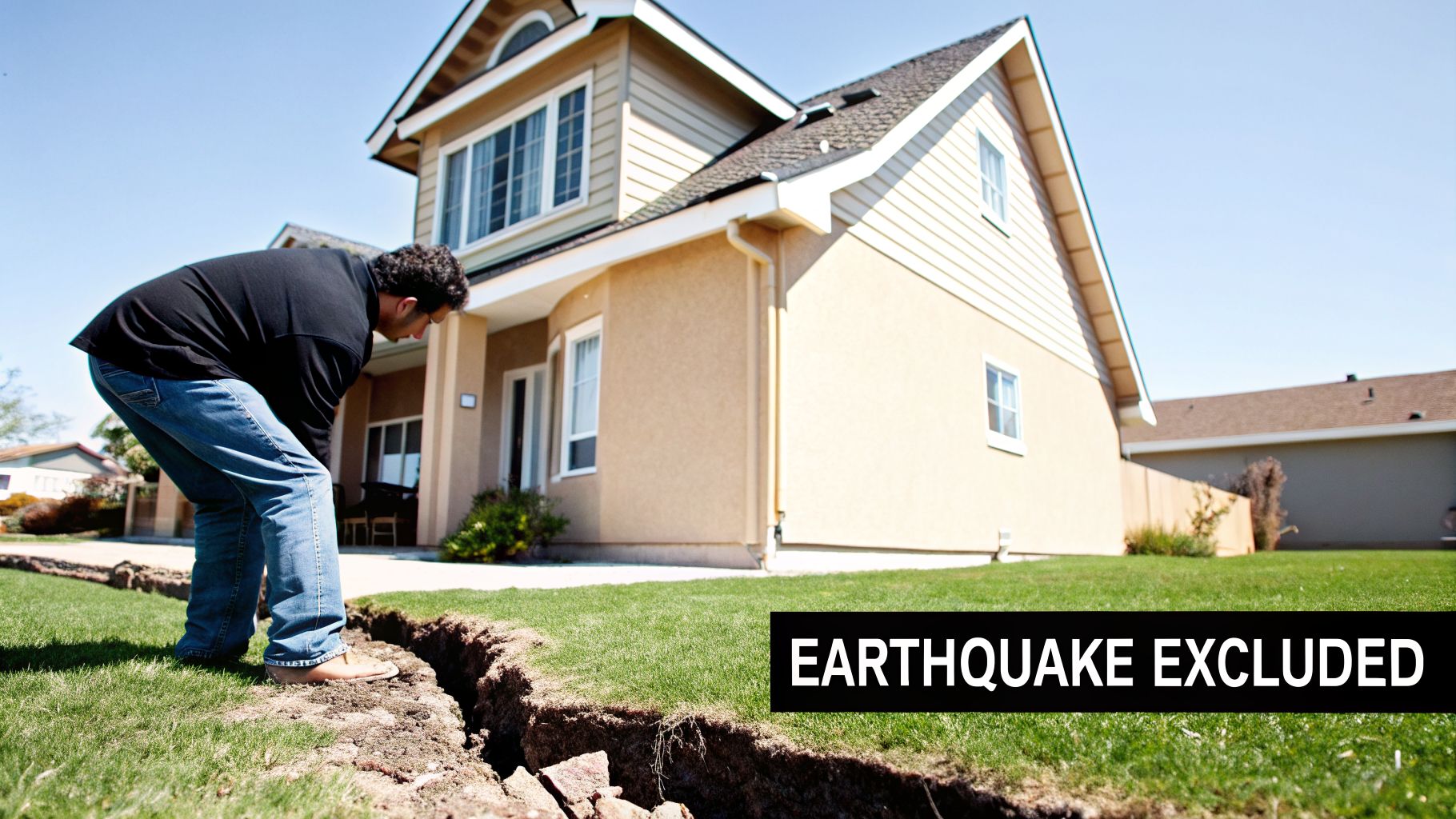
It’s a common—and frankly, dangerous—assumption many of us make here in California: that our homeowners insurance has us covered for just about anything. But there’s a massive hole in that safety net. Your standard policy almost certainly excludes damage from earth movement, which is insurance-speak for earthquakes.
Without a dedicated earthquake policy, you’re on your own to pay for repairs. That’s a risk no homeowner should have to take.
Why Your Home Insurance Falls Short After a Quake
Think of your standard homeowners policy as a fantastic, all-weather jacket. It’s built to protect you from the usual threats like fire, theft, and liability claims. It's an essential piece of protection for everyday risks, which you can learn more about in our complete guide to home insurance in California.
But that jacket offers zero protection when the very ground beneath your feet gives way.
This is because nearly every home, condo, and renters insurance policy sold in California contains a specific and critical exclusion for "earth movement." It’s not a footnote; it’s a fundamental gap in your financial protection.
What the "Earth Movement" Exclusion Really Means
Let's cut through the jargon. The "earth movement" exclusion means that any damage directly caused by an earthquake—the shaking, the shifting, the cracking—is not covered by your standard policy.
To put this in real-world terms, take a look at what a standard policy covers versus what a dedicated earthquake policy is designed to handle.
Standard Home Insurance vs. Earthquake Policy Coverage
| Covered Peril | Standard Homeowners Insurance | Earthquake Insurance |
|---|---|---|
| Dwelling Structure | Covered for fire, theft, wind, etc. EXCLUDED for quake damage. | COVERED for quake-related structural damage. |
| Personal Property | Covered for fire, theft, etc. EXCLUDED for quake damage. | COVERED for belongings damaged in a quake. |
| Loss of Use (ALE) | Covered if a fire makes home unlivable. EXCLUDED for quakes. | COVERED for temporary living costs after a quake. |
| Foundation Cracks | EXCLUDED for quake-related cracks. | COVERED for quake-related foundation damage. |
| Fires after a Quake | Usually covered as a fire loss, but can be complicated. | Your standard policy's fire coverage kicks in here. |
As you can see, the policies are designed to be mutually exclusive for this specific peril. One simply doesn't do the job of the other.
The Sobering Financial Reality
This isn't just a theoretical problem. The devastating 1994 Northridge earthquake caused an estimated $20 billion in residential damages. Only about half of that staggering figure was actually covered by insurance.
The quake left countless families financially shattered, turning a natural disaster into a full-blown personal crisis. It was a harsh lesson in the real-world cost of being uninsured for a seismic event.
Without a separate earthquake insurance policy, you are solely responsible for every dollar it takes to rebuild your home and replace everything you own.
This is precisely where earthquake insurance in California steps in. It's a separate, specialized policy created to fill that critical gap left by your standard home insurance. It's designed to protect your largest asset from the one peril most likely to destroy it.
Navigating the options, from the California Earthquake Authority (CEA) to policies on the private market, can feel overwhelming. That’s why working with an expert independent agency like Mai & Associates is so important. We help you find the right protection to ensure your family’s financial security isn’t left to chance when the ground starts to shake.
Navigating Your California Earthquake Insurance Options
So, you’ve realized your standard homeowner's policy won't cover you in a shaker. What now? Where do you actually turn for earthquake protection?
For California homeowners, renters, and even those looking to protect their vehicles, there are a few clear paths to getting the right coverage. Think of it as two main highways: the well-known California Earthquake Authority (CEA) and the more varied private insurance market. Each has its own on-ramps and destinations, and knowing the difference is crucial to finding a policy that fits your home and your wallet.
The California Earthquake Authority (CEA)
Many people mistakenly think the CEA is a government agency. It’s actually a publicly managed, not-for-profit organization that the state legislature created after the devastating 1994 Northridge earthquake. Back then, insurers fled the market, leaving homeowners with no options. The CEA was designed to stabilize things and ensure coverage would always be available.
You won't find a CEA office to walk into, though. Instead, you purchase their policies through participating insurance companies—likely the same one that handles your home insurance or auto insurance. It’s a convenient setup that lets you get a quote from your existing provider.
CEA policies are built on a standardized framework, which makes comparing them pretty simple. Key things to know are:
- Consistent Coverage: The policy options are the same no matter which participating insurer you go through.
- Widespread Access: If your home insurer is part of the CEA network, you're almost certainly eligible for a policy.
- Flexible Deductibles: You can select a deductible from 5% to 25% of your dwelling coverage, giving you control over the balance between your monthly premium and what you’d pay out-of-pocket after a quake.
Exploring the Private Insurance Market
While the CEA is a fantastic, reliable option, it’s not the only game in town. A growing number of private insurers now offer their own earthquake policies directly to consumers. These often provide more flexibility and can be tailored to cover things the standardized CEA plans don't.
This is where you can really fine-tune your protection. An independent agency like Mai & Associates lives in this space, constantly comparing these private market options against each other and against the CEA to pinpoint the best value for your specific situation.
Private earthquake insurance can often provide higher coverage limits for your home and personal belongings, add-ons for things like swimming pools or detached structures, and sometimes even offer lower deductibles than what the CEA has available.
If you feel the CEA’s one-size-fits-most approach isn't quite right for you, or if you have unique assets to protect, the private market is definitely worth a look. It's a critical part of a holistic financial plan that should also include reviewing your car insurance and life insurance to make sure you're truly prepared.
A Look at Market Penetration
Here’s a startling fact: despite California’s well-known seismic activity, most homeowners are rolling the dice. In 2022, data from the California Department of Insurance showed that only 12.71% of residential properties carried earthquake insurance.
This is a massive protection gap, especially when you consider that California has seen six of the top 10 most expensive earthquakes in U.S. history. The CEA alone collected over $10.6 billion in premiums that year, which shows the scale of the risk people are trying to cover. You can dig into the numbers yourself in the state's official report on earthquake premium and exposure data.
What About the California FAIR Plan?
For some homeowners, especially those in very high-risk fire zones, getting any kind of property insurance can feel impossible. That’s where the California FAIR Plan comes in. It acts as an insurer of last resort, offering a basic fire insurance policy when you can't get one on the open market.
The FAIR Plan does offer an optional earthquake endorsement, but it's important to understand its limitations. This is truly a safety net—the coverage is minimal and likely won't be enough to fully rebuild your home and replace everything you own.
This is a situation where an expert can be invaluable. Before you resign yourself to a bare-bones FAIR Plan policy, an agent at Mai & Associates can perform a deep dive into the market. We frequently find private insurers who can offer far more comprehensive coverage, often at a competitive price, giving you much better protection than the last-resort option. Whether you have renters insurance or a full home and auto bundle, getting that expert second opinion is always a smart move.
How Earthquake Insurance Costs and Deductibles Actually Work
Let's get one thing straight: the cost and deductibles for earthquake insurance in California are probably the biggest reasons homeowners hesitate. They seem confusing and expensive, but once you see how they're put together, you’ll realize you have more control than you think.
Unlike the straightforward, flat-dollar deductible you're used to on your auto insurance or home insurance—say, $1,000—an earthquake deductible works on a percentage. It’s not a fixed amount; it’s a percentage of your home's total insured value.
This percentage usually falls somewhere between 5% and 25%. That might just sound like numbers on a page, but it has a huge impact on your out-of-pocket responsibility after a quake.
Breaking Down the Deductible Calculation
Let's walk through a real-world example. Say your home has a replacement value of $600,000, and you've chosen an earthquake policy with a 10% deductible.
Your deductible in this case would be $60,000 (10% of $600,000). This is the amount you’d need to cover for repairs before your insurance policy steps in to pay for the rest of the damage, all the way up to your coverage limit.
This is the most important concept to grasp. It connects your potential payout directly to your home's value, but it also gives you a powerful lever to manage your costs. If you choose a higher deductible percentage, you’ll pay a lower monthly premium. It’s all about finding a balance you can live with.
When you're ready to get a policy, you'll find there are a few different paths to take here in California.
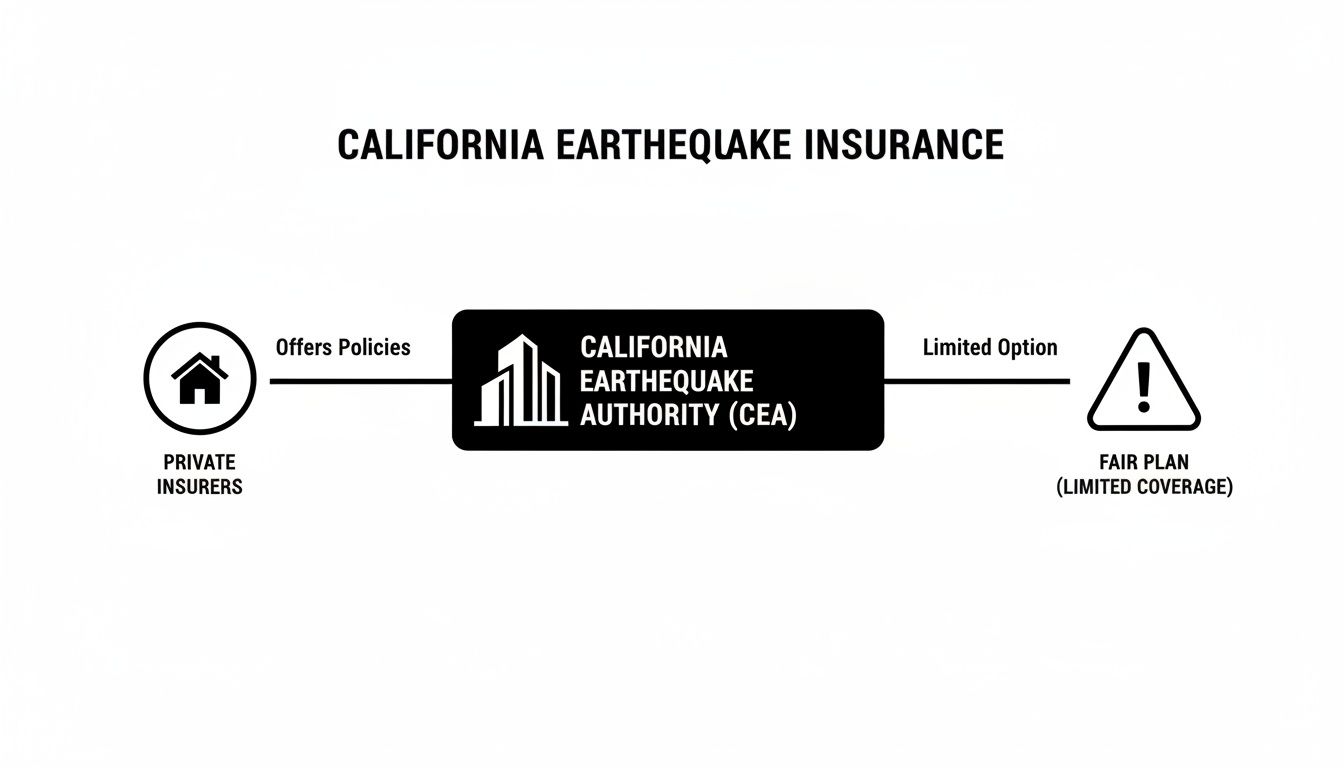
As you can see, your main choices are the state-managed California Earthquake Authority (CEA), a private insurance company, or the more basic California FAIR Plan.
Key Factors That Determine Your Premium
Your insurance premium isn’t just a random number. It's the result of a very specific risk calculation for your property. Think of it like car insurance—a driver with a perfect record pays less than someone with a history of accidents. For earthquake insurance, your home's location and structure are your "driving record."
Here are the main things insurers look at when pricing your policy:
- Proximity to Fault Lines: It's no surprise that the closer you are to a known, active fault, the higher your risk. This is a primary driver of cost.
- Home Age and Construction: Older homes, particularly those built before modern seismic codes took effect (generally pre-1980), often carry higher premiums. The building material is also critical; a flexible wood-frame house tends to handle shaking better than a rigid brick one and is usually cheaper to insure.
- Foundation Type: What's under your house? Whether it’s a concrete slab, a raised foundation, or built on a hillside matters. A house that has its foundation properly bolted and its cripple walls braced is considered far more stable and can earn you significant discounts.
- Soil Type: The very ground your home sits on is part of the equation. A house on soft, sandy soil is at greater risk for intense shaking and liquefaction compared to one built on solid bedrock.
- Coverage Limits and Deductibles: This is the area where you have the most direct control over your premium.
- Choosing higher coverage limits for your dwelling, belongings, and loss of use will naturally increase the cost.
- Opting for a higher deductible percentage (like 20% instead of 10%) will lower your monthly premium.
Understanding these variables is key. It shows that your premium is a unique reflection of your home's specific risk profile—it’s not a one-size-fits-all price like you might find for renters insurance or life insurance. This is exactly why working with an expert at Mai & Associates can make all the difference. We can run the numbers with you, showing you how adjusting deductibles and coverage levels impacts your final cost, helping you find that sweet spot between solid protection and a budget that works for you.
Reduce Your Premiums with Seismic Retrofitting
When you see the price tag for earthquake insurance, it's easy to feel a bit of sticker shock. But you have more control over that cost than you might think. The single most effective way to lower your premiums is by proactively strengthening your home against seismic activity. This is called seismic retrofitting.
Think of it this way: insurance companies base their prices on risk. A home that's better prepared to withstand a quake is less of a risk, and insurers reward that reduced risk with significant discounts—often between 5% and 25%. It's a direct investment in your home's safety that pays you back.

Core Retrofitting Techniques for California Homes
From our experience, especially with homes built before 1980, two key upgrades make the biggest difference in both safety and insurance costs.
- Foundation Bolting: This is exactly what it sounds like. A contractor anchors your house’s frame directly to its concrete foundation with steel bolts. Without this, your home can literally slide off its foundation during a major shaker. Bolting it down ensures the whole structure moves as one solid unit with the ground.
- Cripple Wall Bracing: Many older houses have a short, wood-framed wall between the foundation and the first floor, which creates a crawl space. These "cripple walls" are a notorious weak point and can collapse sideways in an earthquake. Bracing them with plywood sheathing makes them far more rigid and secure.
Together, these fixes create what engineers call a "continuous load path." It's a fancy term for ensuring your home is tied together from the roof to the foundation, preventing it from shaking apart. This is a huge green light for underwriters pricing earthquake insurance in California.
Financial Help for Retrofitting Your Home
California wants you to do this. The state recognizes how critical retrofitting is and offers financial help to make it happen. The best-known initiative is the Earthquake Brace + Bolt (EBB) grant program.
The Earthquake Brace + Bolt (EBB) program offers grants of up to $3,000 for qualifying homeowners in high-risk ZIP codes. This grant helps cover the direct costs of bracing and bolting your home, making it one of the smartest financial decisions you can make.
Completing an EBB-approved retrofit doesn't just make your home safer; it gives you the exact documentation needed to secure the best possible discounts from your insurance carrier.
Your Partner in Maximizing Savings
This is where having an experienced advisor really matters. At Mai & Associates, we don't just find you a policy for your home insurance or auto insurance and call it a day. We help you build a long-term strategy for savings.
We can look at your home’s specific details and show you the real-world impact of retrofitting before you hire a contractor. We’ll break down how much you can expect to save on premiums by bolting the foundation or bracing those cripple walls, helping you make an informed decision. Our goal is simple: get you the best protection at the lowest possible price.
Retrofitting is a powerful first step, but there are other things you can do to protect your property. This resource on 5 Ways to Disaster-Proof Your California Home offers more excellent tips for safeguarding your biggest investment.
For more practical advice on protecting what matters most, take a look at our other expert insurance guides.
Finding the Right Policy with Mai and Associates
Okay, so you've decided earthquake insurance is a smart move for your California home. Now what? The thought of navigating policies, deductibles, and different carriers can feel overwhelming, but it doesn't have to be a solo mission. Working with an independent agency like Mai & Associates means you have an expert in your corner, turning a confusing process into a clear path forward.
Our process always starts with a simple conversation. We'll take a close look at your property's specific risks and review your current home insurance or renters insurance policy to see exactly where you stand. The goal is to get a complete picture of your unique situation before we even think about quotes.

Comparing Your Options Instantly
Once we understand what you need to protect, we'll shop the market for you. We compare quotes from both the California Earthquake Authority (CEA) and a wide range of top-rated private insurance companies, all at once. You get a side-by-side comparison that lays out the entire landscape in just a few minutes.
This isn't just about price. You'll clearly see how different deductibles, coverage limits, and unique policy features compare, so you can make a truly informed decision. It sure beats spending hours on the phone or trying to decipher insurance jargon on your own.
Customizing Your Coverage with Expert Guidance
This is where having an experienced agent really pays off. A quote is just a set of numbers; we help you understand the story behind them. We’ll walk you through the pros and cons of each option, translating the complex terms into plain English.
Our multilingual agents are here to help you in English, Spanish, Armenian, Russian, and Vietnamese. Clear communication is essential, and we ensure you can discuss your options comfortably and confidently in the language you prefer.
We'll work with you to find that sweet spot between robust coverage and a premium that fits your budget. Want to see how raising your dwelling coverage or lowering your personal property limit affects the cost? We can show you instantly. It's about tailoring a policy that makes sense for your family's financial security, whether we're discussing earthquake insurance in California, car insurance, or life insurance.
Securing Your Policy with Ease
After you’ve picked the policy that’s right for you, the final step is just as straightforward. We’ll walk you through a quick and secure e-signature process to lock in your new coverage. Our team handles all the behind-the-scenes paperwork to make sure your policy is issued correctly and without delay.
Protecting your biggest asset shouldn't feel intimidating. With a dedicated partner guiding you, you can get the peace of mind that comes from knowing you’re prepared for when the ground shakes. If you're ready to explore your options, you can get an instant insurance quote from Mai & Associates today and let's start the conversation.
Your California Earthquake Insurance Questions Answered
When it comes to earthquake insurance in California, it's natural to have questions. It's a complex topic, and we hear a lot of the same concerns from homeowners and renters. Let's clear up some of the most common ones.
Is Earthquake Insurance Mandatory in California?
No, there’s no state law that says you have to buy it. However, don't be surprised if your mortgage lender requires it, especially if you live in a high-risk seismic zone. While it's not legally mandated for everyone, we strongly recommend it to protect what is likely your single biggest investment—your home.
How Is My Personal Property Covered?
This is a separate line item in your earthquake policy, distinct from the coverage for the structure of your house. It has its own limit and its own deductible. Think of it as the part of the policy that helps you replace your furniture, electronics, clothing, and other belongings if they're damaged or destroyed in a quake.
What is 'Loss of Use' and why is it important? Loss of Use coverage, sometimes called Additional Living Expenses (ALE), is one of the most critical parts of a policy. If a quake makes your home unlivable, this coverage pays for you to live somewhere else during repairs. It covers expenses like a hotel or rental home, meals, and other essentials. It's the financial safety net that helps your family maintain a sense of normalcy after a disaster.
Can I Get Earthquake Insurance if I'm a Renter?
Absolutely. Many renters don't realize their standard renters insurance policy excludes earthquake damage, just like a home insurance policy does. You can—and should—buy a separate earthquake policy for renters. It’s designed to protect your personal belongings and provide Loss of Use coverage, since your landlord's insurance only covers the building itself, not your stuff.
Have more questions? We've compiled a ton of detailed information in our California insurance FAQ section.
Ready to feel secure? The team at Mai & Associates is here to walk you through your options and find the right earthquake coverage for your situation. Visit us at https://cahomeauto.com for a no-obligation quote today.