Earthquake Insurance Deductibles Explained: California

A California earthquake insurance deductible is typically percentage-based, most commonly 10%, 15%, 20%, or 25% of your dwelling coverage limit. A 15% deductible on $600,000 of dwelling coverage means you absorb the first $90,000 of covered earthquake damage before the policy begins contributing.
You may be reviewing your declarations page after buying a home, comparing California insurance quotes, or wondering whether your existing protection would help after a major quake. The number that looks manageable beside your premium can represent a substantial cash obligation when it's calculated against the home's coverage limit rather than the repair bill.
That distinction matters for your broader insurance plan, too. Standard home insurance, renters insurance, car insurance, auto insurance, and life insurance each protect different risks, and earthquake coverage usually requires its own policy or endorsement. A careful review can prevent an unpleasant surprise when you need to file a claim.
What Earthquake Insurance Deductibles Actually Mean for You
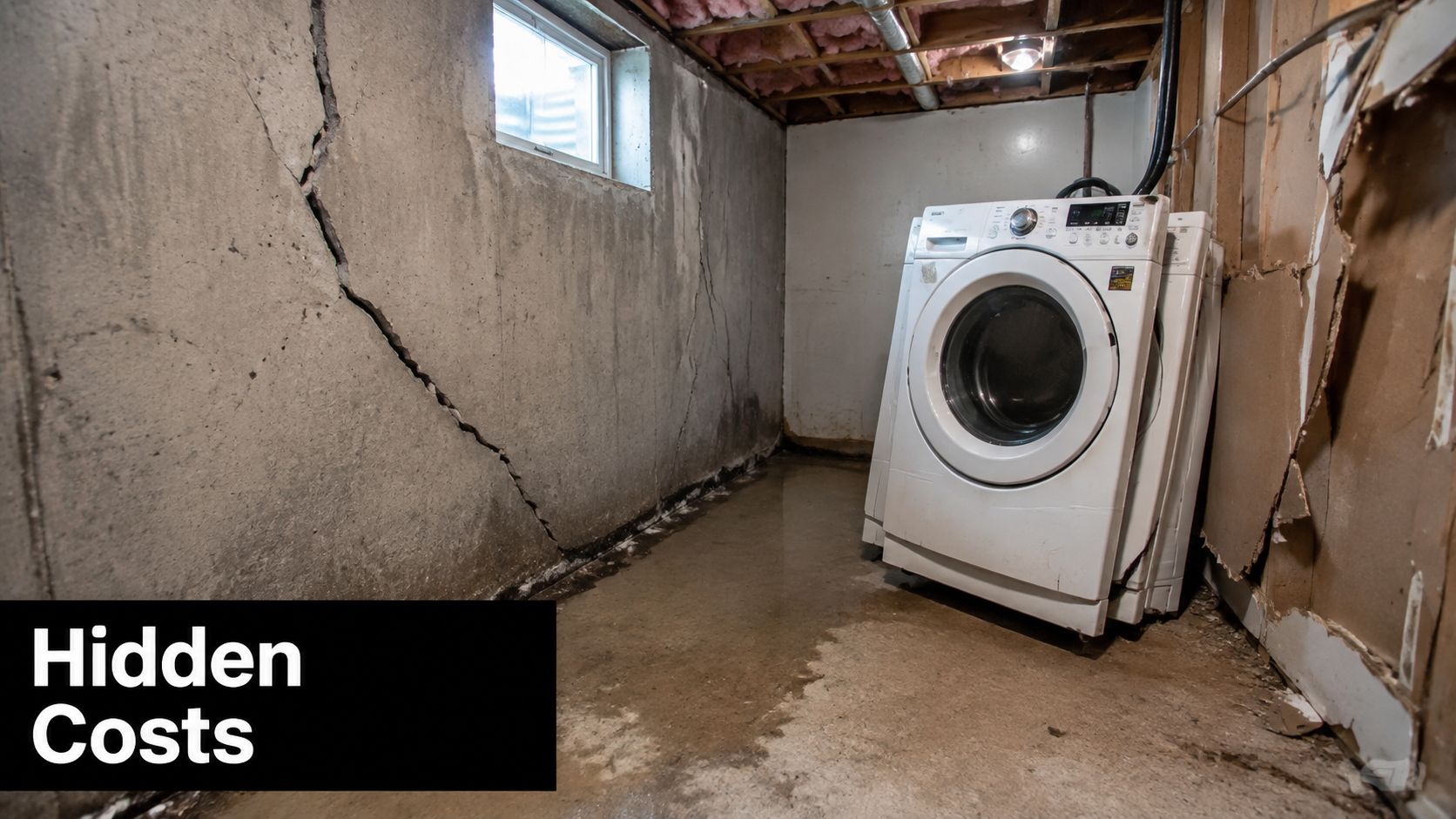
After an earthquake, you might find a foundation crack, shifted appliances, broken drywall, or several problems at once. You report the damage, expect the insurer to send an adjuster, and begin estimating repairs. Then you learn that the policy won't contribute until your earthquake deductible has been satisfied.
That deductible is your share of a covered loss. The California Department of Insurance explains that an earthquake deductible generally isn't paid to the insurer upfront. Instead, the insurer subtracts it from the covered claim payment, leaving you responsible for that portion of the loss. California Department of Insurance earthquake guidance describes the deductible as commonly tied to the coverage limit.
Why the usual deductible assumption fails
Many people associate a deductible with a familiar flat amount on auto insurance or standard homeowners insurance. If the deductible is a fixed dollar figure, you can usually understand the initial portion of a covered claim immediately.
California earthquake insurance often works differently. The deductible is commonly a percentage of Coverage A, the dwelling limit shown on your declarations page. That means your potential obligation rises with the amount required to rebuild the home, not with the size of the premium you paid.
A policyholder with a higher dwelling limit may therefore face a larger earthquake deductible even when two homes have the same deductible percentage. The deductible also isn't a fee charged for opening a claim. It's the amount of covered loss you retain before the insurer pays the remaining eligible amount.
Practical rule: Never judge an earthquake policy by its premium alone. Convert the deductible percentage into dollars before deciding whether the coverage fits your finances.
Your declarations page, policy forms, and a reliable insurance glossary can help you identify the terms, but the agent or insurer should confirm how the deductible applies to your specific coverage sections.
Percentage Versus Flat Deductibles in California Earthquake Policies
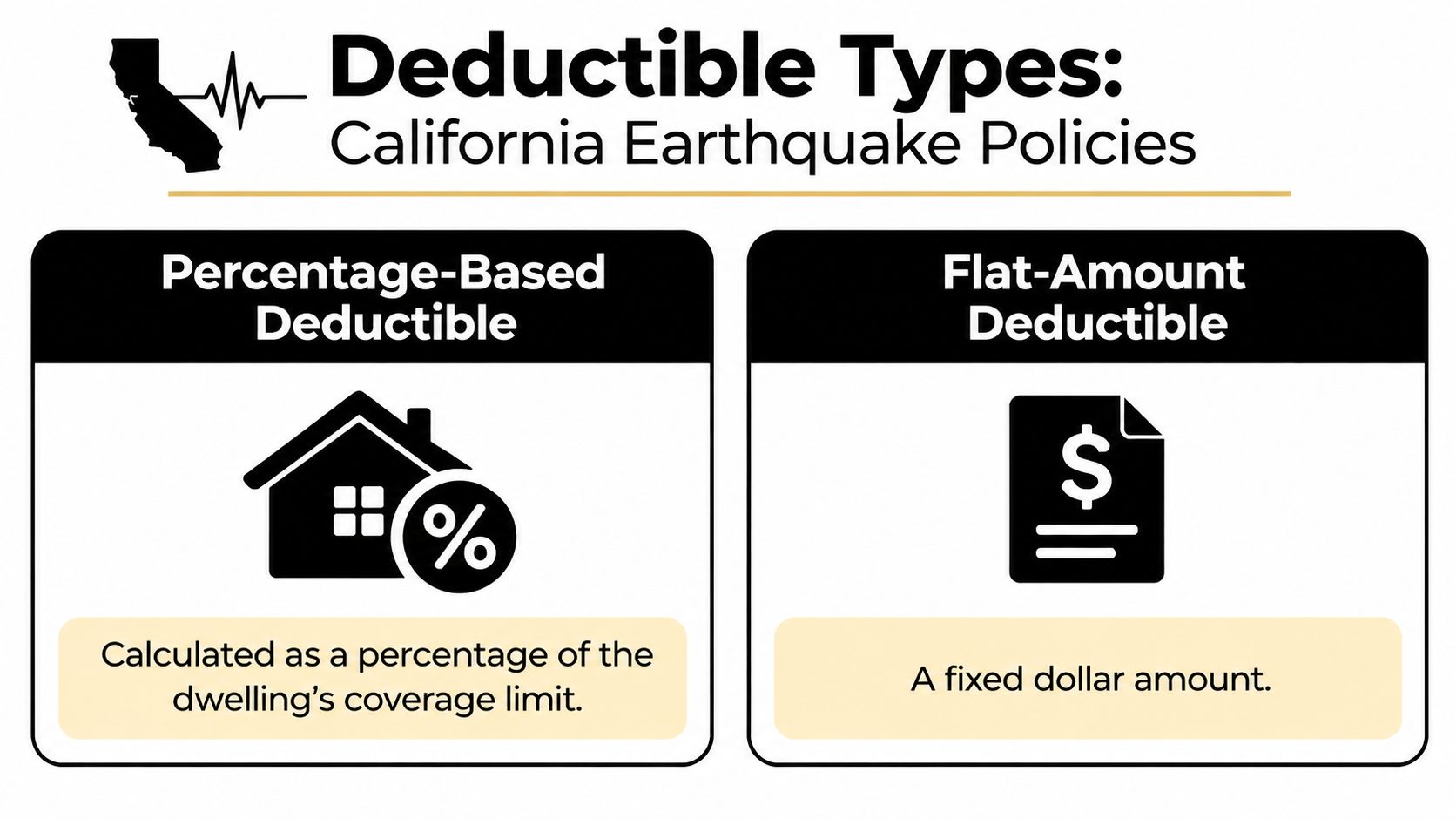
Start with the declarations page and locate the earthquake deductible. The wording usually points to one of two structures: a percentage-based deductible or a fixed dollar deductible.
How the percentage calculation works
Suppose the dwelling limit is $600,000 and the earthquake deductible is 15%. The calculation is:
$600,000 × 15% = $90,000
The result is not 15% of the repair estimate. It's calculated from the applicable coverage limit. If covered dwelling damage is less than that threshold, the policy may provide no payment for the dwelling portion. If the covered loss exceeds it, the insurer generally considers the amount above the deductible, subject to policy terms, exclusions, limits, and claim adjustments.
Coverage A generally refers to the dwelling itself, including the structure insured for repair or reconstruction. Some policies may use a combined Coverage A and Coverage B limit for the deductible calculation. Coverage B commonly refers to other structures, such as a detached garage or another structure identified by the policy. Your policy language controls, so don't assume every carrier applies the calculation identically.
Think of a percentage deductible as a measuring cup that grows with the insured home. A flat deductible is more like a fixed entry fee. The first changes when the coverage limit changes, while the second stays at the stated dollar amount.
How to identify the structure in your policy
Look for these details:
- Deductible format: A percentage sign usually signals a percentage-based deductible. A stated dollar amount signals a flat deductible.
- Calculation base: Check whether the policy references Coverage A alone or a combined Coverage A and Coverage B limit.
- Coverage sections: Confirm whether dwelling, other structures, and personal property have separate deductible language.
- Policy version: Review the current declarations page, not an older quote or prior renewal document.
Some private-market policies or California Fair Plan arrangements may use different deductible structures, but availability and terms vary. A California insurance guide can help you prepare questions, but only your actual policy documents can establish the binding calculation.
California Deductible Standards, Rules, and Real Cost Scenarios
California's regulatory framework gives homeowners a baseline, but it doesn't make every policy identical. State law requires insurers to offer earthquake coverage with at least a 15% deductible, while the California Department of Insurance describes the California Earthquake Authority, or CEA, standard deductible as 15%, with optional 10% or 5% buy-downs in some cases. California Department of Insurance earthquake information explains the regulatory context.
CEA materials identify five main deductible choices: 5%, 10%, 15%, 20%, and 25% of Coverage A, or the combined Coverage A and Coverage B limit for some policies. The lowest available deductible can rise to 15% for homes valued above $1 million or for certain pre-1980 raised-foundation homes that haven't been seismically retrofitted. Property characteristics can therefore affect the available choice, not just the homeowner's budget. CEA coverage and deductible information provides the applicable policy details.

The dollar math homeowners need
The following examples use the dwelling limit as the calculation base. They show the deductible amount you would absorb for the dwelling portion, not the total cost of all possible coverage sections.
| Dwelling limit | 10% deductible | 15% deductible | 20% deductible |
|---|---|---|---|
| $400,000 | $40,000 | $60,000 | $80,000 |
| $600,000 | $60,000 | $90,000 | $120,000 |
| $1,000,000 | $100,000 | $150,000 | $200,000 |
For a $400,000 dwelling limit, moving from 10% to 15% increases the dwelling threshold from $40,000 to $60,000. At 20%, the homeowner would absorb $80,000 before the earthquake policy contributes to an eligible dwelling loss.
With $600,000 of dwelling coverage, the same choices mean $60,000, $90,000, or $120,000. That is why a premium comparison without deductible math can give an incomplete picture of affordability.
A $1 million dwelling limit produces an even larger exposure. State guidance says the lowest available deductible can be 15% for certain homes in that risk category, which means the dwelling threshold may be $150,000. A 25% option on an $800,000 dwelling limit would imply $200,000 of first-dollar exposure, as described in the state policy context. A California home insurance review can help you examine how the earthquake policy fits alongside your standard home coverage.
How Your Deductible Choice Affects Premiums and Claims Payouts
A higher deductible generally lowers the premium for earthquake coverage. A lower deductible generally raises it because the insurer takes on more of the potential loss. The right comparison is not “which premium is cheaper?” It is whether the savings justify the larger amount your household may need to fund after an earthquake.
For example, compare two otherwise similar policy options. Option A has a 10% deductible and an annual premium of $3,000. Option B has a 20% deductible and an annual premium of $2,400. The higher-deductible option saves $600 each year, or $3,000 over five years. That saving is useful only if you can also handle the larger claim responsibility when covered damage occurs.
The dwelling limit determines the dollar exposure, but the deductible is applied under the policy's terms, not to every expense after an earthquake. Coverage sections may have separate limits, exclusions, valuation rules, or conditions. Temporary housing and inspections may also require cash while the claim is being reviewed.
How the deductible appears in a claim
The California Department of Insurance says earthquake deductibles aren't paid upfront. Instead, the insurer applies the deductible to the covered loss and subtracts the applicable amount when calculating the claim payment. A loss below the deductible for a coverage section may result in no payment for that section. A larger covered loss may receive payment above the deductible, subject to the policy language.
The deductible works like the homeowner's first layer of responsibility. The insurer does not reimburse that layer, even when the remaining covered loss exceeds it. Claims adjustment also matters, because the final payment depends on which damage is covered, how the loss is valued, and whether policy limits apply.
The central trade-off: A higher deductible can reduce premiums and leave more money available for routine expenses, but it also leaves the homeowner responsible for more of a covered earthquake loss.
Review the premium difference alongside your liquid savings and recovery plan. A lower annual cost may be sensible for a household with adequate reserves. If the added exposure would delay structural repairs or force difficult borrowing, the lower premium may not represent a safer overall choice.
Strategies to Lower Your Effective Deductible and Net Cost
You can't eliminate a percentage deductible through clever shopping, but you can manage the amount it represents and the total cost of your insurance program. Start with the deductible you could realistically absorb, then compare the premium difference for other options.
Choose with cash flow in mind
A higher deductible may be appropriate for a homeowner with substantial reserves and a clear plan for temporary expenses. It can be uncomfortable for someone whose liquid savings would be exhausted by the first stage of a structural repair.
Review the choice at renewal. Your dwelling limit, property condition, household income, and financial reserves may change, and a deductible that made sense at purchase may no longer match your circumstances.
Ask about mitigation and retrofitting
Some insurers may offer seismic-retrofitting credits or different eligibility treatment for homes that meet applicable construction or retrofit standards. Availability depends on the carrier, the home's age and foundation, the work completed, and the policy program. Retrofitting also costs money and does not guarantee a lower deductible.
Ask the agent to confirm the requirements in writing. If you're planning broader property work, a resource on accurate shingle cost data can help you separate roofing costs from earthquake-specific mitigation decisions.

Reduce the net burden across policies
Bundling earthquake coverage with home, renters, auto, or life insurance through one agency may create package savings, depending on the carriers and products available. It won't automatically reduce the earthquake deductible, but it may help offset the premium cost of selecting a lower percentage.
Compare the full package, not just one line item. Mai & Associates offers policy reviews that can include earthquake options, California Fair Plan comparisons, auto insurance, home insurance, renters insurance, and life insurance. The useful question is whether the combined arrangement leaves you with appropriate coverage and a deductible you can fund.
Earthquake Deductibles Compared to Standard Homeowners and Fair Plan Options
A standard homeowners deductible and an earthquake deductible may sit in the same insurance portfolio while operating under different rules. Standard home insurance typically uses a flat dollar deductible, while California earthquake policies predominantly use a percentage tied to the dwelling coverage limit.
That difference can be easy to miss if you look only at the premium summary. A standard home policy might show a familiar fixed amount, but earthquake damage may be excluded unless earthquake coverage has been separately added or purchased. Your car insurance is separate again, and damage to a vehicle requires reviewing the applicable auto policy rather than assuming the home or earthquake policy will respond.
A side-by-side view
| Coverage arrangement | Deductible structure | What to verify |
|---|---|---|
| Standard homeowners insurance | Usually a flat dollar amount | Whether earthquake damage is excluded and which non-earthquake losses are covered |
| California earthquake policy | Predominantly percentage-based | The percentage, calculation base, coverage sections, and applicable limits |
| California Fair Plan arrangement | Terms and deductible structure can differ | Coverage limitations, deductible wording, and whether separate earthquake protection is needed |
The California Fair Plan is a specialty property arrangement, so homeowners shouldn't assume its deductible or coverage scope mirrors a standard CEA or private-market earthquake policy. A Fair Plan review can reveal gaps involving structural protection, personal property, loss of use, or the amount you would retain after a covered event.
A comparison also helps renters and condo owners. A renter may focus on personal property and additional living expenses, while a condo owner must examine unit-interior coverage and possible association-related exposure. The policy wording determines how the deductible applies.
For broader catastrophe education, hurricane insurance deductible insight offers a useful comparison point. Catastrophe deductibles in other regions can also differ from the flat deductible people associate with everyday property claims, although each policy must be read on its own terms.
Frequently Asked Questions and Next Steps for California Homeowners
Is the deductible applied once per earthquake?
The answer comes from the policy wording. Some policies apply deductibles by coverage section, while others use a shared or combined structure. Check whether the deductible applies separately to Coverage A, Coverage B, personal property, or a combined limit. Ask the insurer to walk through one earthquake that damages the structure, belongings, and another covered category.
The dollar effect depends on the calculation base. On a $400,000 home, a 5% deductible would represent $20,000. On a $600,000 home, the same percentage would represent $30,000, and on a $1 million home, $50,000. Confirm which limit the percentage uses before comparing quotes.
Do the homeowners and earthquake deductibles apply together?
They usually respond to different coverage grants. Standard homeowners insurance commonly excludes earthquake damage, so the earthquake policy or endorsement may handle covered seismic loss. A separate fire or other covered cause could involve the homeowners policy, but the facts and policy language control.
Two deductibles do not automatically stack on the same damage. Ask the carrier which policy responds, which cause of loss controls, and whether exclusions or anti-concurrent-causation wording affects the claim.
What if the damage is below the deductible?
If the covered loss does not exceed the applicable earthquake deductible, the insurer may make no payment for that coverage section. Document the damage anyway, protect the property from further harm, and keep repair estimates, invoices, photographs, and related records.
Can the deductible change at renewal?
It can change when the insurer, policy program, coverage limit, property characteristics, or available options change. Review each renewal declaration page instead of relying on the prior percentage. Available deductibles may also relate to property risk, including homes above $1 million or certain pre-1980 raised-foundation homes without seismic retrofits.
What should I do before requesting quotes?
Gather your declarations pages, dwelling limit, deductible percentage, foundation details, retrofit records, and any Fair Plan documents. Ask a licensed California agent to convert each percentage into dollars, compare earthquake options, and explain how the coverage fits with your home, renters, auto, car, and life insurance.
You can request a California insurance quote without committing to a policy. Review the deductible, exclusions, limits, renewal terms, and available bundling or mitigation opportunities before choosing coverage.
Mai & Associates can review California earthquake coverage, compare California Fair Plan options, and coordinate home, renters, auto, car, and life insurance around your budget. Visit Mai & Associates to request a no-obligation review and discuss deductible exposure with a licensed agent, including multilingual support when needed.