Earthquake Insurance Cost California: A Homeowner Guide

So, what's the real bottom line on earthquake insurance costs in California? You can expect to see annual premiums ranging anywhere from $800 to $5,000. That’s a huge spread, and it’s why a simple statewide "average" doesn't tell you much.
For a home valued at $700,000, your premium could be a manageable $1,722 in a lower-risk area or jump all the way up to $4,550 if you're in a high-risk zone. Let's break down what drives those numbers and how this specialized coverage fits into your overall California insurance portfolio, which includes everything from home insurance to auto insurance.
What Is the Real Cost of Earthquake Insurance in California?
Trying to nail down the cost of earthquake insurance is a bit like pricing car insurance. A driver in downtown Los Angeles is going to have a very different rate than someone in a quiet suburban town. It's the same principle for your home—its proximity to an active fault line is the single biggest factor.
Insurers boil this down to a simple metric: the cost in dollars per $1,000 of coverage. This formula helps them give you a price that reflects your home's specific value and its unique seismic risk. It’s crucial to remember that this is a separate policy, as your standard home insurance almost never covers damage from an earthquake.
A Tale of Two Cities
Let's put this into practice. Imagine you own a home worth $700,000. The statewide average rate works out to about $3.54 per $1,000 of coverage, giving you an annual premium of around $2,478.
But averages can be deceiving.
If your home is in a high-risk coastal city like Alameda, your rate could be closer to $6.50 per $1,000. Suddenly, that annual premium is $4,550. On the other hand, if you're inland in a lower-risk area like Sacramento, your rate might be just $2.46 per $1,000, bringing your annual cost down to $1,722. You can find more detail on how these rates are calculated over at hippo.com.
To give you a clearer picture, here’s how premiums can shift based on your home's value and location.
Estimated Annual Earthquake Insurance Premiums in California
This table shows some sample annual premiums. We calculated these based on a home's value and its location in a low, average, or high-risk seismic zone.
| Home Value | Low-Risk Area (e.g., Sacramento) | Average-Risk Area | High-Risk Area (e.g., Alameda) |
|---|---|---|---|
| $500,000 | $1,230 | $1,770 | $3,250 |
| $700,000 | $1,722 | $2,478 | $4,550 |
| $900,000 | $2,214 | $3,186 | $5,850 |
| $1,200,000 | $2,952 | $4,248 | $7,800 |
As you can see, the numbers climb steeply as both home value and risk level increase. Your final premium will always come down to the specific details of your property and its exact location.
This next infographic really drives home how much seismic risk influences your insurance bill.
The map makes it obvious—premiums skyrocket as you move from the green zones to the red ones. This is why a "one-size-fits-all" answer for earthquake insurance cost just doesn't exist.
Because the price is so specific, it's always a good idea to see if you can get discounts by bundling your policy with other coverage, like auto insurance or life insurance. At the end of the day, where you live and what your home is worth are what matter most.
Decoding the 15% Earthquake Deductible

When you think about insurance deductibles, your mind probably jumps to a fixed dollar amount. Maybe it’s the $1,000 deductible on your car insurance or the $2,500 for your home insurance. Earthquake insurance in California, however, plays by a completely different set of rules, and this is where most homeowners get tripped up.
Instead of a small, predictable number, earthquake deductibles are calculated as a percentage of your home's total insured value. This can range from 5% all the way up to 25%, with 15% being a very common choice.
Think of it like a financial shock absorber. It’s designed to handle a massive impact, not every little bump in the road. This high-deductible model is precisely what allows insurance companies to offer coverage for catastrophic events in a place like California, reserving the funds for when they're truly needed.
How Percentage Deductibles Work in the Real World
Let's put some real numbers to this to see what it means for your wallet. If your home is insured for $500,000 and you've selected a 15% deductible, your out-of-pocket responsibility is a staggering $75,000. That’s the amount you have to cover before your insurance policy kicks in to pay for the rest of the repairs.
That number can definitely cause some sticker shock, but there’s a reason for it. This structure is designed to filter out smaller claims—like minor stucco cracks—and ensure the insurance pool is there for the big, devastating quakes that can level entire neighborhoods. For a home insured at $400,000, that same 15% deductible means the homeowner is on the hook for the first $60,000 of damage. You can get more familiar with how this works by reviewing these insights on California earthquake insurance deductibles.
Here’s a quick look at how the numbers change based on your home’s value and deductible choice:
- Home Insured for $600,000 with a 10% Deductible: You pay the first $60,000.
- Home Insured for $800,000 with a 15% Deductible: You pay the first $120,000.
- Home Insured for $1,000,000 with a 20% Deductible: You pay the first $200,000.
As you can see, this isn't pocket change. It means having a serious financial game plan and enough savings or equity to cover your share if the "Big One" hits.
The Trade-Off Between Your Deductible and Your Premium
The good news is that you have some control here. Your deductible percentage is the single biggest lever you can pull to adjust your earthquake insurance cost in California. The relationship is straightforward: the higher the deductible you're willing to accept, the lower your annual premium will be.
By agreeing to shoulder more of the financial risk yourself with a higher deductible, you’re essentially telling the insurance company you’ll only be making a claim for truly catastrophic damage. They reward that promise with a much more affordable yearly premium.
This trade-off empowers you to find a balance that aligns with your personal risk tolerance and financial preparedness. It’s a strategic choice between paying less now in premiums or paying less later after a disaster.
For instance, a homeowner might opt for a 25% deductible to keep their annual premium low, knowing they have substantial home equity or savings to cover that amount if needed. On the other hand, someone who wants more peace of mind might choose a 10% deductible, accepting a higher yearly cost in exchange for a smaller financial hit after a quake. Understanding this balance across all your policies—from home insurance and auto insurance to renters insurance—is the key to building a truly resilient financial safety net for anyone needing California insurance.
What Goes Into Your Earthquake Insurance Premium?
Ever get an earthquake insurance quote and wonder why it’s so different from your neighbor’s, even if you live right down the street? It's because insurers don't just look at your zip code; they put your specific home under a microscope to figure out the real risk.
Think of it like car insurance. Two people can drive the exact same car, but their rates will be worlds apart based on their driving record, where they park, and their daily commute. Your home has its own unique risk profile, and that’s what determines your final premium. Let's pull back the curtain on the main factors at play.
Proximity to a Fault Line
This is the big one. Hands down, nothing impacts your rate more than how close you are to an active earthquake fault. Living a few miles nearer to a major player like the San Andreas or Hayward fault can cause your premium to jump significantly.
Insurers use incredibly detailed geological maps to pinpoint your property's exact location relative to known faults. A home sitting right on top of or next to a fault line faces a much higher chance of severe shaking and ground rupture. That extreme risk means a higher premium, simply because the odds of a catastrophic claim are that much greater. This is the number one reason you see such wild swings in insurance costs from one town to the next.
Your Home's Age and Construction
How your house was built and what it's made of tells an underwriter a lot about how it will hold up when the ground starts to move.
- Age Matters: Homes built before modern seismic codes were put in place (think pre-1980s) often lack the reinforcement that's standard today. Older homes are generally seen as a bigger gamble.
- Building Materials: A standard wood-frame house has a natural flexibility that helps it ride out the shaking. On the other hand, an unreinforced brick or masonry home is rigid and brittle, making it far more vulnerable—and more expensive to insure.
- Number of Stories: Taller homes can sway more violently during a quake, putting incredible stress on the structure. A single-story home is usually on more solid footing, which often translates to a lower premium.
Basically, an underwriter is trying to predict how your home will perform. A modern, single-story, wood-frame house is almost always going to get a better rate than an old, three-story brick home that's never been updated.
The Ground Beneath Your Feet
What's underneath your home is just as crucial as the structure itself. The type of soil and foundation are critical pieces of the risk puzzle.
Your home’s foundation is its first line of defense in a quake. If a house isn't properly bolted down, it can literally slide off its foundation during intense shaking, resulting in a total loss.
Here’s what insurers look at:
- Soil Conditions: Are you sitting on solid bedrock or soft, sandy soil? Loose soil can liquefy during an earthquake, turning solid ground into something more like quicksand. A home on bedrock is in a much safer—and more insurable—position.
- Foundation Type: Homes with a raised foundation and a crawl space rely on "cripple walls" to support the main floor. If those aren't braced, you've got a major vulnerability. A concrete slab foundation is generally considered more stable.
- Seismic Retrofitting: This is your best tool for lowering your premium. Proving that you've bolted your house to its foundation, braced those cripple walls, or installed an automatic gas shut-off valve can earn you some serious discounts. When you reduce the insurer's risk, they'll reduce your rate.
Once you understand these factors, the price on your quote starts to make sense. It’s not a random number; it's a careful calculation based on your home's specific vulnerabilities. By focusing on the things you can control, like getting a seismic retrofit, you can take meaningful steps to lower your earthquake insurance cost in California and better protect your biggest asset. It’s a smart approach that applies to all your policies, from home insurance to life insurance.
Getting to Know the California Earthquake Authority (CEA)
If you start looking into earthquake insurance in California, you'll run into one name over and over again: the California Earthquake Authority (CEA). You really can't grasp how earthquake coverage works in this state without understanding the huge role this unique, not-for-profit organization plays.
The CEA isn't your typical private insurance company. It's a publicly managed entity, created by the California Legislature after the devastating 1994 Northridge earthquake. That quake triggered so many claims that private insurers simply packed up and stopped offering home insurance in the state. The CEA’s job was to step in, stabilize the market, and make sure earthquake coverage was still an option for Californians.
So, How Does a CEA Policy Actually Work?
This is where a lot of people get confused. You don't actually call up the CEA to buy a policy directly. Instead, you get a CEA policy through one of the many private insurance companies that participate in their program—most likely, the same company that handles your standard home insurance or renters insurance.
Think of it like this: the CEA is the main supplier of the earthquake coverage, while your local insurance agent is the one who sells it to you and handles the paperwork. It’s a smart partnership. The CEA can focus on the big picture of managing risk and keeping rates stable, and you get the convenience of working with the agent you already know for your other policies, like auto insurance.
The California Earthquake Authority isn't just a player in the market; it is the market. It insures more than 1 million Californians and writes the vast majority of all earthquake policies sold in the state.
Its market share is massive for a reason. With total direct earthquake insurance premiums in California recently hitting $3,472,618, the sheer scale of the CEA's operations becomes clear.
A Powerful Tool: The CEA Premium Calculator
One of the best resources the CEA provides is its online premium calculator. This isn't some flimsy estimator; it's a sophisticated tool that crunches real scientific risk data along with your specific home details—your address, home value, and construction style—to give you a genuinely solid quote.
- Get a Real-World Benchmark: The calculator provides a standardized price, giving you an excellent starting point for understanding your potential earthquake insurance cost in California.
- Play with the Numbers: You can easily adjust things like your deductible percentage or coverage limits to instantly see how those choices affect your annual premium.
- No Strings Attached: It’s completely free to use, and you get estimates on the spot. This lets you do your homework without any sales pressure.
By plugging in your information, you can get a clear, data-driven idea of what coverage should cost before you even pick up the phone. You can check out the official CEA premium calculator to see how their rates are determined and run your own numbers. For more details on other types of coverage, you can explore our other helpful insurance guides.
Practical Ways to Lower Your Insurance Costs
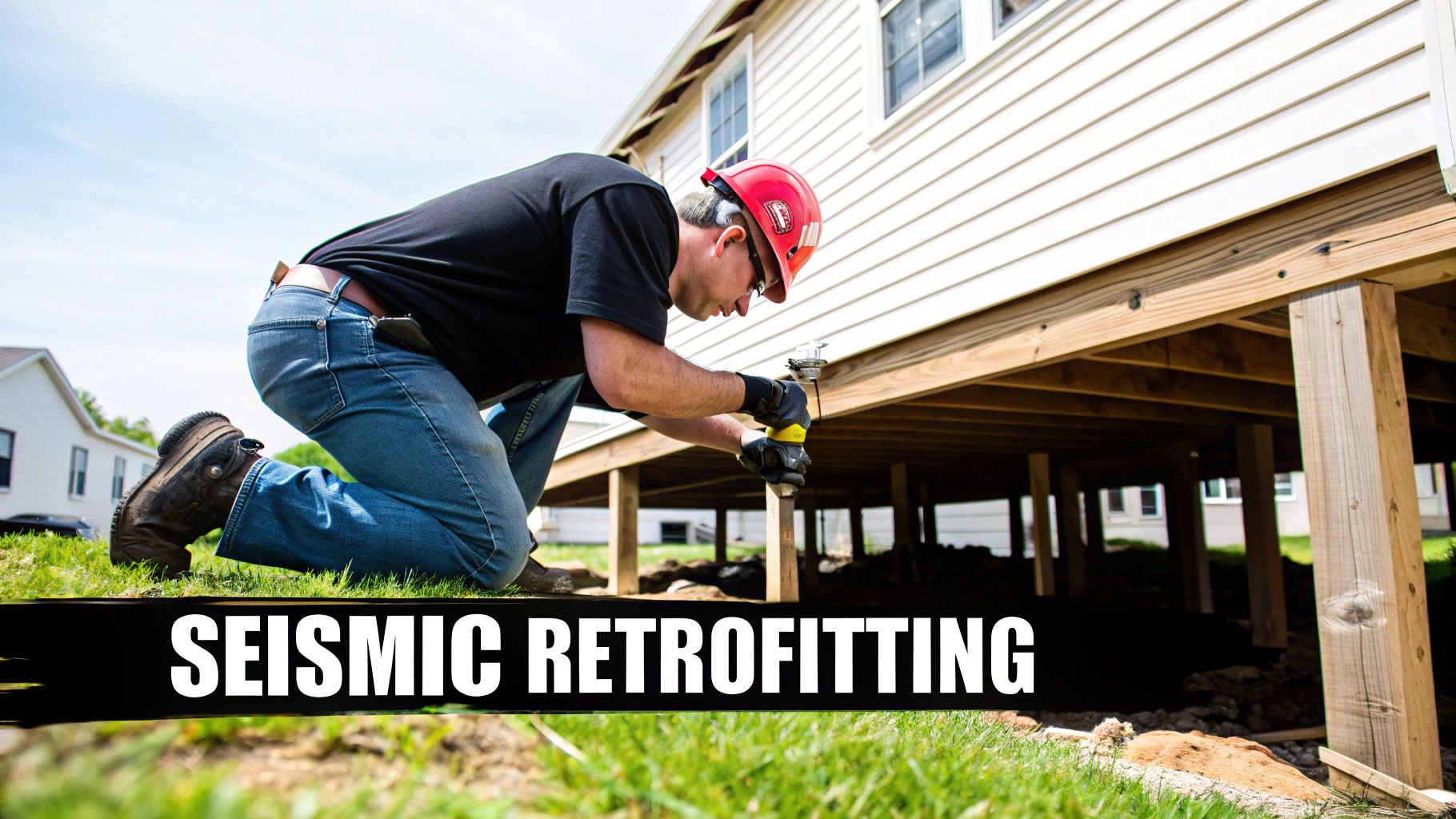
While you can't move your house to a lower-risk fault zone, you have more control over your earthquake insurance cost in California than you might realize. By taking a few smart, proactive steps, you can significantly reduce your home's risk profile and, in turn, your annual premium.
Think of it like getting a good driver discount on your car insurance. An insurer sees a safe driver as a lower risk. In the same way, they see a structurally sound, retrofitted home as a much safer bet when the ground starts to shake—and they’ll reward you for it.
Fortify Your Foundation with a Seismic Retrofit
Without a doubt, the most impactful thing you can do to lower your premium is a seismic retrofit. This is the process of physically strengthening your home to resist earthquake damage. Insurers love to see this, and they offer some of their biggest discounts for it—often reducing your premium by 20% or more.
For the many older, raised-foundation homes in California, retrofitting typically involves two key steps:
- Foundation Bolting: This is exactly what it sounds like. A contractor bolts your home’s wood frame to its concrete foundation. It’s a straightforward process that prevents the entire structure from sliding off its foundation during a quake, which is one of the most common ways a home becomes a total loss.
- Cripple Wall Bracing: If your home has a crawl space, it likely has short "cripple walls" between the foundation and the first floor. These are notorious weak points. Bracing involves reinforcing these short walls with plywood sheathing, giving them the strength to withstand the violent side-to-side forces of an earthquake.
By bolting and bracing your home, you are directly addressing the most critical structural vulnerabilities that insurers worry about. This demonstrated reduction in risk is why they are willing to offer such substantial discounts on your policy.
Adjust Your Policy's Levers
Beyond physical upgrades to your home, you can also pull different "levers" within the policy itself to manage the cost. The choices you make on deductibles and coverage limits have a direct and immediate effect on what you pay each year.
The following table breaks down a few common strategies and their potential impact.
Impact of Premium Reduction Strategies
| Strategy | Description | Potential Premium Discount | Associated Cost / Risk |
|---|---|---|---|
| Increase Your Deductible | Opting for a higher deductible (e.g., 15% or 20%) means you take on more financial risk, which lowers your premium. | 10% - 30% | Higher out-of-pocket cost if you need to file a claim. Requires having sufficient emergency savings. |
| Seismic Retrofit | Strengthening your foundation and cripple walls to better withstand shaking. | Up to 25% | Upfront cost of construction, typically ranging from $3,000 to $7,000. |
| Bundle with Other Policies | Purchasing your earthquake policy from the same carrier that provides your home, auto, or life insurance. | 5% - 15% | Requires all policies to be with the same insurer, which may not always be the cheapest option for each individual policy. |
| Review Coverage Limits | Ensuring your Dwelling Coverage (Coverage A) is based on rebuild cost, not the higher market value of your home. | 5% - 10% | Risk of being underinsured if the replacement cost estimate is too low. |
Each of these choices involves a trade-off, balancing upfront savings against potential future costs. Let's look a little closer.
Choose a Higher Deductible Strategically
There's a direct relationship here: a higher deductible equals a lower premium. Moving from a 10% to a 15% or 20% deductible will immediately drop your annual bill. This is a personal financial call based on your savings and comfort with risk. If you have the emergency funds to cover a larger out-of-pocket expense after a disaster, this strategy can save you a lot of money year after year.
Bundle Your Policies for Multi-Line Discounts
Insurers want to keep your business, and they reward loyalty. If you have multiple policies with the same company, they almost always offer a bundling discount. Combining your earthquake policy with your existing home insurance or auto insurance can often trim 5% to 15% off your premiums. It's one of the easiest ways to find savings. You can see how much you could save by getting a personalized insurance quote that explores bundling options.
Right-Size Your Coverage Limits
Finally, double-check that you aren't over-insured. Your coverage should reflect the cost to rebuild your house, not its market value. The market value includes your land, which an earthquake can't destroy. Paying to insure your land is paying for coverage you can never use. Work with an expert agent to calculate an accurate replacement cost and adjust your policy to avoid paying an inflated premium.
Finding the Right Coverage for Your Home
Online calculators and broad estimates are a decent place to start, but they can't tell you the whole story. To get a policy that actually fits your home and your budget, you need to move beyond ballpark numbers and into real, actionable advice. This is where you go from just understanding the cost of earthquake insurance in California to actually securing the right protection.
Making the right choice isn't about chasing the lowest price tag. It's about finding that sweet spot—a premium you can afford paired with coverage that will genuinely be there for you if the ground starts shaking. This is where getting a real expert in your corner makes all the difference.
Why an Independent Agent Is Your Best Ally
Here’s a pro tip: work with an independent insurance agent. Unlike a "captive" agent who only sells policies from one company, an independent agent has access to the entire marketplace. They can pull quotes from both the California Earthquake Authority (CEA) and a variety of private insurance companies.
A good agent does more than just run numbers. They'll look at your home's specific risks, consider your financial comfort zone, and help you find the best fit. They're your best defense against common mistakes like being underinsured or, just as bad, overpaying for bells and whistles you don't need. It's the kind of personalized guidance that's vital for all your insurance needs, from auto insurance to life insurance.
Think of an independent agent as your personal insurance shopper. They sift through all the complex options out there to build a protection plan that's a perfect match for your home, your wallet, and your peace of mind.
What You Need for an Accurate Quote
To get a fast, accurate quote, it helps to have a little homework done ahead of time. When you have the key details ready, the process is much smoother, and the quote you get will be solid.
Try to gather these details before you make the call:
- Property Information: Your home’s address, the year it was built, its square footage, the construction type (most are wood-frame, but some are masonry), and the foundation type (e.g., slab or a crawl space).
- Retrofit Status: Have you done any seismic upgrades? Be ready to share details about foundation bolting, cripple wall bracing, or other improvements.
- Current Insurance Details: You’ll need info on your current home insurance policy, since earthquake coverage is typically an add-on to it.
- Desired Coverage Levels: Have a rough idea of the deductible you’d be comfortable with (10%, 15%, etc.) and whether you want to include coverage for your personal belongings or loss of use (which covers temporary living expenses).
Having this info handy helps an agent zero in on the best policies for you without any guesswork. And for a more complete picture of how to protect your property, check out our guide to home insurance in California—it’s a great companion piece to your earthquake insurance search.
Your Top Questions, Answered
Let's tackle some of the most common questions California homeowners have about earthquake insurance. Getting clear on these points is the first step toward making a smart decision for your family and your finances.
Is Earthquake Insurance Mandatory In California?
Nope. Earthquake insurance is not mandatory in California. While your mortgage lender will insist you have a standard home insurance policy, no state law forces you to buy earthquake coverage.
That said, every insurer that sells homeowners policies in the state is legally required to offer it to you. The choice is yours, but they have to make sure you have the option.
Doesn't My Homeowners Insurance Already Cover Earthquakes?
This is a huge, and potentially devastating, misunderstanding. Your standard home insurance or renters insurance policy explicitly excludes damage from earthquakes.
Without a separate earthquake policy, you have zero coverage for structural damage, lost belongings, or the cost of living elsewhere after a quake. It's a separate risk that needs its own dedicated policy.
An earthquake policy isn’t just an optional add-on; it's the only way to protect your home's value from a seismic event. Assuming your standard policy has you covered is one of the costliest mistakes a Californian can make.
What Is Loss Of Use Coverage?
Loss of Use is a lifesaver. Often called Additional Living Expenses (ALE), this part of your policy pays for you to live somewhere else if an earthquake makes your home uninhabitable.
It covers things like hotel bills, a short-term rental, and other essential costs so your family can maintain some normalcy while your home is repaired or rebuilt.
Is The Cost Of A Seismic Retrofit Worth It?
For most homes built before modern seismic codes, the answer is a firm yes. The upfront cost of a seismic retrofit, typically between $3,000 and $7,000, can feel steep.
However, it often unlocks premium discounts of 20% or more every single year. Over time, those savings can pay for the entire project, all while making your home vastly safer and less likely to suffer catastrophic damage in the first place.
You can find more answers to your questions in our comprehensive California insurance FAQ section.
Figuring out the world of earthquake insurance is much easier with an expert in your corner. The licensed agents at Mai & Associates can help you find that sweet spot between great coverage and an affordable price, comparing options from the CEA and private carriers to protect your home. Get a personalized, same-day quote by visiting us at https://cahomeauto.com.