Earthquake Insurance Cost: A California Homeowner's Guide

Earthquake insurance in California often runs around $800 to $5,000 per year, and the spread is wide because the home itself drives the price as much as the ZIP code. If you're buying your first place, that cost can feel jarring, but it's usually easier to manage when you understand what moves the premium up or down.
A lot of buyers only think about earthquake coverage after the first small shake rattles the windows and sets off that ugly chain of questions. Would my homeowners policy cover structural cracks? What if the house becomes unlivable? Am I still paying the mortgage while paying for temporary housing too?
That moment is why this matters. Earthquake insurance isn't a luxury line item in California. It's a financial decision about whether you want to self-insure one of the biggest risks tied to your home.
If you're comparing policies across California insurance needs, this sits next to the same basic planning decisions you already make with home insurance, renters insurance, auto insurance, car insurance, and life insurance. You protect what would hurt most to lose. Your home usually tops that list.
Why Thinking About Earthquake Insurance Is Smart
You feel a quick jolt at night. Nothing falls. The dog barks. Ten seconds later, the house is quiet again, but your brain isn't. You start walking room to room, checking for cracks, checking the water heater, checking the foundation vents, wondering whether your regular homeowners policy would pay if the next one is worse.
That reaction is normal, and it's also useful. It forces the question most California buyers put off too long: if the structure takes earthquake damage, who pays?
The answer to earthquake coverage isn't found in a standard home policy. Earthquake coverage is usually separate, and that surprise catches first-time buyers all the time. If you're still sorting through your broader protection options, a good starting point is this roundup of vetted home insurance for homeowners, then compare it with California-specific options like home insurance in California so you can see where standard home coverage ends and earthquake coverage begins.
The real reason buyers hesitate
The hesitation usually isn't about whether earthquakes happen. It's about whether the premium feels worth it.
That's fair. When you're already paying for homeowners coverage, maybe car insurance for two vehicles, and possibly starting a life insurance policy because you just bought a house, one more premium can feel like overkill. I don't think that's the right way to frame it.
A better question is this: Could you absorb major structural repair costs without wrecking your finances?
If the answer is no, you should take earthquake insurance seriously.
Practical rule: If rebuilding or major repairs would force you into debt, a fire sale, or years of financial recovery, earthquake coverage deserves a real quote instead of a quick dismissal.
This is about planning, not panic
Buying earthquake insurance doesn't mean you're expecting disaster tomorrow. It means you're making a sober California homeowner decision today. The same way you don't buy auto insurance because you plan to crash, you don't buy earthquake coverage because you're predicting the date of the next shake.
You buy it because California risk is uneven, deductibles are different from standard home policies, and the wrong assumptions get expensive fast.
The 5 Key Factors That Determine Your Premium
Earthquake insurance pricing works a lot like car insurance pricing. Two drivers can own similar cars and pay very different rates because one parks in a riskier area, drives more, and chooses lower deductibles. Earthquake coverage works the same way. Two houses with similar values can price out very differently because the insurer is measuring risk from multiple angles.
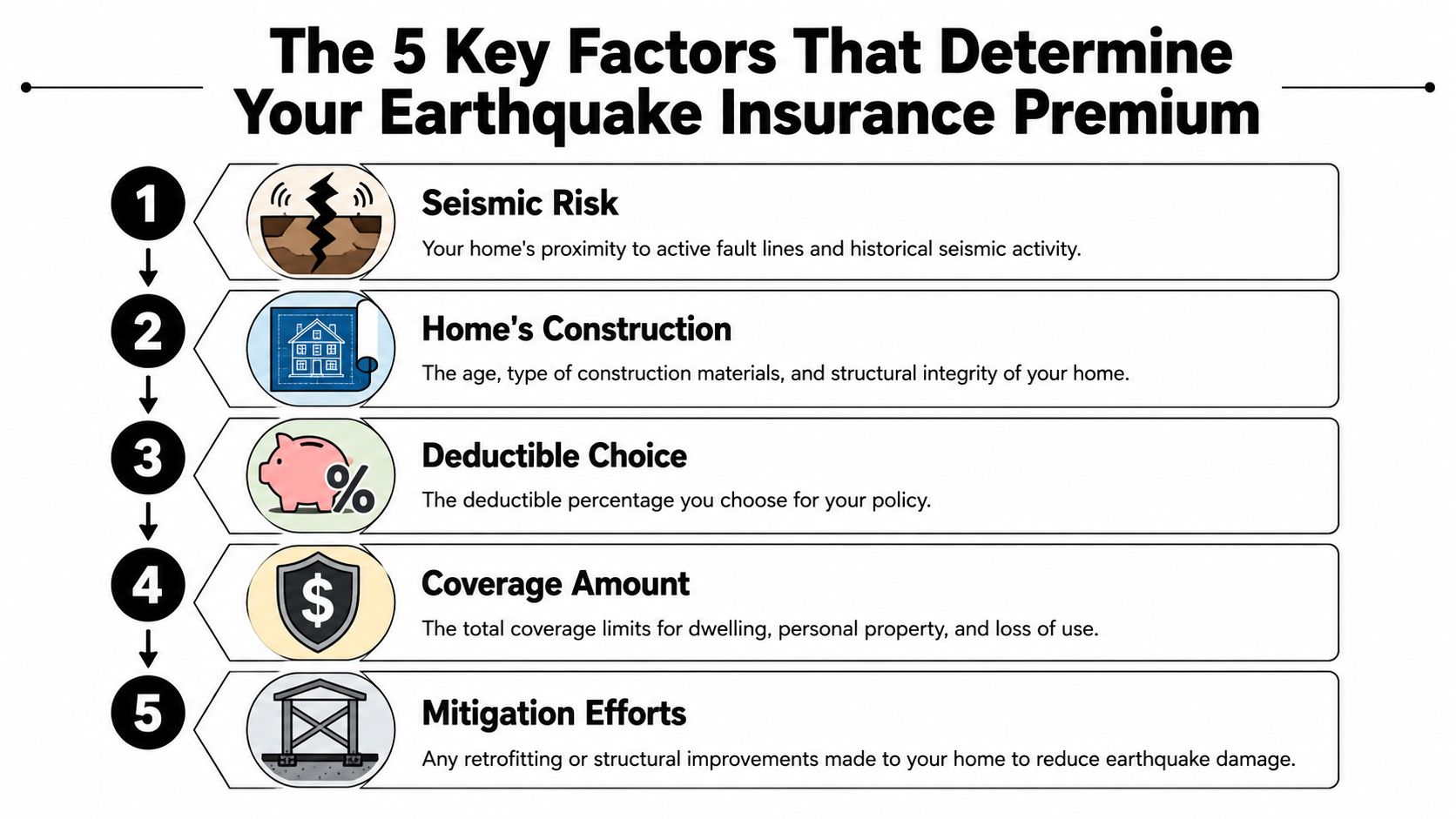
Seismic risk
Location is the first big lever. A home closer to active fault exposure or in an area with stronger modeled shaking risk will usually cost more to insure than a similar home in a less exposed area.
You can't change that factor. You can only account for it.
That's why buyers should stop asking, “What's the average earthquake insurance cost?” and start asking, “How does my specific location affect the premium?” The first question is broad. The second gets you to a usable answer.
Home construction
Insurers care a lot about what the house is made of and how it behaves under stress. Wood-frame homes often price better than brittle construction because they tend to flex more effectively during shaking. Older homes can also cost more when they haven't been updated or reinforced.
Construction details that usually matter include:
- Frame type: Wood-frame homes are often viewed more favorably than unreinforced masonry.
- Age of the structure: Older homes can raise concern if they predate more modern seismic practices.
- Foundation connection: A house that isn't well anchored can be more vulnerable.
- Soft-story or crawl-space issues: Certain layouts can increase loss potential.
Older brick or unreinforced homes can be expensive to insure for earthquake risk, even when their standard homeowners premium looks reasonable.
Deductible choice
Many buyers regain some control through earthquake policies, which commonly use percentage-based deductibles instead of the flat dollar deductibles people are used to in home insurance.
A higher deductible usually lowers the annual premium. That can make sense, but only if you can afford the out-of-pocket share after a claim. Choosing the highest deductible just to make the premium look better on paper is a bad move if you couldn't write that check when it matters.
Coverage amount
More protection costs more. That sounds obvious, but people still miss how coverage design changes price.
You may be looking at protection for the dwelling, personal property, and loss of use if you have to live elsewhere during repairs. If you own a condo, the inside-unit needs can look different than a detached home. If you're a renter, renters insurance still won't automatically mean earthquake protection unless you add the right coverage.
Mitigation efforts
Retrofitting can help. Insurers like homes that have been strengthened because the home is less likely to suffer severe damage.
That doesn't mean every improvement produces the same pricing result or the same underwriting response. Still, if your home has foundation bolting, cripple wall bracing, or other seismic upgrades, bring that up when you shop. It can matter.
California Earthquake Insurance Cost Scenarios
Here's the part most buyers want but rarely get in plain English: the same earthquake insurance cost range can feel reasonable or outrageous depending on the house.
A newer townhouse in a lower-risk part of inland Northern California may land near the lower end of the range. An older house in a higher-risk Southern California neighborhood can push toward the upper end quickly, especially if construction and deductible choices aren't working in your favor.
Scenario one: newer attached home
Think of a first-time buyer purchasing a newer wood-frame townhouse in a relatively lower-risk part of Sacramento. The home is newer, attached, and built with construction that insurers usually like better than older brittle materials.
That buyer may see earthquake insurance cost closer to the lower side of the broad range. Why? Less concerning construction profile, potentially more favorable risk modeling, and fewer red flags from a structural standpoint.
Scenario two: older single-family home
Now take an older single-family home in Los Angeles with aging construction details, a raised foundation, and no known retrofit work. That's a very different risk picture.
The premium can climb fast because the insurer is stacking concerns: location, age, potential foundation vulnerability, and the higher likelihood of meaningful structural damage if a strong quake hits. As a result, first-time buyers get shocked. They compare the quote to a friend's policy in another city and assume something is wrong. Usually, nothing is wrong. The house is just a tougher risk.
Scenario three: condo owner near the coast
Condo buyers often assume earthquake pricing will be simple because the HOA handles the building. Sometimes it is simpler. Sometimes it isn't.
Your quote depends on what the master policy covers, what your unit policy needs to fill in, and whether you want protection for belongings and temporary living expenses. Condo owners can still face meaningful earthquake insurance cost, but the structure of the policy may be different from a detached home.
| Home profile | What usually pushes cost down | What usually pushes cost up |
|---|---|---|
| Newer townhouse | Wood-frame construction, newer build, higher deductible | Lower deductible, broader add-ons |
| Older detached home | Retrofit work, strategic deductible, cleaner risk profile | Older structure, masonry issues, high-risk location |
| Condo unit | Limited interior-only needs, well-structured HOA coverage | Gaps in association coverage, added personal property needs |
If a quote feels high, don't assume earthquake insurance is overpriced. First check whether your house is expensive to insure for very specific reasons.
CEA vs Private Insurance Which Option Is Better for You
California homeowners usually end up weighing two paths: a policy connected to the California Earthquake Authority, or a private-market option. Neither is automatically better. The right answer depends on how much flexibility you want, how comfortable you are with the deductible structure, and whether you want your earthquake policy to fit into a broader insurance strategy.
I'll give you the blunt version. If you want standardized choices that are widely available, the CEA is often the first place people land. If you want more room to tailor coverage or coordinate it with the rest of your insurance portfolio, private options can be more attractive.
CEA vs. Private Earthquake Insurance at a Glance
| Feature | California Earthquake Authority (CEA) | Private Insurance Market |
|---|---|---|
| Coverage approach | More standardized policy structure | Often more customizable, depending on carrier |
| Deductible options | Menu-style deductible choices are common | Varies by carrier and product |
| Personal property and use-of-home options | Structured options available | May offer different packaging and limits |
| Best fit for | Homeowners who want a familiar California earthquake option | Homeowners who want flexibility and carrier comparison |
| Bundling potential | More limited as part of a broader package | May align better with home, auto, car insurance, renters insurance, or life insurance planning |
| Shopping experience | Often tied to participating insurers | Broker or agency comparison can show multiple carriers |
Where the CEA makes sense
The CEA exists because California's earthquake exposure is unusual, and the market needed a durable residential option. For many homeowners, that matters. The CEA can be a practical fit when you want a known framework and a straightforward way to access earthquake coverage through a participating insurer.
That kind of standardization helps some buyers. Less guesswork. Fewer moving parts. Easier comparison between deductible and coverage selections.
Where private insurance can win
Private carriers can be better when you want sharper customization. Some homeowners want broader options, different packaging, or a cleaner way to line up earthquake coverage with other policies.
Your total insurance picture matters. If you're already reviewing home insurance, auto insurance, car insurance, renters insurance, or life insurance, a private-market quote may fit better with the rest of the stack. Not always cheaper. Not always broader. But often worth a serious side-by-side review.
The smartest move isn't picking a side before you quote. It's comparing both paths using the same deductible tolerance and the same coverage goals.
My recommendation
Don't assume the state-backed option is automatically the best deal. Don't assume private coverage is automatically better either.
Get both looked at if they're available to you. Focus on these questions:
- How much structure protection do I want?
- What deductible could I realistically handle after a loss?
- Do I need better fit with existing home or auto policies?
- Am I comparing true apples to apples, or just chasing the lowest premium?
If you only compare price, you can end up with the wrong policy for the right number.
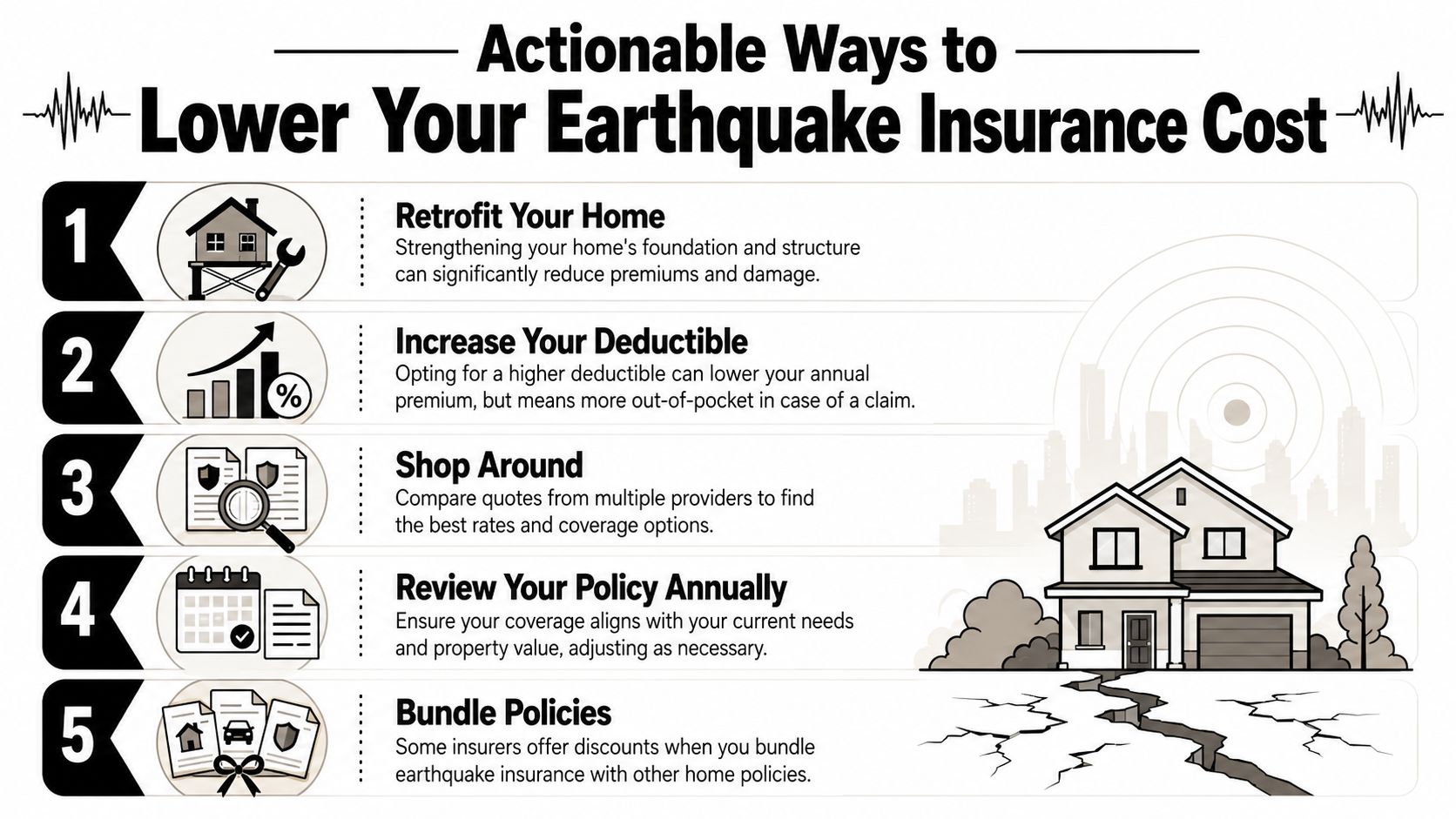
Actionable Ways to Lower Your Earthquake Insurance Cost
You usually can't bargain your way to a lower earthquake premium, but you can make decisions that reduce it. Some are immediate. Others take planning. The key is to work on the factors you control instead of obsessing over the ones you don't.
Start with the structure
If your home has older foundation or bracing concerns, retrofitting is the strongest long-term move. It can improve underwriting appeal and reduce the chance of severe damage in the first place. Even when the premium impact is modest, the resilience payoff can still be worth it.
I'm firmly in favor of retrofit work when the home needs it. It's one of the few cost-saving steps that also makes the house safer.
Use your deductible on purpose
A higher deductible can lower your annual premium. That's the easy part. The hard part is choosing one you can live with.
Use this filter:
- Good deductible choice: One that lowers premium but still leaves you with a realistic claim-day obligation.
- Bad deductible choice: One that looks affordable now and becomes impossible after damage happens.
A lot of buyers make the second mistake.
Shop the full picture, not one line
People often shop earthquake coverage in isolation. That's a mistake. If you also carry home insurance, auto insurance, car insurance, or life insurance, the better move is a broader policy review. In some cases, policy alignment and bundling can soften the overall cost picture even if the earthquake line itself doesn't look dramatically cheaper.
For California-specific policy education, the insurance guides from Mai & Associates are useful because they lay out how different policy types fit together in real households.
Four cost-saving moves that actually matter
- Retrofit where it counts: Foundation bolting, cripple wall bracing, and similar improvements can strengthen the risk profile.
- Raise the deductible carefully: This lowers premium, but only works if your savings can absorb the deductible after a claim.
- Recheck coverage every year: Home improvements, HOA changes, or shifts in rebuild needs can make your old setup inefficient.
- Compare multiple insurers: One carrier may view your construction type more favorably than another.
Buyers save the most when they stop treating earthquake coverage as a standalone expense and start treating it as part of their total protection plan.
Get Your Same-Day Quote from Mai & Associates
If you want a real answer on earthquake insurance cost, stop guessing and get a quote. That sounds obvious, but too many homeowners spend hours reading generic ranges and still don't know what their own house will cost to insure.
The process is simple.

What to do first
Go to the online insurance quote page and submit the basic property and contact details. Don't overcomplicate it. The goal is to start the comparison process so a licensed agent can review the home, the location, and the coverage options available.
At this stage, many first-time buyers relax a little. Once you've submitted the form, you're no longer trying to reverse-engineer a premium from internet averages.
What happens next
A licensed agent reviews the request, compares available options, and helps you sort through the tradeoffs. That matters because earthquake insurance isn't just about price. It's about the deductible, the dwelling limit, how the policy handles belongings, and whether there are better ways to structure the rest of your California coverage at the same time.
The practical upside of using a real agency instead of trying to piece this together alone is speed and comparison. You can look at multiple carriers, ask direct questions, and get help spotting gaps that a first-time homeowner usually misses.
What to have ready
You'll get better results if you can provide:
- Property basics: Address, year built, and home type.
- Construction details: Any known retrofit work, foundation updates, or structural improvements.
- Current policies: Existing homeowners, condo, renters, or auto details if you want a broader review.
- Your deductible comfort level: What you could realistically absorb out of pocket.
That last point matters more than people think. A quote only helps if it fits your finances.
Frequently Asked Questions About California Earthquake Coverage
Is earthquake damage included in a standard homeowners policy
Usually, no. Earthquake damage is typically handled through a separate policy or endorsement, not your base homeowners coverage. That's one of the most common misunderstandings among first-time buyers.
Do I need earthquake coverage if I already have a California Fair Plan policy
You may still need a separate review. A California Fair Plan setup often solves one problem, usually basic property access in a hard-to-place market, but it doesn't automatically mean you have all the protection you assume you do. Earthquake exposure should be reviewed on its own merits.
What if I rent instead of own
Renters can buy earthquake-related protection for personal belongings and temporary living costs, depending on the policy available. Standard renters insurance doesn't automatically mean earthquake damage to your stuff is covered. If you rent in California, that distinction matters.
Does auto insurance cover earthquake damage to my car
If you carry full coverage, your vehicle may be protected for earthquake-related damage under that part of the policy. Liability-only car insurance won't do that. This is one more reason to look at your total California insurance setup instead of thinking in silos.
Where can I get answers about policy details
If you want plain-language answers on common coverage questions, the California insurance FAQ page is a useful place to start before you compare quotes or adjust existing policies.
If you want a fast, no-obligation review of your earthquake options, Mai & Associates makes it easy to compare California coverage for your home, condo, renters needs, auto insurance, car insurance, and life insurance in one place. For first-time buyers especially, that kind of side-by-side guidance can save time, prevent coverage gaps, and turn a confusing earthquake insurance cost question into a clear decision.