Early Lease Termination in California: Tenants Guide 2026
In California, breaking a lease without a protected reason generally leaves you responsible for rent through the end of the term, reduced only by what the landlord can reasonably mitigate by re-renting. For a periodic tenancy, written notice is generally 30 days for a tenancy under one year and 60 days for a tenancy of one year or more, under Civil Code §1946.1.
You may be staring at a new job offer, a sudden move, a dangerous housing condition, or a landlord who says you owe every remaining month. The answer depends less on the emotional reason for leaving and more on the legal category of your tenancy, the reason for termination, the notice you give, and the landlord's documented efforts to reduce the loss.
This guide focuses on the part most renters and property owners misunderstand: the final damages bill is usually controlled by mitigation. Moving out doesn't automatically erase rent, but it also doesn't automatically give the landlord the right to collect the entire remaining balance.
Why Breaking a Lease in California Is Rarely Free
A tenant in Sacramento signs a one-year lease, then receives a job offer in San Diego. The tenant packs, leaves the keys on the counter, and assumes the contract ends because the apartment is empty. That assumption can create a serious financial problem.
A fixed-term lease is a contract. Unless the lease contains a valid buyout or early-termination provision, or a statutory exception applies, an ordinary move for work, a relationship change, a preferred neighborhood, or a home purchase usually doesn't release the tenant. California tenants generally remain exposed to rent and other losses caused by an early breach, subject to the landlord's obligation to mitigate by trying to re-rent the unit. The basic statewide framework is summarized in this California early lease termination guide.
The keys aren't a release
A landlord doesn't have to treat dropped-off keys as a negotiated surrender. The landlord may accept possession while preserving a claim, depending on the circumstances, and must address the vacancy rather than allowing avoidable losses to accumulate. The tenant's exposure can include unpaid rent, reasonable costs caused by the breach, and other provable losses.
That doesn't mean the landlord can leave the unit vacant, reject suitable applicants, and send the former tenant an invoice for every remaining month. California's mitigation rule matters. The landlord must make reasonable efforts to reduce the loss through re-rental, and the tenant can challenge avoidable amounts.
Practical rule: Moving out ends your physical occupancy. It doesn't necessarily end your financial obligations.
The practical consequences can include a disputed security deposit, collection activity, adverse credit reporting, a demand letter, or a lawsuit in small claims or superior court. Before assuming you can walk away, compare your circumstances with the guidance on whether you can break a rental lease early, then review your broader household obligations through California home and auto insurance FAQs.
The important exceptions are real, but they're specific. Military orders, qualifying violence or abuse, and serious habitability failures can change the result. The next question is whether you have a fixed-term or periodic tenancy, followed by the damages calculation that determines what you may owe.
Fixed-Term vs Month-to-Month Tenancies
The tenancy type controls the starting point. A fixed-term tenancy has a defined ending date. A periodic tenancy, commonly month-to-month, continues from period to period until one party gives legally sufficient notice or another lawful termination event occurs.
A tenant four months into a twelve-month fixed lease has a contract problem if the tenant leaves without an applicable exception. A Bakersfield renter on a month-to-month agreement who gives proper written notice generally ends the tenancy without breaching a fixed term. The first tenant may face mitigation-based damages. The second is using the ordinary termination mechanism.
Notice depends on the tenancy
California's written-notice framework under Civil Code §1946.1 generally requires at least 30 days for tenancies under one year and 60 days for tenancies of one year or more. The California Department of Real Estate's moving-out resource guide also distinguishes ordinary residential move-outs from the more complicated damages issues that arise after a lease breach.
Read the lease for its ending date, renewal language, notice provisions, and any early-termination clause. A lease can establish procedures that help the parties administer a move-out, but a private clause can't erase a statutory protection or authorize conduct California law prohibits.
| Tenancy | What leaving usually means |
|---|---|
| Fixed term | Leaving early may breach the contract unless a valid clause, agreement, or legal exception applies. |
| Month-to-month | Proper written notice ordinarily ends the tenancy without a fixed-term breach. |
| Protected termination | A qualifying statute may provide a separate notice period and limit financial liability. |
Don't confuse a lease's administrative notice language with permission to terminate early. Notice may tell the landlord when you intend to leave, but it doesn't necessarily excuse rent owed under a fixed-term contract.
How California Calculates the Tenant's Damages
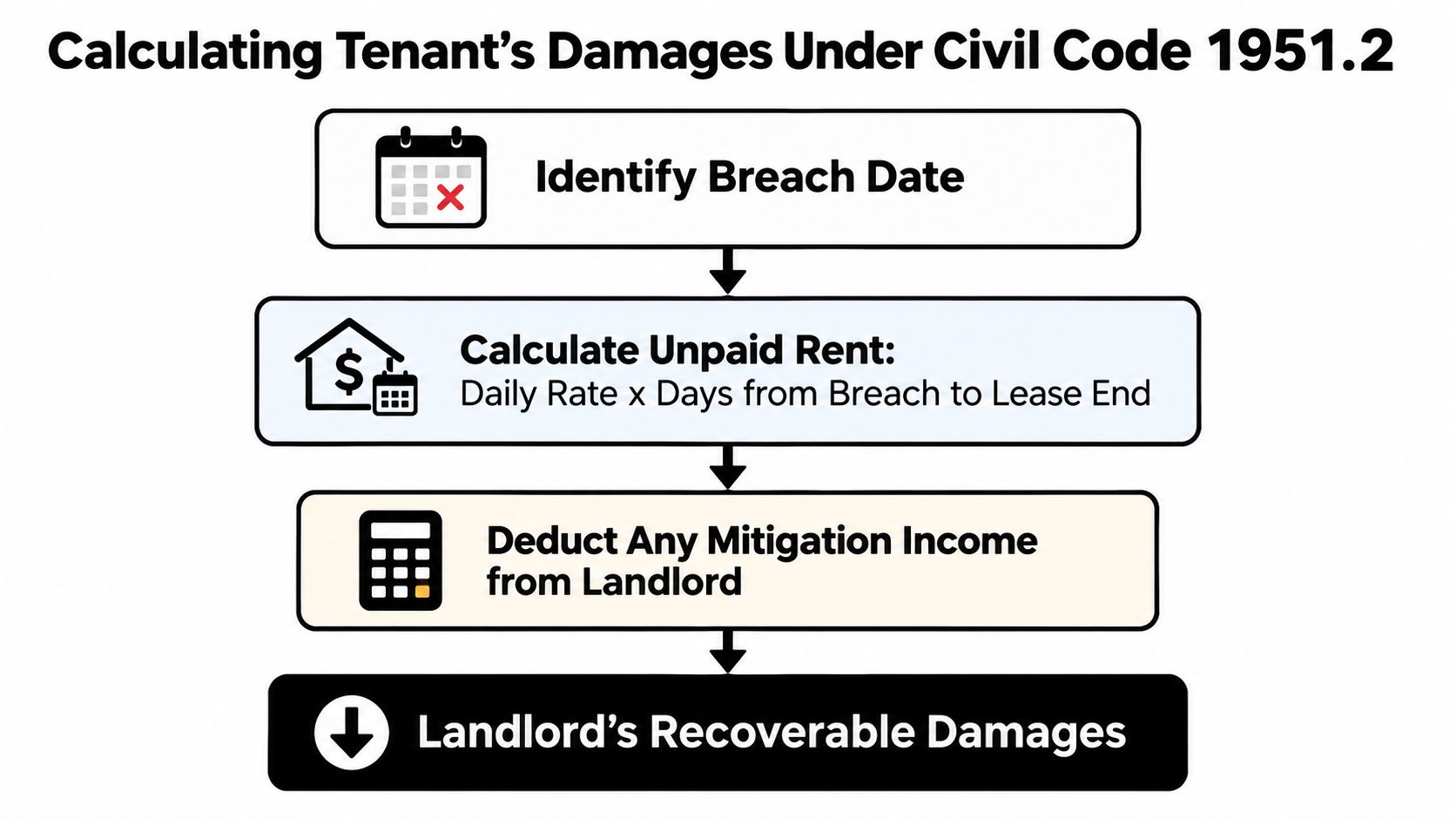
Civil Code §1951.2 does not give a landlord a blank check for the entire remaining lease balance. It creates a damages framework that accounts for unpaid rent, future losses, avoidable losses, and other detriment caused by the breach. The statutory structure is summarized in this California Civil Code §1951.2 reference.
The arithmetic
Use the example required to understand the mechanics. A tenant pays $2,400 per month on a twelve-month lease and leaves at month four. The nominal rent remaining is $19,200, calculated as eight months multiplied by $2,400. If the landlord re-rents the unit in month six at the same $2,400 monthly rent, the vacancy period represents two months, or $4,800, before considering other legally recoverable losses.
The calculation isn't “remaining months times rent.” California permits recovery of earned unpaid rent, future rent through the award date reduced by amounts the landlord could reasonably have avoided, the remaining term's rent reduced by reasonably avoidable losses, and other detriment proximately caused by the breach. The statute also addresses present-value treatment for future rent damages.
Mitigation income offsets the claim. If a replacement tenant pays less than the original rent, that replacement income still reduces the former tenant's claim dollar-for-dollar for the period it applies. A landlord can't collect full rent from the original tenant and full rent from a replacement tenant for the same period.
Evidence decides the bill
The landlord should preserve advertising records, showing dates, rental terms, inquiries, applications, screening decisions, and the date a replacement tenant begins paying. The tenant should request an accounting and examine whether the landlord acted reasonably, rather than accepting an unsupported demand.
A landlord must act in good faith and can't deliberately refuse a suitable applicant to inflate damages. The security deposit also can't be treated as an automatic windfall or used to support double recovery. Its lawful deductions must be accounted for separately.
The tenant's real exposure is the provable net loss, not an automatically collectible lease balance.
Protected Exceptions That Let You Exit Penalty-Free
California has several high-specificity routes that can change an ordinary breach into a protected termination. The paperwork matters as much as the reason. A tenant who qualifies but gives incomplete notice or fails to provide requested evidence can create an avoidable dispute.
Military service
The Servicemembers Civil Relief Act may allow a qualifying service member to terminate a lease signed before active duty or qualifying military orders. The tenant generally must deliver written notice and a copy of the orders to the landlord. The federal protection bars an early termination fee, and the termination follows the statute's timing rules rather than an informal handover.
Keep the orders, delivery proof, and a copy of the notice. Don't rely on a phone call.
Violence, stalking, trafficking, and abuse
Civil Code §1946.7 provides a special termination right for victims of domestic violence, sexual assault, stalking, human trafficking, and elder or dependent adult abuse. The statute requires notice within 180 days of the qualifying order, report, or incident, and termination becomes effective 14 days after notice, with rent owed for those fourteen days unless a replacement tenant moves in sooner. The statutory text is available through the California Legislature's Civil Code §1946.7 page.
Supporting documentation can include a qualifying protective order, police report, or other evidence identified by the statute. State tenant guidance also explains that protected survivors may leave without an early-termination penalty and receive the security deposit without a penalty in those circumstances. This California lease-break guidance from Edinhart Realty can help identify questions to raise, but statutory compliance should control.
Habitability and safety
An uninhabitable unit may support termination, but "I dislike the apartment" isn't enough. Document code problems, unsafe conditions, repair requests, landlord responses, photographs, inspection records, and any notice-and-cure opportunity required by the facts.
Natural-disaster displacement, elder or dependent-adult safety concerns, and serious repair failures can overlap with statutory or common-law remedies. Don't announce a penalty-free exit before identifying the exact rule, the evidence it requires, and the date the protection becomes effective.
Residential vs Commercial Lease Breaks
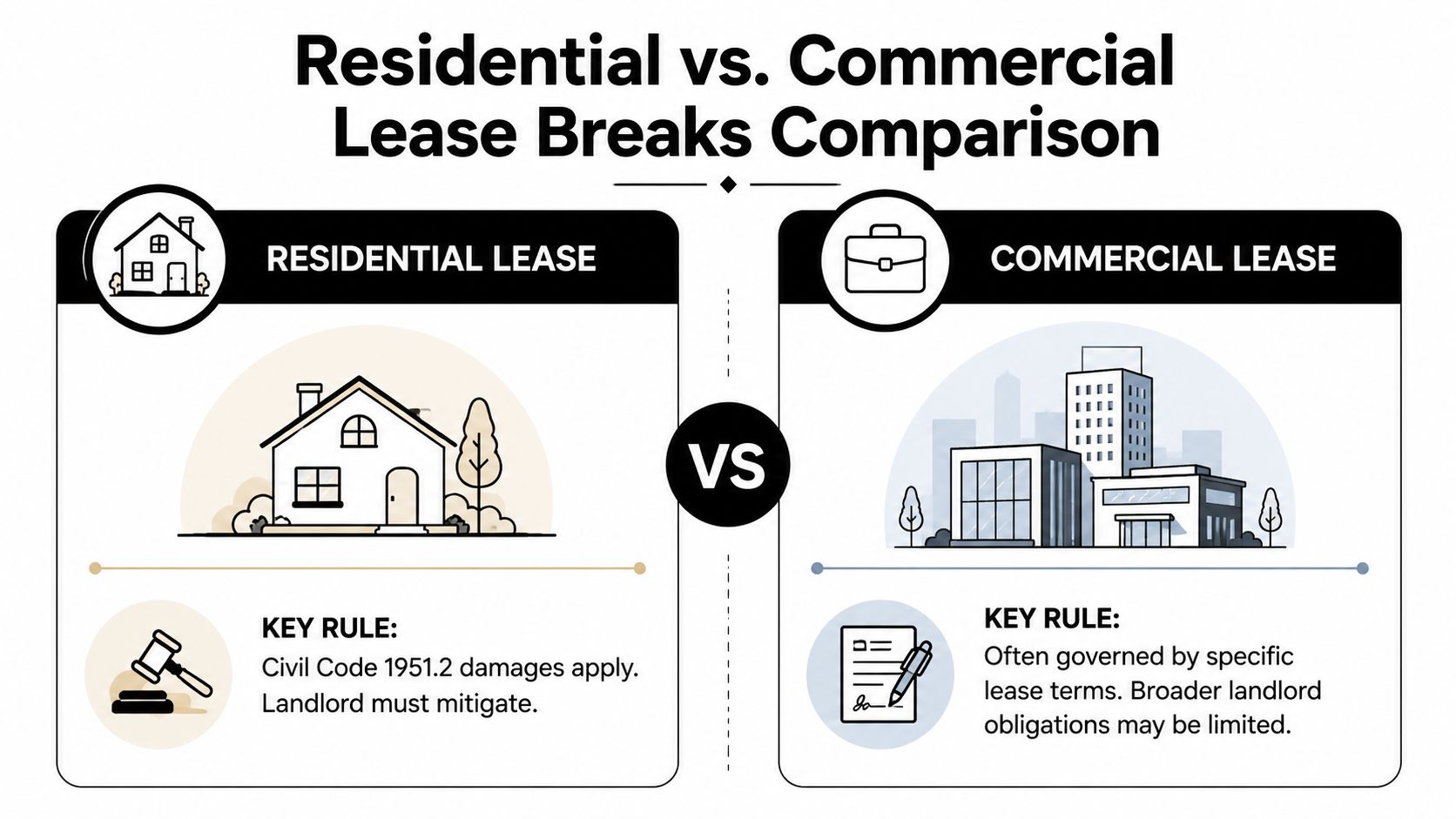
Residential and commercial leases share contract principles, but the risk analysis diverges sharply. Residential disputes commonly turn on statutory notice, protected reasons, habitability, required disclosures, local tenant protections, and mitigation under California law.
Commercial tenants face a more contract-driven environment. The lease may contain surrender language, an early-termination provision, a liquidated-damages clause, an accelerated-rent provision, or a personal guarantee. Those provisions can determine the dispute before anyone reaches a simple residential rule of thumb.
The practical divide
| Residential lease | Commercial lease |
|---|---|
| Civil Code §1951.2 damages and mitigation can shape the claim. | Specific lease terms often drive remedies and may limit broader landlord obligations. |
| Habitability and protected-termination statutes can be central. | Business interruption, buildout, guarantees, and use restrictions can dominate. |
| Local residential protections may affect termination and relocation issues. | The tenant must scrutinize negotiated remedies and proof requirements. |
Commercial landlords may seek future-rent damages after mitigation, with applicable discounting and reductions for avoidable losses. A business tenant may also have to prove that the landlord could have avoided claimed losses. The presence of a personal guarantee can expose an individual even after the business stops operating.
Constructive eviction, fraud, and serious landlord breaches can matter in both settings. But don't borrow residential advice for a storefront, office, or mixed-use commercial space. Have counsel read the actual lease, especially the default, surrender, guarantee, and damages provisions.
Step-by-Step Playbook for Tenants and Landlords
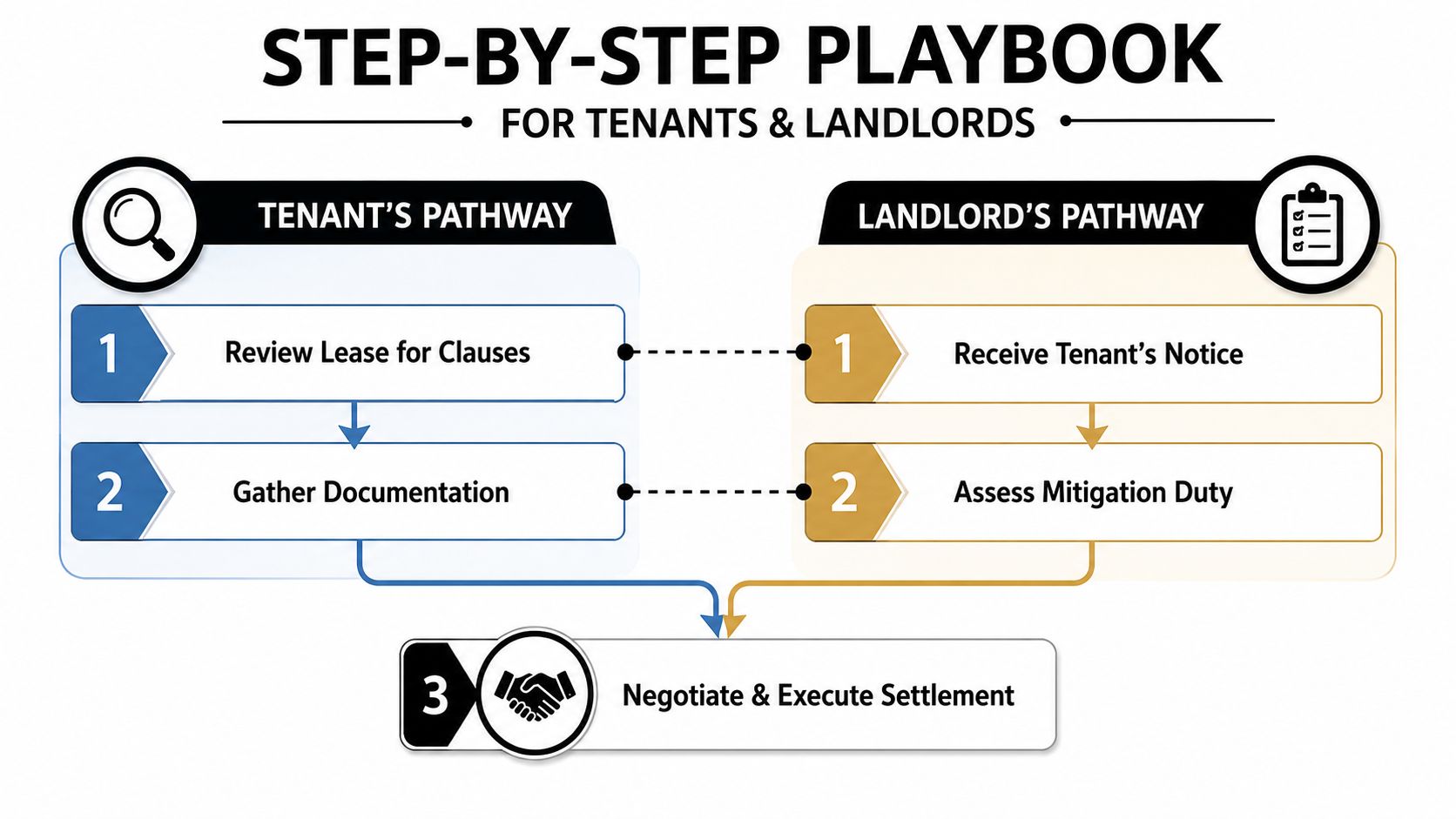
The safest early termination is documented from the first conversation. A tenant should treat the move as a legal transaction, not a casual change of plans. A landlord should treat the vacancy as a mitigation project, not an opportunity to let damages grow.
Tenant checklist
- Read the lease first. Find the fixed end date, notice clause, subletting language, surrender provision, buyout option, and any fee clause.
- Classify the reason. Separate an ordinary move from military service, protected violence or abuse, habitability failure, or another specific legal basis.
- Gather proof. Save orders, reports, photographs, repair requests, inspection records, and any other evidence supporting the claimed exception.
- Serve written notice. State the intended termination date, legal basis if applicable, and delivery method. Keep proof that the landlord received it.
- Request an inspection. Ask to inspect the unit before surrender, correct avoidable damage, and photograph every room after cleaning.
- Negotiate in writing. A signed settlement should identify the move-out date, rent owed, deposit treatment, releases, and whether the landlord may pursue later charges.
- Provide a forwarding address. Ask for the final accounting and keep copies of every message.
A tenant who wants a practical starting format can review this sample letter to cancel a lease. Use it as a drafting aid, not as a substitute for matching the notice to the governing statute.
Landlord checklist
The landlord should verify any claimed exception promptly, without retaliating or exposing private safety information. Then advertise the unit, schedule showings, screen applicants consistently, record reasonable re-rental expenses, and preserve rejected-application reasons.
Track vacancy dates, offered rent, replacement rent, communications, repairs, and the condition at surrender. Apply the mitigation offset to the damages calculation and provide the required deposit accounting. A buyout can be cheaper than litigation when both parties can agree on a clean release, but the agreement must be signed before possession changes hands.
For insurance needs that arise during the move, compare options through a California insurance quote request, while keeping the lease dispute itself separate from coverage decisions.
Insurance, Habitability, and High-Risk Area Moves
A fire, flood, or serious building defect can leave a tenant paying for a new place while the old lease remains in force. Insurance may help with relocation and property loss, but it does not cancel the lease. The tenant still needs a legal termination ground or a written release. The landlord must also mitigate by seeking a replacement tenant instead of allowing avoidable rent losses to grow.
California renters insurance typically covers personal contents, loss of use, personal liability, and medical payments to others. The California Department of Insurance states that loss of use is generally 20% of Coverage C, personal liability is generally subject to a minimum of $100,000, and medical payments to others are generally subject to a minimum of $1,000. The department's renters insurance guide explains those coverage categories. Tenants should also review California renters insurance coverage details before assuming a policy will pay rent, moving costs, or damaged belongings.
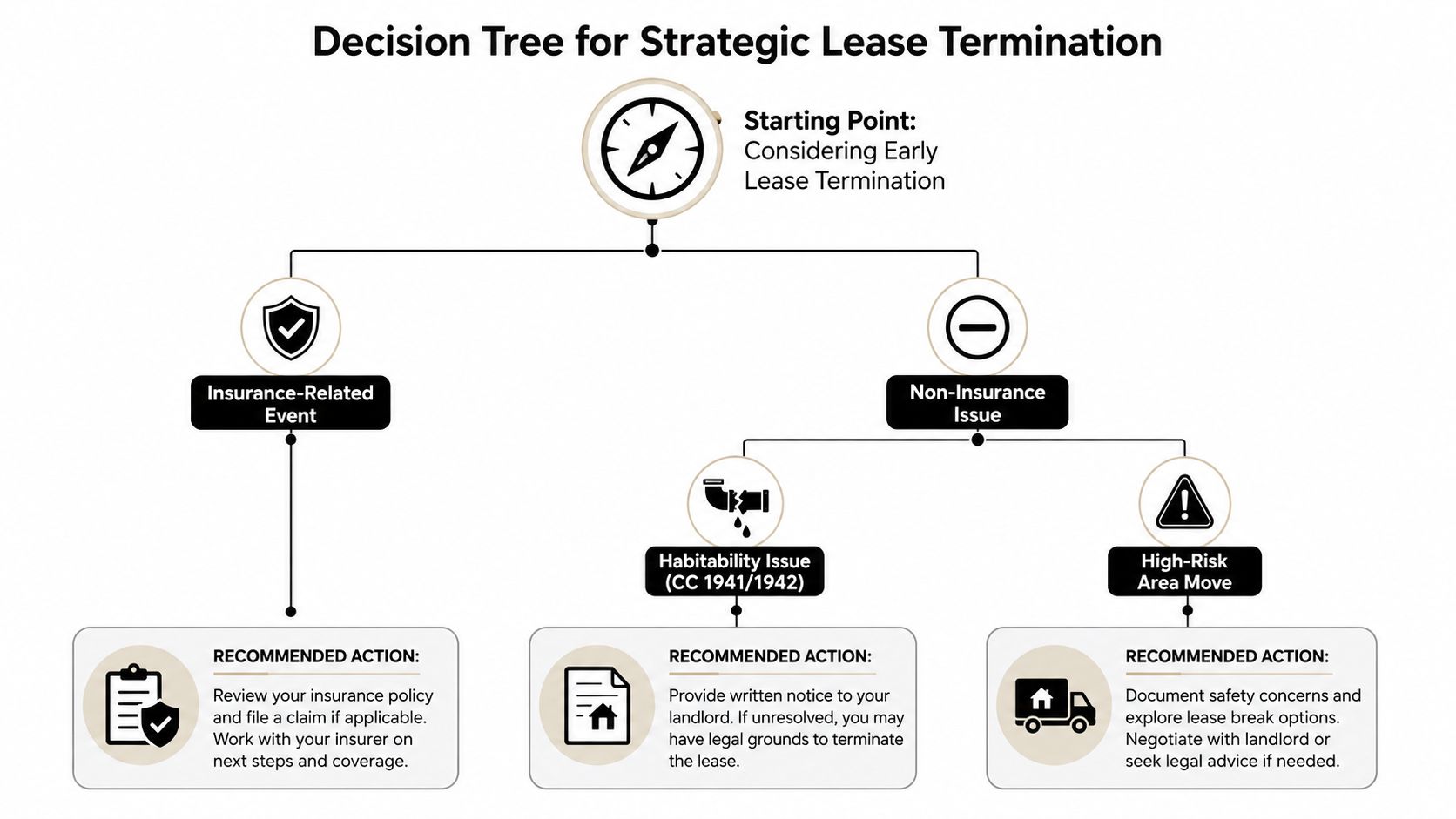
Three questions change the strategy
Is the unit uninhabitable? California habitability duties and repair remedies may apply when serious defects affect safe occupancy. Give written notice, allow the required opportunity to repair, and document the condition. Leaving too early can look like abandonment if the evidence does not support constructive eviction, exposing the tenant to rent and repair claims.
Did a covered event displace the tenant? Review loss-of-use terms, additional living expense provisions, exclusions, deductibles, and claim instructions. The landlord should review property coverage, business interruption protection, and applicable endorsements. The tenant's policy does not automatically pay the landlord's rent claim.
Is the property in a high-risk area? Wildfire displacement, insurance availability, and local tenant protections can affect negotiations, but a news event alone does not terminate a lease. Identify the specific state or local protection, confirm whether the unit remains legally occupiable, and follow its notice and evidence requirements.
Lease liability also stays separate from auto insurance obligations. California's standard auto insurance minimums for policies renewing on or after January 1, 2025, are $30,000 per person and $60,000 per accident for bodily injury or death, and $15,000 per accident for property damage, according to the California Department of Insurance auto guide. Moving does not automatically terminate those policies, and a new address can affect underwriting information.
Sharp Questions Tenants and Landlords Ask Next
Can the landlord use my deposit for unpaid rent?
Don't assume the deposit disappears into the rent account. California's deposit rules require an accounting and return process, including an itemized statement and return of any remaining balance within 21 days, as summarized in the California Civil Code §1946 resource at this California lease termination reference. A landlord can make lawful deductions, but the landlord still must account for them and can't double-dip.
Does an early-termination fee end the dispute?
Only if the clause is valid and the parties follow it. Read the fee language, notice requirements, payment conditions, release language, and any conflict with mitigation duties or statutory protections. A fee clause doesn't eliminate a protected tenant's rights, and a landlord shouldn't demand a fee barred by an applicable statute.
What happens if the tenant simply leaves?
The landlord should document the apparent abandonment, secure the property, inspect it, advertise it, and calculate the net loss. The tenant shouldn't assume silence means forgiveness. The landlord also shouldn't inflate the claim by ignoring reasonable re-rental opportunities.
Is this an eviction?
Usually not. A tenant who leaves early may have breached a contract, while an eviction is a formal court process used to recover possession or enforce specific rights. The landlord must use the correct legal process if the tenant remains in possession and refuses to leave.
Can subletting solve the problem?
It may reduce damages if the lease and landlord permit it, but a subtenant doesn't automatically release the original tenant. Get written consent where required, document screening, and sign an agreement that clearly allocates rent, damage, and possession responsibilities.
Do local rules change the outcome?
They can. San Francisco, Los Angeles, Oakland, Berkeley, and other California jurisdictions may impose additional tenant protections or relocation obligations. Check the local ordinance before sending a notice or demanding payment. The California insurance and housing guides can help you organize the broader move, but a local landlord-tenant attorney should handle a contested termination.
Finally, remember that documentation decides most disputes. Keep the lease, notices, delivery confirmation, photographs, repair records, advertising history, applications, accounting, and settlement drafts in one file. If you also need to review life insurance during a major move or family transition, California guidance generally describes a 31-day grace period after a premium due date and a contestability period typically lasting 2 years from policy issuance, as explained in the California Department of Insurance life guide.
If an early move has created a lease dispute or exposed insurance gaps, contact Mai & Associates for practical guidance on California auto insurance, home insurance, renters insurance, and life insurance. Their licensed agents can compare coverage, review wildfire and California FAIR Plan concerns, and help you secure a same-day quote while you focus on resolving the lease correctly.