Driving Without Insurance: Risks & Penalties in 2026
You're driving home on a California freeway after work. Traffic is tight, your phone is buzzing from the cup holder, and then you see flashing lights in the mirror. The officer asks for license, registration, and proof of insurance. That's the moment many drivers realize they don't have active coverage, can't find the card, or let a payment lapse without noticing.
That moment feels small. The consequences usually aren't.
For California drivers, driving without insurance can turn into court costs, vehicle impoundment, license trouble, and direct personal exposure if a crash happens. It also matters beyond auto coverage. A gap in your planning mindset often shows up elsewhere too, whether that's weak home insurance in a wildfire area, bare-bones renters insurance, or no life insurance protection for your family. Good California insurance planning starts with understanding risk before it gets expensive.
Introduction to Driving Without Insurance
A lot of people think insurance problems begin after a crash. In reality, they often begin with a routine traffic stop.
You may have meant to renew your car insurance. Maybe your debit card changed, the payment failed, and the policy canceled. Maybe you assumed you had a grace period. Maybe you just bought a car and thought you could sort out coverage later. California law doesn't treat those situations the same way you do in your head. Once you're on the road without valid proof of financial responsibility, the issue becomes legal and financial at the same time.
Nationally, 15.4% of U.S. motorists were uninsured in 2023, and the combined share of uninsured and underinsured drivers reached 33.4%, according to the Insurance Information Institute's summary of the Insurance Research Council data at Facts and statistics on uninsured motorists. That means the risk isn't rare. It's part of everyday driving.
California is a bigger concern. The state had an uninsured driver rate of 20.4% in 2023, which is about one in five drivers, according to California uninsured and underinsured driver statistics.
Practical rule: If you drive in California, assume the car next to you may not have enough coverage, or any coverage at all.
That's why this topic matters even if you've never been ticketed. It affects what happens when police stop you, what happens after a collision, and how fast you need to act if your insurance has lapsed. One of the least discussed parts of this issue is that quick action can sometimes change the outcome. Another is that California recognizes limited alternatives to standard insurance, though they're not realistic for most drivers.
Understanding Legal and Financial Responsibilities
Insurance is a safety net. If you drive without it, you're walking a tightrope with no net underneath.
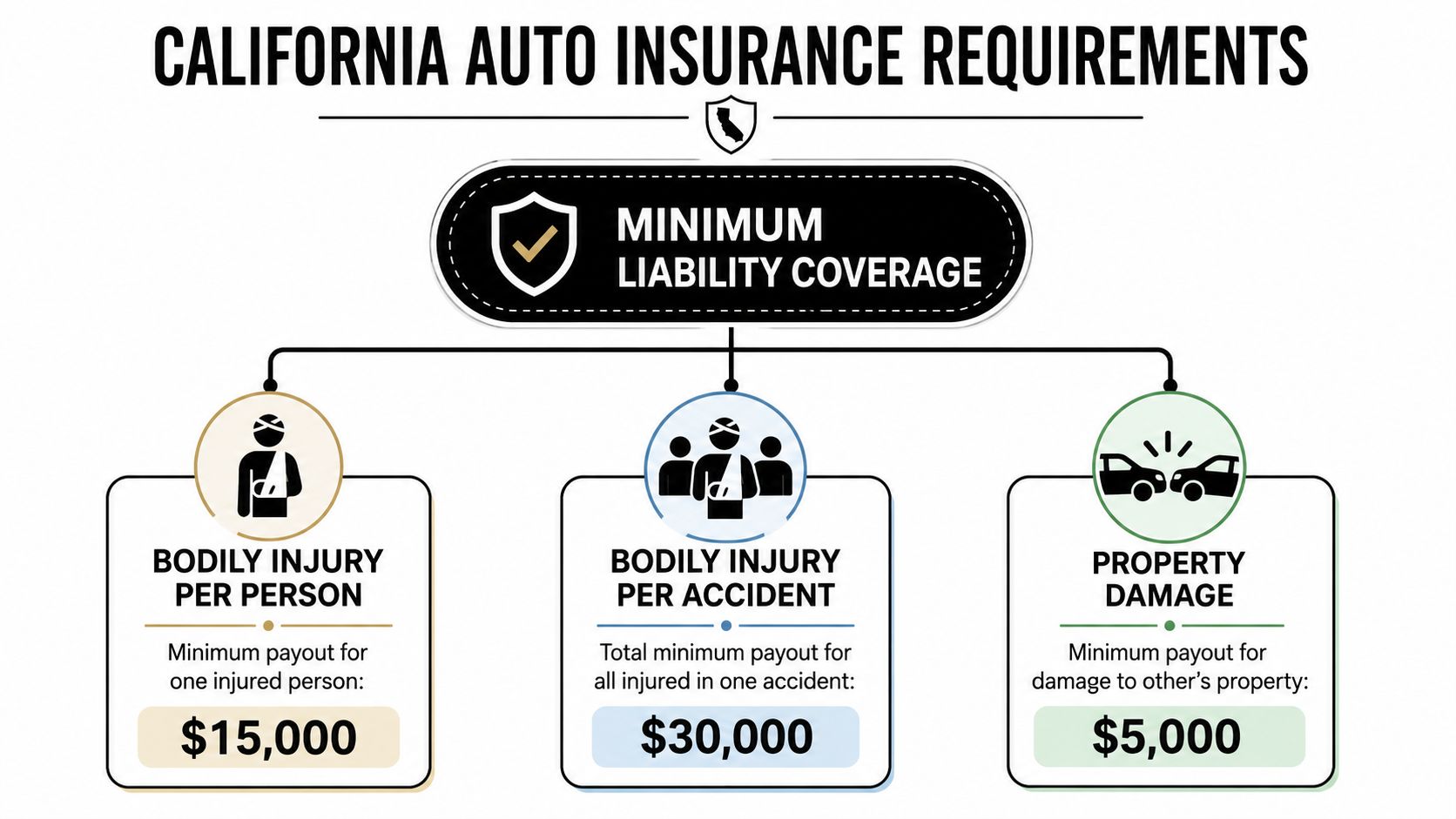
California required minimum liability coverage of $15,000 for bodily injury per person, $30,000 per accident, and $5,000 for property damage per accident through December 31, 2024, and a driver without that coverage can face full personal liability for accident costs, including medical bills, repairs, rental cars, and property damage, which can exceed $100,000 in serious collisions, according to California driving without insurance rules.
A visual makes the old minimums easier to grasp:
What those limits actually mean
Those three numbers protect other people when you cause damage.
- Bodily injury per person: This is the maximum your policy pays for one injured person under the minimum structure.
- Bodily injury per accident: This is the total cap for all injured people in the same crash under the minimum structure.
- Property damage: This applies to the other person's car, fence, storefront, mailbox, or similar damaged property.
Starting January 1, 2025, California updated its minimum liability limits to 30/60/15, doubling the earlier 15/30/5 structure that had been in place since 1967, according to California minimum car insurance limits update. If you're reading policy paperwork from different dates, that's why the numbers may not match.
Why uninsured drivers face the hardest fall
If you cause a crash while uninsured, there's no policy standing between your personal finances and the claim. The injured driver's attorney, repair shop, medical provider, or insurer may pursue you directly.
Think about a chain reaction of costs:
| Expense category | Who may seek payment |
|---|---|
| Medical treatment | Injured driver, passengers, providers |
| Vehicle repair | Other driver, repair facility, insurer |
| Temporary transportation | Rental provider or insurer |
| Property damage | Homeowner, business owner, public agency |
One useful way to understand medical cost exposure is to look at out-of-pocket care pricing. A resource like this Deerfield Beach physical therapy cost guide shows how treatment bills can become a serious burden when insurance isn't carrying part of the load. The example is about therapy, not California auto claims, but the lesson is the same: once coverage disappears, ordinary care starts landing directly on the person paying.
If your insurance lapses, the risk isn't only the ticket. It's every bill that comes after a collision.
Penalties and Enforcement for Uninsured Drivers
California treats driving without insurance as a civil infraction under Vehicle Code §16028, not a criminal offense. That sounds less severe than many drivers expect, but the money and administrative fallout can still hit hard.
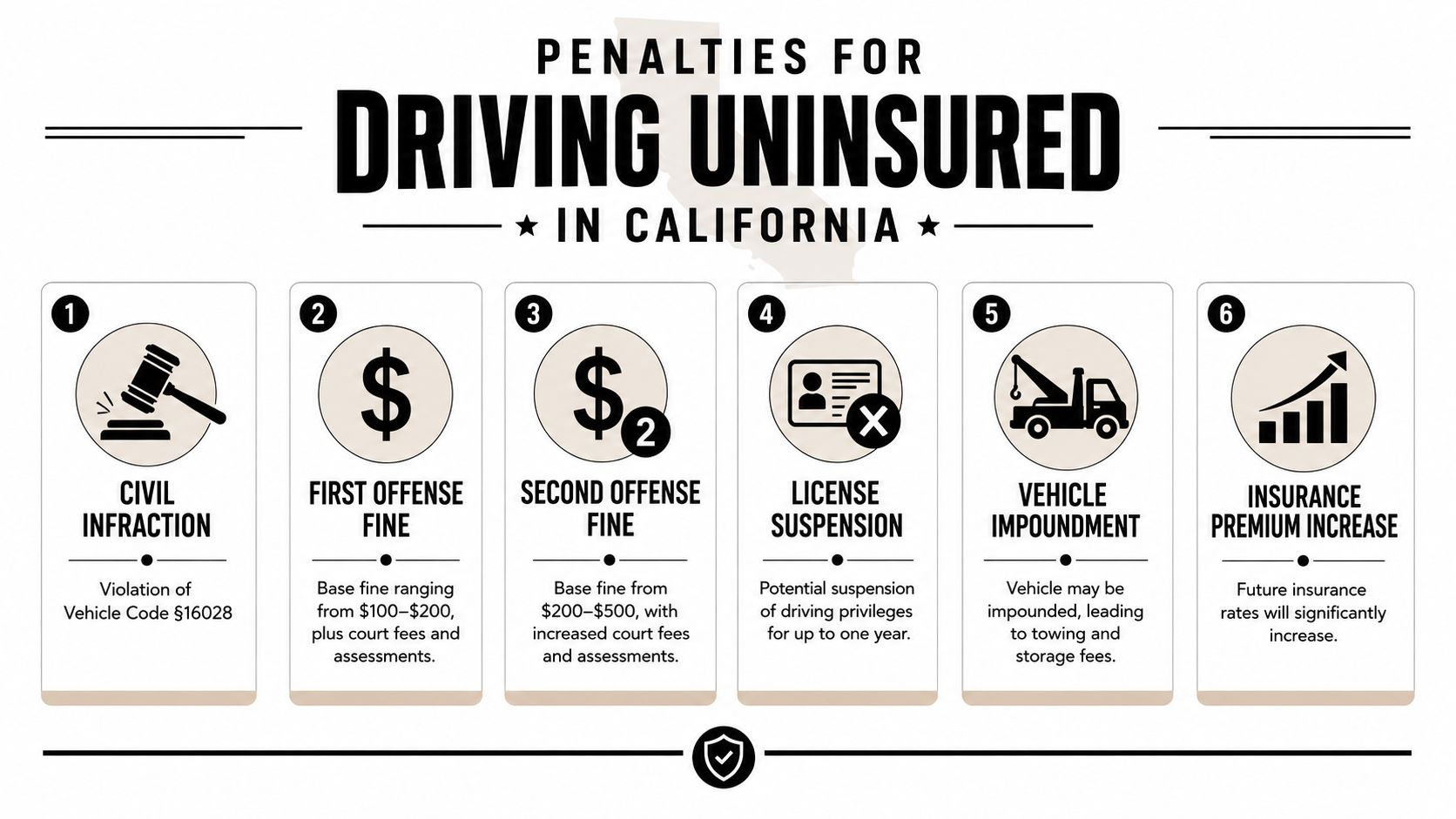
According to California uninsured driving penalties, a first offense carries a base fine of $100 to $200, while a subsequent offense within 3 years carries a base fine of $200 to $500. After penalty assessments and court fees, a $100 base fine can rise to about $390, and a $500 repeat fine can approach $2,000.
Why the ticket amount confuses people
Drivers often hear the base fine and assume that's the total. It usually isn't.
California stacks assessments and fees on top of the base amount. So the number you remember from the statute may be much lower than the number you ultimately pay. The California courts have also noted under the mandatory automobile insurance law that the total penalty for failing to provide proof of financial responsibility on request can reach $1,350, including a $500 minimum fine plus penalty assessments, as described in the California courts overview of the mandatory automobile insurance law.
What enforcement can include besides the fine
The citation is only one layer. Depending on the facts, the consequences can widen.
- No DMV points for the infraction alone: The same legal summary notes that this offense by itself doesn't add NOTS points.
- Possible license suspension after an accident: If you're involved in a crash and can't show financial responsibility, the case can trigger DMV action.
- Vehicle impoundment: Police may impound the vehicle immediately, and you pay towing and storage before release.
- Future filing requirements: Some drivers end up needing an SR-22 to prove financial responsibility going forward.
A repeat violation can be even more disruptive. According to California liability insurance requirements and penalties, a second offense within three years can lead to total costs that typically exceed $1,000 and may reach $2,500, with possible license suspension, registration issues, impoundment, and a required SR-22 filing.
A practical way to think about the risk
A no-insurance ticket is rarely one bill. It's a stack.
- Court fine and assessments
- Towing and storage if the car is impounded
- Higher future insurance costs if SR-22 is required
- Time away from work for court, DMV, and recovery tasks
If you want a broader look at common California policy questions before a problem turns into a citation, the California insurance FAQ library is a useful place to sort out basic coverage confusion.
One missed premium can lead to a court problem, a DMV problem, and a transportation problem all at once.
Real Accident Scenarios and How Uninsured Claims Work
A crash without insurance changes the whole claims process in the first five minutes. After a normal fender bender, both drivers usually swap policy details and let insurance companies sort out payment. If one driver has no coverage, that missing policy acts like a missing chair in a three-legged stool. The claim can still move forward, but it is less stable, slower, and more personal.
California consistently has a large share of uninsured drivers, so these cases come up often on real roads, not just in rare worst-case stories. The Insurance Information Institute facts and statistics on uninsured motorists gives useful national context on how common uninsured-driver claims are and why many insured drivers add their own backup protection.
Parking lot scrape
Start with a low-speed example.
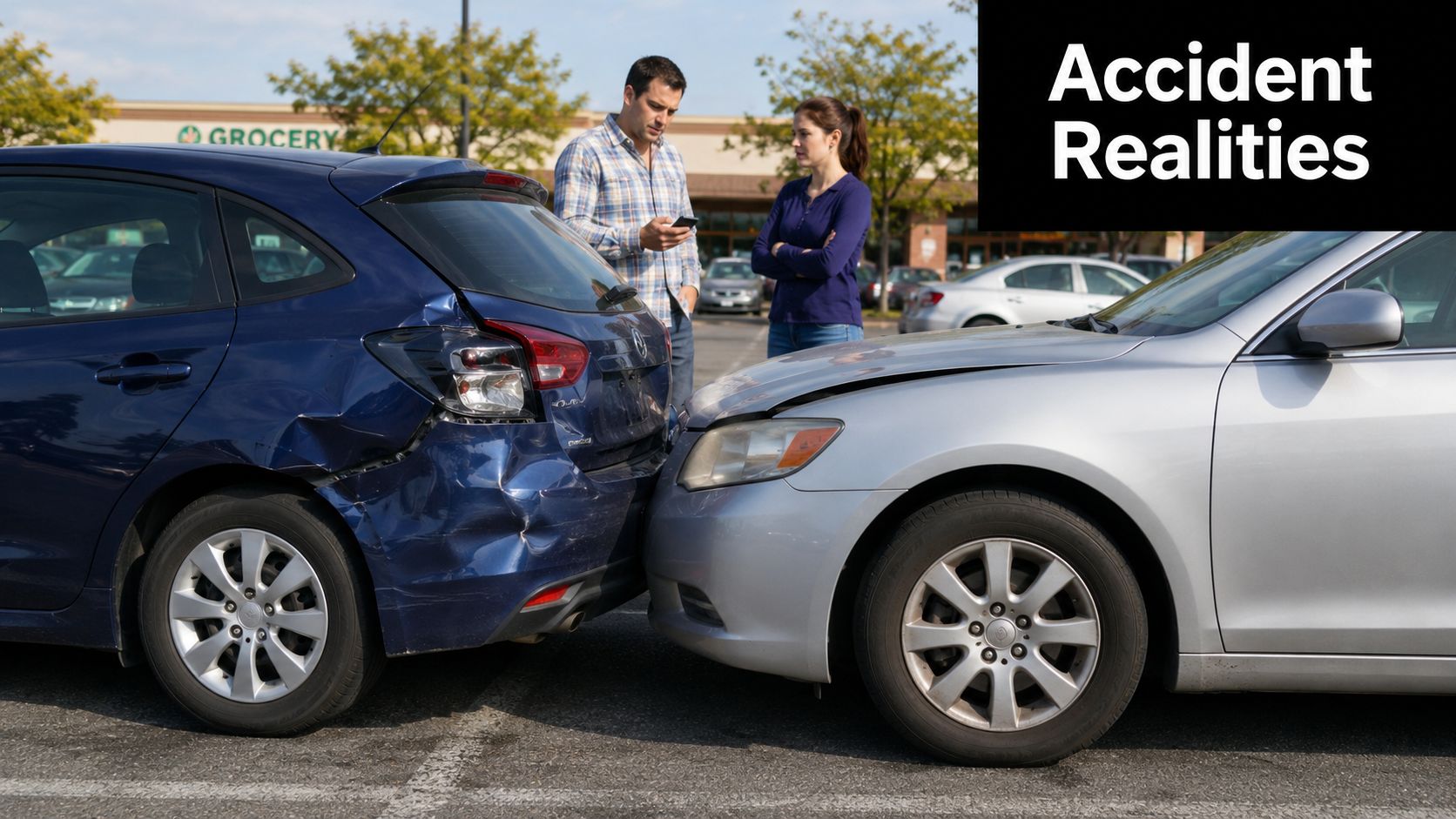
A driver backs out of a grocery store space too quickly and cracks another car's bumper and taillight. Everyone is standing up, no ambulance is needed, and the damage looks manageable. Then the at-fault driver cannot provide insurance information.
At that point, the other driver usually has three possible payment paths. Their own collision coverage may pay for repairs, minus the deductible. In some situations, uninsured motorist property damage coverage may help, depending on the policy and the facts of the claim. If neither path is available, the innocent driver may have to pay out of pocket first and then try to collect from the at-fault driver directly.
That last option is where confusion starts. Winning reimbursement on paper and receiving payment are two different things.
Highway rear-end crash
Now raise the stakes.
Traffic slows on the freeway. One driver brakes too late and hits the car ahead hard enough to push it onto the shoulder. The front driver feels fine at first, then develops neck pain that evening, misses work, and starts treatment.
Without liability insurance from the at-fault driver, the injured person often turns to their own uninsured motorist bodily injury coverage. That coverage can help pay for injury-related losses under the policy terms when the other driver should have had insurance but did not. For a plain-English walkthrough, this guide on understanding UM protection is a helpful starting point.
A common question comes up here: does uninsured motorist coverage fix everything? Usually no. It can be a safety net, but the amount available depends on the limits the injured driver purchased before the crash happened.
Why uninsured claims feel harder
An ordinary claim usually has two insurers communicating, investigating fault, and negotiating payment. An uninsured claim often shifts that work onto the injured person's insurer, the injured person, or both.
That changes the experience in a few practical ways:
- Your own policy matters more: Coverages you may have barely thought about, such as collision or uninsured motorist protection, can become the main source of help.
- Collection gets harder: If the at-fault driver has limited income or assets, getting repaid directly can be slow or unrealistic.
- Disputes turn personal fast: A driver without insurance may be more likely to argue about fault because their own money is on the line.
- Documentation matters even more: Photos, witness names, repair estimates, and medical records help fill the gap that a liability carrier would normally help organize.
There is one point many articles skip. If the stop that exposed the missing insurance happened before or apart from the accident, some California drivers can sometimes fix the immediate court problem by getting coverage quickly and showing proof within the court's allowed correction window. That does not erase accident liability, but it can reduce or dismiss the citation penalty in the right situation. It is one reason fast action matters.
If you want more plain-language examples of California coverage options and claim basics, the California insurance guides library is a useful place to keep reading.
Finding Immediate and Affordable Coverage
If your policy lapsed, speed matters. The goal isn't just getting insured eventually. It's getting compliant as fast as you can and keeping proof ready.
California also allows a few alternatives to standard auto insurance. Under Vehicle Code 16020, drivers can satisfy financial responsibility by depositing $35,000 in cash with the DMV, obtaining a self-insurance certificate from the DMV, or securing a $35,000 surety bond from a California-licensed issuer, according to California minimum car insurance requirements and financial responsibility alternatives.
Which path fits most drivers
For many, a regular liability policy is the practical answer. The alternatives are legal, but they're usually better suited to businesses or drivers with unusual financial arrangements.
Here's a simple comparison:
| Option | Requirement | Approval Timeline |
|---|---|---|
| Standard auto liability policy | Buy a policy that meets California requirements | Often same day |
| DMV cash deposit | Deposit $35,000 with the DMV | Depends on DMV processing |
| Self-insurance certificate | Qualify through the DMV | Depends on DMV review |
| Surety bond | Secure a $35,000 bond from a California-licensed issuer | Depends on issuer and filing |
| CAARP placement | Obtain coverage through the assigned risk plan if standard market access is difficult | Varies by application and carrier assignment |
Fast action checklist
If you've been cited or discovered a lapse, focus on the tasks that restore proof quickly.
- Confirm the lapse date. Look at your cancellation notice or carrier portal.
- Bind replacement coverage immediately. Ask for proof by email and mobile app.
- Save multiple copies. Keep a digital card on your phone and a printed copy in the glove box.
- Check for required filings. If a court or DMV action mentions SR-22, address that separately.
- Review your broader protection. If you're fixing one gap, it's a good time to review related California insurance needs like home insurance, renters insurance, and life insurance too.
If you're comparing policy options in California, the auto insurance options page is a practical starting point for understanding available coverage paths.
Key takeaway: The cheapest legal option isn't always the safest option. Minimum coverage gets you compliant. Stronger limits protect your savings.
Next Steps to Regain Compliance
Once you've secured coverage, don't stop there. The next part is proving it to the right place, on time.
California has a rarely discussed opportunity for some first-time situations. According to a legal explainer on , submitting proof of insurance before your court date can lead to full dismissal or a reduction of fines for a first offense, helping you avoid license suspension and a lasting infraction record. That's why waiting is a mistake.
What to do first
Gather every document in one place:
- Your new proof of insurance
- The citation or court notice
- Any DMV letter
- Payment confirmation if the policy was just bound
Then contact the court clerk or follow the instructions on the citation right away. If your case involves an accident or a separate DMV action, check whether an SR-22 filing is required and whether your registration or license status needs separate reinstatement steps.
Why timing matters
Some drivers assume the court date is the first deadline that matters. It often isn't. The practical issue is getting proof on file before the opportunity for dismissal or reduction disappears.
That's especially important if your car was impounded or your driving privileges are under review. Delays create friction. Clerks need paperwork. The DMV may need proof. Your insurer may need to send a filing. Each day you wait can add another problem.
If you need to secure proof quickly, the California insurance quote page can help you start the process promptly.
Mai & Associates helps Californians compare affordable coverage for auto insurance, home insurance, renters insurance, car insurance, and life insurance with licensed guidance and same-day quote support. If you need help restoring compliance, reviewing coverage gaps, or finding a policy that fits your budget, visit Mai & Associates.