Does Renters Insurance Cover Mold Damage? Expert Advice
TL;DR: Renters insurance usually does renters insurance cover mold damage only when the mold comes from a covered peril like a sudden pipe burst, not from long-term leaks, humidity, or neglect. Even when it is covered, many policies cap mold claims at $5,000 or less, and with a $250 deductible that can leave a maximum recovery of $4,750.
A lot of renters discover mold the same way. You notice a musty smell near the bathroom. Then you spot a dark patch behind a bookshelf, under a window, or along the ceiling after a leak. Your first question is usually simple: is this my landlord’s problem, or mine?
The answer in California is rarely one-word simple. Mold claims sit at the intersection of renters insurance, landlord responsibility, and fast documentation. If you understand how those three pieces fit together, you can make better decisions before you file a claim, before you throw away damaged belongings, and before a small moisture issue becomes a much bigger dispute.
That Musty Smell The Renter's Dilemma with Mold
You come home after work, drop your keys on the counter, and catch a stale, earthy smell that wasn’t there last week. At first you blame damp towels or old shoes. Then you see a yellowish stain spreading on the wall near the baseboard.

That’s the moment many first-time renters freeze. They don’t know whether to call the landlord, their insurance company, or a mold company first. They also don’t know whether speaking up too late could hurt their claim.
Why mold feels so confusing
Mold isn’t handled the way renters expect. People assume insurance covers the mold itself. In most cases, the key question is what caused the moisture in the first place.
That difference matters. If water came from a sudden event, the claim may have a path. If moisture built up slowly over time, the same visible mold can lead to a denial.
The two problems renters are really dealing with
Most renters are facing two separate issues at once:
- Damaged belongings: Clothes, furniture, rugs, books, and electronics may be affected.
- Damage to the unit: Drywall, ceilings, cabinets, subflooring, and insulation are part of the building.
Those two buckets often fall under different responsibilities. Your policy may address your personal property. The landlord usually handles the building itself.
Mold claims often turn on one practical question: was there a sudden water event you can prove, or a condition that built up over time?
The right way to think about it
Think of mold as smoke after a fire. People notice the smoke, but the cause is what determines how insurance responds. With mold, insurers look backward. They want the chain of events.
If you’re renting in California, that chain matters even more because state habitability rules can pull the landlord into the picture quickly. That means your next move should be calm, documented, and in writing.
The Golden Rule of Mold Coverage Understanding Named Perils
The most important rule is this: renters insurance doesn’t usually insure “mold” as a standalone problem. It may cover mold only when the mold came from a named peril, which is a specific event listed in the policy.
A simple analogy helps. Think of your policy like a guest list at a private event. If the cause of loss is on the list, it may get in. If it’s not on the list, the door stays closed.
What a named peril means in plain English
A named peril is a covered event the policy specifically recognizes. Mold is usually treated as secondary damage, not the main event.
That means the insurer asks:
- What was the original water event?
- Was that event sudden and accidental?
- Can the renter show that the mold came from that event?
If the answer to those questions is yes, there may be coverage. GEICO explains this clearly in its discussion of when renters insurance may cover mold from a named peril.
Why the water source matters more than the mold itself
Two apartments can have the same black patch on the wall and get completely different insurance outcomes.
One renter has a pipe burst under the sink. Water spreads fast. Photos show the leak, the date, and the damage. That’s the kind of sudden event insurers expect to review.
Another renter notices the same kind of mold after months of humidity, poor airflow, or a drip that was never reported. The mold may look similar, but the cause is different. Insurance usually treats that as maintenance or neglect, not a covered loss.
Documentation is part of coverage
For California renters, documentation is not extra credit. It’s part of proving the claim.
Save:
- Photos of the first water damage
- Videos showing where the water came from
- Texts or emails to the landlord
- Move-in photos if you have them
- Receipts for damaged personal property
If you’ve never reviewed how property coverage works more broadly, this overview of California home insurance basics helps clarify how insurers separate covered events from ongoing maintenance issues.
The visible mold is only part of the story. The covered event, if there is one, is what opens the insurance conversation.
When Your Renters Policy Is Your Ally Covered Mold Scenarios
Some mold claims do get paid. The common thread is that the moisture came from a sudden, accidental event tied to the policy.
Scenarios that can trigger coverage
A claim is more likely to get traction when the mold traces back to an event like:
- A burst pipe: Water escapes suddenly and damages your couch, clothing, or boxes in a closet.
- Appliance overflow: A washing machine or similar appliance overflows and soaks nearby belongings.
- Fire-related water damage: Water used to put out a fire leaves moisture behind, and mold develops afterward.
- Storm-related leak: A storm creates an abrupt opening that lets water in and damages your property.
In these situations, the mold isn’t the lead actor. The covered water event is.
Covered cause does not mean unlimited payout
Even when the policy responds, mold is often capped. According to this explanation of renters insurance mold limits, many renters policies cap mold-related claims for personal property damage at $5,000 or less. Deductibles still apply. With a $250 deductible and a $5,000 mold cap, the most you’d recover is $4,750.
That’s why renters are often surprised after hearing “yes, it may be covered.” Covered doesn’t always mean fully paid.
Mold Coverage Scenarios Sudden vs. Gradual Damage
| Scenario | Type of Water Damage | Likely Covered by Renters Insurance? |
|---|---|---|
| Pipe bursts under kitchen sink and water damages stored items | Sudden and accidental | Likely yes |
| Washing machine overflows unexpectedly | Sudden and accidental | Likely yes |
| Water from putting out a fire leads to later mold on belongings | Sudden and accidental | Likely yes |
| Storm creates a sudden leak and belongings get wet | Sudden and accidental | Likely yes |
| Bathroom stays damp for months and mold forms from poor ventilation | Gradual moisture buildup | Likely no |
| Small drip under sink continues for a long time | Slow leak | Likely no |
| Mold was already present before move-in | Pre-existing condition | Likely no under renter’s policy |
| High indoor humidity causes mold on clothing and furniture | Environmental condition | Likely no |
Where renters often get tripped up
People hear “water damage” and assume all water damage is treated the same. It isn’t. Insurance usually splits water losses into two buckets:
- Sudden accidents
- Gradual conditions
That distinction is central to how a California renters insurance policy responds.
A practical example
Say a supply line behind your toilet fails overnight and soaks towels, a bath mat, and a cabinet full of toiletries. You photograph the leak, shut off the water, and email the landlord right away. That claim has a clearer story.
Now change one fact. The toilet line had been dripping for months, and there are old stains you ignored. Same room. Similar mold. Very different claim outcome.
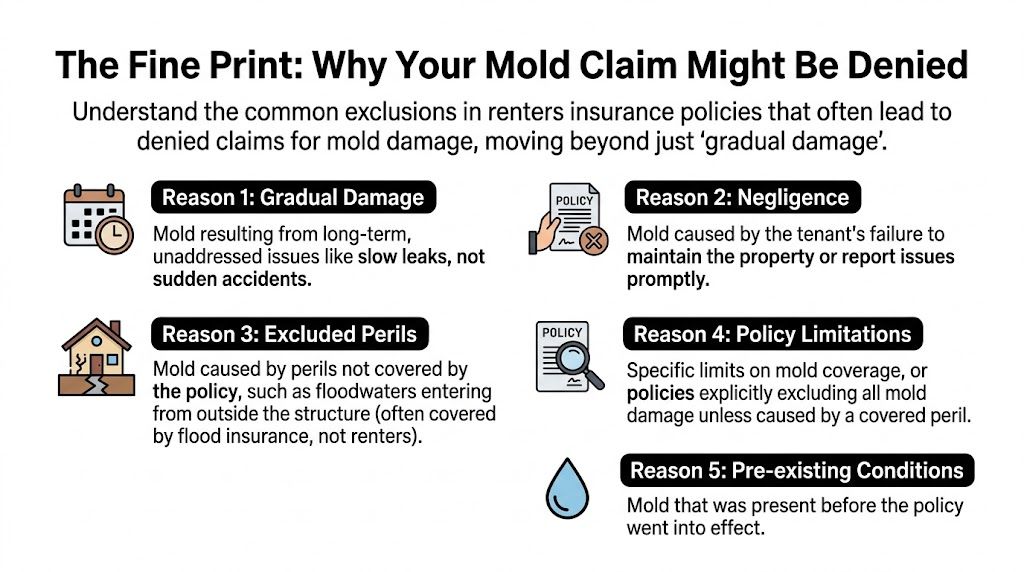
The Fine Print Common Reasons Mold Claims Are Denied
A lot of denied mold claims aren’t denied because the renter did anything reckless. They’re denied because the policy draws hard lines that people don’t notice until after damage appears.
The biggest misunderstanding
Many renters think, “If water caused mold, insurance should cover it.” That sounds reasonable. It’s also where many claims fall apart.
According to the Insurance Information Institute information summarized by Farmers, most renters insurance policies exclude mold caused by neglect or failure to report an issue promptly. The same explanation notes that coverage is generally limited to sudden, accidental events, and mold from floods isn’t covered without separate flood insurance.
Five denial triggers renters should know
- Late reporting: You saw a leak, stain, or damp area and waited too long to notify the landlord.
- Gradual damage: Moisture built up over time from condensation, humidity, or a slow leak.
- Floodwater: Water entered from flooding, which usually requires separate flood coverage.
- Pre-existing mold: The mold was there before your policy applied, or before you moved in.
- Uncovered backup issues: Some water backup events may require separate added coverage.
What “neglect” can look like in real life
Neglect isn’t always dramatic. It can be ordinary delay.
A renter notices paint bubbling behind a couch and assumes it’s old paint. Weeks later, the wall smells musty and belongings inside the closet are damaged. The insurer may argue the condition should have been reported earlier.
Practical rule: If you notice moisture, staining, peeling paint, or odor, report it in writing the same day. Fast reporting protects your health and your claim.
Flood is its own category
Renters mix up leaks and floods all the time. Water from a burst pipe inside the unit is one thing. Water entering from an outside flood event is another.
That distinction matters because standard renters insurance and flood insurance are separate products. If outside floodwater caused the mold, a standard renters policy often won’t respond.
Your Rights and Duties as a California Renter
California renters need to think about mold in two lanes at once. One lane is insurance. The other is habitability.
Your renters policy is mainly about your belongings. The landlord’s responsibility is usually about the building itself.
What belongs to you and what belongs to the landlord
If mold ruins your clothes, mattress, or desk, you look first at your renters policy. If mold is inside the wall, ceiling, or flooring, that’s generally part of the structure.
California Civil Code §1941.1 requires habitable conditions, and mold tied to building maintenance can fall under that duty. That’s why California mold disputes often involve more than a simple insurance claim.
The California split that renters need to understand
Data summarized in this California-focused discussion of mold, renters insurance, and landlord responsibility notes a 28% rise in mold-related tenant complaints in high-humidity coastal areas. The same source says a 2025 study found landlords’ policies cover 70% of structural mold costs when negligence is proven.
Those numbers point to a practical lesson. If walls, ceilings, cabinets, or built-in materials are affected, don’t assume your renters policy is the main solution.
When the landlord’s duty matters most
A few common situations point strongly toward landlord responsibility:
- Roof or window maintenance issues: Water enters because the building envelope wasn’t maintained.
- Plumbing inside walls: The leak isn’t from your belongings or your misuse.
- Ventilation problems in the unit: Bathrooms and kitchens stay damp because the property isn’t properly maintained.
- Pre-existing moisture conditions: The unit had a problem before your tenancy began.
If you want a plain-language overview of what repairs landlords are responsible for in California, that guide is useful for understanding where habitability and maintenance duties usually land.
Your job as the tenant
California law doesn’t erase the renter’s role. You still need to act reasonably.
That means:
- Report leaks fast.
- Keep copies of every written notice.
- Take photos before cleanup.
- Save receipts for damaged property.
- Follow reasonable steps to reduce further damage if it’s safe to do so.
When a mold problem affects both your belongings and the building, you may be dealing with two claims at once. One with your insurer, and one with your landlord or the landlord’s insurer.
Why this matters beyond renters insurance
This same coverage-splitting mindset shows up in other California insurance decisions too. Auto insurance covers your car, not your apartment. Home insurance covers a house differently than a renters policy covers a tenant. Life insurance is different again because it protects income and family finances rather than property. Good coverage planning starts with knowing which policy is supposed to answer which problem.
Your Action Plan The Moment You Suspect Mold
The first few hours matter. Not because mold is always an insurance claim, but because evidence disappears fast once cleanup starts.
Step 1 Take pictures before you touch anything
Use your phone and be methodical. Photograph the stain, the wet area, the floor, nearby furniture, and anything else that shows where the moisture started.

Include wide shots and close-ups. If water is actively dripping, record a short video.
Step 2 Notify the landlord in writing
Text is better than a phone call. Email is even better if it creates a clear timestamp.
Write a short message that says:
- What you found
- Where it is
- When you first noticed it
- Whether water is active right now
Keep the wording simple and factual. Don’t guess at the cause if you don’t know.
Step 3 Stop the immediate damage if it’s safe
If you can safely move a chair, suitcase, or clothing away from moisture, do it. If a shutoff valve is obvious and safe to use, use it.
Don’t tear into drywall or start major cleanup without direction from the landlord or insurer unless there’s an immediate safety reason.
Step 4 Review your policy documents
Pull up your declarations page and policy wording. Look for:
- Personal property coverage
- Deductible
- Water damage wording
- Mold limitations or endorsements
You’re not trying to become an adjuster overnight. You’re checking whether your policy even has a mold sublimit or added protection.
Step 5 Talk to your agent before filing if the situation is unclear
A quick conversation can help you avoid filing a claim that has no path under the policy. It can also help you identify whether this is mainly a landlord habitability issue instead.
Save every message, every photo, and every receipt in one folder on your phone or cloud drive. In mold disputes, organized evidence often matters as much as the damage itself.
Step 6 Make a property list
If your belongings were affected, start a list right away. Include the item, where it was located, and what happened to it.
Examples:
- Winter coat in hallway closet with visible odor or staining
- Books stored under leaking window
- Rug soaked near bathroom doorway
- Shoes in bedroom corner near wet baseboard
You can always refine the list later. Starting early is what matters.
Mold Prevention and Uncovered Health Costs
The best mold claim is the one you never need to make. That’s not a slogan. It’s the reality of how narrow many mold provisions are.
Prevention is cheaper than arguing over cause
Small habits do real work in a rental.
- Run the exhaust fan: Use it during and after showers if your bathroom has one.
- Report drips early: A tiny leak today can become a denied maintenance dispute later.
- Keep air moving: Open windows when conditions allow, and avoid trapping damp air behind heavy furniture.
- Watch problem spots: Windows, under sinks, and exterior-facing walls tend to reveal moisture first.
- Dry wet items quickly: Don’t leave damp bath mats, towels, or clothing piled in corners.
These steps also help you show that you acted reasonably if there’s ever a dispute over neglect.
Insurance gaps renters don’t expect
Many renters focus on property damage and miss the related expenses around mold. Those can be frustrating.
According to this review of mold exclusions, allergy risks, and optional endorsements, renters policies generally exclude mold testing, building remediation, and medical expenses, even when the mold followed a covered peril. The same source notes CDC data showing 20% to 30% of the U.S. population has mold allergies, while optional cleanup endorsements can go up to $10k, but fewer than 20% of policies include them.
What that means in real life
If mold makes you feel sick, your renters policy usually won’t pay for doctor visits or lost wages. If you want an air sample or inspection for peace of mind, that often won’t be covered either.
That gap catches people off guard because the mold may be visible, the symptoms may feel real, and the apartment may clearly need attention. But the policy still separates property coverage from health care and structural repair.
Why prevention is the strongest position
A renter who documents leaks quickly, ventilates the unit reasonably, and keeps written communication with the landlord is in a stronger position on every front.
That helps with:
- Health concerns
- Property reimbursement
- Landlord disputes
- Future renewal conversations
If you want broader plain-language insurance education beyond mold, these California insurance guides can help you compare renters, home, auto, and related coverage decisions without getting buried in policy language.
The biggest mold costs often sit outside the renters policy. Prevention and quick reporting are what protect you from that gap.
Get Clear Answers for Your California Insurance Needs
Mold confuses renters because the answer isn’t just yes or no. It depends on the water source, the timing, the documentation, and whether the damage involves your belongings or the landlord’s building.
If you remember three things, remember these. Mold is usually covered only when it follows a sudden covered event. California landlords still have separate duties when the structure is involved. And written records can make or break the outcome.
That bigger lesson applies across California insurance planning. Auto insurance protects your vehicle. Home insurance protects an owner differently than a renters policy protects a tenant. Life insurance fills a completely different role by protecting the people who depend on your income. When people buy coverage in pieces without reviewing gaps, surprises happen.
Practical prevention matters too. If you want extra reading on moisture control and building habits, this guide on how to avoid mold in your home is a useful companion to the insurance side of the conversation.
For Californians who want a clearer read on renters, auto, home, car insurance, life insurance, wildfire-related concerns, or policy gaps, a one-on-one policy review is often the fastest way to get real answers instead of generic assumptions.
Frequently Asked Questions About Mold and Renters Insurance
Some mold questions are small on the surface but important in practice.
FAQ
| Question | Answer |
|---|---|
| Does renters insurance cover mold damage from a burst pipe? | It may, if the burst pipe is a covered peril and the mold is secondary damage from that sudden event. |
| Does renters insurance cover mold from humidity? | Usually not. Humidity-related mold is often treated as a maintenance or environmental issue rather than a covered loss. |
| Does my renters insurance pay to repair walls and ceilings with mold? | Usually no. Structural remediation is generally part of the landlord’s side, especially in California habitability situations. |
| If mold ruins my furniture, should I call my insurer or landlord first? | Usually both, but start with written notice to the landlord and preserve evidence before making assumptions about coverage. |
| Is mold testing covered? | Often no. Many policies exclude testing and related inspection costs. |
| Are medical bills from mold exposure covered by renters insurance? | Generally no. Renters insurance typically doesn’t cover your doctor visits or lost wages from mold exposure. |
| If I found mold right after moving in, is that my claim? | Often that points to a pre-existing condition or maintenance issue rather than a renters insurance claim. |
| Where can I get answers about policy wording and claim basics? | A good starting point is this California insurance FAQ page, then compare it with your own declarations page and endorsements. |
If you want help sorting out whether a mold issue belongs under your renters policy, your landlord’s responsibility, or both, Mai & Associates can review your coverage and explain the gaps in plain English. The agency helps Californians with renters, auto, home, car, and life insurance, offers multilingual support in English, Spanish, Armenian, Russian, and Vietnamese, and serves clients through offices in Glendale, Westlake Village, Escondido, and Costa Mesa.