Does Insurance Cover Roof Leaks in California?
The quick answer is yes, your homeowners insurance policy will often cover a roof leak. But there's a huge catch: it all comes down to why the roof is leaking in the first place.
If a tree branch smashes through your roof during a wild storm, you’re almost certainly covered. That’s a classic example of sudden and accidental damage. On the other hand, if the leak is from old, brittle shingles that have been slowly failing for years, your claim will probably be denied.
The Golden Rule of Roof Leak Coverage
When homeowners ask, "Does my insurance cover this leak?" the answer always circles back to one core idea: was the damage a surprise, or did it happen because of age and neglect? Insurance is built to shield you from unexpected calamities, not to pay for the routine upkeep your home needs.
Think of your policy as an emergency fund for disasters, not a home warranty for things that naturally wear out.
This distinction is the single most important concept for any California homeowner to grasp. Your home insurance in California policy is there to help you bounce back from a covered peril—an event like a fire, windstorm, or falling object. It’s not there to replace a roof that has simply lived out its natural lifespan.
Sudden Damage vs. Wear and Tear
To have a successful claim, you need to be able to show that the leak started because of an abrupt event. For instance, if powerful winds tear a section of shingles off your roof, letting rain pour in, that’s a clear-cut case of sudden damage. But a slow drip that’s been leaving a stain on your ceiling for months? That’s almost always traced back to something like deteriorated flashing, which is considered a maintenance issue.
This handy infographic breaks down how an adjuster typically thinks through a roof leak claim.
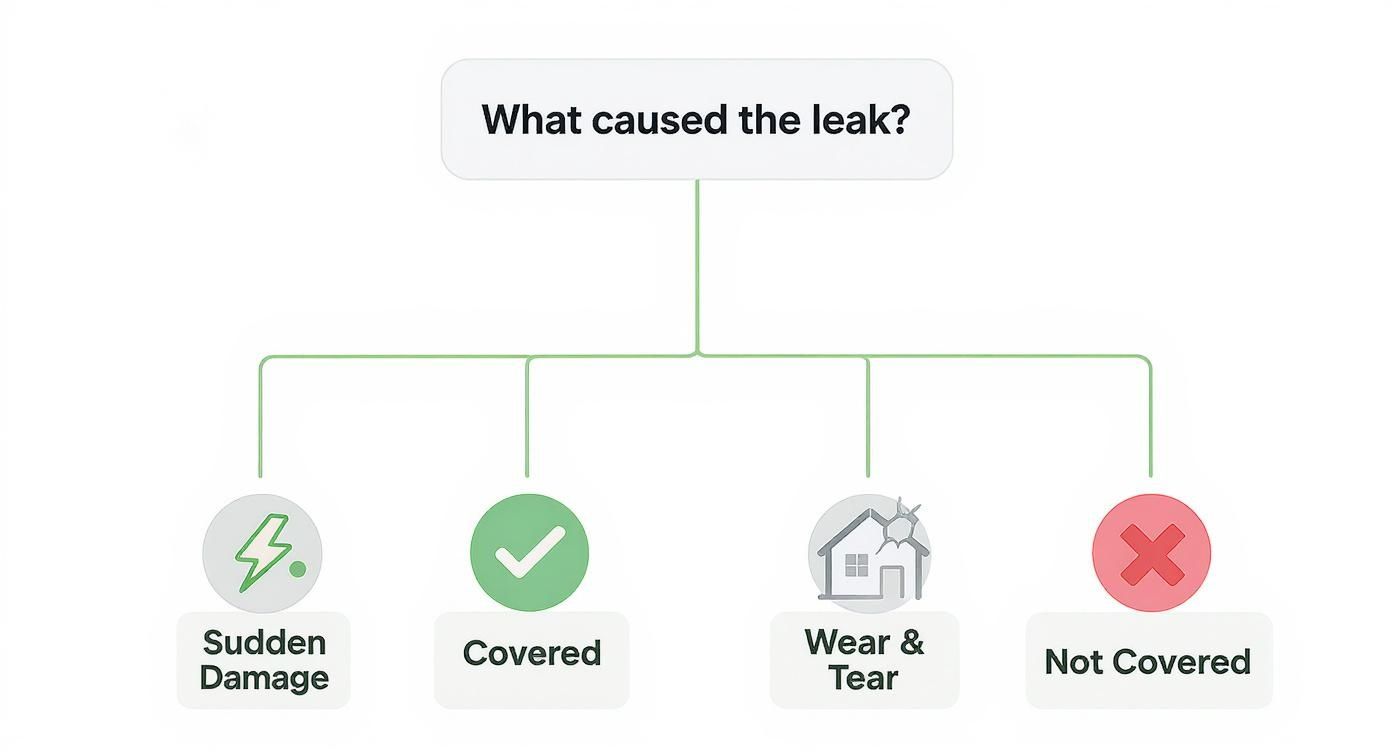
As you can see, the road to an approved claim starts with a sudden, accidental event. The path to a denial usually starts with gradual decay. It's why denial rates for leaks caused by wear and tear are so high—some industry data suggests as many as 70% of these claims get rejected.
To help make this crystal clear, here’s a quick breakdown of common scenarios.
Roof Leak Coverage at a Glance
| Scenario | Typically Covered? | Reasoning |
|---|---|---|
| Tree branch falls on roof during a storm | Yes | The damage was sudden, accidental, and caused by a covered peril (wind/falling object). |
| Shingles are ripped off by high winds | Yes | This is a direct result of a specific weather event (a covered peril). |
| A slow leak from old, cracked shingles | No | This is considered gradual wear and tear and a failure of routine maintenance. |
| Water damage from an ice dam | Often, yes | Most policies cover ice dams as they are considered a specific, sudden event. |
| Leaks around a poorly installed skylight | No | This points to faulty workmanship, which is a standard exclusion. |
| A 25-year-old roof starts leaking | No | The roof has simply reached the end of its expected lifespan. |
Ultimately, it's about being able to point to a specific "moment" when the damage occurred. If you can’t, it’s likely going to be viewed as a maintenance problem you were responsible for preventing.
Sudden Damage vs. Wear and Tear Explained
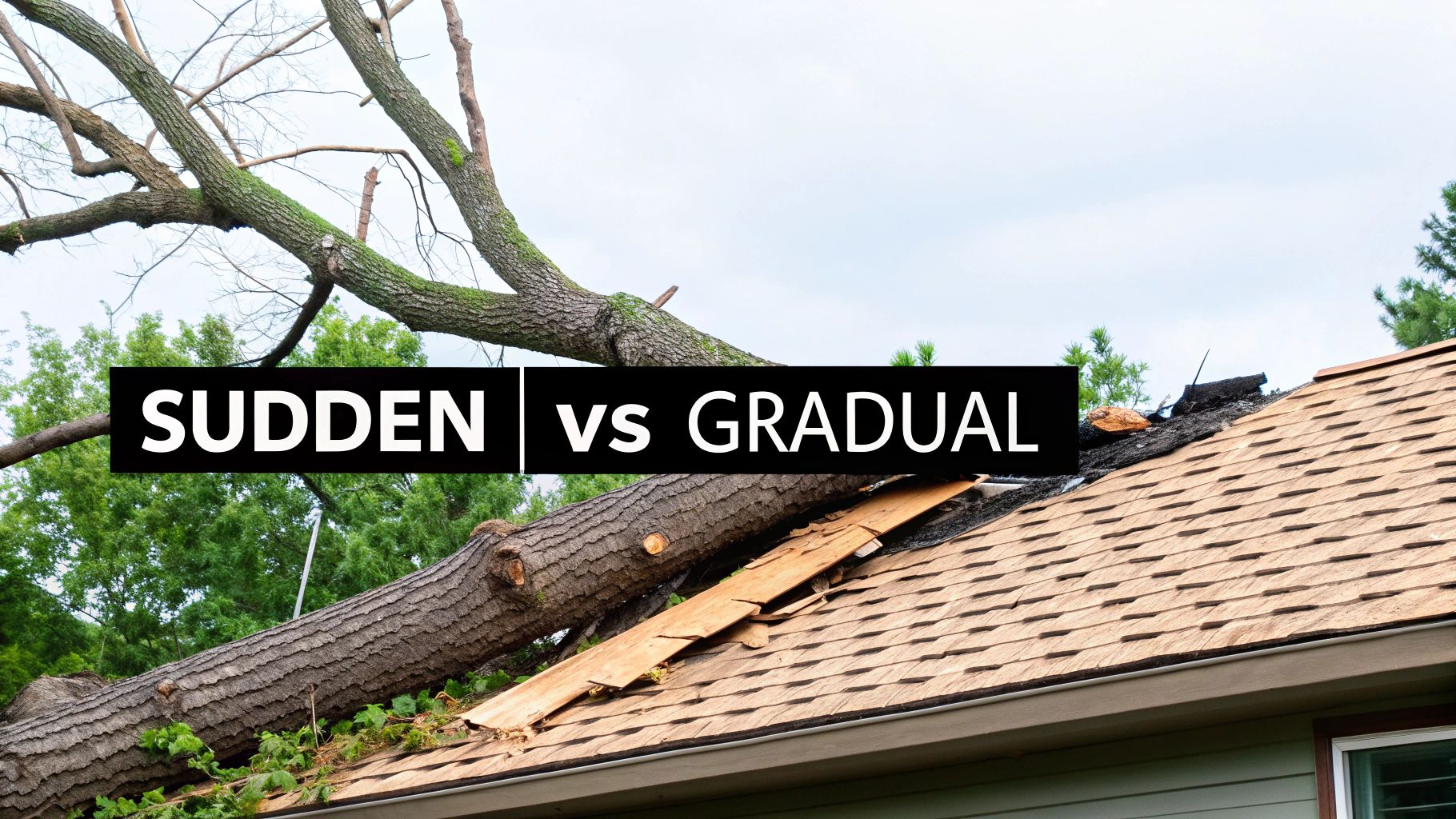
When you file a claim for a leaking roof, the insurance adjuster has one primary job: to play detective. They're trying to figure out if the damage happened all at once in an unexpected event, or if it was the result of a slow, creeping problem that's been developing for years.
This single distinction is the make-or-break factor for almost every roof leak claim. It's what determines whether you're getting a check to help with repairs or a denial letter.
Think of your home insurance as a safety net for unexpected disasters, not a savings account for home maintenance. It’s there for the sudden fall, not the slow decline from old age.
Sudden and accidental damage is a specific, identifiable incident you couldn't have reasonably seen coming. In contrast, wear and tear is just the natural process of things breaking down over time from exposure and use.
The Car Insurance Analogy
Let's put this in terms every Californian understands: car insurance. Say you're on the 405 and a rock flies up from a truck and cracks your windshield. That's a classic case of a sudden, unforeseen event, and your auto insurance will likely cover it.
But what if the rubber seals around that same windshield have been slowly drying out and crumbling for a decade? Then, one day you notice water dripping inside after a car wash. That leak is a direct result of wear and tear—a maintenance issue that was years in the making. Your home insurance policy works on the exact same logic.
A policy covers a roof punctured by a falling tree limb for the same reason it won't cover a 25-year-old roof that has simply reached the end of its useful life. One is an accident; the other is an expectation.
Insurers see routine upkeep as the homeowner's job. Not replacing a worn-out roof is like never changing the oil in your car—you can't be surprised when the engine eventually fails.
Real-World Examples in a California Home
Let’s bring this home to your roof. The why behind the water getting in is everything. An adjuster will always trace the leak back to its origin.
Here’s how it typically plays out:
- Covered (Sudden Damage): A ferocious Santa Ana windstorm rips a whole section of shingles off your roof, and rain pours in. The windstorm is the specific, covered event that caused the immediate problem.
- Not Covered (Wear and Tear): The sealant around your roof vents has turned brittle and cracked after years under the California sun. A small opening forms, letting water seep in bit by bit. That’s a clear-cut maintenance failure.
- Covered (Sudden Damage): A rare but powerful hailstorm pelts your roof, leaving it pockmarked with dents and cracks that cause a leak in the next storm. Hail is a named peril your policy covers.
- Not Covered (Wear and Tear): Moss and algae have been growing on that shady part of your roof for years, trapping moisture against the shingles and causing them to rot. This slow deterioration from a lack of cleaning is a textbook example of gradual damage.
Your policy is designed to put your home back to how it was right before an unexpected event. It's not there to pay for a brand-new roof just because the old one got, well, old.
For more helpful explainers like this, you can explore our various insurance guides covering topics from home to auto insurance at https://cahomeauto.com. This proactive knowledge is your best defense against a denied claim, ensuring you're prepared long before a storm ever hits.
Navigating California's Unique Roof Risks
Living in California means dealing with a unique playbook of risks, from seasonal storms battering the coast to the constant threat of wildfires in the hills. These aren't just abstract threats; they directly affect your home, especially your roof, and how your insurance policy responds when something goes wrong. A standard policy isn't a catch-all, and understanding its quirks is crucial when you live in the Golden State.
When we ask, "does insurance cover this roof leak?" in California, the answer still hinges on why it started. But here, the potential causes are a bit different, and you need to know exactly how insurers see them.
Wildfires and Wind-Driven Rain
Wildfire is, understandably, a top concern for many Californians. The good news is that if flying embers land on your roof and start a fire, the damage is almost always covered. Any water damage that follows, whether from the rain or from the firefighters' hoses, is also typically covered because it’s a direct result of a covered event—the fire.
Then there are the powerful winter storms that bring wind-driven rain. This is where things get a little tricky. If a gust of wind is strong enough to rip shingles off your roof, creating a clear opening for water to get in, you’re likely covered for both the roof repair and the water damage inside.
But what if the rain just... gets in? If heavy rain seeps under perfectly fine shingles simply because of the storm's intensity, coverage gets murky. An adjuster might deny the claim if they can't find proof of direct, physical damage to the roof itself.
The magic word here is "breach." An insurance adjuster is looking for physical proof that the storm broke through your roof's protective layer. Without evidence of torn shingles or damaged flashing, they might chalk it up to a pre-existing maintenance issue, which isn't covered.
The cost of roof damage across the country is massive. In the U.S., homeowners spent nearly $31 billion on roof repairs and replacements, a figure that jumped almost 30% in just two years. More than a quarter of all home insurance claim payouts are for roof problems, and over 50% of those are from wind and hail. You can dig deeper into these trends in Verisk’s detailed report.
The Big Two: Earthquake and Flood Exclusions
While your policy covers a lot, every Californian needs to be aware of two major exclusions: earthquakes and floods. Your standard home insurance or renters insurance policy will not cover damage from either of these events. Period.
If a quake shakes your foundation and cracks your roof, causing a leak, your standard policy won't pay a dime. For that, you need a completely separate earthquake policy, usually from the California Earthquake Authority (CEA) or a private company. It's a huge coverage gap that catches many by surprise.
The same goes for floods. If a nearby river overflows or a storm surge sends water into your home, you'll need a standalone flood insurance policy, typically purchased through the National Flood Insurance Program (NFIP).
When You Can't Get Coverage: The California FAIR Plan
For many people living in high-risk wildfire areas, getting a traditional California insurance policy has become nearly impossible. Insurers are pulling back, leaving homeowners with few options. That’s where the California FAIR Plan steps in. It’s not your typical insurance company; it’s a state-mandated pool designed to be an insurer of last resort.
But it's crucial to understand its limits. The FAIR Plan is basic—it mainly covers damage from fire, lightning, and internal explosions. It does not cover water damage, theft, or liability. So, if a windstorm causes a leak, a standalone FAIR Plan policy won't help you.
To get comprehensive protection, you usually have to pair a FAIR Plan policy with a second "Difference in Conditions" (DIC) policy from a private insurer. This combo helps fill in the gaps to get you closer to the coverage of a standard plan. To get a better sense of how these pieces fit together, check out our complete guide to home insurance in California, where navigating high-risk zones is a common challenge.
Your Step-by-Step Guide to Filing a Roof Leak Claim

That sinking feeling when you spot a water stain spreading across your ceiling is unmistakable. It’s easy to panic, but what you do in the next few hours can make all the difference between a denied claim and a successful one.
Think of yourself as the first responder to an emergency in your home. By taking quick, methodical steps, you can protect your property and build a rock-solid case for your home insurance provider. Let’s walk through the playbook for turning a stressful situation into a manageable process.
Step 1: Stop the Bleeding—Mitigate Further Damage Immediately
Before you even touch the phone to call your agent, your absolute first priority is damage control. Insurance policies require you, the homeowner, to take reasonable steps to prevent the problem from spiraling. Ignoring this can seriously jeopardize your claim.
Your goal here is simple: show the insurance company you acted responsibly to minimize the loss.
- Catch the Water: Get buckets, pans, or waterproof bins under any active drips. This protects your floors, subfloors, and belongings.
- Move Your Stuff: If it's safe, get furniture, electronics, rugs, and any other valuables out of the affected area.
- Apply a Band-Aid: For many, the best immediate action is getting a tarp over the damaged part of the roof. This is a powerful, temporary fix that shows you're serious about stopping more water from getting in.
Remember, this isn’t about making permanent repairs. It’s about triage. Acting decisively here sets the right tone for everything that follows.
Step 2: Become a Detective—Document Everything
Now, it’s time to put on your detective hat. Solid, thorough documentation is the foundation of any successful insurance claim. Memories fade and details get fuzzy, but photos and videos are hard evidence.
Grab your smartphone and start capturing proof before you clean up or move a single thing.
- Shoot Wide, Then Zoom In: Get pictures of the entire room to show the scale of the problem. Then, get close-ups of the water stains, the dripping water, and any damaged drywall or flooring. If you can safely access it, take photos of the roof damage that appears to be the culprit.
- Record a Walk-Through: A short video can be incredibly compelling. Walk from room to room, narrating what you're seeing and when you first noticed it. This creates a clear timeline and connects the interior damage to the source.
- Catalog Your Losses: Take individual photos of every single item damaged by the water, whether it's a warped end table, a soaked rug, or a fried laptop.
This visual diary is your most valuable asset when the claims adjuster arrives. It’s a timestamped snapshot of the moment the damage occurred.
Step 3: Make the Official Call—Notify Your Insurer Promptly
With your initial evidence gathered, it's time to get your insurance company in the loop. Don't put this off. Nearly every policy has a clause that requires you to report claims in a "timely manner."
When you call your agent or the carrier's claims hotline, have your policy number ready. Give them a clear, factual account of what happened. If a specific event, like a major windstorm, caused the leak, be sure to mention it. This helps frame the damage as a sudden and accidental event.
One of the biggest mistakes we see is homeowners waiting too long to report a leak. A delay can make it much harder to prove the damage wasn't a slow, long-term problem. Quick reporting shows you're on top of it.
After that first call, you’ll be assigned a claims adjuster who will be your main point of contact. They'll schedule an inspection and walk you through the specifics. If you have general questions about your home insurance or auto insurance, you can always check our resources for quick answers.
Step 4: Get Your Ducks in a Row—Prepare for the Adjuster
While you wait for the adjuster's visit, use the time to gather any paperwork that can bolster your claim. The more organized you are, the smoother and faster the process will be.
This is where being a proactive homeowner really shines. Having maintenance records on hand is a great way to push back against any argument that the damage was due to neglect.
To help you stay organized, we’ve put together a quick checklist. Having these items ready will show the adjuster you’re serious and help them do their job more efficiently.
Your Roof Leak Claim Documentation Checklist
| Document/Action Item | Why It's Important | Pro Tip |
|---|---|---|
| Photos & Videos | This is your undeniable "before" picture of the damage. | Enable date and time stamps on your phone's camera. Keep everything in a dedicated digital folder. |
| Maintenance Records | Proves you've cared for your roof, countering potential "wear and tear" exclusions. | Dig up receipts for past roof repairs, inspections, or even professional gutter cleanings. Every little bit helps. |
| Original Roof Info | Helps the adjuster accurately determine the age and material for calculating the replacement cost. | If you have it, find the contract or receipt from the last time the roof was installed or replaced. |
| Written Damage List | An organized inventory ensures no damaged items are forgotten during the assessment. | Create a simple spreadsheet listing both structural damage (drywall, paint, flooring) and personal belongings. |
Coming to the meeting with this information in hand not only speeds things up but also demonstrates that you're a responsible partner in the claims process.
Why Roof Leak Claims Get Denied and How to Avoid It
Understanding why an insurance company might say "no" to your roof leak claim is the single best tool you have for getting them to say "yes." A denial always feels frustrating, but it’s rarely a random decision. Most of the time, claims are rejected for a few common, and frankly, preventable reasons.
If you can spot these pitfalls ahead of time, you can stop being reactive and start being proactive. It's about building a rock-solid case for your claim long before the first drop of water ever hits your ceiling.
The Top Reasons for a Denial
When an adjuster denies a claim, they're usually pointing to one of three things: the damage happened slowly over time, you waited too long to report it, or you hired the wrong person for the job. These all come back to a core principle of insurance: it’s for sudden, unexpected events.
Let's unpack the most common reasons for a denial and, more importantly, what you can do about them.
- Pre-existing Damage and Neglect: This is, by far, the biggest claim-killer. If an adjuster finds old, weathered shingles, cracked seals that have been there for years, or just general signs of wear and tear, they’ll chalk the leak up to a maintenance issue, not an accident.
- Late Reporting: Waiting weeks or months to call your insurance company is a huge red flag. It makes it incredibly difficult to connect the leak to a specific event, like a recent storm, and signals to the insurer that the problem wasn't really an emergency.
- Lack of Documentation: Without photos or videos from the moment you found the leak, your claim becomes a "he said, she said" situation. A claim with no proof is a weak claim.
Proactive Strategies to Protect Your Claim
You don't have to wait for a disaster to put yourself in a strong position. A few simple, consistent habits can build a powerful defense against a potential denial. Think of it as an investment in your home and your peace of mind.
A little foresight makes all the difference.
A well-maintained home with clear records transforms a questionable claim into a straightforward approval. It's about showing you've done your part as a responsible homeowner.
1. Conduct Routine Roof Inspections
You don’t have to climb up there yourself. Just grab a pair of binoculars and do a quick visual check from the ground twice a year—I recommend spring and fall. Look for anything obvious: shingles that are curling, cracked, or completely missing. And don't forget to poke your head in the attic to look for water stains or damp spots.
2. Keep a Simple Maintenance Log
This sounds more intimidating than it is. Just create a folder on your computer or get a physical binder to stash receipts and notes for any work you do on your home. This should include:
- Receipts for professional roof repairs or inspections.
- Invoices for things like gutter cleaning.
- A quick note with the date you did your own visual inspection and what you saw.
This log becomes your proof that you’ve been taking care of your property.
3. Understand Your Policy Exclusions
Seriously, take 30 minutes and read the "Exclusions" section of your home insurance or renters insurance policy. Knowing exactly what isn't covered—like faulty workmanship from a bad contractor or damage from pests—will stop you from filing a claim that’s doomed from the start.
The Danger of Storm-Chasing Contractors
After a big storm rolls through, you’ll often see contractors blanketing the neighborhood, going door-to-door offering "free" inspections and promising to handle everything with your insurance company. Be very careful here. While many are legitimate, some are just looking to make a quick buck and can put your claim—and you—in jeopardy.
Insurance fraud is a massive problem. The FBI estimates that fraudulent roof damage claims cost the industry at least $1 billion a year in the U.S. alone. That cost gets passed on to everyone, driving up premiums for both home insurance and car insurance. You can learn more about how these inflated claims affect the insurance market by reading reports from industry experts.
Your safest bet is always to work with a vetted, local professional. They have a reputation in your community to protect and are far more likely to give you an honest assessment of the real, verifiable damage.
Here is the rewritten section, designed to sound completely human-written and natural:
How a California Insurance Agent Can Help
Let’s be honest: trying to decipher an insurance policy on your own, especially when water is dripping from your ceiling, is a nightmare. While you can get a quick quote online, nothing beats having a real person in your corner who knows the ins and outs of California’s tricky insurance market. Think of an independent agent as your personal guide, helping you understand your coverage long before you ever have to use it.
Their job isn't just to sell you a policy and disappear. A great agent digs into your current home insurance, hunting for dangerous gaps you might not know exist. They'll make sure your coverage limits are high enough to handle California's steep rebuilding costs and walk you through how your specific policy handles local risks.
Your Advocate in a Complex Market
The real value of an agent shines through when things get messy. They're the person you call when you need to:
- Bundle Policies for Better Protection: An agent sees the whole picture. They'll look at your auto insurance, renters insurance, and even life insurance to find discounts and make sure all your policies are working together, not against each other. It’s a holistic approach that prevents costly blind spots.
- Navigate the Claims Process: When a leak happens, your agent should be your first call. They can give you practical advice on how to document the damage and what to say to the claims adjuster, basically coaching you through the entire process.
- Find Specialized Coverage: Living in a high-risk area? Your agent can explain specialized options like the California FAIR Plan for fire risk or a separate earthquake policy. They'll help you secure the right protection for the threats you actually face.
An experienced agent isn't just looking for the cheapest premium; they're looking for the right protection. Their goal is to build a real relationship, making sure your car insurance, your home, and your family are truly shielded from a financial disaster.
Frequently Asked Questions About Roof Leaks & Insurance
Once you’ve got the basics down, the real-world questions start popping up. Let's be honest, dealing with a surprise roof leak is stressful enough without having to decipher confusing insurance jargon. So, let's walk through some of the most common situations we see California homeowners and renters run into.
Getting a handle on these scenarios now can save you a world of headache later. While the nitty-gritty details will always come down to your specific home insurance or renters insurance policy, the core concepts are pretty consistent across the board.
What if My Insurer Only Wants to Repair Part of My Roof?
This is a big one, and it causes a lot of frustration. It’s important to remember that your insurance company’s job is to bring your roof back to the condition it was in before the damage happened, not to upgrade you to a brand-new one. If a tree branch punched a hole in one section and that section can be patched, that's likely all your policy will cover.
But it’s not always so black and white. A full replacement could be on the table if:
- The damage is extensive and affects several areas of the roof.
- The original shingles or tiles are no longer manufactured, making it impossible to find a perfect match for the repair.
That "matching" issue can be a powerful argument for a full replacement, but it really hinges on the specific language in your policy and sometimes even local California building codes.
Does My Renters Insurance Cover a Leaky Roof?
This is a critical point for anyone who rents. Your renters insurance is there to protect your stuff, not the building you live in. The roof, the walls, the plumbing—that's all on your landlord and should be covered by their own property insurance.
So, if a sudden leak soaks your couch and fries your laptop, your renters policy is what you’ll use to replace those personal items (after you pay your deductible, of course). It can also help with temporary living expenses if the damage is so bad you have to move out during repairs. But it will never pay to actually fix the hole in the roof.
Simple rule of thumb: Renters insurance covers what you'd pack in a moving truck. The landlord's policy covers the truck itself—and the building it's parked at.
Can a Claim Be Partially Approved?
Absolutely. In fact, it happens all the time. Let’s say a leak starts because your shingles are 25 years old and have simply worn out. That’s a maintenance issue, and your insurer will almost certainly deny the claim to replace the old shingles.
But here’s the twist: many policies will still cover the resulting damage inside your home, as long as the leak was sudden and you acted quickly to stop it from getting worse. So in this case, your home insurance won't pay for a new roof, but it very well might pay to replace the water-stained ceiling and buckled hardwood floors below. This is a crucial detail that can save you thousands, so it's always worth checking your policy for that specific language.
Trying to figure all this out on your own can feel overwhelming. That’s where having an expert on your side makes a real difference. The licensed agents at Mai & Associates can look over your current home insurance, auto insurance, and life insurance policies to find any risky gaps and make sure you’re properly protected. For a no-obligation quote and the confidence that comes from a solid California insurance plan, visit us at https://cahomeauto.com to get started.