What does homeowners insurance cover mold? A California guide
"Does homeowners insurance cover mold?" It's a question I hear all the time from California homeowners, and the answer is a frustrating 'it depends.'
The truth is, coverage isn't really about the mold itself. It’s about how the mold got there in the first place. If a sudden and accidental covered event—like a pipe bursting behind your drywall—causes the mold, you’re likely covered. But if it's the result of a slow leak you never fixed or just general poor maintenance, you're probably on your own. This distinction is crucial for anyone managing their home insurance in California.
The Complicated Truth About Mold and Your Home Policy
For any California homeowner, finding mold is a nightmare. You’re immediately thinking about your family's health, your property's value, and the huge potential cost of getting rid of it. This is where a major misunderstanding about home insurance pops up.
A homeowners policy is designed to be your safety net for unexpected disasters, not a substitute for a home maintenance fund. That distinction is everything when it comes to whether an insurer will pay a mold claim.
Think of it this way: your policy is like an emergency response team. It’s there for a sudden crisis, like when your washing machine hose blows and floods the laundry room. The water damage is a covered peril, and the mold that grows as a direct consequence of that incident is usually covered, too. But that team isn't going to respond to problems that have been brewing for months or years, like mold from a perpetually steamy, unventilated bathroom. That’s considered a maintenance issue. Understanding this is key to getting the most from your California insurance portfolio.
Sudden Disaster Versus Gradual Damage
Getting your head around this difference is the key. Insurers draw a very firm line here because one scenario is an unforeseen accident, while the other is often preventable with basic upkeep. Not fixing a dripping faucet or ignoring a growing water stain on the ceiling is seen as neglect from the insurer's perspective, and it's a fast track to a denied claim.
This flowchart can help you visualize how it works.
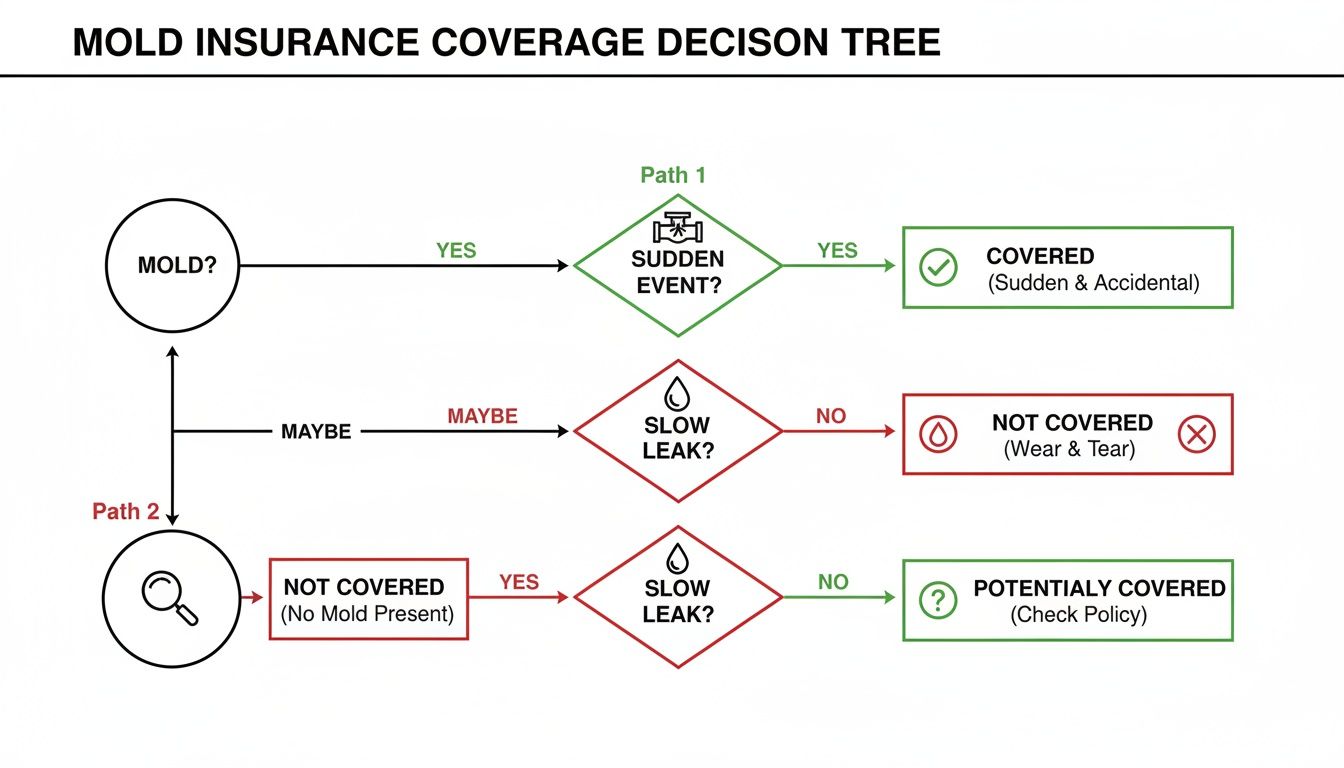
As you can see, the path to coverage almost always starts with a sudden water event. A gradual problem? That’s typically a dead end.
To simplify this, let's break down some common scenarios.
Quick Guide to Mold Coverage
| Cause of Mold | Is It Usually Covered? | The Core Reason |
|---|---|---|
| Burst pipe or appliance hose | Yes | The damage was caused by a sudden, accidental event that is a "covered peril." |
| Water from extinguishing a fire | Yes | The mold is a direct result of damage from a covered event (the fire). |
| Leaky roof after a storm | Yes | Storm damage is typically a covered peril, and the resulting water damage is covered. |
| Persistent high humidity | No | This is considered a maintenance issue related to poor ventilation. |
| A slow, long-term pipe leak | No | The damage is gradual and not sudden, pointing to a lack of maintenance. |
| Groundwater seepage or floods | No | Standard policies exclude flood damage. A separate flood policy is needed. |
This table makes it clear: the why behind the water is what really matters to your insurance company.
This isn't just a technicality; it has huge financial consequences. A serious mold remediation project can easily run upwards of $10,000. Facing that bill out-of-pocket after a claim denial is devastating. That’s why you absolutely need to know what’s in your policy.
You can learn more about finding the right home insurance in California to ensure you're protected from the most common risks here. Working with an experienced agent is the best way to spot these kinds of gaps before you have a claim.
When Your Homeowners Insurance Will Cover Mold Damage
So, what's the bottom line? When does your homeowners insurance actually cover mold, and when are you stuck with the bill? It all comes down to a simple but critical idea: the mold has to be the direct result of a sudden and accidental water problem that your policy already covers.
Essentially, your insurance isn’t covering the mold itself. It’s covering the consequences of a bigger, insurable event.
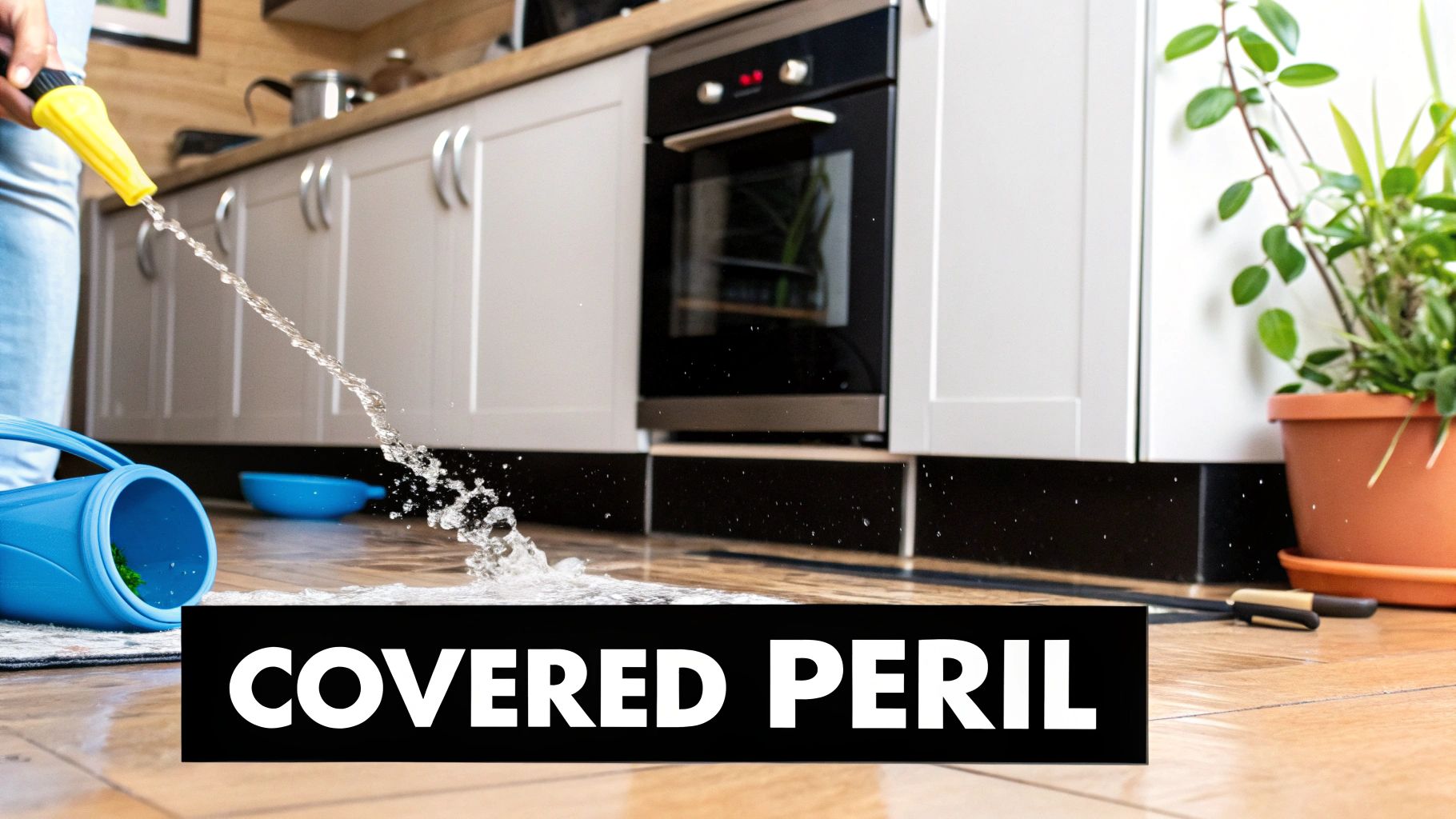
Think of it as a domino effect. The first domino to fall must be what insurers call a "covered peril"—an incident your policy is specifically designed to protect you from. If that first domino is covered, the ones that fall after it, including the mold, usually get covered too.
And this is a massive issue for homeowners. In 2022, water damage and the mold that follows accounted for a whopping 27.6% of all homeowners' insurance losses across the country. That number really shows how often this happens, especially in states like California where things like plumbing failures or water damage after a wildfire are all too common. You can explore more national insurance trends to get the full picture of what homeowners are facing.
Clear Examples of Covered Mold Damage
Let's make this real. Here are a few common scenarios where your policy would most likely kick in to cover mold remediation. Notice the pattern: the water showed up out of nowhere and happened fast.
A Burst Pipe: A pipe inside a wall freezes and suddenly bursts, flooding your kitchen. Your policy would typically cover the repairs to the drywall and floors, plus the cost to remove any mold that grows from the moisture, because a burst pipe is a covered event.
Appliance Malfunction: The hose on your washing machine gives out without warning, turning your laundry room into a swimming pool. The cleanup and any mold that sprouts in the damp walls behind the machine would generally be covered.
Water from Extinguishing a Fire: Imagine firefighters douse a kitchen fire, saving your home but soaking your cabinets and walls. Since the fire is a covered peril, the resulting water damage and any subsequent mold are also covered.
Leaking Roof After a Storm: A nasty windstorm blows a section of shingles right off your roof, letting rain pour into your attic. The water damage and mold that follows are almost always covered because the storm was the initial covered event.
The golden rule is this: If the source of the water was sudden, accidental, and caused by an event your policy covers, the mold that grows from it is generally covered. It's the symptom, not the disease.
The Critical Role of Sub-Limits
Now for the fine print. Even when your policy does cover mold, you need to be aware of coverage sub-limits. This is a hard cap on how much your insurance company will pay for a specific type of claim, no matter what the final repair bill looks like.
For mold, these sub-limits can be surprisingly low. Many standard policies cap mold remediation at just $5,000 or $10,000. If you're dealing with a serious mold infestation, the cost to fix it can easily blow past that limit, leaving you to pay the rest out of your own pocket.
This is exactly why simply "having mold coverage" isn't the full story. You need to know your number. An experienced agent can dive into your policy, find those sub-limits, and help you figure out if that amount is enough to protect you or if you should look into an endorsement for higher limits. This level of detail is vital for managing all types of policies, from car insurance to life insurance.
Understanding Common Mold Exclusions in Your Policy
Knowing when your policy covers mold is one thing, but it’s just as important—if not more so—to understand when it won't. This is the fine print where so many homeowners, from Glendale to Escondido, get tripped up. Think of your insurance policy as a shield for unexpected disasters, not a maintenance contract for your home.
That core idea is behind most denied mold claims. Insurance is designed to protect you from sudden and accidental damage. If mold appears because of a slow, gradual issue you could have prevented, the cleanup costs will almost certainly fall on your shoulders.
The Maintenance and Neglect Exclusion
By far, the most common reason for a denied mold claim is what insurers call "neglect" or "poor maintenance." They expect you to keep your home in good shape. If you don't, they aren't obligated to pay for the resulting damage.
Imagine a tiny, slow drip under your kitchen sink. If you spot it and fix the pipe, that’s just routine home maintenance. But what if you ignore it for months? That slow drip saturates the cabinet, seeps into the drywall, and suddenly you have a serious black mold problem. Your insurer will likely deny the claim, arguing that the real issue wasn't the drip itself, but the failure to address it.
Here are a few classic examples of maintenance-related mold that your policy almost certainly will not cover:
- Old, Leaky Roofs: A roof that’s been slowly wearing out for years finally gives way, letting water in and causing mold to grow in your attic.
- Constant Humidity: Mold creeping up the walls in a bathroom that’s always steamy and never properly ventilated.
- Foundation Issues: Water gradually seeping through tiny cracks in your foundation, creating a damp basement that becomes a perfect breeding ground for mold.
- Window Condensation: Mold forming around window frames because of long-term condensation that was never dealt with.
Most policies have specific language excluding mold that could have been prevented. That’s why understanding how to avoid mold in your basement and taking proactive steps is your best defense against a denied claim.
The Flood Water Exclusion
Here’s another point of confusion that trips up homeowners: the difference between water damage and flood damage. In the insurance world, they are two completely different things, and this distinction is crucial.
A standard homeowners insurance policy—whether for a house in Los Angeles or a condo in San Diego—does not cover damage from flooding. That includes any mold that grows as a result of a flood.
Flooding is specifically defined as water that comes from a natural source and inundates land that is normally dry. Think of events like:
- A nearby river overflowing its banks.
- Coastal storm surges pushing inland.
- Heavy, pooling rains that overwhelm drainage systems.
For your home to be protected from flood-related mold, you need a separate flood insurance policy, usually from the National Flood Insurance Program (NFIP) or a private carrier. Without it, you’re on your own for the staggering costs of flood cleanup and mold remediation. If you're foggy on what your policy covers, our insurance glossary of terms can help clear things up.
Other Common Exclusions
Beyond maintenance and floods, a few other scenarios are typically left out of standard mold coverage. Construction defects are a big one. If your builder installed the plumbing incorrectly or used a faulty vapor barrier that led to mold, your insurer will likely say the builder is liable, not them.
Likewise, mold that results from earth movement, like an earthquake that cracks a pipe, isn't covered by a standard policy. You’d need a separate earthquake insurance endorsement for that. Recognizing these gaps is the first step toward making sure you have the right protection in place.
Understanding Mold Coverage Limits and Endorsements
Finding out your homeowners insurance might help with a mold problem after something like a pipe bursts can feel like a huge weight off your shoulders. But don't get too comfortable just yet—the devil is truly in the details. Most standard policies put a strict, and often surprisingly low, cap on what they’ll actually pay for mold cleanup.
This is where the term “coverage sub-limit” comes into the picture. A good way to think about it is to imagine your total home insurance as a big pool of money. For most covered damage, you can dip into that pool for whatever you need, up to your main policy limit. But for mold, your insurer hands you a tiny little bucket.
That little bucket is your sub-limit, and it’s the absolute maximum your policy will pay for mold remediation, no matter how high the actual bill climbs.
What Are Coverage Sub-Limits, Really?
These sub-limits can be a real shocker. It's common for a standard California home insurance policy to cap mold remediation payouts at just $5,000. While that might seem like a decent chunk of change, a serious mold issue that has worked its way behind your drywall or into the HVAC system can easily run you $15,000 to $30,000, or even more, to properly fix.
A low sub-limit can leave you on the hook for a massive bill, even when the mold was triggered by a covered event. This is one of the most common and expensive blind spots homeowners discover when filing a claim.
Insurers see mold as a maintenance problem, which is why they rarely offer broad, open-ended coverage for it. When it is covered as part of another claim, it’s usually capped at that $5,000 limit or something similar. As you can see from how standard mold coverage often falls short, simply having "mold coverage" on your policy is not enough. You have to know precisely how much that coverage is worth.
Boosting Your Protection with a Mold Endorsement
So what’s the fix if that tiny bucket of coverage just won't cut it? The answer is a mold rider, also known as an endorsement. Think of it as an optional upgrade you can add to your policy to beef up your financial protection against mold damage.
An endorsement typically works in one of two ways:
- It raises your sub-limit: Instead of being stuck with the standard $5,000, you could increase your coverage to a much safer amount, like $25,000 or $50,000.
- It broadens your coverage: In some cases, a special endorsement might cover mold in situations that your base policy would normally exclude.
Let's walk through a real-world example. Imagine a frozen pipe bursts inside a wall of your Westlake Village home over the winter. This leads to major water damage and, before you know it, a serious mold infestation. The quote to tear out the damaged walls, remediate the mold, and rebuild comes in at $22,000.
- Without an Endorsement: Your standard policy has a $5,000 sub-limit. The insurance company cuts you a check for that amount, and you're left to pay the remaining $17,000 yourself. Ouch.
- With an Endorsement: You were proactive and added a mold endorsement that raised your limit to $25,000. Your policy now covers the entire $22,000 repair bill. That foresight just saved you from a huge financial hit.
This shows just how critical an endorsement can be. A small addition to your premium can provide an enormous safety net. The best way to figure out what you need is to talk it over with an agent at Mai & Associates. We can help you look at your home’s specific risks and find the right coverage to close those dangerous gaps in your policy.
Your Step-by-Step Guide to Filing a Mold Claim in California
Finding mold in your home is a gut-wrenching experience. It's stressful, and the path forward can feel murky. But having a clear plan of action can make all the difference, especially when it comes to your insurance claim.
Let’s walk through the exact steps you need to take. Following this process will not only help you manage the immediate problem but also significantly improve your chances of a successful claim.
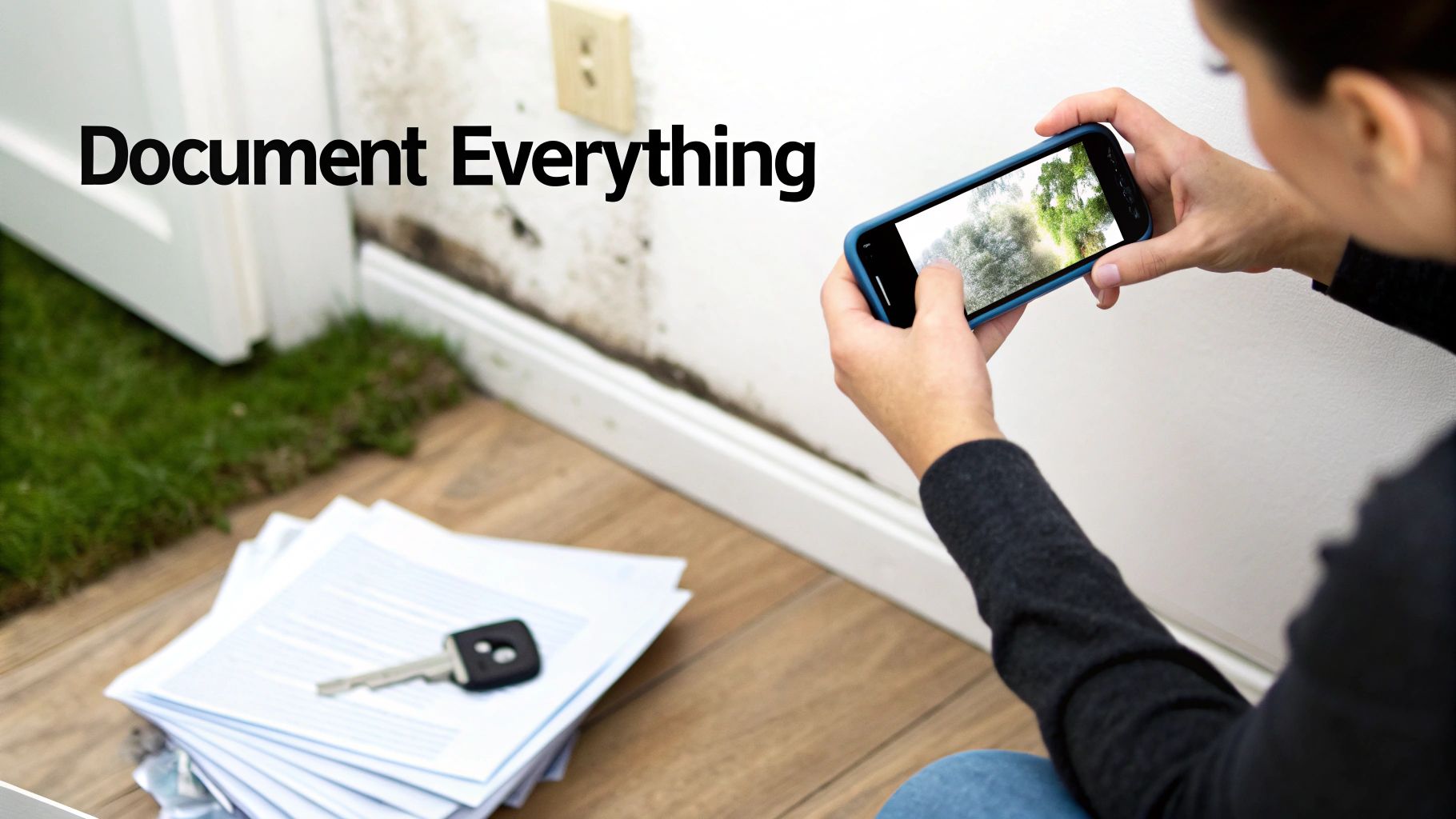
Think of filing a claim as building a case. It’s more than just a quick phone call; it’s about methodically proving what happened.
Step 1: Stop the Source and Prevent More Damage
Before you do anything else, you have to stop the bleeding. Your insurance policy requires you to take reasonable steps to mitigate further damage—and frankly, it’s just common sense. This isn't just a suggestion; it's a core responsibility of the homeowner.
If a pipe just burst, find the main water valve and shut it off. Fast. If your roof is leaking during a storm, get a bucket under the drip and a tarp over the hole. Acting immediately shows your insurer that you're being responsible, which is crucial. They can, and often do, deny claims if they feel your delay made a bad situation worse.
Step 2: Document Everything Thoroughly
Now, put on your detective hat. Before you clean or move anything (beyond what was necessary to stop the leak), document the scene like a pro. Your smartphone is your best friend here.
Here’s your evidence-gathering checklist:
- Take Photos and Videos: Get pictures of the mold and the water source from every angle—close-ups, wide shots, everything. Videos are gold for showing the scale of the problem, especially if you can capture water actively dripping.
- Write It All Down: Make detailed notes. When did you first spot the leak? What do you think caused it? Jot down the date, time, and every room that was affected.
- Keep Your Receipts: Did you run to the hardware store for a tarp or call an emergency plumber? Save every single receipt. These expenses are often reimbursable as part of your claim.
Think of this documentation as the evidence you're presenting to a jury. The more detailed and organized it is, the stronger and more straightforward your claim will be when the adjuster takes a look.
Step 3: Notify Your Insurer Immediately
Don’t wait on this. As soon as you’ve stopped the immediate threat and have your initial photos, call your insurance agent or the carrier's claims department. Most companies have 24/7 hotlines for exactly this reason.
Have your policy number handy and give them a clear, simple summary of what happened. They'll give you a claim number and assign an adjuster to your case. Prompt notification is a standard condition in every policy, and it gets the ball rolling on the right foot.
Step 4: Prepare for the Adjuster's Visit
The insurance adjuster is the person from the insurance company who inspects the damage to figure out the cause and the repair costs. You want this visit to be as productive as possible.
Get all your documentation—photos, videos, notes, and receipts—organized and ready to go. When the adjuster arrives, walk them through the damaged areas and calmly explain what happened. Be honest and stick to the facts. Don’t be shy about pointing out damage you think they might have overlooked. For more detailed insights into what local policies cover, you can find great resources on home insurance in Los Angeles and the broader Southern California region.
Especially in complex situations—like water damage after wildfires or issues from atmospheric rivers—having an independent agent from Mai & Associates on your side can be a huge advantage. We act as your advocate, helping you communicate effectively with the adjuster and ensuring your claim is handled fairly based on the specific language in your policy.
Your Top Questions About Mold and Insurance, Answered
When you're staring at a potential mold problem, the last thing you want is a confusing insurance policy. Let's cut through the noise and tackle the most common questions California homeowners have about mold, their insurance, and what to do when you find it. This applies to homeowners, but the principles of sudden vs. gradual damage are important for understanding renters insurance as well.
Does a California FAIR Plan Policy Cover Mold Damage?
In short, no. A standard California FAIR Plan (CFP) policy is really just basic fire insurance. Think of it as the absolute bare minimum, designed as a last resort for homes in high-risk areas. It won't cover water damage or the mold that almost always follows.
To get that kind of protection, you need to supplement your FAIR Plan with something called a "Difference in Conditions" (DIC) policy. This separate policy "wraps around" your fire coverage, filling in the gaps for things like burst pipes and other water-related disasters. An independent agent is your best bet for finding the right DIC policy to make sure you're truly protected.
How Much Does Extra Mold Coverage Cost in California?
There's no single price tag for a mold endorsement in California—it really depends. The cost is based on your insurance carrier, how much coverage you want (say, bumping it from $5,000 to $50,000), where you live, and your past claims.
You could be looking at anywhere from $50 to a few hundred dollars extra per year. While nobody loves another bill, it's a small price for some serious peace of mind, especially when you consider that a major mold cleanup can easily run into the tens of thousands. The only way to know for sure is to get a personalized quote.
Is Mold From a Leaky Appliance Covered by Insurance?
This is a big one, and the answer always comes down to why it leaked.
Picture this: your washing machine hose suddenly explodes, flooding the laundry room. The resulting water damage and any mold that grows from it? That's almost always covered because it was a "sudden and accidental" event. It’s exactly what insurance is for.
But if a slow, steady drip from that same hose goes unchecked for months, leading to a massive mold colony behind the machine, your claim will likely be denied. Insurers see that as a maintenance issue, not an accident. This highlights why staying on top of home upkeep is so critical; learning how to detect water leaks early can be a real lifesaver for both your home and your wallet.
What Should I Do If My Insurer Denies My Mold Claim?
Getting a denial letter is frustrating, but don't give up. The first thing you need to do is read that letter carefully. The insurance company is required to point to the exact language in your policy that justifies their decision.
If you think they've made a mistake, you can—and should—appeal. Pull together all your evidence: photos, contractor estimates, inspection reports, and any other documentation. Then, call your insurance agent. A good agent can be your best advocate, helping you navigate the appeals process.
If an appeal doesn't get you anywhere, you can bring in a public adjuster or file a complaint with the California Department of Insurance. And remember, renters often run into similar issues with property damage, where understanding the policy details is just as important. For more on that, check out our guide on renters insurance in California.
Protecting your home from threats like mold begins with having the right insurance partner on your side. At Mai & Associates, our licensed agents specialize in reviewing policies for California homeowners to find and fix those hidden, dangerous coverage gaps. Whether you need to add a mold endorsement, track down the right DIC policy for your FAIR Plan, or just want to compare rates for your home insurance, auto insurance, or life insurance, we're here to provide clear, expert guidance. Don't wait for a disaster to find out you weren't properly covered.