Does Homeowners Insurance Cover Foundation Problems in California?
That sinking feeling you get when you spot a crack snaking up your wall or find a door that just won’t close properly is a universal homeowner fear. Your mind immediately leaps to the worst-case scenario: foundation trouble. And the very next question is always, does homeowners insurance cover foundation problems?
The short answer is frustratingly vague: it depends. The long answer is that coverage almost always hinges on whether the damage was sudden, accidental, and caused by a specific event your policy covers. In California, understanding the nuances of your home insurance policy is critical.
The Unsettling Truth About Foundation Coverage
For most California homeowners, figuring out what their policy actually covers can feel like trying to solve a puzzle in the dark. Your home’s foundation is its literal bedrock, but insurance policies are incredibly specific about what they will and won't pay for. The critical distinction always comes down to the cause of the damage, not just the existence of the damage itself.
Think of it this way: your policy is meant to be a safety net for unexpected disasters, not a long-term warranty against the slow march of time. If a covered event, like a house fire or a major plumbing line suddenly bursting, damages your foundation, you're likely in the clear. But if the cracks are from gradual soil settling, shoddy construction from decades ago, or just general wear and tear, you'll probably have to foot the repair bill yourself. This principle applies across various types of California insurance, from home insurance to renters insurance.
Covered Perils Versus Common Exclusions
Most homeowners in the U.S. have a standard policy known as an HO-3. In fact, the National Association of Insurance Commissioners (NAIC) reports that the HO-3 form accounts for nearly 80% of owner-occupied home insurance policies. This policy type is built around covering damage from specific, named events called "perils."
This is precisely why a sudden pipe collapse that washes out the soil under your house is often covered, while slow-moving, expansive soil shifting your foundation over years is not. Understanding this difference is especially important for us here in California, where unique environmental factors are always at play.
Your homeowners insurance is a shield against sudden accidents, not a warranty against the effects of aging or environmental changes. Understanding this core principle is the first step to knowing your real coverage.
Foundation Damage Coverage at a Glance
To make this a bit more concrete, let's walk through a few common scenarios. The table below breaks down what a standard California home insurance policy is likely to cover versus what it will almost certainly exclude.
| Cause of Foundation Damage | Typically Covered? | Why or Why Not? |
|---|---|---|
| Sudden pipe burst eroding soil | Yes | The damage is from a sudden, accidental, and covered peril (water damage). |
| Gradual soil settling over years | No | This is considered a maintenance issue or wear and tear, which is a standard exclusion. |
| Earthquake or earth movement | No | Earth movement is a specific exclusion and requires a separate earthquake insurance policy. |
| Damage caused by a house fire | Yes | Fire is a standard covered peril that would extend to the foundation. |
| Tree roots growing into foundation | No | This is viewed as a preventable maintenance issue that occurs over a long period. |
As you can see, the theme is consistency: sudden and accidental events are the key. Anything that happens slowly over time is almost always considered the homeowner's responsibility to maintain.
So, What Does Your Policy Actually Cover?
When it comes to foundation problems, the big question is always, "Will my insurance pay for this?" The answer almost always boils down to one key concept: covered perils.
Think of your insurance policy as a pact. It doesn't offer a blanket promise to fix anything that breaks in your home. Instead, it lists specific types of events—or "perils"—that it will cover. If one of those approved events is the culprit behind your foundation damage, you’re likely in good shape.
These covered events are almost always things that are both sudden and accidental. We’re talking about the kind of disasters that blindside you, the stuff no amount of careful home maintenance could have ever prevented. A house fire that weakens the concrete, a sudden explosion, or a tornado ripping through the neighborhood are all classic examples. The insurance company's perspective is straightforward: they’re there to protect you from the unexpected, not the inevitable.
Sudden vs. Gradual Damage: The Deciding Factor
If there's one thing you need to understand, it's this: insurers draw a very thick, bold line between damage that happens in an instant and problems that develop over time. A successful foundation claim almost always points back to a single, abrupt event.
Let's look at two common water damage scenarios.
- Scenario 1 (Probably Covered): Your water heater explodes. It’s a sudden, catastrophic failure that floods your basement, and the sheer force of the water erodes the soil supporting your foundation, causing a crack. This is immediate, unforeseen, and directly tied to a covered peril (sudden and accidental discharge of water).
- Scenario 2 (Probably Denied): A tiny, pinhole leak in a pipe under your slab goes unnoticed for months. Water slowly seeps into the ground, causing the soil to expand and shift, eventually cracking the foundation. This is gradual damage. An insurer will likely see this as a maintenance issue—a slow-burn problem that falls under the umbrella of "wear and tear."
This distinction is everything. Your insurance is there for the accident, not for the slow decay that comes with owning a home.
The question an adjuster will really be asking isn't, "Is your foundation broken?" It's, "What specific, sudden, and covered event broke it?" Your entire claim hinges on the answer to that second question.
Finding the Covered Perils in Your Policy
To get the real story, you have to dig into your own policy documents. Most standard homeowners policies in California (often called HO-3 policies) split coverage into two main categories, which can feel a little confusing at first.
- Dwelling Coverage (Open Peril): This is the part that protects the structure of your house itself, foundation included. "Open peril" is good news for you. It means the policy covers damage from any and every cause unless it's specifically named on the exclusions list. You can bet that things like earthquakes, floods, and general wear and tear will be on that list.
- Personal Property Coverage (Named Peril): This covers your stuff—furniture, electronics, etc. It only covers damage from perils that are specifically listed, or "named," in the policy, like fire, theft, or a windstorm. This is the core protection in a renters insurance policy.
For a foundation issue, you’re working with your dwelling coverage. Your goal is to show that the damage was caused by something that isn't on that dreaded exclusion list. For instance, if a delivery truck backs into the side of your house and cracks the foundation, that’s a sudden impact that isn’t normally excluded. That means you’d have a very strong claim. Knowing this puts the power back in your hands, helping you understand what your policy is truly designed to protect.
Common Exclusions That Leave Homeowners Unprotected
Knowing what your policy covers is a good start, but understanding what it excludes is the real secret to avoiding a financial nightmare. Insurance policies are essentially "contracts of exclusion"—they cover everything except for what's specifically listed in the fine print. When it comes to foundation problems in California, this list of exclusions is where most claims go to die.
Think of your policy as a protective bubble around your home. A covered peril, like a fire, is a threat the bubble is designed to stop. An exclusion, however, is a hole that was put in the bubble from the start. It’s a vulnerability the insurance company has explicitly stated it won’t pay for.
Earth Movement: The Major California Exclusion
For anyone living in California, the most significant exclusion you'll find is almost always earth movement. This isn't some minor clause buried on page 37; it's a foundational principle of standard home insurance policies across the state. It’s a broad category that lumps together a whole range of events that can wreck a foundation.
Here’s what typically falls under the "earth movement" umbrella:
- Earthquakes: This is the big one, the most obvious and destructive form of earth movement.
- Landslides and Mudflows: These are common risks in hilly or coastal areas, especially after heavy rains drench the soil.
- Subsidence: This is the gradual caving in or sinking of the ground beneath your home.
- Settling, Cracking, and Shifting: The natural movement of soil over time is almost always excluded because it’s not considered a sudden and accidental event.
From the insurer's perspective, these events are either too catastrophic (requiring separate, specialized coverage like earthquake insurance) or they're gradual and somewhat predictable. Your standard HO-3 policy just wasn't built to handle the widespread, massive damage that a major seismic event can cause.
Wear & Tear and Faulty Construction
Another major roadblock for foundation claims is the exclusion for wear and tear, gradual deterioration, and damage from poor maintenance. Insurance is meant to cover sudden and accidental losses, not problems that could have been prevented with regular upkeep or issues that pop up as a house gets older.
This includes things like:
- Gradual Settling: The slow, natural process of a house settling on its soil over decades.
- Expanding and Contracting Soil: California's clay soils are notorious for swelling up like a sponge when wet and shrinking when dry, putting constant stress on foundations. This isn't an "accident"—it's a known issue.
- Faulty Construction: If your foundation was poorly designed from the start or built with subpar materials, any resulting cracks or failures won't be covered by your policy.
An insurer views these issues as the homeowner's responsibility to manage. It's similar to how your car insurance won't pay to replace worn-out brake pads from normal driving; your home insurance won't cover a foundation cracking from predictable soil movement or neglect.
A denied claim often feels personal, but it's usually based on a simple principle: if the damage resulted from a slow process or a pre-existing flaw, it's typically excluded from coverage.
Untangling "Concurrent Causation"
Here’s where things get really tricky. One of the most complex legal concepts homeowners run into is concurrent causation. This comes into play when two things happen—one covered and one excluded—that both contribute to the same damage. For instance, a heavy windstorm (covered) damages your roof, letting rain pour in. That water then combines with pre-existing foundation settling (excluded) to cause a massive structural crack.
In California, insurers often write their policies to deny the entire claim if an excluded event was involved at all, even if a covered event also played a part. This makes it incredibly difficult to get a claim approved when multiple factors are at play. Understanding this clause is crucial because it’s a powerful tool insurers can use to limit their payout.
The financial stakes here are incredibly high. Property damage accounts for about 97% of all homeowners insurance claims, and foundation repairs are some of the most expensive fixes a homeowner can face. A full foundation replacement can easily cost over $100,000. When a claim is denied because of an exclusion, homeowners are left holding that massive bill. You can learn more about these insurance industry statistics on the Insurance Information Institute's website. Knowing these common exclusions is your first and best line of defense.
Finding the Right Coverage for California's Unique Risks
Once you realize what a standard policy doesn't cover, it’s easy to feel a little vulnerable. If your homeowners insurance won't touch the most common causes of foundation damage here in California—like earthquakes and soil movement—how are you supposed to protect your home's literal bedrock? The answer isn’t to cross your fingers and hope for the best. It's to build a smarter insurance plan with the right add-ons.
Protecting your foundation means looking beyond the basic policy and adding specific layers of protection designed for the Golden State’s unique landscape. Think of your standard policy like a basic toolkit. It’s great for everyday problems, but for a specialized job like dealing with seismic activity, you need specialized tools. These tools come in the form of separate policies and endorsements.
Earthquake Insurance: A Necessity, Not an Option
Here in California, the number one threat to any foundation is an earthquake. Period. And it's a danger that is explicitly excluded from every single standard home insurance policy. There’s no gray area. If a tremor cracks, splits, or shatters your foundation, your regular homeowners policy will pay zero toward the repairs.
The only way to cover this massive risk is by purchasing a separate earthquake insurance policy. This isn't just a simple add-on; it's an entirely different policy, often from the California Earthquake Authority (CEA) or private insurers. It’s specifically designed to cover the very "earth movement" your standard policy runs from, including the cost to repair or even rebuild a foundation destroyed by a quake. Without it, you are completely on the hook for one of our state’s most inevitable disasters.
An earthquake policy is the only financial bridge between a stable home and a catastrophic, six-figure repair bill after a seismic event. For California homeowners, it's the most critical piece of foundation protection you can buy.
Strengthening Your Policy with Key Endorsements
Beyond a separate earthquake policy, you can use endorsements to plug other critical gaps in your coverage. One of the most important for foundation issues is Ordinance or Law coverage.
Let’s walk through a scenario. A fire—a covered peril—damages 25% of your foundation. When you begin repairs, you learn that local building codes have been updated since your home was built. Now, you’re legally required to upgrade the entire foundation to meet modern seismic standards. Your standard policy will only pay to fix the damaged part, leaving you to foot the bill for the enormously expensive code-mandated upgrades on the rest.
That’s where Ordinance or Law coverage comes in. It helps pay for these required upgrades during a covered repair, preventing a manageable claim from spiraling into a financial nightmare.
California Home Insurance Add-Ons for Foundation Protection
Navigating the different types of supplemental coverage can be confusing. To simplify, we've broken down the key options that California homeowners should consider to shield their foundation from risks that a standard policy won't cover.
| Coverage Type | What It Covers | Is It Right For You? |
|---|---|---|
| Earthquake Insurance | Damage from seismic activity, including shaking, landslides, and liquefaction that harms your foundation and home structure. | Essential for all California homeowners. This is a separate policy, not an endorsement, and is the only way to cover quake damage. |
| Ordinance or Law | The extra cost to rebuild or repair your home to meet current building codes after a covered loss. | Highly recommended. It's a low-cost endorsement that can save you tens of thousands on mandatory upgrades during a claim. |
| Flood Insurance | Foundation damage caused by external flooding from overflowing rivers, storm surges, or heavy rainfall. | Crucial if you live in a flood zone or an area prone to poor drainage. This is a separate policy, typically from the NFIP. |
| Mine Subsidence | Damage caused by the ground sinking or collapsing due to underground mines. | A niche but vital coverage if your home is located in a historical mining area of California. |
Each of these options addresses a specific exclusion in a standard policy. By carefully selecting the right additions, you can build a comprehensive safety net that truly protects your home from the ground up.
Navigating California's Shifting Insurance Market
Finding the right protection has gotten trickier as California's insurance market tightens up. With some major carriers pulling back from high-risk areas, homeowners are often left piecing together coverage from different sources. You can get a deeper understanding of these market shifts from recent analyses of the U.S. homeowners insurance markets.
Understanding these moving parts is key. A knowledgeable agent can help you figure out which endorsements you truly need and guide you through the complexities of securing the right earthquake policy for your property. To get started, you can explore the options available for home insurance in California on our website. By being proactive, you can create an insurance strategy that reflects the real-world risks of living in our beautiful state.
How to Successfully File a Foundation Damage Claim
That sinking feeling when you spot a serious crack in your foundation is something no homeowner wants to experience. It's jarring, to say the least. But while the initial shock can be a lot to handle, what you do in the moments and days that follow is what really counts. Tackling a foundation damage claim isn't about luck; it's about being methodical and proactive to turn a stressful mess into a manageable process.
Your very first move? Mitigate further damage. Seriously, stop the bleeding. If a burst pipe is the culprit, shut off the main water supply to your house. If a storm tore things up, get a tarp over the exposed area to keep water out. Taking these immediate, responsible steps is actually part of your duty as a policyholder, and it shows the insurance company you're doing your part to keep things from getting worse.
Document Everything—Immediately
Once you've contained the immediate problem, put on your detective hat. Before a single thing is moved, cleaned, or repaired, you need to create a thorough record of the scene. This evidence is the bedrock of your claim.
- Go crazy with photos and videos. Get every angle you can think of—close-ups of the cracks, water stains, and buckled floors, but also pull back and take wider shots that show the damage in the context of the room or the outside of your house.
- Start a detailed log. Write down the exact date and time you found the damage. Jot down any recent events that might be connected, like that wicked thunderstorm last Tuesday or a sudden drop in your home's water pressure.
- Hang on to the physical evidence. Don't you dare throw out that piece of burst pipe or any other broken parts. The adjuster will want to see the physical proof of what failed.
Think of this initial documentation as your most powerful asset. It creates a clear timeline and helps you prove the damage was from a sudden, covered event—not a slow, pre-existing problem the insurer will deny.
This diagram shows how different layers of protection, from your basic policy to specialized add-ons, work together to create a solid safety net for your foundation.
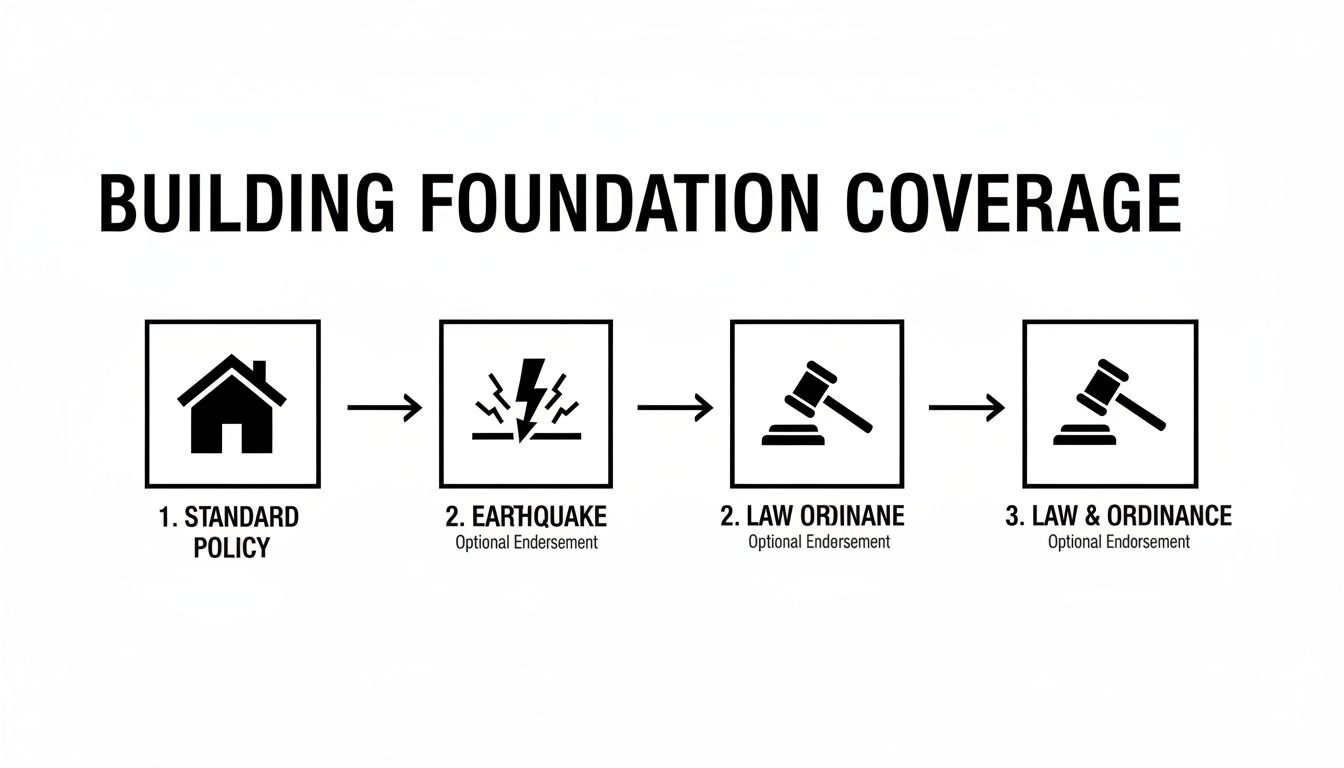
You can see how a truly comprehensive strategy is built piece by piece, starting with a standard policy and adding endorsements for things like earthquakes or building code updates. It's rarely a one-size-fits-all solution.
Bring in the Pros and Keep Your Communication Tight
With your evidence in hand, it's time to call your insurance agent and officially report the claim. Have a clear, simple summary of what happened ready to go. After that call, it's often a smart move to get your own independent expert on the scene.
Hiring an independent structural engineer before the insurance adjuster even shows up can be a total game-changer. Their report is an unbiased, professional analysis of what caused the damage and how bad it is. That kind of third-party validation carries a lot of weight when it's time to negotiate.
From here on out, stay organized. Keep a dedicated folder—digital or physical—for every email, letter, and report related to your claim. And here's a pro tip: after every phone call with your claims adjuster, send a quick follow-up email summarizing what you discussed. This creates a paper trail and prevents any "he said, she said" confusion down the line.
Finally, remember that the insurance company's first settlement offer is just that—an offer. If it seems low and won't cover the repair estimates from contractors you trust, don't just accept it. Push back politely with your evidence, your photos, and that engineer's report to justify what you need. By staying organized, communicating clearly, and backing everything up with proof, you can navigate this process with confidence and fight for a fair outcome.
Protecting Your Home with Proactive Foundation Maintenance
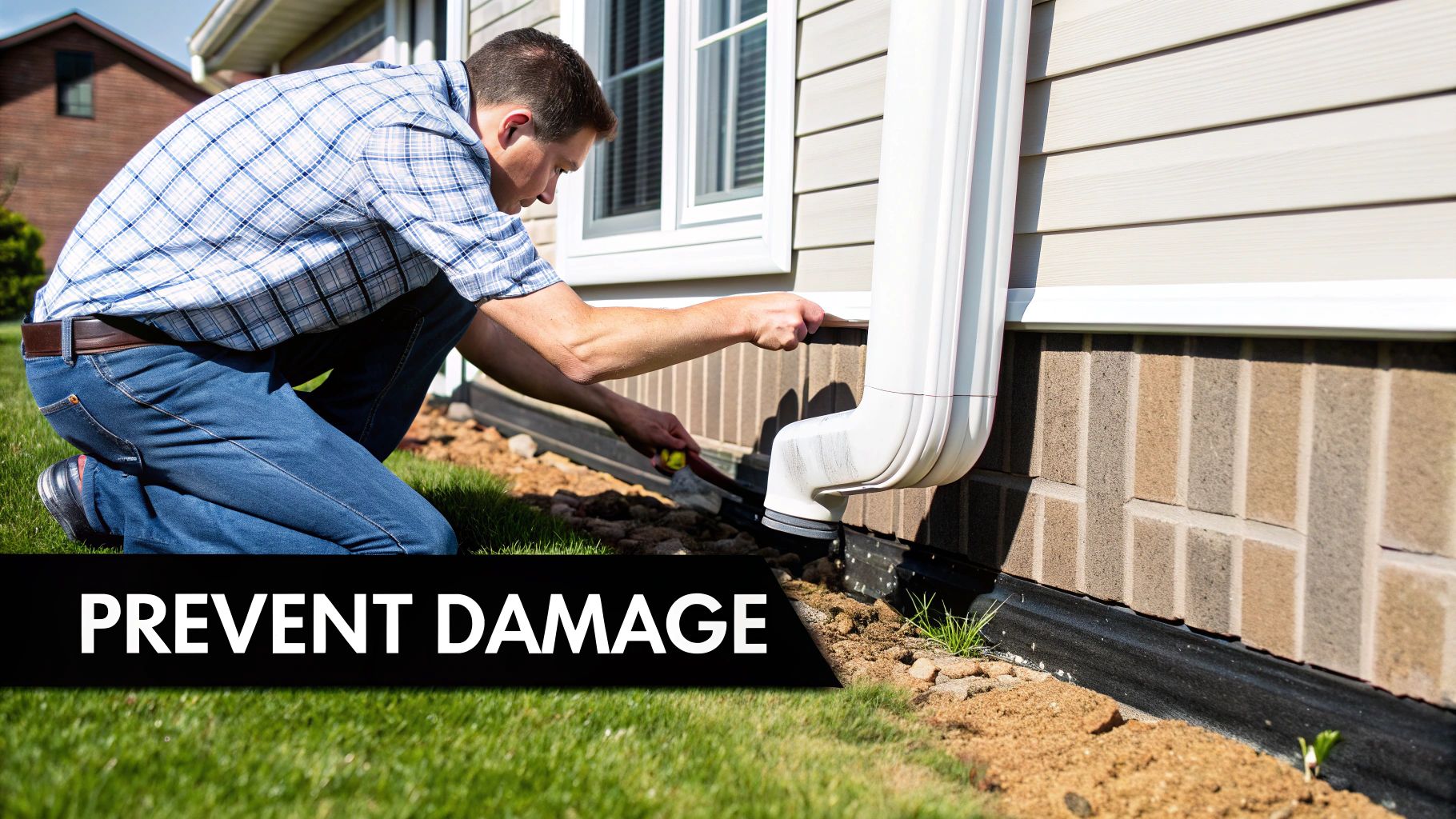
While it's smart to know what your insurance policy covers, the absolute best strategy for dealing with foundation problems is to stop them before they start. After all, the best insurance claim is the one you never have to file. Taking a proactive approach not only protects your home’s structural integrity but also puts you in a much stronger position if you ever need to prove the damage was from a sudden, covered event.
Think of your foundation like your health. It’s always easier and cheaper to stay healthy with good habits and regular check-ups than it is to deal with a serious illness later. The same idea applies to your home—a little consistent maintenance can save you from a world of expensive, catastrophic repairs down the line.
Master Your Water Management
When it comes to your foundation, water is public enemy number one. Soil swells up like a sponge when it gets soaked and shrinks when it dries out. This constant expansion and contraction puts a ton of stress on your foundation, eventually leading to cracks and settling.
Your main job is to keep water away from the base of your house. It really comes down to a few key tasks:
- Keep Gutters Clean: Gutters clogged with leaves and debris will send water cascading right down your walls and into the soil next to your foundation. Clean them out at least twice a year.
- Extend Downspouts: Your downspouts should be channeling water at least five to ten feet away from your home. This simple fix prevents all that roof runoff from saturating the ground where it can do the most damage.
- Check Your Grading: Take a look at the ground around your house. It should slope away from the foundation, not toward it. If it slopes inward, you’re basically funneling water directly to where you don't want it.
Be Vigilant for Early Warning Signs
Catching a problem early can mean the difference between a simple fix and a full-blown disaster. Get in the habit of walking around your property and looking for the classic signs of foundation stress.
A small issue today is a preventative fix; the same issue next year could be a structural crisis. Paying attention to your home’s subtle signals is the most effective form of risk management you can practice.
Keep an eye out for these red flags:
- Cracks in Walls or Ceilings: Be especially wary of diagonal cracks that shoot out from the corners of doors and windows.
- Sticking Doors and Windows: If doors suddenly start jamming or windows are tough to open, it could be because a shifting foundation has warped their frames.
- Uneven or Sloping Floors: A floor that feels bouncy, or has a noticeable dip or slant, is a major indicator that your foundation is settling.
By showing you’re a responsible homeowner who performs regular maintenance, you do more than just protect your biggest investment. You also build a much stronger case if a covered peril ever does strike. For more tips on protecting your property, feel free to explore our homeowner guides. These simple, proactive steps are your first and best line of defense.
We Can Help You Find the Right Coverage for Your California Home
Trying to figure out California’s insurance market on your own can feel like a maze. As we've seen, the big question of does homeowners insurance cover foundation problems rarely has a simple "yes" for an answer. Protecting your home—likely your biggest investment—demands more than just an off-the-shelf policy. It requires a real strategy built on the right California insurance.
Here at Mai & Associates, we live and breathe California insurance. We specialize in helping homeowners like you build a protective shield that actually stands up to the risks we face in this state, from earthquake country to tricky soil conditions. We're not just here to sell you a policy; we're here to make sure you understand what you're buying and feel confident in your coverage for home insurance, auto insurance, and more.
More Than an Agent, We're Your Partner
Our process starts with a simple conversation about your current home insurance. We'll take a close look to spot any potential gaps or weak spots that could leave you exposed.
From there, we'll map out the best path forward. That might mean adding a specific endorsement for something like water backup or finding you a comprehensive earthquake policy. Our mission is to create a safety net that truly protects your home, foundation and all.
We can also look at bundling your home insurance, car insurance, and life insurance. This often unlocks better pricing, but more importantly, it ensures all your policies work together seamlessly to protect your financial world.
Protecting your home is about more than just a piece of paper; it's about building a partnership with an expert who can guide you through tough decisions and advocate for your best interests.
Don't wait until you see a crack in the wall to discover a crack in your coverage. Get a personalized insurance quote today and let our team at Mai & Associates help you build a more secure future for your home and family.
Frequently Asked Questions About Foundation Coverage
Even after digging into the details, you probably still have a few specific questions buzzing around. It's completely normal. Let's tackle some of the most common ones we hear from California homeowners just like you.
Is Damage From Tree Roots Covered?
Almost certainly not. Insurers see damage from tree roots as a slow-moving problem that falls under routine home maintenance. Because it happens over years, not in a sudden event, it’s considered preventable and is a standard exclusion in most policies.
Your best bet here is being proactive with your landscaping. Think occasional root barrier installation or just planting trees a safe distance from your home in the first place.
How Do Slab Leaks Fit into Foundation Coverage?
This is where things can get a little tricky. A standard policy will often pay to tear out the slab to access the broken pipe and repair it. It will also likely cover the water damage that resulted—to your floors, drywall, and furniture.
But what about the foundation itself? Coverage usually hinges on whether the leak was sudden and accidental. A pipe that bursts unexpectedly is a covered peril. A slow, tiny drip that gradually undermines your foundation over months or years? That’s typically considered a maintenance issue, and the claim for the foundation damage itself will likely be denied.
The key difference for a slab leak claim is always the speed of the event. A sudden burst is an accident; a slow drip is a maintenance problem.
Will My Insurer Cancel My Policy if I File a Foundation Claim?
Filing a single, legitimate claim for a major, covered disaster is unlikely to get your policy canceled. That’s what insurance is for, after all.
However, filing multiple claims in a short time frame can definitely raise a red flag. It signals to the insurer that your property is high-risk, which could lead them to not renew your policy. This is why it’s often smart to pay for smaller repairs yourself and save your insurance for the truly big, expensive problems.
For more general insurance questions, feel free to check out our comprehensive FAQ page.
How Much Is Earthquake Insurance in California?
There’s no single answer here—the cost is all over the map. Your premium depends heavily on your home’s specific ZIP code, its age, and how it was built (e.g., wood-frame, masonry).
Premiums can be as low as a few hundred dollars or run into thousands per year. The only way to know for sure is to get a personalized quote that assesses your home's unique risk profile.