Does Homeowners Insurance Cover Fire in California?
You smell smoke, your heart drops, and your first thought isn't policy language. It's whether your family is safe, whether the house can be saved, and how bad the damage will be by morning. Once the fire department leaves and the reality sets in, the next question comes fast: does homeowners insurance cover fire?
In most cases, yes. But in California, that simple answer can mislead people into a false sense of security.
A fire claim isn't just about whether the policy responds. It's about whether the right kind of fire is covered, whether your limits are high enough to rebuild, whether your belongings are covered at replacement cost or depreciated value, and whether your policy still gives you real wildfire protection if you live in a high-risk area. That matters because from 2016 to 2020, the average home insurance claim settlement for fire and lightning damage was $77,340, compared with $13,804 for the overall average property damage claim, according to Policygenius homeowners insurance statistics.
If you're shopping for California insurance, this issue doesn't exist in isolation. Home insurance connects directly to how you protect your household overall, including auto insurance, car insurance, renters insurance for family members in separate residences, and life insurance for long-term financial stability. Fire coverage is one part of a bigger protection plan. It just happens to be one of the most expensive parts to get wrong.
The Answer Is Yes But The Details Matter
Most standard homeowners policies cover fire. If a candle tips over, faulty wiring sparks inside a wall, or smoke spreads through the home after an accidental kitchen fire, your policy will usually respond. That's the good news.
The bad news is that too many homeowners stop reading after the word "yes."
California homeowners face a much tougher reality than the average online article admits. A policy can cover one kind of fire loss well and still leave you exposed in the exact scenario you're worried about most. Coverage limits, payout method, wildfire restrictions, non-renewal issues, and exclusions all matter. If you miss any of them, you can end up underinsured even though you technically had coverage.
Why the simple answer isn't enough
Fire losses are expensive because they rarely stay contained to one room. Structural repairs, smoke remediation, debris removal, replacing furniture and electronics, and paying for a place to stay all stack up fast. That's why the average fire and lightning claim is so much higher than the average property damage claim, as noted in the Policygenius data linked earlier.
Practical rule: Don't ask only, "Am I covered for fire?" Ask, "Which fires, up to what limit, and how will my insurer calculate the payout?"
That question matters even more in California's current market. Many homeowners still assume a standard policy covers every fire scenario the same way. It doesn't. In some parts of the state, wildfire exposure has changed how insurers write, renew, and limit policies.
What to look at first
Before you feel comfortable with your policy, check these points:
- Cause of loss: Was the fire sudden and accidental, or could the insurer argue neglect or an excluded cause?
- Coverage type: Does your policy pay replacement cost or actual cash value on the house or belongings?
- Coverage limits: Are your dwelling and personal property limits strong enough for today's rebuilding environment?
- California-specific risk: If you're in a wildfire-prone area, does your current setup protect you from wildfire loss?
A lot of people learn the wrong lesson from broad insurance advice online. They hear "homeowners insurance covers fire" and assume the problem is solved. In California, that's often where problems begin.
Your Policy's Four Layers of Fire Protection
A strong homeowners policy works like a shield around your life. Fire doesn't damage just one thing. It can hit the house itself, detached structures, everything inside, and your ability to live there while repairs happen.
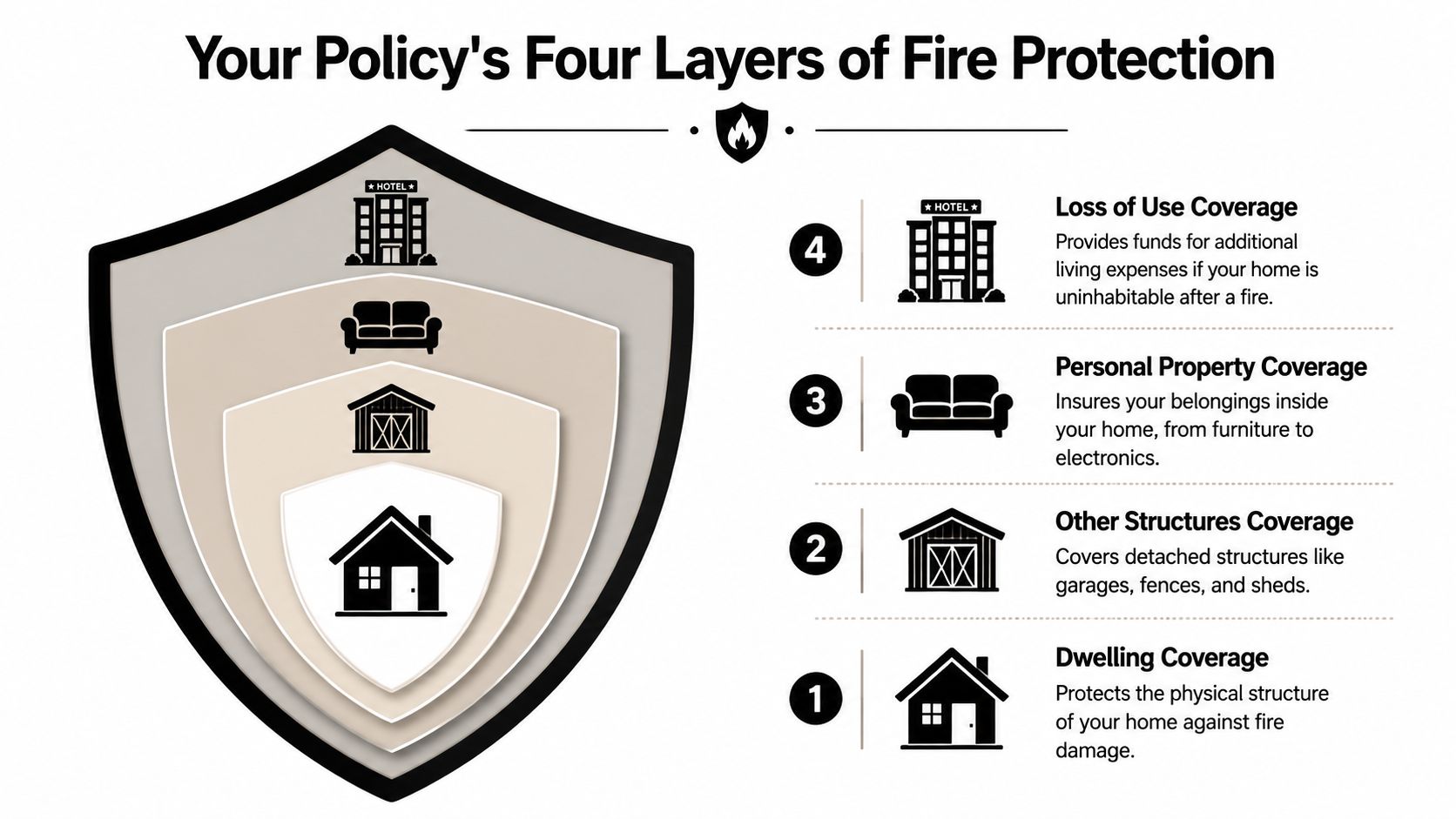
Standard homeowners insurance policies in California generally cover fire and smoke damage to the dwelling, other structures, and personal property up to policy limits, and they also include Additional Living Expenses if the home becomes uninhabitable, as explained in Kin's fire insurance overview. That applies to accidental fires from candles, electrical malfunctions, and lightning strikes.
Dwelling coverage protects the house itself
This is the core layer. Dwelling coverage pays to repair or rebuild the physical structure of your home after a covered fire. Think roof, walls, floors, cabinets, built-in systems, and attached structures.
If a grease fire spreads from the kitchen into the attic, dwelling coverage is what responds to the actual building damage. If smoke saturates drywall and insulation, this part of the policy is still central.
Other structures coverage protects what's separate
Detached garages, sheds, fences, and similar structures usually fall into a different bucket. Homeowners often forget this until a fire jumps from the main house to a backyard workshop or detached garage.
A policy can cover the home itself well but still leave confusion if the damaged structure isn't attached. That's why this second layer matters.
Personal property coverage protects what you own
Furniture, clothing, electronics, cookware, bedding, and countless everyday items fall under personal property. After a fire, this category becomes overwhelming because you don't realize how much you own until you have to list it.
Here's a brief overview of the situation:
| Coverage layer | What it generally protects after a covered fire |
|---|---|
| Dwelling | The home's main structure |
| Other structures | Detached garage, shed, fence |
| Personal property | Belongings inside the home |
| Loss of use | Temporary living costs while repairs happen |
Loss of use helps you function while displaced
If your home can't be lived in after a covered fire, Additional Living Expenses, sometimes called loss of use, can help with temporary housing and meals. This is one of the most overlooked parts of a policy until a family suddenly needs a hotel, rental, or short-term housing.
A fire claim isn't only a repair claim. It's often a housing disruption claim at the same time.
That outer layer can be the difference between a manageable recovery and a financial scramble. If you're asking whether does homeowners insurance cover fire, this is part of the answer people forget. Good fire protection isn't just about rebuilding walls. It's about keeping your life moving while the house is being rebuilt.
Understanding Your Payout Replacement Cost vs Actual Cash Value
Coverage is only half the question. The other half is what the insurer will pay when your property is damaged or destroyed.
That comes down to the difference between replacement cost and actual cash value. If you don't understand this distinction, you're guessing at your recovery.
Replacement cost pays for a new equivalent
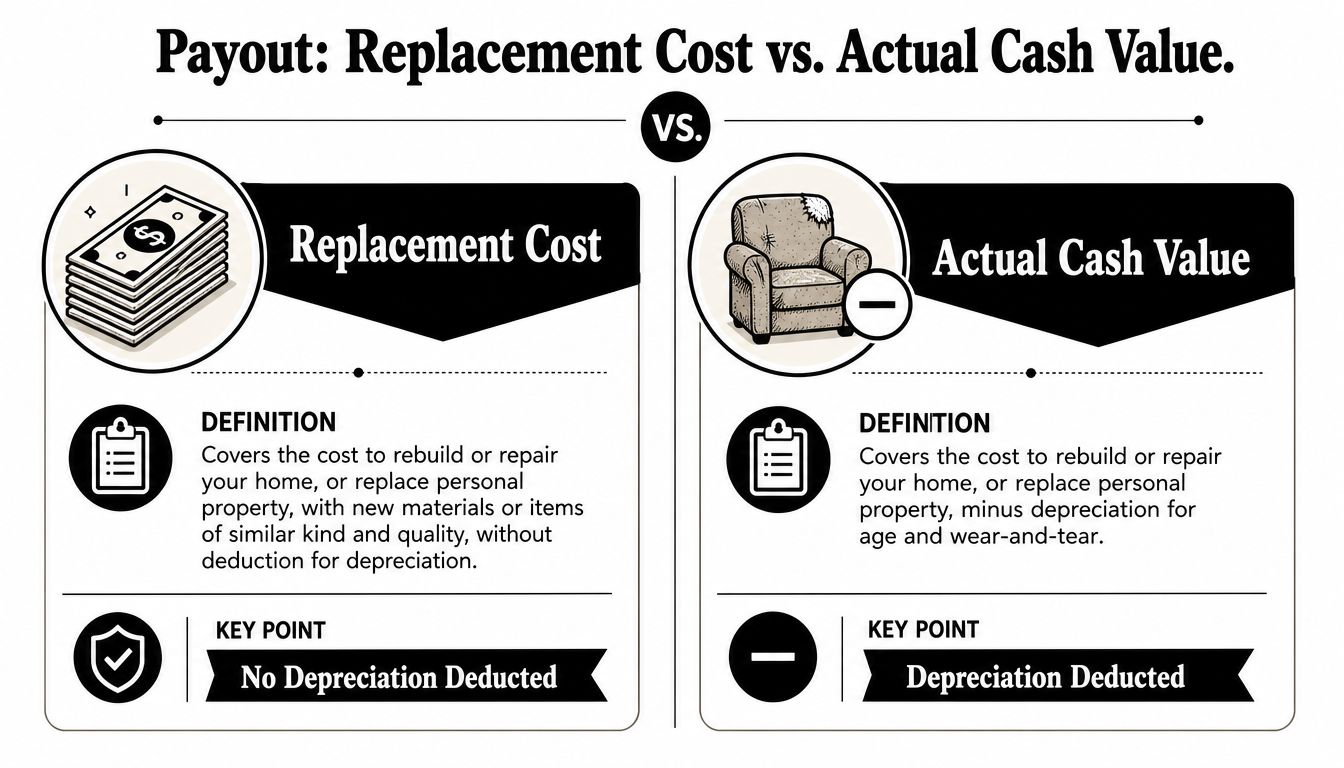
Replacement cost means the policy pays what it costs to repair or replace damaged property with new materials or comparable new items, without subtracting depreciation. If a fire destroys your couch, replacement cost aims to buy a similar couch today, not what your old couch was worth after years of use.
This is the version of coverage most homeowners should want, especially for the dwelling.
Actual cash value subtracts depreciation
Actual cash value starts with replacement cost, then reduces the payout based on age and wear. If the same fire destroys an older laptop, sofa, or television, the payout may be far less than what it costs to buy a replacement now.
That gap can sting. People expect the policy to "make them whole," then discover the check reflects the used value of what they lost.
A simple example
Take a five-year-old laptop damaged in a house fire.
- With replacement cost, the insurer generally looks at what it costs to buy a comparable laptop now.
- With actual cash value, the insurer applies depreciation first, so the payout is lower.
- With a deductible, your out-of-pocket amount still applies before the final payment.
- With policy limits, the insurer won't pay beyond the amount your policy provides.
If your belongings are insured on an actual cash value basis, expect the settlement to feel smaller than the replacement shopping list in your head.
This issue also affects building repairs, not just contents. Some policies and endorsements provide stronger replacement protection than others. That's why homeowners should read the declarations page, not just the marketing summary.
Why this matters in California
California rebuilding costs can move faster than homeowners expect. Materials, labor, code upgrades, and contractor demand can all push the actual cost of repair above what a policyholder assumed years earlier. The American Academy of Actuaries' 2026 issue brief says rising rebuilding costs can create a protection gap when the actual cost to rebuild exceeds the policy limit, and it notes that replacement cost coverage and inflation guard endorsements are important tools to close that gap in the future-facing market discussion found in the Academy's issue brief on home insurance protection gaps.
If your home is insured too low, even a covered fire can leave you paying the difference.
When Fire Damage Is Not Covered
A lot of homeowners believe fire coverage means any fire, any time, no questions asked. That's not how insurance works. Fire is commonly covered, but certain causes and conditions can lead to a denial.
The most important exclusions are straightforward. If someone intentionally sets the fire, that isn't a covered loss. If the home is vacant and not insured correctly for that condition, coverage can fail. If the damage stems from neglect, the insurer may argue the loss wasn't sudden and accidental.
The exclusions that catch people off guard
According to Andover's explanation of fire damage exclusions, homeowners insurance typically does not cover fire damage caused by intentional acts such as arson, vacant homes unless specifically insured for that situation, or neglect such as failing to repair known faulty wiring. The same source also notes that high-risk areas may face limited or excluded wildfire coverage.
Here are the problem areas that deserve your attention:
- Intentional damage: If the fire was set on purpose by the homeowner or someone in the household, don't expect coverage.
- Known maintenance issues: Old wiring, recurring electrical problems, and other hazards you've ignored can turn a claim into a dispute.
- Vacancy: A home left vacant may require different insurance treatment.
- Major excluded causes: War, nuclear radiation, and contamination are outside normal homeowners coverage.
Neglect is where many disputes start
This is the gray area homeowners underestimate. Insurance is built for sudden, accidental loss, not preventable deterioration. If you've known for months that an electrical panel is unsafe, extension cords are overloaded, or rodents have damaged wiring, and you never fix it, you've handed the insurer an argument.
That doesn't mean every electrical fire gets denied. It means documentation matters. Repair records matter. Maintenance history matters.
Keep records of major home repairs. If an insurer questions a fire's cause, proof that you addressed known hazards can make a difference.
If you're unsure what your current policy excludes, review the language carefully or compare it against other policy types and FAQs through this California insurance FAQ resource. The point isn't to panic. The point is to stop assuming.
The California Wildfire Insurance Crisis Explained
The biggest mistake California homeowners make is treating "fire coverage" and "wildfire coverage" as interchangeable. They aren't always the same in practice anymore.
That's the uncomfortable truth behind today's insurance market. A policy that looks solid on paper for a kitchen fire may leave major gaps when the loss involves a wildfire, especially after policy changes, non-renewals, or shifts into last-resort coverage.
The wildfire coverage gap is real
Moody's reports that in wildfire-prone parts of California, a growing wildfire insurance gap is emerging as insurers non-renew more policies, leaving homeowners to rely on the limited California FAIR Plan, as discussed in Moody's analysis of hidden risks for California homeowners in wildfire-prone areas. That means a homeowner can have coverage for ordinary fire scenarios yet still face a weaker overall protection setup for wildfire-related loss.
That distinction matters because the California FAIR Plan is not the same as a broad traditional homeowners policy. It can provide basic fire protection, but it may require separate coverage solutions for other exposures. Homeowners often discover that too late.
Non-renewal changes the whole conversation
When a private carrier doesn't renew a policy, the question changes from "Does homeowners insurance cover fire?" to "What kind of fire protection do I still have, and what did I lose in the transition?"
If you've been moved into a FAIR Plan arrangement or you're patching together multiple policies, review all of it together. Don't treat each policy as a separate island.
A practical review should focus on:
- Wildfire exposure: Does your current setup respond the way you think it does?
- Dwelling limit: Is it high enough for today's rebuild reality?
- Replacement terms: Are you getting replacement cost or a reduced valuation?
- Companion policies: Have you added the coverage needed for perils the FAIR Plan doesn't address?
The rebuilding gap can hurt even covered homeowners
The second California problem is the rebuilding gap. Even when the fire is covered, the policy limit may not be enough to rebuild the home at current costs. That gap has become harder to ignore as rebuilding conditions have tightened.
A covered loss doesn't guarantee a full recovery. If the limit is wrong, the policy can work exactly as written and still leave you short.
Proactive risk management matters in these situations. Homeowners in wildfire areas should also think about immediate property protection and emergency response planning. For businesses, HOAs, or sites facing heightened fire-watch concerns after an incident or during a shutdown, professional monitoring can serve as an essential property safety net.
If you live in Sonoma County or another exposed region, it's smart to compare your current setup against local options and wildfire realities through a focused Santa Rosa home insurance review.
How to File a Homeowners Insurance Claim After a Fire
After a fire, people make mistakes because they're exhausted and overloaded. The best approach is simple, orderly, and documented. A claim gets easier to manage when you act quickly and keep records from the start.
That's worth taking seriously because about one in 430 insured homes in the United States experiences a property damage claim related to fire and lightning, according to the Insurance Information Institute's homeowners and renters insurance facts. The frequency may sound low, but when it happens to you, preparation matters more than averages.
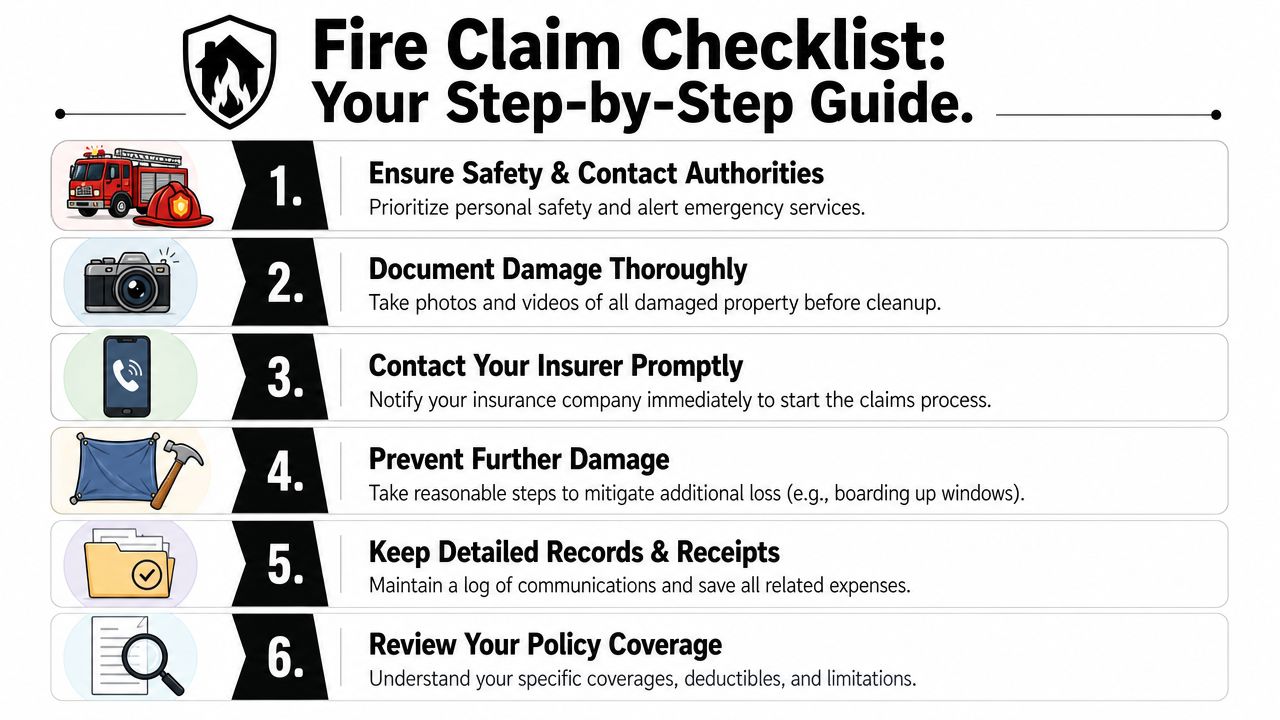
Follow these steps in order
- Put safety first. Get everyone out, seek medical attention if needed, and follow the fire department's instructions before thinking about property.
- Notify your insurer promptly. Start the claim as soon as you're able. Delays create confusion and can slow payments.
- Document the damage before cleanup. Take photos and video of every affected area and damaged item if it's safe to do so.
- Prevent further damage. Board openings, protect exposed areas, and take reasonable steps to stop additional loss.
- Save every receipt. Temporary lodging, meals above your normal spending, emergency purchases, and cleanup-related costs may matter.
- Meet the adjuster prepared. Bring your photos, inventory, receipts, and policy information.
Keep your claim file organized
Use one folder, digital or physical, for everything:
- Photos and video: Capture structure, contents, smoke damage, and water damage from firefighting efforts.
- Expense receipts: Hotel stays, food, clothing, and emergency supplies can support an ALE claim.
- Communication log: Write down who you spoke with, when, and what they said.
- Inventory notes: List damaged belongings room by room instead of trying to remember everything at once.
The homeowners who recover more smoothly aren't lucky. They're organized.
Get outside guidance when needed
Insurance is only one part of post-fire recovery. Cleanup, mitigation, and restoration decisions matter too. If you want a practical overview of immediate next steps after the event, Eagle Restoration's fire recovery advice is a useful companion checklist.
For broader preparation and insurance education before a loss happens, keep a reliable set of California insurance guides bookmarked. When you're under stress, you won't want to start researching from scratch.
Secure Your Peace of Mind with a Policy Review
If you've read this far, you already know the answer to does homeowners insurance cover fire. Usually, yes. Automatically and adequately, not always.
That's the distinction that matters in California. Key risks aren't just the fire itself. They're underinsurance, weak payout terms, wildfire-related gaps, non-renewal fallout, and outdated limits that no longer match the cost to rebuild. A policy can look fine until the day you need it.
What a serious review should include
A proper review shouldn't stop at the declarations page. It should examine how the policy behaves under stress.
Look for these issues:
- Dwelling adequacy: Is the limit realistic for your home's rebuild cost?
- Contents valuation: Are belongings covered at replacement cost or actual cash value?
- Wildfire exposure: If you're in a high-risk area, does your current arrangement still provide meaningful protection?
- Policy coordination: Does your broader protection plan make sense across home insurance, auto insurance, car insurance, renters insurance, and life insurance?
Hoping is not a strategy
Too many homeowners renew year after year without asking better questions. They assume their mortgage company, prior agent, or current carrier already handled it. That's a mistake.
Review your coverage before a fire, not during a fire claim.
If you're in California, get a full comparison and make sure your current setup reflects today's market, not last decade's assumptions. A focused California home insurance review is the right next step if you want clarity instead of guesswork.
A strong insurance plan should protect your house, your vehicles, your belongings, your income stability, and your family. That means treating home insurance as part of a complete California insurance strategy, not a standalone bill you pay and forget.
If you want a clear second opinion on your protection, talk to Mai & Associates. Their licensed California team can review your current home insurance, compare options across carriers, and help you spot wildfire, rebuilding, and valuation gaps before they turn into expensive surprises. If you also need auto insurance, car insurance, renters insurance, or life insurance, they can help you line up those policies so your coverage works together instead of leaving blind spots.