Does Homeowners Insurance Cover Earthquakes in California?

It's one of the biggest misconceptions in home insurance, and it can be a financially devastating one for California homeowners. The short, direct answer is no, your standard homeowners insurance policy does not cover damage from an earthquake.
This exclusion is a critical detail that leaves your most valuable asset completely exposed to the financial fallout of a seismic event.
Why Your California Home Insurance Needs a Second Look
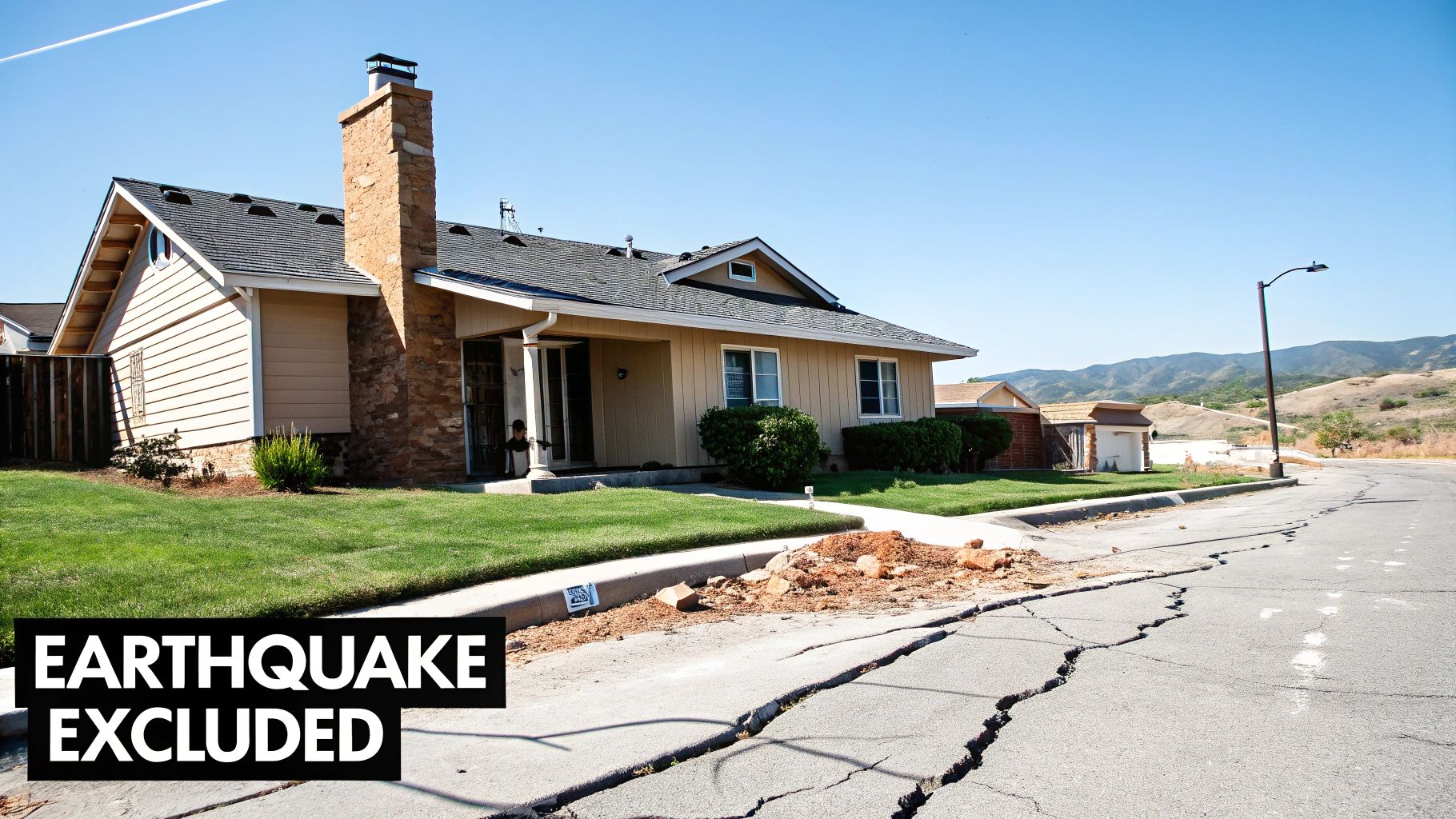
Living in California means accepting that earthquakes are a fact of life. But far too many homeowners operate under the dangerous assumption that their insurance policy will have their back when the shaking stops. The reality is, it won't.
Think of it like flood insurance. Just as a standard home policy won't cover damage from rising water, it's also designed to exclude damage from "earth movement." This broad category includes everything from tremors and landslides to sinkholes.
Without a separate earthquake policy, you're on your own. If your foundation cracks, your walls crumble, or your belongings are destroyed, the bill for repairs comes directly to you. Those costs can easily soar into the hundreds of thousands, forcing many families into financial ruin.
A Staggering Coverage Gap
This isn't just a fine-print detail; it's a massive gap in protection, especially here in California. The numbers paint a sobering picture: despite living on shaky ground, only about 10% of California residents have earthquake insurance, according to FEMA. This leaves millions of families one major quake away from a financial catastrophe.
When a major earthquake hits, having dedicated insurance is what separates a manageable recovery from a complete financial disaster. It's the tool that allows you to rebuild your home and your life.
To truly protect your investment, you need to either purchase a standalone earthquake policy or add an earthquake endorsement to your current home insurance. Understanding the fundamentals of home insurance in California is the perfect starting point for building a solid protection plan.
What Your Policies Cover Side-by-Side
It's helpful to see exactly where the lines are drawn. The difference between what your standard policy covers and what an earthquake policy covers is stark. Let's break it down to see the coverage gap clearly.
Standard Homeowners Policy vs. Earthquake Coverage At a Glance
| Damage Type | Covered by Standard Homeowners Policy? | Covered by Separate Earthquake Policy? |
|---|---|---|
| Structural Damage (foundation, walls, roof) | No | Yes |
| Damage to Other Structures (garage, shed) | No | Yes |
| Destroyed Personal Property (furniture, electronics) | No | Yes |
| Temporary Living Expenses (ALE/Loss of Use) | No | Yes |
| Fire Damage Caused by an Earthquake | Yes (usually) | No (covered by the home policy) |
| Water Damage from Burst Pipes (earthquake-related) | No | Yes (if part of the covered damage) |
As you can see, a standard policy leaves you completely exposed to the direct physical damage caused by shaking. Only a dedicated earthquake policy steps in to cover the costs of rebuilding your home and replacing your belongings.
Why Your Home Policy Excludes Earthquakes
You've probably flipped through your homeowners policy, seen the earthquake exclusion, and wondered, "Why?" It's a fair question. It’s not some arbitrary fine print meant to frustrate you; it's a deliberate choice rooted in how insurance has to work to stay afloat.
The whole reason boils down to two core insurance ideas: catastrophic risk and adverse selection. Once you get these, the exclusion stops being a mystery and starts making practical sense.
The Kitchen Fire vs. The Big One
Think about the everyday risks your standard home policy does cover. A kitchen fire. A pipe bursting in the wall. These are terrible for the family involved, but they're typically isolated incidents. A fire in your house doesn't usually burn down the whole block. Insurance companies are great at predicting how many of these individual events will happen across millions of homes, and they price your policy based on that math.
Now, picture a major earthquake. It doesn’t just damage one home. It devastates thousands, sometimes tens of thousands, of homes all at once, all in the same area. This is what insurers call a catastrophic risk. If every standard home, renters, and even auto insurance policy in California had to pay out claims after a massive quake, the sheer volume would be financially crippling for the insurance industry.
The entire insurance model is built on spreading risk out. A catastrophic event like an earthquake shatters that model because all the risk is concentrated in one place, at one time.
To cover that kind of widespread damage, insurers would have to jack up the price of every single home insurance policy to build a massive cash reserve. Basic insurance would become completely unaffordable for most people. By separating earthquake coverage, they keep standard policies accessible and create a specialized product for those who need it.
The Challenge of Adverse Selection
This brings us to the second big piece of the puzzle: adverse selection. It’s a simple concept: the people most likely to buy a certain type of insurance are the ones who think they’ll actually use it.
Imagine if earthquake coverage was just a cheap, optional add-on. Who would buy it? Almost exclusively people living on or near major fault lines in places like Los Angeles and the Bay Area. Nobody in a lower-risk area would bother. This creates an insurance pool full of people who are almost certain to file a major claim someday. Instead of spreading risk, it concentrates it, which again, would make the cost skyrocket.
Creating separate, dedicated earthquake policies solves both problems at once.
- It keeps standard home insurance, renters insurance, and even car insurance affordable for everyone.
- It creates a separate, specialized pool of funds specifically for those who choose to protect themselves from seismic events.
So, the exclusion isn't about insurers trying to avoid paying. It’s a necessary strategy to manage an immense, unpredictable risk without making the entire California insurance market unstable. It’s the very reason why asking "does homeowners insurance cover earthquakes?" is so important—and why a separate policy is the only real answer for protecting your biggest investment in California.
Navigating Your California Earthquake Insurance Options
For Californians, the question isn’t just about if you need earthquake coverage, but where to get it. Once you realize your standard homeowner's policy won’t cover quake damage, you’ll find two main paths forward: the state-managed California Earthquake Authority (CEA) and the competitive private insurance market.
Think of it this way: the CEA is a publicly managed safety net, created after the 1994 Northridge earthquake to guarantee that coverage would always be available. The private market, on the other hand, is more like a bustling bazaar, with different insurers competing to offer more flexible—and sometimes more comprehensive—coverage options.
Your job is to figure out which path best fits your home, your budget, and your personal comfort level with risk. It's a big decision that will directly shape how well you can recover after a major shake.
The California Earthquake Authority (CEA)
The CEA is a not-for-profit, publicly run organization that provides the bulk of earthquake insurance policies in the state. It doesn't sell policies directly. Instead, you get a CEA policy through the same company that provides your standard home insurance or renters insurance—think State Farm, Allstate, or Farmers.
This setup provides stability and a standardized set of options, making it a solid choice for many. Key features of a CEA policy typically include:
- Widespread Access: Since they're offered through most major California insurers, CEA policies are easy to find and add.
- Flexible Deductibles: You can choose a deductible anywhere from 5% to 25%, which lets you control your premium cost. A higher deductible means a lower premium, but more out-of-pocket costs if you file a claim.
- A La Carte Coverage: You get to pick separate coverage limits for your house itself, your personal belongings, and your temporary living expenses (loss of use).
The CEA was fundamentally designed to prevent an insurance market collapse and make sure a baseline of protection is always available—a critical function in a state as seismically active as ours.
The Private Insurance Market
Outside of the CEA, a growing number of private insurance companies are now offering their own earthquake policies. We often call these "standalone" policies because you can buy them from a different company than the one that insures your home. This competition is great for homeowners, as it can lead to more innovative products and sometimes better pricing.
Here’s where the private market can really shine:
- Greater Coverage Flexibility: Some private insurers cover things the standard CEA policy doesn't, like swimming pools, detached sheds, or higher limits for your personal property.
- Potentially Lower Premiums: If you have a newer, well-built, or retrofitted home, a private carrier might see you as a lower risk and offer a more competitive rate than the CEA’s standardized pricing.
- Simpler Deductibles: You might find policies with a single, straightforward deductible that applies to all your coverages, which can be much easier to understand than juggling separate deductibles.
This is exactly why understanding the nuances of home insurance in San Francisco and other high-risk areas is so important. The right policy can truly be a financial lifesaver. While it takes a bit more effort to shop around in the private market, the payoff can be a policy that’s a much better fit.
The whole reason for separating catastrophic risk from standard policies is to keep insurance available and affordable for everyone. This visual shows the fundamental difference between a single event, like a house fire, and a widespread catastrophe like an earthquake.
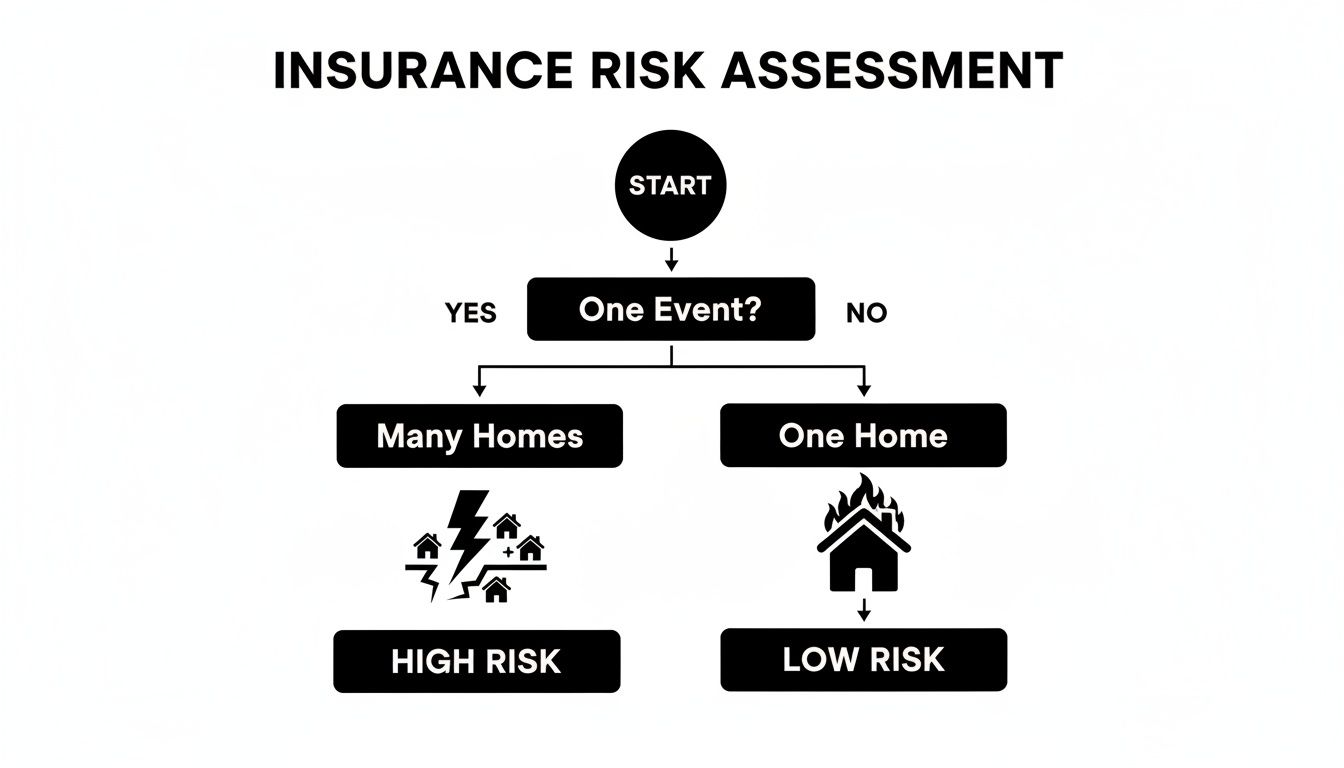
This distinction is why insurers have to treat catastrophic events differently to stay in business. Despite this, a major "protection gap" remains. FEMA data shows that in California's riskiest zones, only about 10% of homeowners have earthquake insurance. Nationally, the number is a similarly low 11%. This gap highlights a massive vulnerability, leaving millions of families exposed.
An independent agency like Mai & Associates can be your personal shopper in this complex market. We'll compare quotes from both the CEA and various private carriers to help you find that perfect balance of coverage and cost, ensuring your family and your biggest investment are properly protected.
What Your Earthquake Policy Actually Protects

So, you’ve decided to look into a separate earthquake policy. It’s a smart move. This isn't just an add-on; it's a completely different kind of financial safety net, built specifically for the kind of catastrophic damage a major tremor can cause.
Your standard home insurance policy is great for things like fire or a burst pipe, but it draws a hard line at "earth movement." An earthquake policy steps in to fill that critical gap. To really understand its value, you need to look at what it’s designed to do: get you back on your feet and make your home whole again.
The Four Pillars of Earthquake Coverage
A good earthquake policy, whether it’s from the CEA or a private company, is typically built around four core protections. Think of them as the legs of a table—each one is essential for keeping your financial life stable after a disaster.
Here’s a breakdown of the coverage you’ll almost always find:
- Dwelling Coverage: This is the big one. It’s the money to repair or completely rebuild your house. We're talking about the foundation, the walls, the roof—the very structure that keeps your family safe.
- Other Structures Coverage: Got a detached garage, a workshop in the back, or a sturdy fence? This part of the policy covers those structures on your property that aren't physically attached to your main house.
- Personal Property Coverage: This covers your stuff. All the things inside your home that make it a home—furniture, appliances, clothes, electronics—are protected. It helps you replace what gets crushed or destroyed.
- Loss of Use (or Additional Living Expenses): This might be the most underrated part of the policy. If the quake damages your home so badly that you can't live there, this coverage pays for you to stay somewhere else. It covers hotel bills, a short-term rental, and even the extra cost of eating out while you're displaced. It’s a true lifesaver.
The need for this specific protection is huge. The global earthquake insurance market was valued at a staggering USD 99,518.2 million in 2024. Even though North America makes up 40% of that market, an alarmingly low 11% of U.S. homeowners have this coverage. You can read more about the global trends in the earthquake insurance market to see why this is a growing concern.
To give you a clearer picture, here’s how these coverages fit together.
Earthquake Insurance Coverage Breakdown
| Coverage Type | What It Protects | Example of Use |
|---|---|---|
| Dwelling | The physical structure of your main house, including the foundation, roof, and walls. | Your home's foundation cracks and a chimney collapses. This coverage pays for the structural repairs. |
| Other Structures | Buildings on your property not attached to the house, like a detached garage or shed. | The earthquake causes your separate two-car garage to shift off its foundation, requiring major repairs. |
| Personal Property | Your belongings inside the home—furniture, electronics, clothing, and other valuables. | A violent tremor sends your big-screen TV and glass dining table crashing to the floor, destroying them. |
| Loss of Use | Temporary living expenses if your home becomes uninhabitable during repairs. | Your home is red-tagged by inspectors, forcing you to move into a rental apartment for six months. |
As you can see, each piece of the policy plays a specific role in helping you recover, from rebuilding your home to keeping a roof over your head in the immediate aftermath.
Demystifying the Earthquake Deductible
Here’s where things get a little different from your typical insurance. The deductible on an earthquake policy is the number one thing that trips people up. Forget the simple, flat-dollar amount you see on your auto insurance (like a $500 deductible).
Earthquake deductibles are a percentage, usually somewhere between 5% and 25%. And here’s the crucial part: that percentage is based on your home's total insured value (your Dwelling Coverage limit), not the cost of the repairs.
Think of it this way: your deductible isn't what you pay for a small repair. It’s the threshold of damage your home must sustain before your insurance coverage kicks in. You are responsible for all costs up to that percentage.
Let's walk through a real-world example to make this crystal clear.
- Your Home's Insured Value (Dwelling Coverage): $600,000
- Your Chosen Earthquake Deductible: 15%
The Calculation: $600,000 (Dwelling Coverage) x 0.15 (15% Deductible) = $90,000
In this case, your deductible is $90,000. That means you’d have to cover the first $90,000 of repairs to your home's structure. If the quake causes $250,000 in damage, your policy would pay out $160,000 ($250,000 - $90,000). But if the damage is only $80,000, you would have to pay for it all out of pocket because it didn't meet the deductible.
How This Translates into Real-World Support
Numbers on a page are one thing, but how does this actually help you when disaster strikes?
Picture it: a major quake hits your neighborhood. Your house is a mess—cracked walls, a shifted foundation, and it's been declared unsafe to enter. Your life is turned upside down.
Here’s how a solid earthquake policy would spring into action:
- Immediate Shelter: Your Loss of Use coverage kicks in right away. It pays for a hotel room or a rental so your family has a safe place to sleep that night.
- Rebuilding Your Home: Once the dust settles, your Dwelling Coverage gives you the money to hire engineers and contractors to repair your home's structure and make it safe again.
- Replacing Your Belongings: Your Personal Property coverage provides the funds to go out and buy a new couch, replace your shattered dishes, and get new clothes for your family.
This is why we call it a financial lifeline. It’s not just about fixing a house; it’s about having the resources to put your life back together without wiping out your savings or taking on crippling debt.
How to Make Earthquake Insurance More Affordable
For most California homeowners, the need for earthquake insurance is a given. The real question is, how do you afford it? The sticker shock can be a major roadblock, but high premiums shouldn't stop you from protecting your home. The good news is you have more control over the price than you might realize.
By being strategic and making a few informed choices, you can find solid coverage that actually fits your budget. It really boils down to showing insurance companies that your home is a safer bet. From smart home upgrades to simple policy tweaks, let's walk through the practical ways to bring that premium down.
Strengthen Your Home with a Seismic Retrofit
Without a doubt, the single biggest thing you can do to slash your earthquake insurance costs is to seismically retrofit your house. Think of it as giving your home a stronger, more resilient skeleton to stand up against violent shaking.
When you invest in these kinds of upgrades, insurers take notice. A properly retrofitted home is far less likely to be a total loss, and that reduced risk translates directly into savings for you. The most common and effective projects include:
- Foundation Bolting: This anchors your home’s wood frame to its concrete foundation, which is crucial for preventing it from sliding off during a quake.
- Cripple Wall Bracing: If you have an older home, you might have short "cripple walls" between the foundation and the first floor. Bracing them with plywood adds incredible stability where it's needed most.
- Water Heater Strapping: A tipped-over water heater is a primary cause of fires and gas leaks after a quake. Securing it with heavy-duty straps is a simple, high-impact fix.
These projects don't just make your home safer for your family—they deliver real, tangible discounts. The California Earthquake Authority (CEA), for instance, offers premium reductions of up to 25% for older homes that have been properly retrofitted. That’s a huge testament to how much these improvements matter.
Investing in your home's structural integrity is a direct investment in lowering your risk. Insurers see that, and they'll reward you for it. It's the ultimate win-win: a safer home and a more affordable policy.
This proactive approach is at the heart of smart insurance planning. You can dig into more strategies for protecting your property in our collection of insurance guides.
Other Smart Ways to Lower Your Premium
Beyond major retrofitting projects, there are several other levers you can pull to manage the cost of your earthquake policy. These are all about tailoring the coverage to fit your financial comfort zone.
1. Adjust Your Deductible
As we covered earlier, your deductible is a percentage of your total dwelling coverage. If you're comfortable taking on a bit more of the initial financial risk, choosing a higher deductible—like jumping from 10% to 15%—will instantly lower your annual premium. It’s a classic trade-off: you pay less now, but you’d be responsible for a larger amount out-of-pocket before your insurance kicks in. The key is to pick a number you could realistically handle after a disaster.
2. Review Your Coverage Limits
Take a hard look at the limits you've set for your personal property and loss of use. Of course, you don’t want to be underinsured, but you also don't want to pay for coverage you'll never use. The best way to get this right is to create a detailed home inventory. It will give you a much clearer picture of what your belongings are actually worth.
3. Shop the Market Thoroughly
Never, ever settle for the first quote you receive. The earthquake insurance market is surprisingly competitive, with both the CEA and a growing number of private insurers offering different rates, features, and discounts. This is where working with an independent agency like Mai & Associates really pays off. We can pull quotes from multiple carriers at once, laying them out side-by-side so you can see the full picture. We'll help you find that perfect balance of cost and protection for your unique California home.
Let Mai & Associates Help You Find the Right Coverage

Figuring out the California insurance market can be a headache, especially after learning that your standard homeowners policy leaves you completely exposed to earthquakes. But you don't have to navigate this alone. At Mai & Associates, our goal is to be your trusted partner, translating confusing insurance jargon into a clear, straightforward plan that protects your home and family.
We're specialists in the unique risks that come with living in California. Our job is to bridge the gap between your current insurance and the earthquake coverage you need to feel truly secure. We take the guesswork out of the entire process so you can understand your options and make a confident choice.
Your Personal Insurance Shopper
Think of us as your personal guide to a complicated marketplace. Our expert, multilingual agents know the California insurance world inside and out. We can deliver same-day quotes from both the CEA and a wide variety of top-rated private carriers, giving you a complete picture of your options in one easy step.
We'll look at everything you have in place—your home insurance, auto insurance, renters insurance, and even life insurance policies. This big-picture review helps us find critical gaps you might not be aware of, showing you how a major earthquake could impact your financial life far beyond the walls of your house.
Our promise is simple: to find you solid, affordable protection for your home, your car, and your family. True peace of mind shouldn't be confusing or out of reach.
This review is especially important for homeowners with a California FAIR Plan policy. We have extensive experience finding the perfect standalone earthquake policy to pair with your FAIR Plan, making sure you aren't left vulnerable when the ground shakes.
A Team That Knows California
With offices throughout California, our team lives here too. We understand the challenges our neighbors face, from seismic fault lines to wildfire threats. We aren't a generic national call center; we're part of your community, committed to providing clear, honest advice. Our agents speak English, Spanish, Armenian, Russian, and Vietnamese, ensuring you feel comfortable and understood every step of the way.
The next step is simple. It's time to stop worrying about "what if" and start building a plan that prepares you for whatever comes next. Let our team do the heavy lifting of comparing policies, deductibles, and premiums to find the absolute best value for you.
Ready to protect your biggest investment? You can easily get a no-obligation insurance quote from our team and see just how affordable real security can be.
Your Top Earthquake Insurance Questions Answered
When you start digging into earthquake insurance, it's natural for questions to pop up. Let's walk through some of the most common ones we hear from California homeowners, with clear, practical answers to help you figure out the best way to protect your home.
Do I Absolutely Need Earthquake Insurance for My Mortgage?
Short answer: No, California law doesn’t force you to buy earthquake insurance to get a home loan. Your lender will insist on a standard home insurance policy, but that’s to protect their investment, not necessarily yours.
Think of it this way: the bank just wants to make sure the loan is covered. But what about your equity? Your family's financial stability? Given California's constant seismic activity, most financial experts will tell you that going without this coverage is a massive gamble.
A lender's requirement is the bare minimum for protecting the bank. True protection for your family's financial future means securing coverage against the most probable catastrophic risks in your area.
Imagine your home is insured for $500,000. A major quake could level it, leaving you with a pile of rubble but still on the hook for your entire mortgage. This is exactly the kind of financial disaster earthquake insurance is designed to prevent.
How Does an Earthquake Deductible Actually Work?
This is a big one, and it’s where a lot of confusion comes in. Unlike the flat $1,000 deductible you might have on your car insurance, an earthquake deductible is a whole different ballgame. It’s calculated as a percentage of your home's insured value, typically falling between 5% and 25%.
Let’s break it down with a simple example:
- Your Home’s Insured Value: $600,000
- Your Earthquake Deductible: 15%
- Your Out-of-Pocket Cost: $90,000 ($600,000 x 0.15)
In this scenario, you’d be responsible for the first $90,000 of repairs to your house. The reason for this structure is that earthquakes cause immense, widespread damage, and this percentage-based system helps keep coverage accessible.
I'm a Renter. Are My Belongings Covered in a Quake?
Unfortunately, no. Your standard renters insurance policy will not cover damage to your personal belongings from an earthquake. If you want to protect your furniture, computer, and other valuables, you'll need to add a specific earthquake endorsement or buy a separate policy designed for renters.
I Have a California FAIR Plan Policy. Can I Still Get Earthquake Coverage?
Yes, you absolutely can, and you definitely should. The California FAIR Plan provides a crucial safety net for fire insurance in high-risk areas, but it's important to know that it specifically excludes earthquake damage.
This leaves a huge gap in your protection. The solution is to purchase a standalone earthquake policy from a provider like the CEA or another private insurer. This policy works right alongside your FAIR Plan, filling that critical coverage gap. This is something we specialize in at Mai & Associates—piecing together the right policies to make sure you're fully protected.
Your home is likely the biggest investment you'll ever make. Making sure it’s protected from the risks unique to California is what we do best. The team at Mai & Associates can help you compare quotes for home insurance, auto insurance, and earthquake insurance to build a plan that gives you real security and peace of mind.
Ready to explore your options? Visit us online to get started at https://cahomeauto.com.