Does Homeowners Insurance Cover Dog Bites? A CA Guide
A lot of California homeowners ask this question only after something goes wrong.
A friend comes over for a barbecue. Your dog gets startled near the gate, nips a guest's hand, and what looked like a small incident turns into urgent care, follow-up treatment, and a call from an insurance adjuster. In that moment, the question isn't whether they love their dog. They're asking whether their homeowners policy will help.
The short answer is yes, homeowners insurance often covers dog bites, but only under the right part of the policy, only up to your liability limit, and only if your carrier hasn't excluded the dog or the situation. In California, that question matters even more because dog owners face strict legal responsibility in many bite cases, and claim costs can become serious fast.
Your Dog Your Home Your Financial Risk
The most common dog bite situations don't start with an obviously dangerous dog. They start with ordinary life. A delivery at the front door. Kids running through the yard. Relatives visiting for a birthday dinner. A dog that's calm most days can still react badly when it feels trapped, surprised, or protective.
That's why this risk catches people off guard. They think of dog bites as rare, extreme events. Insurance companies see them as a major liability exposure for homeowners.

According to the Insurance Information Institute, U.S. insurers disbursed $1,862 million in 2025, claims rose 25.6% to 28,450, and California led the nation with 2,830 claims in that year's reporting, which the source presents as dog bite liability trends through 2025. Even if you set the national numbers aside, California's position at the top should get any homeowner's attention.
Why the financial side gets serious quickly
A bite claim usually isn't just a doctor bill. It can involve:
- Medical treatment: emergency care, stitches, infection monitoring, follow-up visits
- Lost income: if the injured person misses work
- Pain and suffering claims: often raised when injuries scar or affect a child
- Legal defense costs: if the injured person hires an attorney and files suit
A homeowner can feel financially secure and still be exposed. Your house, savings, future wages, and other assets may all matter if a claim becomes larger than your policy can absorb.
Practical rule: If your dog could interact with guests, neighbors, workers, or delivery drivers, you already have liability exposure. The question isn't whether you consider your dog friendly. The question is whether your policy treats the risk as covered.
A simple example
Say a guest reaches down to move a food bowl. Your dog snaps, breaks the skin, and the injury leaves visible scarring. That can move from “minor accident” to “insurance claim” very quickly. If the person later says you should have restrained the dog, the issue becomes legal as well as medical.
That's why “does homeowners insurance cover dog bites” isn't a narrow insurance question. It's a home, asset, and family protection question.
How Homeowners Insurance Typically Covers Dog Bites
When homeowners insurance covers a dog bite, it usually does so through personal liability coverage. Think of that part of your policy as a financial safety net for injuries or property damage you legally owe to other people.
In California, that matters because the law can hold a dog owner responsible even if the dog has never bitten anyone before. A lot of homeowners still assume coverage only applies if they were clearly careless. That's not how many bite claims are evaluated here.
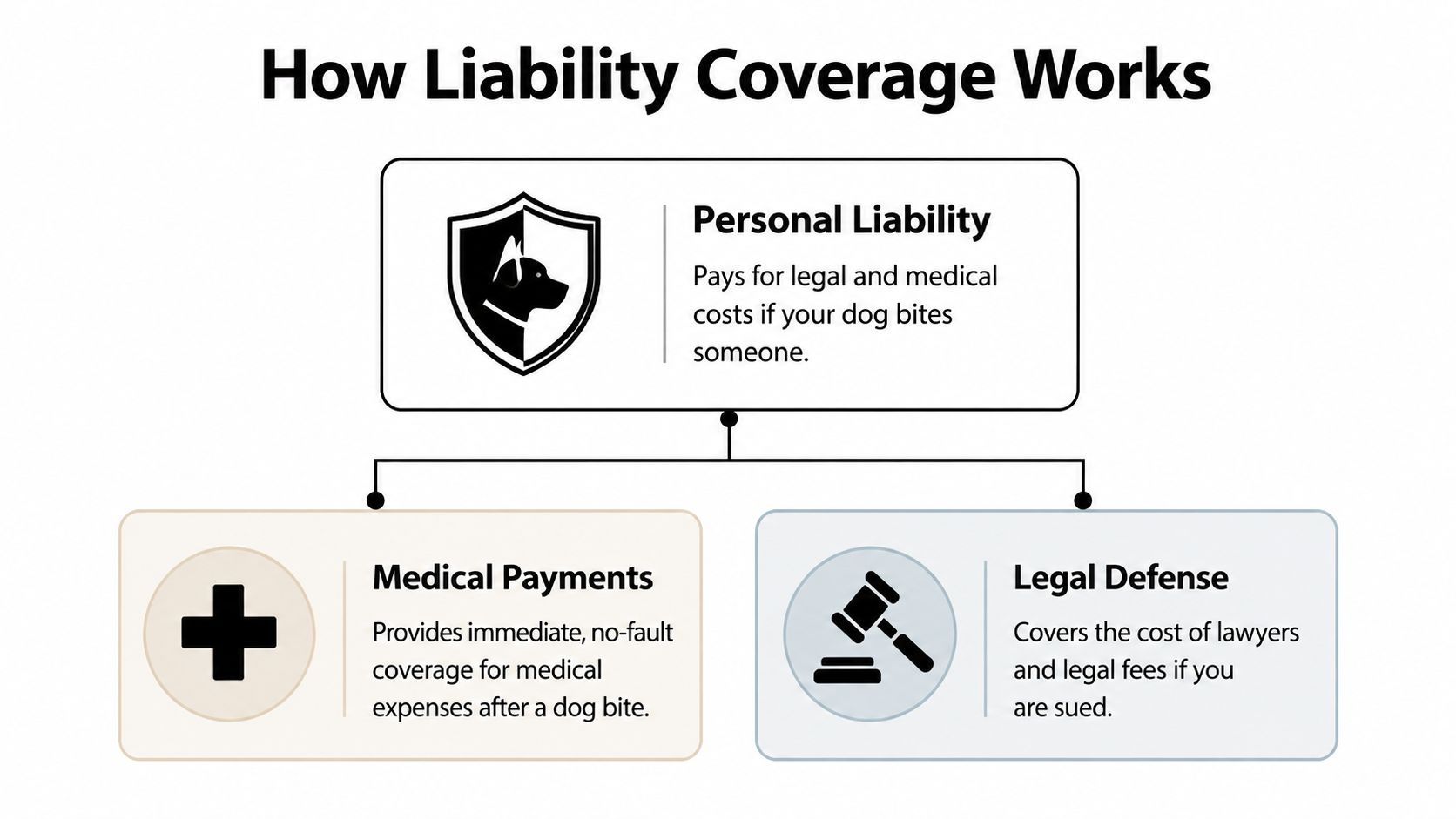
A California dog bite claim often connects to the liability part of a homeowners policy because homeowners insurance policies typically include personal liability coverage for dog bites from $100,000 to $300,000 per occurrence, covering medical expenses and damages under California's strict liability statute, Civil Code §3342, as explained in this California dog bite insurance overview.
What personal liability usually pays for
If a covered claim is made, the policy may help pay for:
- Injury-related damages: medical costs and compensatory damages owed to the injured person
- Legal defense: the cost of hiring counsel and responding to a lawsuit
- Settlement payments: if the carrier resolves the claim within policy terms and limits
Some policies also include a separate medical payments feature for smaller injuries, though the exact operation depends on the form and carrier.
Where people get confused
Many homeowners think coverage applies only if the bite happens on their property. That's not always true. Liability coverage can extend beyond the home, depending on the policy wording and the facts of the incident.
Another point of confusion is the difference between homeowners insurance and renters insurance. Renters often have liability protection too. If you want to compare how these protections fit within a broader California property policy, it helps to review a dedicated California home insurance guide and read the policy language closely.
A dog bite claim is often less about where the dog was standing and more about whether your policy's liability language treats the event as covered.
One situation people overlook
Not every dog-related injury happens at a party or on a sidewalk. Some happen while someone is working. If a delivery person, contractor, or employee is hurt on the job, insurance and legal issues can overlap with workers' compensation. For that narrower scenario, this resource on securing benefits for job-related dog attacks gives useful context.
The main takeaway is simple. Homeowners insurance often does cover dog bites, but the protection comes from a specific coverage part, and the details matter.
When Your Home Insurance Policy Wont Cover a Bite
Many homeowners learn the hard part. Coverage for dog bites is common, but it is not automatic in every case. The most painful surprises come from exclusions, endorsements, and low limits.
A claim can be valid under California law and still create a major out-of-pocket problem if your insurance policy narrows or removes protection.
After a prior bite
The biggest coverage shift usually happens after a dog has already bitten someone once. In California, a dog's bite history triggers deterministic exclusions in 80% of homeowners policies, and repeat-bite dogs can drive average claims 2.5x to over $200,000, according to this California pet liability coverage guide.
That means a homeowner may file one claim successfully, then discover at renewal that the carrier has changed the rules. The insurer might:
- Exclude the dog by endorsement
- Increase the premium
- Refuse to renew the policy
- Require a different placement option
This is one reason renters should take the issue seriously too. Liability problems don't belong only to homeowners. A renter with a dog can face many of the same coverage questions, which is why a separate California renters insurance overview is worth reviewing.
Breed exclusions and business use
Some carriers still use restricted breed rules. Others focus more on the dog's actual history and behavior. Either way, what matters is the policy you have now, not what you assume the market does in general.
A different trap involves business-related use of the dog. If the insurer believes the dog was being used for guarding, security, or another business purpose, coverage can become more complicated. The same goes for situations that fall under intentional acts or other policy exclusions.
Don't rely on a verbal answer from a call center. Ask whether there is an animal liability exclusion, a scheduled excluded animal endorsement, or a breed-related restriction in the actual policy documents.
The limits problem
Even when the claim is covered, your limit may be too low.
Here's the plain-language version:
| Situation | What happens |
|---|---|
| Claim is under your liability limit | Your policy may pay covered damages up to the stated limit |
| Claim is over your liability limit | You may have to pay the amount above that limit yourself |
| Dog is excluded | The insurer may deny the dog-related portion of the claim |
A policy can look solid on paper and still leave a large gap. If your limit is modest and the injury is serious, the insurer's obligation ends at the policy cap. Your financial obligation doesn't.
What to Do Immediately After Your Dog Bites Someone
The first few minutes matter. People often panic, apologize too much, argue, or start offering cash for treatment. Those reactions are understandable, but they can make the legal and insurance side messier.
Start with safety and calm. Then document what happened.
First actions that protect everyone
Secure the dog first. Move the dog to a crate, another room, or a fenced area. Prevent a second incident before doing anything else.
Help the injured person get care. If the injury needs urgent treatment, call for medical help. If it appears minor, encourage prompt medical evaluation anyway.
Exchange basic information. Give your name, address, phone number, and insurance carrier information if appropriate. Keep the conversation factual.
What to document
The claim file will be stronger if you gather facts while they're fresh.
- Photograph the area: include gates, leashes, doors, warning signs, and anything else relevant
- Document the circumstances: what happened right before the bite, who was present, and where the dog was
- Keep vaccination records handy: especially rabies information if requested
- Write down witness names: neighbors, guests, contractors, or anyone who saw the event
If animal control or law enforcement gets involved, cooperate and keep copies of any reports.
What not to do
Good intentions can hurt you.
- Don't admit legal fault on the spot: You can show concern without making legal conclusions.
- Don't promise to pay personally: Once insurance is involved, side agreements can create problems.
- Don't minimize the injury: A wound that looks small can later become infected or scar.
- Don't delay notice to your insurer: Late reporting can complicate claim handling.
Keep your words simple. “Are you okay?” and “Let's get you medical care” are helpful. “This is all my fault” or “I'll pay whatever it costs” can create avoidable problems.
Then call your insurer
Report the incident promptly and stick to the facts. The carrier will usually ask when and where it happened, who was injured, whether the dog has any prior history, and whether authorities were notified.
If you're unsure whether the bite will become a claim, report it anyway. That preserves your options and gives the insurer a chance to guide next steps. Waiting often makes things harder, not easier.
Boosting Your Protection with Umbrella and Specialty Policies
If you've read your policy and feel uneasy, that reaction is reasonable. Standard home insurance can help, but it may not be enough if your liability limit is modest, your dog creates underwriting concerns, or the carrier has added restrictions.
The good news is that homeowners usually have more than one way to strengthen protection.

A useful starting point is this: standard homeowners policies often cap liability at $100,000 to $500,000, and an umbrella policy can be triggered when a claim exceeds those primary limits, as explained in this dog bite liability and umbrella coverage overview.
Three ways to improve protection
| Option | Best for | Main idea |
|---|---|---|
| Higher home policy liability limit | Homeowners with no exclusion but modest limits | Increase the base protection on the homeowners policy |
| Personal umbrella policy | Households with assets to protect | Adds excess liability above underlying policy limits |
| Specialty animal liability policy | Owners facing exclusions or carrier restrictions | Separate protection designed for harder-to-place risks |
Option one works when the policy is otherwise clean
If your dog is covered and the policy has no animal exclusion, raising the liability limit may be the simplest move. It won't solve every problem, but it can narrow the gap between an ordinary claim and your exposure.
This is often the first thing I'd want a California homeowner to check. Not because higher limits are always required, but because low limits create obvious vulnerability.
Umbrella coverage helps when assets matter
An umbrella policy sits above the homeowners policy. If a covered claim exhausts the underlying limit, the umbrella may respond next, subject to its own terms and underwriting rules.
That matters for people who own a home, have savings, or don't want one incident to threaten years of financial progress.
Coverage mindset: Your homeowners policy handles the first layer. An umbrella is there for the claim that goes beyond what felt “probably enough.”
Specialty coverage fills harder gaps
If a carrier excludes your dog, raising the homeowners limit won't help. You may need a specialty liability policy or a carrier that handles animal liability differently.
For these reasons, comparison shopping becomes important. Not every insurer treats dog ownership the same way, and not every umbrella policy handles excluded animals the same way either. A broader set of California insurance resources, including policy comparison topics, can be found in these California insurance guides.
The right answer depends on the exact gap. Low limit, excluded dog, prior incident, and bundled home-plus-auto structure all call for different solutions.
Navigating Dog Bite Liability Under California Law
California homeowners need California-specific advice here. Generic national guidance often misses the two issues that matter most. The legal standard is tough on dog owners, and claim volume in this state has been consistently high.
One reason people get blindsided is that they assume the insurer will look for proof that they knew the dog was dangerous. In California, that assumption can be badly misplaced in many bite cases because strict liability changes the conversation.
Why the state context matters
The Insurance Information Institute reported that California led the nation with 2,026 dog bite claims in a recent year, totaling $120.7 million, with the highest average cost per claim at $59,561, in its 2021 homeowners liability dog bite report. That older snapshot still helps explain why California carriers pay close attention to this exposure.
In practice, that means underwriters, claims teams, and policyholders in this state are not dealing with a fringe issue. They're dealing with a recurring one.
What strict liability means for real households
California Civil Code §3342 generally puts responsibility on the dog owner when a bite happens in circumstances covered by the statute. The practical effect is that “my dog has never done this before” may matter emotionally, but it often doesn't end the claim.
That's why homeowners in places as different as Glendale, Costa Mesa, and Escondido can face similar insurance questions even if their neighborhoods, property types, and carriers differ.
Consider how these situations can play out:
- Suburban family home: guests, children, and backyard gatherings increase casual interaction risk
- Condo or townhome setting: elevators, shared walkways, and close neighbors create frequent contact points
- Wildfire-affected insurance market: homeowners may already be dealing with fewer carrier options and tighter underwriting
California regulations don't remove all problems
Some insurers can't deny strictly by breed under current California rules, but that doesn't mean dog owners are fully protected. Carriers may focus more on individual behavior, prior incidents, restraint practices, or policy endorsements.
That's an important distinction. A homeowner may hear “breed alone isn't the issue” and assume coverage is safe. It may not be. The question is whether the carrier has flagged this dog, this household, or this history as unacceptable.
Get Expert Help Comparing California Home Insurance Policies
If you've made it this far, the main lesson is straightforward. Dog bite liability is one of those risks that looks simple from the outside and becomes complicated as soon as you read the policy.
A homeowner has to think about coverage language, exclusions, limits, post-claim consequences, and California law. Then there's the practical side. If one carrier restricts the dog, another may handle the same risk differently. If you also carry auto insurance, renters insurance for another property, or life insurance to protect your family's finances, the conversation gets broader than one incident.
What a smart review should include
A useful insurance review should look at more than price.
- Check the animal language: Is there an exclusion, endorsement, or restriction tied to the dog?
- Review the liability limit: Is the current amount a realistic fit for your assets and risk tolerance?
- Ask about umbrella compatibility: Some households need an excess layer, but only if it fits the underlying policy structure.
- Look at bundled protection: Home, auto, and even life insurance should support the same financial plan instead of working as separate islands.
For homeowners trying to understand claim severity, legal exposure, and injury context from the claimant side, this Gold Dog Injury Law bite guide can help you see why seemingly modest incidents sometimes grow into bigger disputes.
Why comparison matters in California
California adds another layer because regulatory changes prohibit insurers from denying policies strictly by breed, but companies may still raise premiums or exclude specific animals after a claim, as noted in this California discussion of dog bite coverage changes. That leaves many people with partial answers and no clear plan.
A careful comparison can help you evaluate:
| Review area | Why it matters |
|---|---|
| Home insurance | Liability wording and dog-related restrictions vary by carrier |
| Auto insurance | Bundling may affect overall cost and policy coordination |
| Renters insurance | Dog liability can matter even when you don't own the home |
| Life insurance | Asset protection planning should include family financial security |
If you're ready to compare options, request a California insurance quote review and look closely at both price and liability details. That's the difference between being insured and being protected.
If you want help reviewing dog bite liability, comparing home and renters coverage, bundling with auto insurance, or checking whether life insurance fits your broader family protection plan, Mai & Associates can help you compare California policies side by side and spot coverage gaps before a claim puts your assets at risk.