Does homeowners insurance cover burst pipes? Learn coverage and filing tips

When a pipe bursts in your California home, the first thought that flashes through your mind—right after "Where's the water shut-off valve?"—is almost always about insurance. So, will your policy cover this watery mess?
The short answer is yes, a standard homeowners policy will almost always cover the water damage that results from a pipe that suddenly and accidentally bursts. But it's that last part, and the distinction between the damage and the pipe itself, where things can get a little tricky with your California home insurance.
Why Your Policy Covers the Damage but Not the Pipe
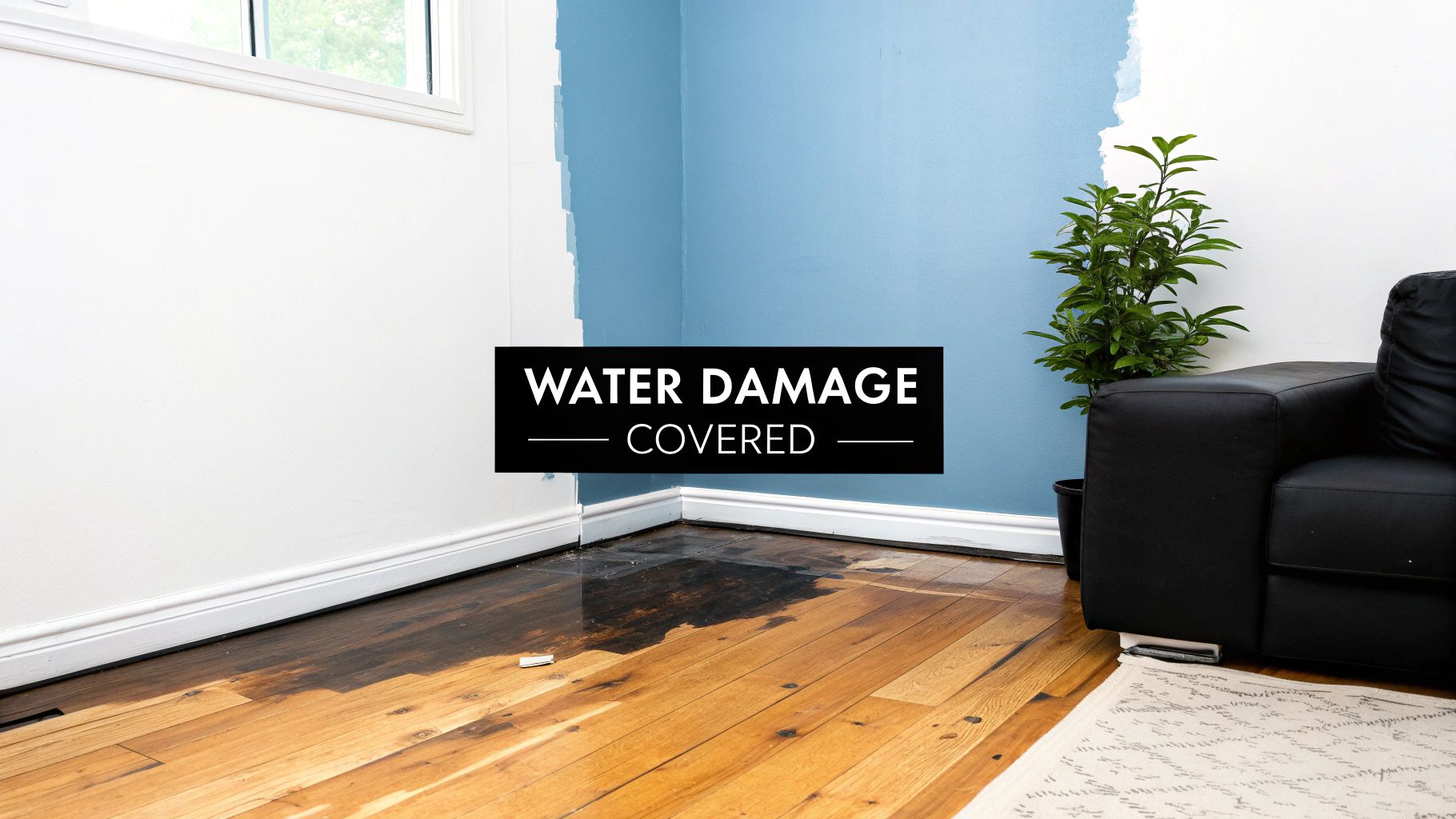
Think of it like this: the pipe is the cause of the problem, and the water damage is the widespread effect. Your insurance is there to help you deal with the disastrous effect—the ruined floors, soaked drywall, and damaged furniture. It’s not there to fix the initial cause.
Insurance carriers see your home’s plumbing as something that requires ongoing maintenance, just like your roof or furnace. Pipes get old and wear out. That's a predictable part of owning a home, not a random, unforeseen accident. The cost of replacing that worn-out pipe falls under your responsibility as a homeowner. This principle applies across many types of California insurance, from home and auto to renters insurance.
Sudden and Accidental Is the Golden Rule
The phrase you need to commit to memory is "sudden and accidental." This is the lens through which every insurer will view your claim. Your policy is an emergency fund for unexpected disasters, not a home warranty for things that wear out over time.
- Sudden Damage: This means it happened in a flash. A pipe freezing and cracking open during a rare California cold snap is a perfect example. You couldn't see it coming.
- Accidental Damage: This means the event was completely unintentional. Maybe the supply line to your dishwasher springs a massive leak out of nowhere because of a faulty connection.
This is exactly why keeping up with home maintenance is your best defense against a denied claim. Insurers draw a hard line between the cause (the failed pipe) and the effect (the water damage) to separate your maintenance duties from a true, insurable accident.
A slow, dripping leak under the sink that you've ignored for months is a classic example of a maintenance issue. If that ignored drip eventually rots the cabinet and floor, your insurer will likely point to neglect and deny the claim. They expect you to fix the small problems before they become big ones.
The stakes are high. Pipe failures are responsible for a staggering 23% of all homeowners insurance claims, making them one of the most common headaches for homeowners. According to the Insurance Information Institute, the average claim for water damage or freezing incidents between 2017 and 2021 was about $12,514.
That's a massive, unexpected bill for anyone. It really highlights why understanding the fine print of your policy is so important. Getting the right home insurance in California can be the difference between a manageable deductible and a financial catastrophe.
The Critical Difference: Was It an Accident or Neglect?
When it comes to water damage, insurance carriers draw a very clear line in the sand. Think of your California homeowners policy as a shield for unexpected disasters, not a home warranty for predictable problems. This distinction all comes down to one core principle: was the damage sudden and accidental, or did it stem from long-term neglect?
A sudden and accidental event is exactly what it sounds like—something that happens out of the blue. Picture a pipe behind your washing machine suddenly failing due to a pressure spike, sending water gushing across your laundry room. You couldn’t have seen it coming, and that's precisely what insurance is for.
Neglect, on the other hand, is a slow-burn problem. It's the drip-drip-drip from the pipe under your bathroom sink that you’ve been meaning to fix for months. When that slow leak finally causes the pipe to fail completely, the insurance company will likely view it as a maintenance issue you could have prevented, not a covered accident.
Through an Adjuster's Eyes
When you file a water damage claim, the insurance adjuster's job is to piece together the story of what happened. They aren't just looking at the damage; they're looking for its origin. Was this a sudden catastrophe, or the final, dramatic chapter of a long-ignored issue?
They'll look for tell-tale signs of neglect like corrosion, rust, visible mineral deposits, or evidence of long-term moisture. As a homeowner, you're expected to handle the routine upkeep of your property. Fixing a small leak is seen as part of the cost of owning a home, just like getting your oil changed is part of maintaining your car to keep your California car insurance valid.
The bottom line is this: Insurance is meant to put you back where you were before an unexpected disaster. It’s not designed to pay for the consequences of deferred maintenance.
This is where good record-keeping becomes your best friend. Having proof of regular plumbing inspections or receipts for past repairs can build a strong case that you’ve been diligent. It shows the burst pipe was a genuine accident, not the result of you ignoring a problem.
Real-World Scenarios
Let's make this crystal clear with a couple of examples:
- Covered (The Accident): One morning, you wake up to find your kitchen floor submerged in water. A plumber discovers that a connection inside the wall failed abruptly and without warning. This is a classic sudden and accidental loss, and your policy would likely cover the water damage.
- Denied (The Neglect): For weeks, you've noticed a musty smell and a soft spot on the drywall behind your toilet. You ignore it. Eventually, the corroded pipe behind the wall gives way, causing a flood. The adjuster would probably deny the claim, pointing to the pre-existing signs of a slow leak that you didn't address.
Getting comfortable with these concepts is one of the smartest things you can do as a homeowner. If you ever feel lost in the lingo, a good insurance glossary can help break down complex terms into plain English. Knowing your policy helps you protect your biggest investment.
When a pipe bursts and your claim gets the green light, the first wave of relief is often followed by a much more practical question: "So, what's my insurance actually going to pay for?"
The answer isn't a single lump-sum check. Instead, your California homeowners policy is built to tackle the mess from a few different angles. Think of it less like a single tool and more like a Swiss Army knife for disaster recovery, with each part designed for a specific job to get both your house and your life back on track.
Let's break down how it all works.
Dwelling Coverage: Putting Your House Back Together
First up is the heavy hitter: Dwelling Coverage, which you'll probably see listed as Coverage A on your policy. This is the core of your home's protection, and it's what pays to repair the physical structure of your house itself. When water from a burst pipe tears through your home, this is the coverage that funds the rebuild.
Dwelling Coverage is what handles the big, messy, and expensive repairs. It's earmarked for things like:
- Tearing out and replacing waterlogged drywall and insulation.
- Repairing or laying down new flooring, whether it's warped hardwood or soaked carpet.
- Fixing built-in elements that got damaged, like your kitchen cabinets or bathroom vanities.
This is the bedrock of your financial recovery, ensuring your home is made structurally sound and livable again. The coverage limit is usually tied to the estimated cost of completely rebuilding your home from the ground up.
Personal Property Coverage: Replacing Your Stuff
While Dwelling Coverage rebuilds the house, what about everything inside it? That's where Personal Property Coverage (or Coverage C) comes in. This is for all your personal belongings that were ruined by the water.
We're talking about everything from the big-ticket items like your sofa and TV to smaller things like clothes, books, and kitchen gadgets. This is a key feature in both homeowners and California renters insurance policies. You'll work with your adjuster to create a list of what was lost, and this coverage helps you get the funds to replace it all and refurnish your life.
Additional Living Expenses: A Place to Stay
In a worst-case scenario, the damage is so bad you can't even live in your home while the crews are working. This is when Additional Living Expenses (ALE), also known as Coverage D, becomes an absolute lifesaver.
If a burst pipe forces you out of your home, ALE steps in to cover the extra costs you rack up while you're displaced. This isn't for your mortgage, but for the expenses above and beyond your normal monthly budget. It can cover things like a hotel stay, a short-term rental, or even the added cost of eating out if you don't have a kitchen. The whole point of ALE is to help you maintain your normal standard of living so your life isn't completely upended while your home is being restored.
Don't underestimate the financial hit from a burst pipe. Water damage is one of the most common and costly reasons people file home insurance claims. Between 2019 and 2023, water damage and freezing events made up about 22.6% of all home insurance claims, with the average claim payout topping $15,000. You can learn more about the costs of home water damage from industry data.
Common Gaps in Your Burst Pipe Coverage
Your standard California homeowners insurance policy is a great foundation, but it's not a waterproof guarantee against every type of water damage. Thinking you’re covered for any and all water-related disasters is an easy—and expensive—mistake to make. Some events, even though they involve water wreaking havoc on your home, are specifically left out, leaving you on the hook for the cleanup and repairs.
The biggest exclusion, by far, is flood damage. Let’s be crystal clear: if a nearby river crests its banks or a torrential downpour causes flash flooding, your homeowners policy won’t cover the damage. That’s a job for a completely separate flood insurance policy.
Another major blind spot? Water that backs up through your sewers or drains. Picture the city’s sewer main getting clogged and forcing raw sewage back up into your pristine bathroom. The disgusting mess and the staggering repair bill that follows are not covered by a standard policy.
Filling the Gaps With Endorsements
The good news is you can patch these holes in your coverage. You do this with simple, surprisingly affordable add-ons called endorsements. Think of them as small, specific upgrades that give your policy a major protection boost where it needs it most.
When it comes to sewer and drain issues, the MVP is the Water Backup and Sump Pump Overflow endorsement. For a relatively small bump in your premium, this little add-on can provide thousands of dollars in coverage, saving you from one of the most stomach-churning and costly home disasters imaginable.
A standard policy is built to cover water that comes from inside your home's plumbing. Water from outside sources, like floods or sewer backups, needs its own dedicated coverage.
Most homeowners are shocked when they learn about these gaps. The average payout for a covered water damage or freezing claim is already $13,954, which just goes to show how quickly the costs add up. Now, imagine getting hit with a bill like that for an excluded event like a sewer backup. That’s a financial gut punch no one wants. You can dig into more of these water damage claim statistics to see just how high the stakes are.
At Mai & Associates, our job is to hunt for these exact kinds of gaps in California insurance policies. We comb through your coverage to make sure it truly protects you from your real-world risks—whether it's for your home, auto insurance, or life insurance—so there are no nasty surprises waiting for you.
How to File a Water Damage Claim and Get It Right
In the chaos that follows a burst pipe, what you do in those first few hours can make or break your insurance claim. It's overwhelming, but having a clear game plan is the key to navigating the process, minimizing your stress, and getting the full payout you deserve.
Your absolute first move—before you even think about calling your insurance agent—is damage control. You need to stop the water. That means finding and shutting off your home's main water supply. If you don't know where that valve is, make it a priority to find it tonight. It's usually tucked away in a garage, a utility closet, or sometimes outside near the street. Knowing its location ahead of time can turn a potential disaster into a manageable problem.
Document Everything Immediately
Once the water is off, your smartphone is your best friend. Before you touch, move, or clean up anything, you need to become a crime scene investigator.
- Take Videos First: Start with a slow, detailed video walkthrough of every affected area. Pan across the rooms, narrate what you're seeing, and capture the full scope of the water damage.
- Then, Take Photos: After the video, switch to photos. Get wide shots of each room to establish the scene, then zoom in for close-ups of specific damage—think warped floorboards, drenched drywall, ruined furniture, and the source of the leak itself, if visible. You can't have too much evidence.
- Create an Inventory: Begin making a detailed list of every personal item that was damaged. For each one, write down a description, the brand, its approximate age, and a rough estimate of its replacement cost.
This visual proof is non-negotiable. It gives the insurance adjuster a crystal-clear picture of the immediate aftermath, leaving no doubt about the extent of the initial damage.
The process of figuring out what’s covered versus what’s not can be confusing. This chart breaks down how a typical policy works, showing where standard coverage ends and where you might have gaps.
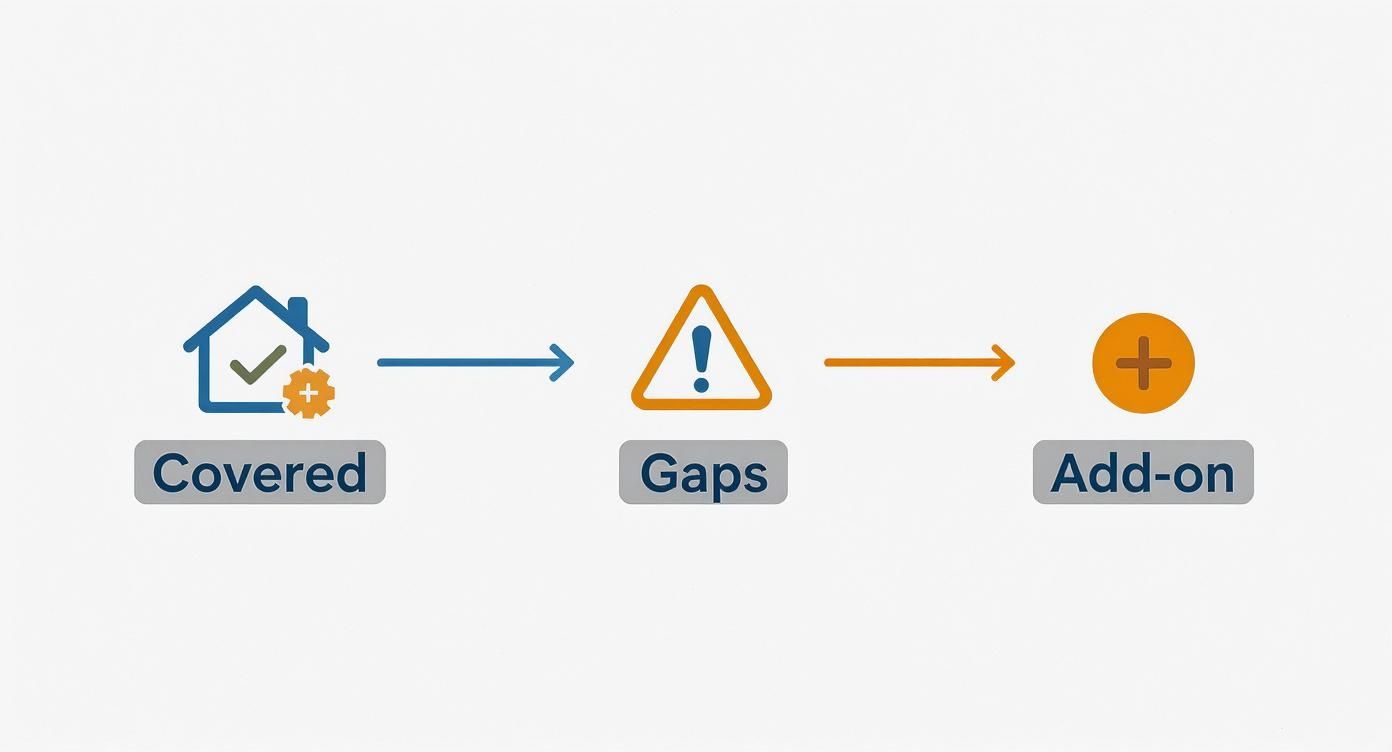
As you can see, a standard policy is great for the direct damage, but it often leaves homeowners exposed to issues like sewer backups, which need a specific add-on for true peace of mind.
Notifying Your Insurer and Preparing for the Adjuster
With your evidence in hand, call your insurance provider as soon as possible to get the claim started. They'll assign an adjuster who will come out to inspect the damage in person. Be ready to hand over all those photos, videos, and your detailed inventory list.
Key Takeaway: Your job is to build a clear, organized, and undeniable case. The more thorough your documentation, the smoother the entire claims process will be. Only make temporary repairs meant to prevent more damage (like putting a tarp on the roof) and hold on to every single receipt.
Dealing with an insurance claim can feel like a full-time job, but understanding the steps gives you the power to stay in control. For more practical advice on protecting your home and assets, you can check out our guide on California home insurance.
Keeping Your California Home Safe from Burst Pipes
Let's be honest, the best insurance claim is the one you never have to make. While California might not have the brutal winters of the East Coast, our homes face their own unique challenges—from aging plumbing systems in older neighborhoods to surprisingly high water pressure. A little proactive maintenance goes a long way in preventing a water damage nightmare.
Think of it as a quick health checkup for your home's plumbing. You can start with the basics right now. Take a look at the hoses connected to your washing machine, dishwasher, and that refrigerator icemaker. If you spot any bulging, cracking, or even a hint of moisture, don't wait. Replace them. These are notorious weak spots and often the first to go.
Smart Moves for Lasting Protection
Once you've done a quick visual inspection, a few strategic investments can seriously lower your risk. First, get to know your pipes. If you live in an older home, you might have galvanized pipes, which are far more likely to corrode and fail than newer copper or PEX piping. Knowing what you're working with is half the battle.
Next up is water pressure. You can't see it, but high water pressure is like a constant stress test on every single pipe, joint, and appliance in your house. It just wears everything down faster.
A plumber can check your home's water pressure in a few minutes. If it's creeping above 80 psi, installing a water pressure regulator is one of the single best things you can do to prevent a sudden, catastrophic pipe burst.
Finally, even in sunny California, we have cold spots in our homes that can put pipes at risk during those rare cold snaps. Don't overlook them. Pay special attention to pipes in:
- Garages: Especially those running along exterior walls.
- Crawl Spaces: These unheated areas can get surprisingly chilly.
- Attics: Any plumbing running through an uninsulated attic is vulnerable.
Wrapping these pipes with simple foam insulation from the hardware store is a cheap and easy weekend project. Taking these steps gives you more than just peace of mind; it can save you from the massive headache and expense of a water damage claim. When it comes to California home insurance, an ounce of prevention is truly worth a pound of cure.
Answering Your Top Questions About Burst Pipes
When you're dealing with a burst pipe, the last thing you want is more confusion. The claim process can feel like a maze, but getting clear answers to a few key questions can make all the difference. Let’s tackle some of the most common concerns we hear from California homeowners.
Will My Insurance Rates Go Up After a Burst Pipe Claim?
This is the big question on everyone's mind. The honest answer is: it depends. Filing a single, isolated claim won't automatically trigger a rate hike, but it could. Insurance companies base your premium on risk, and filing a claim—especially a costly one—can change how they see your property.
You might see an increase when your policy renews, or you could lose a "claims-free" discount you didn't even know you had. It’s often a smart move to chat with your agent before filing a claim for minor damage. They can help you weigh the out-of-pocket repair cost against the potential long-term impact on your premium. This is true for both home and car insurance in California.
What if the Burst Pipe Was in a Condo I Own?
Condo insurance is a bit of a team sport. Your personal policy (called an HO-6) is designed to protect everything from the "walls-in"—think your personal belongings, flooring, cabinets, and drywall. This is a vital piece of the California insurance puzzle for condo owners.
The pipe itself, especially if it’s inside a shared wall, is usually the responsibility of the Homeowners Association (HOA). Their master insurance policy covers the building's structure and common areas. The key is to get familiar with your HOA’s specific rules and bylaws before you have a problem.
Key Insight: Don't assume you're fully covered for mold. Most standard home policies include a very small amount for mold remediation—often capped at $5,000—and only if it’s the direct result of a covered problem, like a sudden pipe burst. Mold that grew over time from a slow, neglected leak? That's almost never covered.
For more answers to common insurance questions, you can explore our detailed California insurance FAQ page.
Every home is unique, and so is every insurance policy. If you’re feeling uncertain about what your policy covers when it comes to water damage or other risks, we can help clear things up.
The licensed agents at Mai & Associates are here to review your current policy and provide same-day quotes for home insurance, auto insurance, renters insurance, and life insurance. Secure the right protection for your California home by visiting cahomeauto.com today.