Does Home Insurance Cover Foundation Issues in California?
Let's cut right to the chase: In most cases, a standard homeowners insurance policy will not cover foundation issues. It’s a hard truth, but one every homeowner in California needs to understand.
Coverage typically only kicks in if the damage is the direct result of a specific, sudden event listed in your policy—what the industry calls a "covered peril." Think of a fire, or a burst pipe that suddenly washes away the soil supporting your home. Gradual cracks that appear over time from the house settling? Those are almost always on you. This is a crucial distinction in any home insurance policy.
Why Your Foundation Is Probably Not Covered
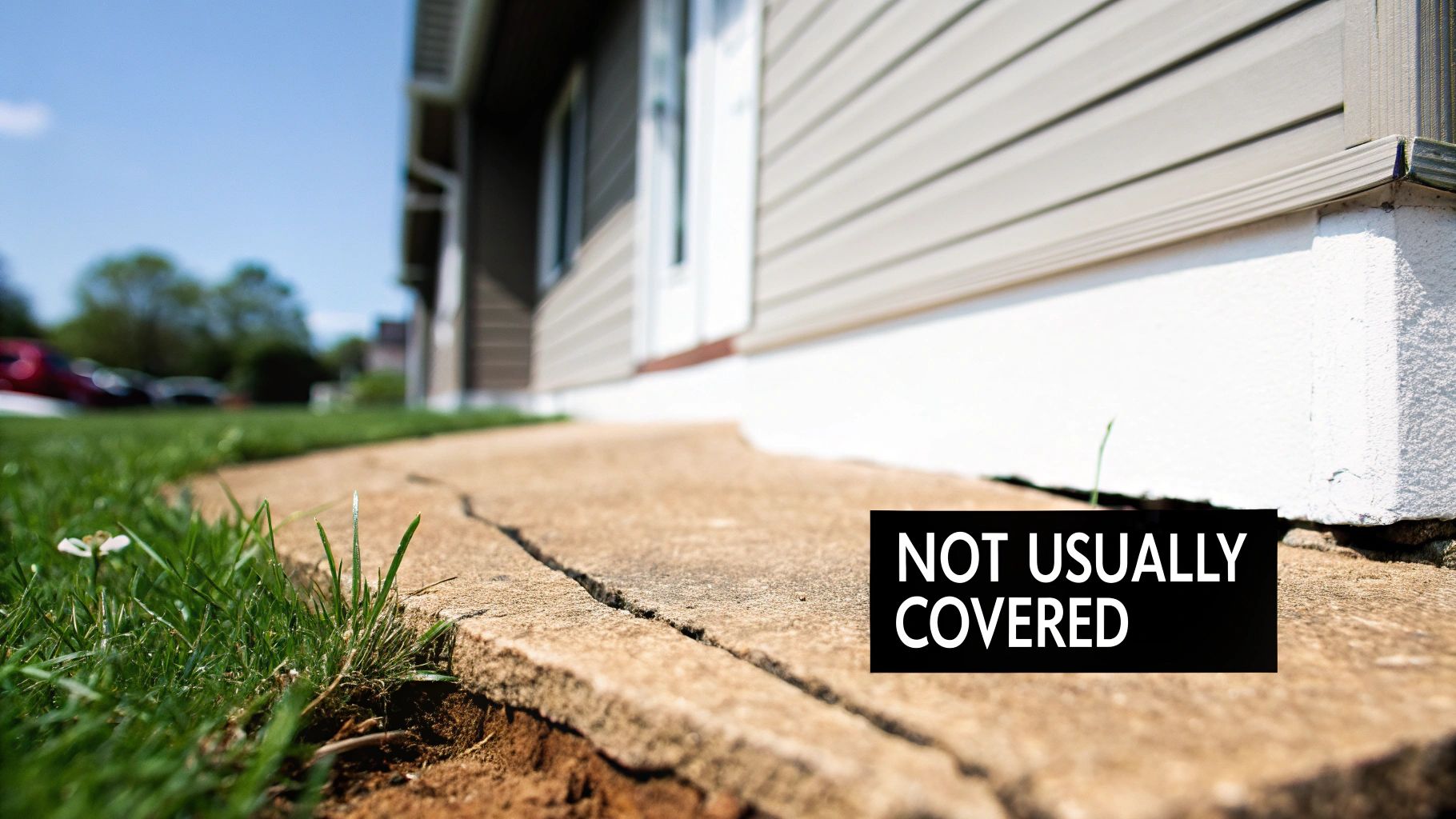
Many California homeowners understandably assume their insurance is a safety net for any major problem, but that’s a common and costly misconception. Your foundation is a perfect example of where the line is drawn.
It helps to think of your policy less like an all-encompassing warranty and more like protection against unexpected disasters. It’s there for the sudden and accidental stuff—a tree falling on your house, an explosion, or a vehicle crashing into your wall. It's not designed to cover the slow, predictable process of a house aging, like the ground shifting over years or concrete naturally settling. This principle applies across different types of California insurance, from home to auto insurance.
At its core, home insurance is meant to shield you from unforeseen catastrophes, not to act as a home maintenance fund. Problems that develop gradually, like soil expansion or normal wear and tear, are considered the homeowner's responsibility to manage.
To give you a clearer picture, let's break down some real-world scenarios in a simple table.
Foundation Damage Scenarios: Covered vs. Not Covered
This table offers a quick look at what's typically included or excluded in a standard policy.
| Damage Scenario | Typically Covered by Standard Policy? | Reason |
|---|---|---|
| A water pipe bursts, eroding soil and causing a foundation collapse. | Yes | The damage was caused by a sudden and accidental "covered peril" (burst pipe). |
| Your house settles over a decade, leading to hairline cracks. | No | This is considered gradual wear and tear, a maintenance issue. |
| An earthquake shifts the ground, cracking the foundation slab. | No | Earth movement is a standard exclusion. You need a separate earthquake policy. |
| Tree roots slowly grow and push against the foundation, causing cracks. | No | This is a gradual event and often falls under maintenance responsibilities. |
| A fire weakens the structural integrity of your foundation. | Yes | Fire is a named peril in virtually all standard home insurance policies. |
| Poor soil compaction from when the house was built leads to sinking. | No | Damage from faulty construction or poor workmanship is typically excluded. |
As you can see, the cause of the damage is everything. If it's slow and predictable, it's almost certainly not covered.
The Reality of Insurance Claims
The numbers back this up. In 2023, only 5.3 percent of all insured homes in the U.S. even filed a claim. And while property damage made up 97.3 percent of those claims, foundation issues often get denied due to common exclusions like "earth movement" or "gradual deterioration."
The financial hit can be significant, so it's smart to look at a foundation crack repair cost guide to get a sense of the potential out-of-pocket expenses. All this insurance jargon can get confusing, so if you're stuck on a term, our insurance glossary can help clear things up.
Why Most Foundation Damage Claims Get Denied
It’s a gut-wrenching feeling: you discover a serious crack in your foundation, file a claim, and get a denial letter in the mail. For most homeowners, it’s a frustrating and confusing experience. But the hard truth is that the reasons for denial are almost always baked right into the fine print of a standard home insurance policy.
The core issue comes down to one critical distinction: your policy is designed to cover sudden and accidental damage, not problems that develop slowly over time. If a problem has been brewing for months or years, the insurance company sees it as a maintenance issue—and that, unfortunately, falls on you.
The Big One: The Earth Movement Exclusion
By far, the most common reason foundation claims are rejected in California is the “earth movement” exclusion. This is a catch-all term that lets insurers off the hook for just about any damage caused by shifting ground.
- Soil Settling and Expansion: We have a lot of expansive clay soil here in California. When it’s dry, the soil shrinks and pulls away from the foundation. After a good rain, it swells up with incredible force. This constant push-and-pull cycle puts immense stress on a foundation over the years, causing cracks. Because it’s a slow, natural process, it’s a textbook example of excluded earth movement.
- Sinkholes and Mudslides: Even more catastrophic events like these are explicitly excluded. They are considered classic forms of earth movement, and your standard home, renters insurance, or even auto insurance policy won’t touch them.
- General Shifting: Any minor, non-earthquake-related shifting of the land your house is built on is also not covered.
This exclusion is so sweeping that it single-handedly knocks out coverage for the most frequent causes of foundation issues in our state.
Slow Leaks and Seepage: The Gradual Water Damage Problem
Another major roadblock for homeowners is gradual water damage. This one trips up a lot of people. A sudden pipe burst that floods your basement and destabilizes the foundation? That’s almost always covered.
But what about a tiny, persistent leak from a pipe in your crawlspace that you don't notice for a year? That constant dampness will weaken the soil and can even degrade the concrete itself. Because it didn’t happen all at once, the resulting foundation damage won’t be covered. The same goes for groundwater that consistently seeps through your foundation walls because of poor yard drainage.
The rule of thumb is simple: If the water damage was a long-term problem, the claim is going to be denied. Insurers consider this a preventable maintenance issue, not a sudden accident.
Wear and Tear and Shoddy Workmanship
Finally, there are two other exclusions that frequently come into play. The first is plain old "wear and tear." A house, just like a car, gets older. You wouldn't expect your car insurance to buy you new tires just because the old ones are bald. In the same way, your homeowners insurance won’t pay to fix a foundation that has simply aged and developed minor cracks over decades.
The second is faulty construction or poor workmanship. Let's say your foundation is failing because the original builder used a bad concrete mix or didn't prepare the ground properly. Your insurance policy won't cover that. The liability in that situation points back to the builder, not your insurance carrier. Getting a handle on these exclusions is the first step in seeing the real gaps in your standard policy.
So, while the fine print on most policies can feel a bit discouraging, it's not all doom and gloom. There are absolutely times when your homeowners insurance will step up to the plate and cover foundation repairs. You just need to remember the golden rule of insurance claims: the damage must be sudden and accidental.
Your policy is built for emergencies, not for the slow march of time. It's not there to fix problems that develop over years, but it's your financial first responder when a specific, named disaster hits your home. If one of these "covered perils" is the direct culprit behind your foundation issue, your dwelling coverage (also known as Coverage A) is designed to kick in and pay for the repairs.
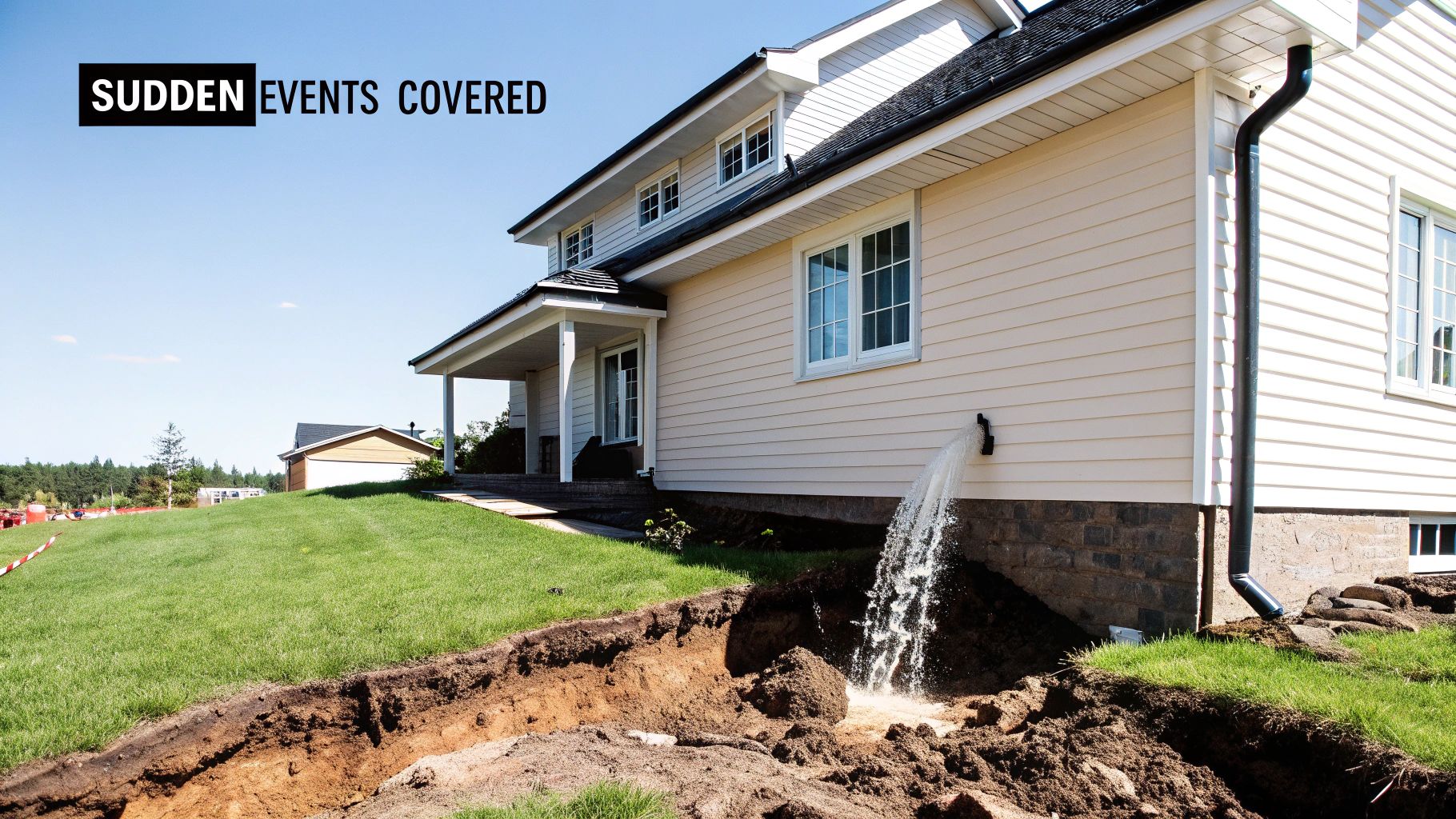
Sudden Water Damage from Internal Sources
This is probably the most frequent reason a foundation claim gets approved. Let's say a water heater gives out or a supply line to your dishwasher ruptures while you're away for the weekend. The sudden, massive release of water soaks the ground beneath your home, washing away the soil supporting your foundation and causing it to shift or crack.
This is a textbook example of a covered event. The key here is the word sudden. Because the pipe burst was an abrupt, accidental event, the resulting foundation damage it caused is covered, too. This is worlds apart from a tiny, dripping leak that you don't notice for months—that would be considered a maintenance issue.
Fire and Explosions
A severe house fire is another clear-cut covered peril. If a blaze gets hot enough, it can cause the concrete in your foundation to spall or crack, compromising its structural integrity. Your policy is there to cover the repairs needed to make your foundation solid again, right along with the rest of the fire and smoke damage.
The same goes for explosions. Whether it's a natural gas leak inside the home or a major incident nearby that sends a shockwave through your property, any resulting cracks or damage to the foundation would be covered. It's sudden, it's accidental, and it's a listed peril.
The core principle is straightforward: If the foundation damage is a direct and immediate consequence of a covered event like a fire or sudden pipe burst, the claim will almost always be approved. The policy follows the peril.
Impact from Vehicles or Falling Objects
It might sound dramatic, but it happens more often than you think. If a car loses control and slams into the side of your house, the impact can easily be strong enough to crack the foundation. Your homeowners policy would cover those repairs.
This same logic applies to other types of sudden impact. A classic example is a powerful windstorm that uproots a huge oak tree in your yard, sending it crashing down onto your roof and foundation. Since windstorms and falling objects are standard covered perils, the damage is covered. Getting good advice on your policy is critical, and you can learn more about finding the right home insurance in California to make sure you're protected from these kinds of unexpected events.
If you find yourself in one of these situations, what you do next is critical. Documentation is everything.
- Act Immediately: Once it's safe, pull out your phone and take photos and videos of everything from every angle.
- Document the Cause: Get clear shots of the source of the problem—the burst pipe, the fire-damaged area, or the tire marks leading to the impact point.
- Mitigate Further Damage: Do what you can to prevent the problem from worsening, like shutting off the water main. Insurers expect you to take these reasonable steps.
- Contact Your Agent: Report the claim right away and have all your photos and notes ready to go.
Knowing when damage is sudden and accidental helps you move quickly and with confidence when disaster strikes.
How California's Climate Puts Your Foundation at Risk
California's beautiful scenery and famous sunshine come with a hidden cost—an environment that is uniquely punishing to your home's foundation. The state's climate isn't just one thing; it's a volatile cycle of extremes. We swing from long, punishing droughts to intense, flooding atmospheric rivers, creating a perfect storm for foundation trouble.
This constant push and pull from Mother Nature is precisely the kind of slow-moving, gradual damage that standard home insurance policies are designed to exclude.
The Whiplash Effect of Rain and Drought
Think of the soil under your house as a giant, thirsty sponge. During California's long droughts, that sponge dries out completely. The soil shrinks, cracks, and pulls away from your foundation, creating empty spaces where solid support used to be. The immense weight of your home, now unevenly distributed, causes it to settle, leading to cracks and serious structural strain.
Then, when the rains finally come—often with the overwhelming force of an atmospheric river—that same soil becomes super-saturated. It swells with incredible power, pushing relentlessly against your foundation walls. This destructive cycle of extreme shrinking and swelling happens year after year, guaranteeing that gradual damage will occur.
Because these are slow, climate-driven changes, they fall squarely into the "earth movement" and "gradual damage" exclusions we discussed earlier. For California homeowners, this creates a massive—and often completely overlooked—gap in their insurance coverage.
This environmental stress is dramatically reshaping the California insurance market. Climate-related disasters are making foundation problems like soil erosion and cracking worse, yet standard policies are built to cover sudden events, not this kind of slow-motion damage.
The numbers tell the story:
- National losses from natural disasters ballooned from $30.8 billion in 2013 to $79.6 billion in 2023.
- In California, where Mai & Associates serves thousands of clients, average home insurance premiums are projected to hit $2,900 annually.
- While that’s below the national average for now, rates have already climbed over 30 percent from 2020-2023 as major insurers flee the state.
- This exodus has caused the number of state FAIR Plan policies to double since 2018.
You can learn more about how climate change is affecting homeowners insurance to get a better handle on these powerful trends.
Why Insurers Are Getting Nervous
The relentless cycle of wildfires, floods, and droughts makes California an extremely high-risk state for insurance carriers. These events don't just destroy homes directly; they fundamentally change the landscape and soil stability. This, in turn, leads to more of the long-term foundation claims that insurers are determined to avoid paying.
As a result, many big-name insurance companies are packing their bags and leaving California. They're either refusing to write new home insurance or car insurance policies or becoming incredibly strict with who they'll cover. This pullback makes finding reliable, comprehensive protection harder than it's ever been.
In this challenging market, a "one-size-fits-all" policy from a single company is a recipe for disaster. The gradual damage caused by California's climate is a guaranteed exclusion, leaving your most valuable asset completely exposed.
Given California's active geology, protecting your home also means considering factors like a professional earthquake risk assessment and slope stability analysis.
This market chaos is precisely why expert guidance is no longer a luxury—it's a necessity. An independent agency like Mai & Associates, which lives and breathes the California market, knows how to navigate these challenges. We work with a wide range of carriers to piece together real solutions, from strong home and auto insurance bundles to specialized life insurance and renters insurance policies built for the unique risks of living here. It’s not just about getting a policy anymore; it's about getting the right one.
Closing Your Coverage Gaps with the Right Policies
Realizing just how many gaps exist in a standard homeowners policy is the first, and most important, step. The next is to build a smarter, stronger safety net with coverage designed specifically for California’s unique risks. Since the slow-moving foundation damage caused by our climate and soil is almost never covered, you need a proactive plan to secure policies that will actually be there for you when you need them.
This means moving beyond a one-size-fits-all policy and strategically layering different types of protection. This is where working with an independent agency like Mai & Associates really pays off. We can help you assemble the right combination of home, auto, and life insurance policies to create a solid financial defense.
Demystifying Earthquake Insurance
The single biggest threat to a home's foundation in our state is, without a doubt, seismic activity. And it's a universal exclusion in every single standard home, renters, and even car insurance policy out there. To get coverage for it, you absolutely need a separate Earthquake Insurance policy.
This isn't just a simple add-on; it's a completely different policy. It's built from the ground up to cover structural damage—including foundation repairs—that happens as a direct result of an earthquake. In California, these policies mostly come from the California Earthquake Authority (CEA) or a few private insurers. The bottom line is simple: without it, you are 100% uninsured for any foundation damage caused by a quake.
This flowchart shows how our state’s climate can create the very foundation risks that standard policies are designed to exclude.
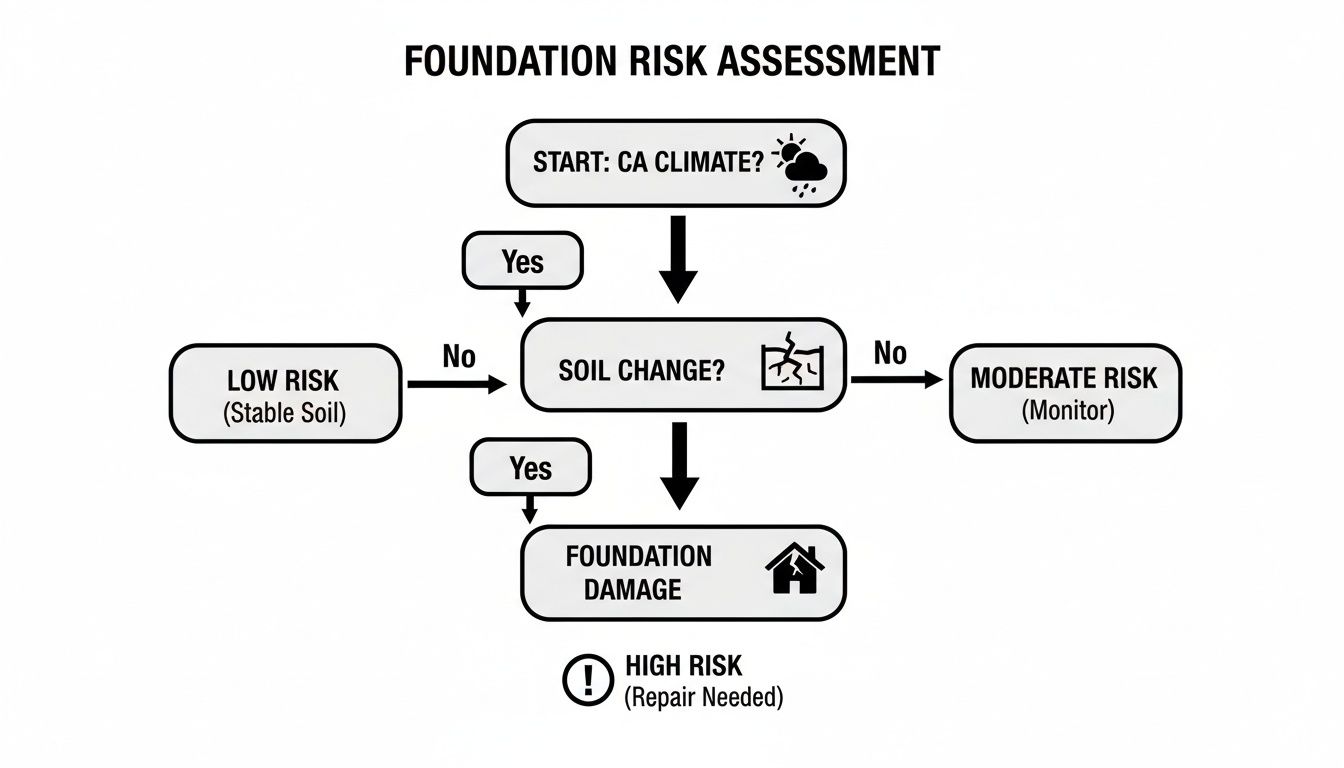
You can see the direct line from California's climate extremes to soil changes and, ultimately, to the kind of foundation damage your basic insurance just won't touch.
The California FAIR Plan and DIC Policies
With more private insurers pulling back from high-risk areas, many homeowners are finding that the California FAIR Plan is their only option. It’s critical to understand what the FAIR Plan is—and, more importantly, what it isn’t.
- What it is: The FAIR Plan is an insurer of last resort. It provides basic fire insurance when you can’t get coverage anywhere else.
- What it isn’t: It's not a comprehensive homeowners policy. It leaves you exposed, with no coverage for common things like liability, theft, or water damage from a burst pipe.
To fill these huge gaps, you have to pair your FAIR Plan policy with something called a Difference in Conditions (DIC) policy. This separate policy essentially "wraps around" the FAIR Plan, adding back all the essential coverages you're missing. An experienced agent can help you find and combine these two policies to build protection that feels like a traditional home insurance plan.
A Valuable Add-On: Ordinance or Law Coverage
Here’s a scenario that catches too many homeowners by surprise. Let's say your foundation damage is from a covered event, like a fire. You could still face a massive, unexpected bill. Building codes change. When you rebuild, you'll be required to bring your foundation up to today's much stricter standards, which can easily add tens of thousands to the cost.
This is exactly what Ordinance or Law coverage is for. It's a valuable endorsement you can add to your policy to help pay for these mandatory, code-related upgrades.
Having the right combination of policies isn't about finding one perfect plan. It's about strategically layering different coverages—Earthquake, FAIR Plan with a DIC, and Ordinance or Law—to create a resilient shield against California’s specific threats.
The market data tells the story. Widespread foundation exclusions are driving huge demand for these specialized policies. While standard policies deny claims for 97.3 percent of property damages not caused by sudden perils, the dwelling coverage segment is expected to see the fastest growth at over a 9 percent compound annual growth rate. This affordability crisis is hitting major markets like California hard, with premiums rising sharply.
At Mai & Associates, we counter this by comparing rates from multiple carriers, focusing on tailored earthquake and FAIR Plan solutions when basic policies won’t cover foundation settling.
Building this kind of robust protection takes real expertise. Check out our other insurance guides to learn more about protecting your assets.
Finding the Right Insurance Partner in California
Let's be honest: trying to figure out California insurance can make your head spin. It’s a tough market. We've established that your standard homeowner's policy is probably not going to help you when it comes to the most common foundation issues. That's a scary thought, but it also means being proactive isn't just a good idea—it's essential for protecting what is likely your biggest asset.
The good news is you can move from a place of uncertainty to one of control. It all starts with a simple, straightforward plan you can put into motion today. This is how you get ahead of potential problems and make sure you have the right protection in your corner before you need it.
Your Three-Step Action Plan
Building a solid defense for your home’s foundation doesn’t have to be complicated. If you follow these three steps, you can save yourself a world of financial pain and frustration down the road.
Get a Professional Foundation Inspection: You can't fix what you don't know is broken. Hire a licensed structural engineer or a dedicated foundation specialist to get an honest look at your home’s condition. They can spot vulnerabilities you’d never see, giving you a chance to address them before they turn into full-blown disasters.
Document Everything: Grab your phone and start taking pictures and videos. Get detailed shots of your foundation from every angle, inside and out. This creates a timestamped "before" snapshot that could be your most valuable piece of evidence if you ever need to prove the damage happened suddenly from a covered event.
Schedule a Comprehensive Policy Review: The worst time to find out what your policy doesn't cover is after you've filed a claim. A thorough review with an expert can shine a light on any critical gaps and help you explore add-ons or different policies better suited for the unique risks we face here in California.
The Mai & Associates Advantage
This is exactly where working with an independent brokerage like Mai & Associates really pays off. We’re not a captive agent who works for just one insurance company. That means we aren't stuck with a single rulebook or a limited menu of options. Our loyalty is to you, period.
We do the legwork for you, shopping the entire market to compare options from dozens of top-rated carriers for all your insurance needs—from home insurance and auto insurance to renters insurance and life insurance. This approach lets us find the right fit at a fair price, which is especially critical for homeowners in areas that big insurers might avoid.
Navigating California's insurance market is more than just buying a policy; it's about finding a strategic partner. An independent agent is your advocate, fitting together the right pieces—like a solid auto policy, a specialized FAIR Plan, and other endorsements—to create a complete shield for your family.
Whether you need to finally add that earthquake policy or figure out how to pair a private policy with the California FAIR Plan, our team knows how to get it done. We specialize in building real-world insurance solutions for the real-world risks Californians live with every single day.
Answering Your Questions About Foundation Coverage
Let's cut through the insurance jargon. When it comes to your home's foundation, knowing what is and isn't covered can save you a massive headache and a lot of money down the road.
Here are some of the most common questions we hear from homeowners.
- I just found cracks in my foundation. Is that covered? (It all comes down to why the cracks appeared).
- I live in California. Does my policy automatically include earthquake insurance? (Spoiler: it doesn't).
- My insurance company dropped me because I live in a high-risk area. What now? (You have options, like the FAIR Plan).
- Foundation repairs are expensive. Is extra insurance actually worth the cost? (Let's weigh the costs vs. the risks).
Common Claims Questions
Will My Home Insurance Cover the Foundation Cracks I Just Discovered?
Probably not, if those cracks are from the house settling over time, soil shifting, or subpar construction from when it was built. Your standard homeowners policy is designed to cover things that are sudden and accidental, not slow-developing problems.
Now, if a truck slams into your house or a sudden pipe explosion causes immediate cracks, that's a different story. That’s a covered event, and you should absolutely file a claim.
Sudden and accidental damage is the key phrase here. Standard policies almost never cover gradual wear and tear.
Is Earthquake Insurance Included in My California Home Policy?
No, and this is a critical gap many California homeowners don't realize until it's too late. Standard policies explicitly exclude damage from earth movement.
Without a separate earthquake policy, any foundation damage from a tremor—big or small—comes directly out of your pocket. You can get this coverage through the California Earthquake Authority (CEA) or a private insurance company.
Options for High-Risk Homeowners
What Are My Options When an Insurer Drops Me for Living in a High-Risk Area?
It can be jarring to lose your coverage, but don't panic. This is where working with an independent agency like Mai & Associates really pays off. We can shop your policy with multiple carriers who might be more comfortable with the risk.
If that doesn't work, we can turn to the California FAIR Plan. It provides a basic fire policy. We then pair it with a special "Difference in Conditions" (DIC) policy to fill in the crucial gaps, like coverage for liability, theft, and water damage from a burst pipe.
How Much Does Foundation Repair Cost, and Is Extra Insurance Worth It?
The costs can be staggering. Minor crack sealing might run you a few thousand dollars, but major work like underpinning to stabilize a sinking foundation can easily soar past $50,000.
When you consider that your standard policy won't touch the most common causes (settling and soil movement), adding an earthquake policy or another specialized endorsement starts to look like a very smart financial decision.
| Repair Scenario | Estimated Cost | Is It Typically Covered? |
|---|---|---|
| Minor crack sealing | $1,000 – $5,000 | No, this is considered maintenance. |
| Major underpinning work | $20,000 – $50,000+ | Only if caused by a covered peril or with a special policy. |
Use these realities to guide your insurance strategy.
For more answers to your questions, explore our California home insurance FAQs.