Does Car Insurance Cover Vandalism?
Standard car insurance can cover vandalism, but only if your policy includes coverage for non-collision incidents. If you carry liability-only insurance, damage to your own car from keying, broken windows, graffiti, or slashed tires usually isn't covered, and if you do have this protection, many drivers still pay the first $250 to $500 through their deductible.
You walk back to your car after work, after dinner, or after a night parked on the street, and something is wrong right away. A deep scratch runs down the door. A window is shattered. Maybe someone spray-painted a panel or slashed a tire. The first reaction is usually the same. Anger, confusion, then the practical question: does car insurance cover vandalism, and is it even worth filing a claim?
For California drivers, that question matters more than most people realize. Vehicle vandalism isn't some rare insurance oddity. The Highway Loss Data Institute reported an average of 692 vandalism claims per day during a five-year study, with an average cost of $1,528 per claim, totaling over $1.4 million in estimated industry-wide losses every day according to HLDI research on auto vandalism losses.
That means two things. First, you're not overreacting if this feels expensive and disruptive. Second, the right answer isn't always just “file a claim.” Sometimes that's the smart move. Sometimes paying out of pocket is cleaner and cheaper in the long run.
This guide looks at the practical side of vandalism claims in California. It covers what insurance applies, where drivers get tripped up on break-ins versus theft, and how to decide whether filing makes financial sense.
That Sinking Feeling Discovering Your Car Was Vandalized
It usually starts with a quick glance that turns into a long stare. At first, you think maybe the light is hitting the paint oddly. Then you get closer and see the scrape, the smashed glass, or the slashed rubber. If you street-park, leave your car in an apartment lot, or use public parking often, you know how exposed a vehicle can feel.
In California, I've found that what throws people off most isn't only the damage. It's the uncertainty right after. They don't know whether to call the police first, their insurer first, or a glass shop first. They also don't know whether the incident counts as vandalism, theft, or both.
Why this hits harder than people expect
Vandalism feels personal in a way many other claims don't. A fender bender is frustrating, but there's usually a clear event and a clear process. Vandalism is different. Someone intentionally damaged your property, then disappeared.
That emotional side matters because it can push people into rushed decisions, including filing a claim before they know whether the numbers make sense.
A calm first hour after discovering the damage usually leads to a better claim decision than an emotional first ten minutes.
What California drivers usually need most
Many drivers don't need a long lecture on policy language. They need straight answers to a few practical questions:
- Do I have the right coverage: If you only carry liability, your own car damage usually isn't covered.
- What kind of incident is this: Keying and graffiti are one thing. A smashed window during a break-in can raise different documentation issues.
- Should I file: Coverage exists doesn't always mean filing is your best move.
- What else is affected: If items were stolen from inside the car, that often becomes a renters or homeowners insurance issue, not just an auto one.
That's the main frustration behind “does car insurance cover vandalism.” The coverage question is only the first layer. The financial decision is the one that usually matters most.
The One Coverage That Protects Against Vandalism
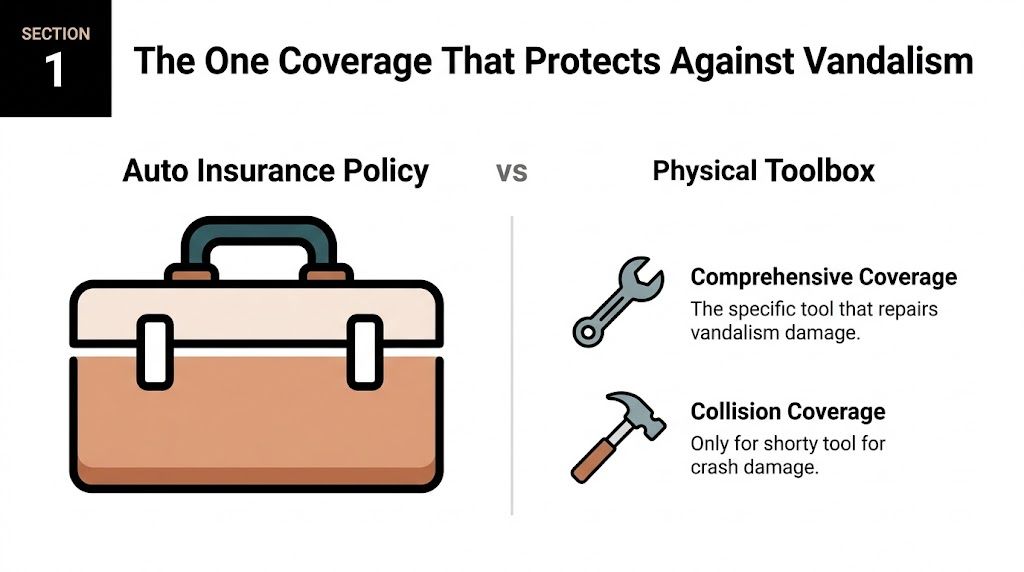
Think of your auto policy like a toolbox. Each coverage is built for a specific kind of problem.
Liability helps pay when you damage someone else's property or injure someone else. Collision helps with crash damage to your car. Protection for non-collision incidents covers many types of damage that happen while your car is parked or otherwise not involved in a typical accident.
That distinction matters because vandalism is not handled under collision. It falls under other-than-collision coverage.
What comprehensive actually does
Industry guidance is consistent on this point. Vandalism is treated as a non-collision claim, not a collision claim. This specific type of coverage is optional in most states and can pay for damage from keying, slashed tires, broken windows, and graffiti, but only after your deductible. Many drivers choose deductibles between $250 and $500, as explained in Progressive's overview of vandalism and comprehensive coverage.
If you only bought the minimum liability coverage to keep costs down, there's the hard truth: your policy usually won't repair your vandalized car.
The easiest way to read your own policy
If you're not sure what you carry, don't start by hunting through every endorsement. Check the declarations page and look for coverage for damage from incidents other than collisions, or wording that points to non-collision damage. If it's listed, then vandalism may be covered subject to the deductible and policy terms. If it isn't listed, this is usually an out-of-pocket problem.
Many California drivers use the term “full coverage” casually, but that phrase is not a specific type of protection on its own. What matters is whether this specific physical damage protection is included on the policy.
For a plain-English breakdown of how this piece of protection works, this guide on how to protect your car with comprehensive insurance is useful. If you want to compare options on a California policy specifically, Mai & Associates also has a practical overview of California auto insurance coverage choices.
Practical rule: If your concern is vandalism to your own vehicle, the one coverage line you need to confirm is comprehensive.
What Car Insurance May Not Cover
Many claims become complex. The visible damage may look like simple vandalism, but the event itself may not be that simple.
A keyed door is usually straightforward. A smashed window with a missing backpack, missing tools, or stolen parts creates a different claim conversation. Insurers often still place these losses under non-collision coverage, but the classification and documentation can change depending on whether the loss looks like vandalism, break-in damage, theft, or a mix of all three.
The gray areas that confuse drivers
Consumers are often unsure how insurers handle borderline events. A broken window from a car break-in, catalytic converter theft, or gasoline contamination may be classified differently, and while insurers generally group these under non-collision coverage, theft-related events often require different documentation than simple vandalism, as discussed in Car and Driver's guide to vandalism versus related losses.
Here's how that usually plays out in practical terms:
- Pure vandalism: Keying, graffiti, or intentional body damage with nothing stolen.
- Break-in damage: A smashed window or pried door lock where the main visible damage came from entry.
- Theft-related loss: Missing parts, stolen accessories, or signs that someone entered the car to steal property.
The repair bill may still move through non-collision physical damage coverage, but the adjuster may want different proof depending on what happened.
What your auto policy usually won't pay for
This is the part many drivers learn too late. Auto insurance may cover damage to the car itself, but personal belongings taken from inside the vehicle are usually a separate insurance issue.
If someone breaks your window and steals your laptop, bag, or other personal items, your renters insurance or home insurance may be the policy that matters for those belongings. Your auto claim may focus on the broken glass and vehicle damage. Your property claim may need to go elsewhere.
That's one reason California households should think about insurance as a package, not a set of unrelated policies. Auto protects the vehicle. Renters or homeowners insurance may protect the stuff inside it.
When a claim involves both car damage and missing personal property, sort the loss into two buckets first. Vehicle damage and personal belongings are often handled by different policies.
How to File a Car Vandalism Claim in California
The best claims start with clean documentation. If you rush to sweep up glass, drive the car away, or repair something before taking photos, you can make the process harder than it needs to be.
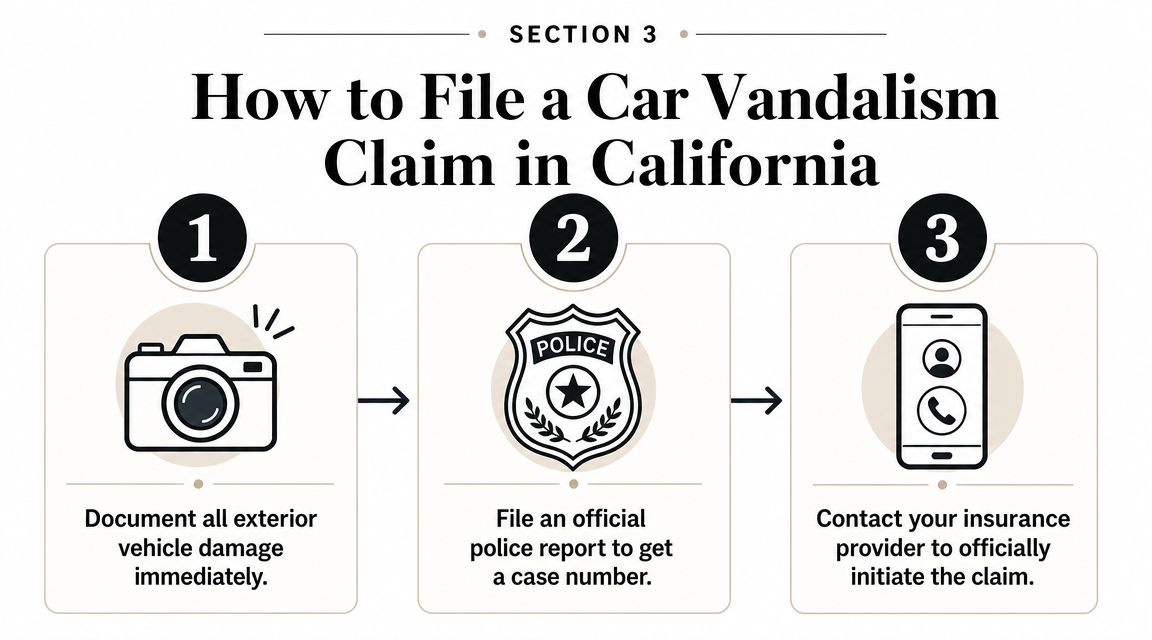
A vandalism claim in California usually goes more smoothly when you follow the event in order and keep your paperwork tight from the beginning.
Start with the scene, not the app
Before you call anyone, make sure the area is safe. If the vandalism happened with signs of an attempted theft or the vehicle is in an unsafe location, handle that first. Then document everything before moving the car if you reasonably can.
Take photos from multiple angles. Get wide shots showing where the car was parked, then close-ups of every damaged area. If glass is broken, photograph both the exterior and interior. If something looks tampered with, capture that too.
A short video walkaround can help because it preserves context in a way close-up photos sometimes don't.
File a police report early
For vandalism and theft-related events, insurers commonly want a police report or report number. Filing early also helps lock in the facts while they're fresh.
When you report it, be specific and factual. Say what you found, where the car was, when you last saw it undamaged, and whether anything appears missing. Don't guess at motives and don't overstate what you can't verify.
Contact your insurer or agent with the right details
Once you've documented the scene and filed the report, contact your insurer. Have these ready:
- Your policy information: The carrier will want the policy number and vehicle details.
- Basic timeline: When you parked, when you returned, and when you discovered the damage.
- Police report details: Even if the final report isn't ready, a case number helps.
- Photos and video: These often answer questions before an adjuster even asks them.
If you work with an independent agency, your agent can also help you understand whether this is likely to be worth filing and what category of claim fits best. For more general insurance explainers and consumer resources, Mai & Associates keeps a useful library of California insurance guides.
Get repair information before you commit too fast
This is the step people skip. They assume coverage means they should immediately open a claim. In practice, it often helps to get a repair estimate first when the damage is not severe and the car is still drivable.
That estimate gives you the number you need to compare against your deductible. It also helps you explain the loss clearly if the event includes both damage and possible theft.
Here's a simple order to follow:
- Secure the vehicle first if broken glass or exposed damage creates a safety issue.
- Document everything before cleanup or repairs.
- Report the incident to law enforcement and save the report number.
- Review your deductible before assuming insurance will pay.
- Compare repair estimates with your out-of-pocket threshold.
Good claims files are boring. Clear photos, a short timeline, a report number, and a repair estimate do more work than long explanations.
Should You File a Claim or Pay Out of Pocket
This is the question most articles avoid. They stop at “yes, non-collision physical damage insurance may cover vandalism.” That's incomplete advice.
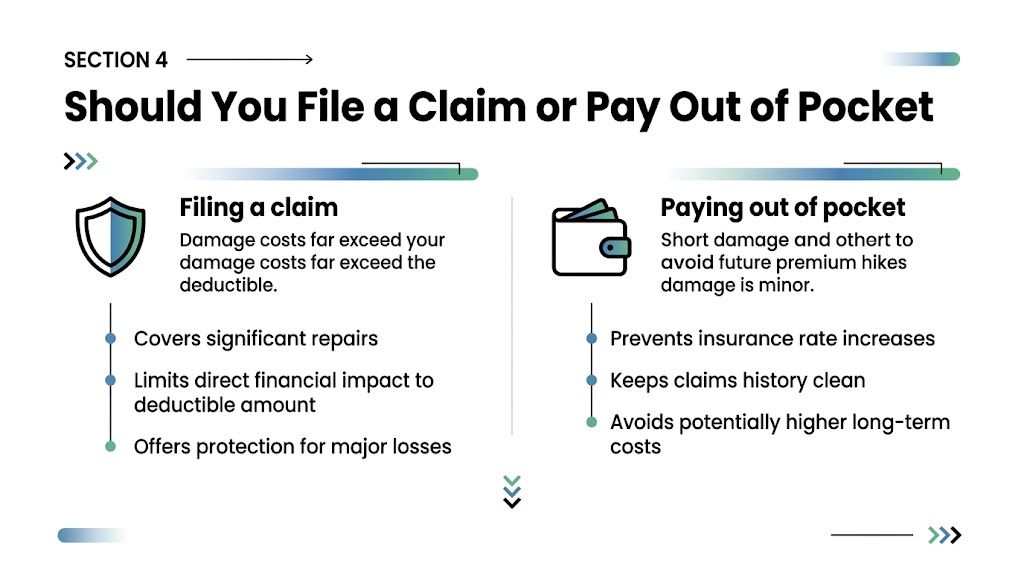
The better question is whether filing helps you financially after your deductible and claim history are taken into account. If the repair cost is below your non-collision deductible, filing won't result in a payout. Industry explainers also note that common deductibles for this type of coverage often fall in the $250 to $1,000 range, which is why many smaller vandalism losses are better handled directly, as summarized in GEICO's discussion of vandalism deductibles and claim decisions.
The deductible threshold matters most
If your deductible is higher than the repair bill, the math is easy. Insurance doesn't help pay.
If the repair cost is only slightly above the deductible, the math is still not automatically in your favor. You may be opening a claim for a relatively small benefit. Because vandalism is covered under non-collision physical damage protection, rate impact is often less severe than an at-fault accident, but increases can still happen depending on the insurer and your prior claims.
That's why I usually tell drivers to think in terms of net help, not just eligibility.
Claim vs. Pay Out of Pocket
| Scenario | Repair Cost | Your Deductible | Insurance Payout | Recommendation |
|---|---|---|---|---|
| Minor damage | $300 | $500 | $0 | Pay out of pocket |
| Moderate damage | $600 | $500 | $100 | Compare carefully before filing |
| Larger repair | $2,000 | $500 | $1,500 | Filing is often worth considering |
| Small glass or cosmetic issue | Around your deductible | $250 to $1,000 | Limited or none | Get estimates first |
The examples above are illustrations of the deductible decision, not promises of claim outcomes. Your carrier, policy terms, and claim history still matter.
A practical way to decide
Use this short test before filing:
- Below deductible: Don't expect a payout.
- Barely above deductible: Slow down and compare the likely benefit with the downside of adding a claim to your history.
- Well above deductible: Filing usually makes more sense.
- Unclear damage category: Get the claim type sorted before deciding, especially if the event includes break-in damage or stolen parts.
If you want to price your options before changing or adding coverage, you can compare policy choices through a California insurance quote request.
Tips to Prevent Car Vandalism
Insurance helps you recover. Prevention helps you avoid the headache in the first place.
California drivers can't eliminate the risk, especially with street parking, apartment lots, or dense urban neighborhoods. But small habits do make a difference.
Habits that lower your exposure
- Choose visible parking: Well-lit, active areas tend to be better than isolated corners of a lot.
- Use a garage when you have one: A closed garage adds a physical barrier and cuts down on random targeting.
- Remove visible valuables: A phone cable, shopping bag, or backpack can turn a simple vandalism risk into a break-in.
- Lock the vehicle every time: It sounds basic, but cars that are not locked invite both tampering and theft.
- Add visible deterrents: A steering wheel lock, blinking alarm light, or parked dashcam can make your car look less appealing to someone looking for an easy target.
What works best in real life
The best prevention is usually layered, not fancy. Good parking choices, no valuables in sight, and visible deterrents work better together than any one tactic by itself.
If you have to leave a car outside overnight often, be consistent. Most losses don't happen because someone ignored one perfect security trick. They happen because the car looked easy to access, easy to damage, or easy to search.
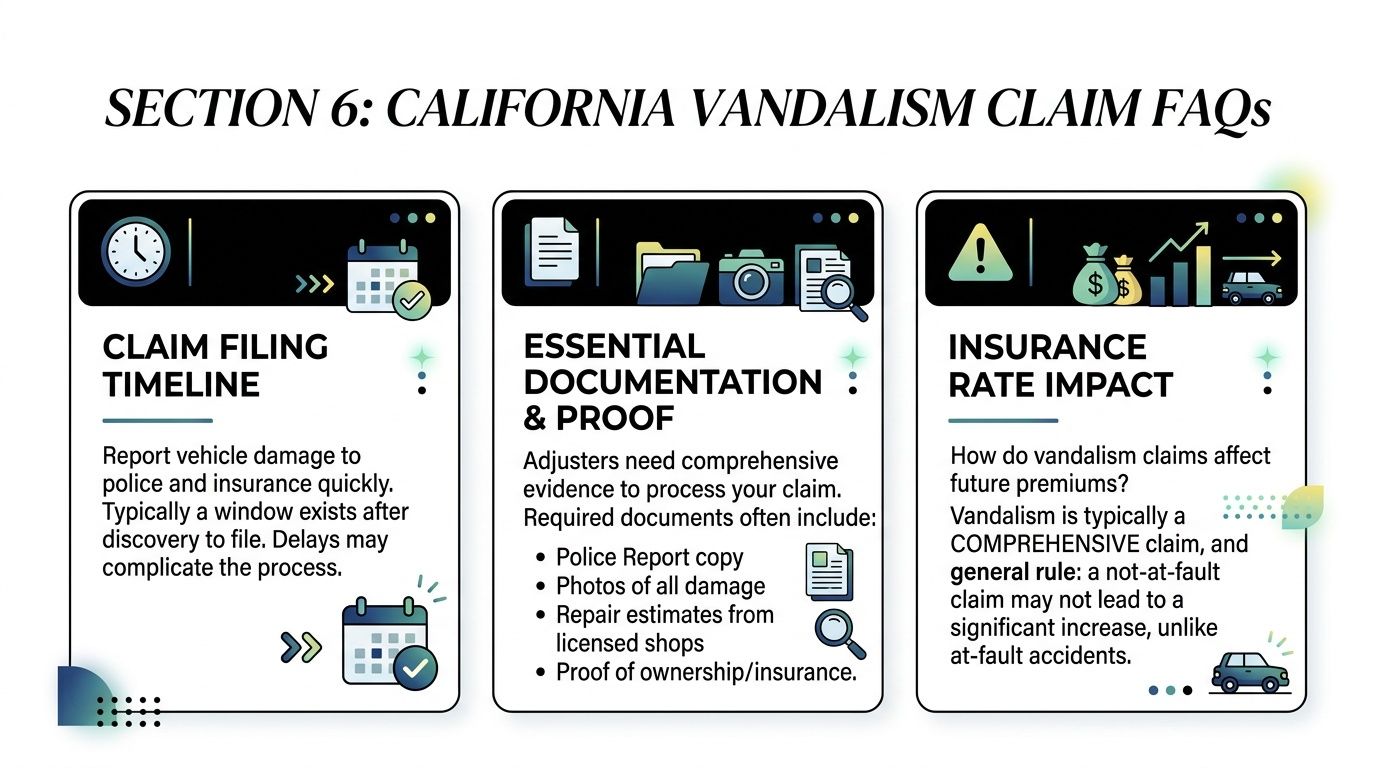
California Vandalism Claim FAQs
Will a vandalism claim raise my rate in California
It can. Because vandalism is typically a claim for non-collision damage, it often affects rates less than an at-fault crash claim, but that doesn't mean no impact. Your insurer and prior claim history matter.
What if only the window was broken
Some policies may handle glass a little differently, and some drivers carry separate glass-related options. Check your policy language before assuming the same deductible applies in every glass situation.
Are stolen items inside the car covered by auto insurance
Usually, damage to the vehicle belongs under auto insurance, while stolen personal belongings may fall under renters or homeowners coverage. If you're building broader protection around your household, security planning matters too. Even though it focuses on another market, this roundup of best home security systems in Australia is a decent example of how people think through layered property protection and deterrence.
Where can I get more California insurance answers
If you want plain-language answers on auto, home, renters, or life coverage issues, Mai & Associates maintains a helpful set of California insurance FAQs.
If you want help reviewing your California auto insurance, checking whether your policy includes coverage for non-collision damage, or comparing auto, home, renters, and life insurance options, Mai & Associates can help you look at the numbers and choose coverage that fits your situation.