Does Car Insurance Cover Rental Cars? A 2026 CA Guide
You’re at the rental counter. The agent asks if you want coverage, people are waiting behind you, and the screen is full of initials like LDW, SLI, and PAI. Most drivers make the decision in under a minute, even though the wrong choice can cost far more than the rental itself.
The short answer is that yes, your car insurance often covers a rental car. But “often” is doing a lot of work there. For California drivers, the key question isn’t just does car insurance cover rental. It’s which parts of your policy follow you, which gaps stay open, and whether paying the rental company effectively protects you or just duplicates what you already have.
That matters even more in California, where state minimum liability limits are low, deductibles can transfer directly to the rental, and local risks like wildfire or earthquake zones can create coverage surprises. If you also carry home insurance, renters insurance, or life insurance, you already know the pattern: the fine print matters most when you finally need the policy.
How Your Personal Car Insurance Follows You
For many individuals, a rental car works like a temporary stand-in for the car you already insure. If your personal auto policy includes the right coverages, those protections usually follow you when you rent for personal use in the United States or Canada. Major insurers explain that collision, protection against non-crash damage, and liability generally extend to a rental of similar value, though standard coverage duration is often capped at 15 consecutive days for U.S. rentals, as noted in GEICO’s rental car insurance guide.

A simple way to think about it is this: your policy doesn’t insure only the metal parked in your driveway. It insures your driving risk, subject to the rules in your contract. When the rental car is being used as a substitute for your own vehicle, the policy often moves with you.
If insurance language makes your eyes glaze over, a quick scan of a plain-English California insurance glossary can help before you rent.
The three parts that matter most
Most rental questions come down to three coverage types:
| Coverage | What it does | How it usually applies to a rental |
|---|---|---|
| Liability | Pays for injuries or property damage you cause to others | Usually follows you if your personal policy includes liability |
| Collision | Pays for damage to the rental car after a crash | Usually follows you if you carry collision on your own vehicle |
| Comprehensive | Pays for non-collision damage, such as theft or certain weather-related losses | Usually follows you if you carry comprehensive |
If you only carry liability on your own car, don’t assume the rental car itself is protected. In that case, your policy may help if you hurt someone or damage their property, but it may not pay for damage to the rental vehicle.
Practical rule: If your own policy doesn’t include collision and comprehensive, your rental usually won’t magically have them.
Similar vehicle, similar protection
There’s another catch people miss. Coverage is typically strongest when the rental is similar in value and type to your own car. If you drive an older sedan and rent a high-end sports car for the weekend, your insurer may not treat that rental the same way.
That’s why “full coverage” can be a helpful shortcut, but it’s still a shortcut. It usually means you carry liability, collision, and other than collision coverage on your own car. It doesn’t mean every rental, every location, and every use is automatically covered.
Where people get tripped up
A lot of confusion comes from mixing up coverage extension with coverage perfection. Your personal auto policy may follow you, but it can still have limits, exclusions, and timing rules.
Here are the common trouble spots:
- Rental length matters. Many policies and card benefits stop after a set number of consecutive days.
- Personal use matters. Coverage rules can change if the rental is used in ways your policy excludes.
- Location matters. U.S. and Canada are commonly covered. International rentals are a different story.
- Vehicle class matters. Luxury or significantly nicer vehicles can create problems.
If you remember one thing from this section, remember this: does car insurance cover rental cars? Usually yes, but only to the extent your own policy is built to do it.
The Hidden Role of Your Credit Card Coverage
A lot of drivers hear “my credit card covers rentals” and stop asking questions. That’s risky. Credit card coverage can be helpful, but it’s often misunderstood because people assume it works like full auto insurance. It usually doesn’t.
The easiest way to understand it is to separate damage to the rental car from damage you cause other people. Credit card benefits are usually aimed at the first problem, not the second.

Primary versus secondary
These two words cause more rental counter confusion than almost anything else.
- Primary coverage means the benefit can respond first, without requiring you to file with your personal auto policy first.
- Secondary coverage means your personal auto insurance is expected to handle the claim first, and the card may only step in for eligible leftovers.
Think of primary coverage as the first person called when there’s a problem. Secondary coverage is the backup person.
Many credit cards offer secondary rental protection. That means if the rental car is damaged, you may still need to open a claim with your own insurer before the card benefit helps. If your goal is avoiding a claim on your personal car insurance, secondary coverage may not accomplish that.
What credit cards often don’t do
This is the part many renters miss: credit card rental benefits generally do not provide liability coverage for injuries or property damage you cause to others. So if you run a red light and hit another driver, the card benefit typically isn’t there to handle that liability side.
That gap matters more than people realize. A card may help with the rental vehicle itself while offering no protection for the biggest legal exposure in a serious crash.
Your credit card can be a useful safety net for the car. It usually isn’t a substitute for real liability protection.
Duration limits and other fine print
Card benefits also have time limits. Some benefits cap U.S. rentals at 15 consecutive days, while others go longer. The exact number depends on the card program. If you rent beyond the allowed period, the protection may stop applying.
Other restrictions can matter too. Some benefits exclude certain vehicle types or uses. Others require you to pay with that card and decline the rental company’s damage waiver for the benefit to activate.
A good pre-rental habit is to check your card’s Guide to Benefits. Don’t rely on a marketing summary or vague memory from when you opened the account.
A quick real-world example
Say you have full coverage on your personal auto policy and a credit card with secondary rental protection. You scrape a pillar in a parking garage and damage the rental door.
In many cases, your personal collision coverage gets involved first. Then the card benefit may help with eligible remaining costs. But if you also injure someone else in the accident, your credit card benefit usually won’t address that liability claim.
That’s why credit card coverage should be treated like a specific tool, not a blanket answer. Helpful? Often yes. Complete? Usually no.
Decoding the Rental Company's Insurance Options
Rental counters are built for speed, not clarity. The screen flashes options, the employee asks quick yes-or-no questions, and everything sounds urgent. That’s why it helps to know what each product does before you arrive.
The big picture is simple: rental company coverage can be useful, but it’s often expensive. A consumer pricing example showed a base rental of $36 plus optional extras that totaled nearly $60 per day, with LDW costing $27 to $42 daily and SLI adding $13 to $17 daily, according to this KOMO consumer report on rental car insurance pricing.
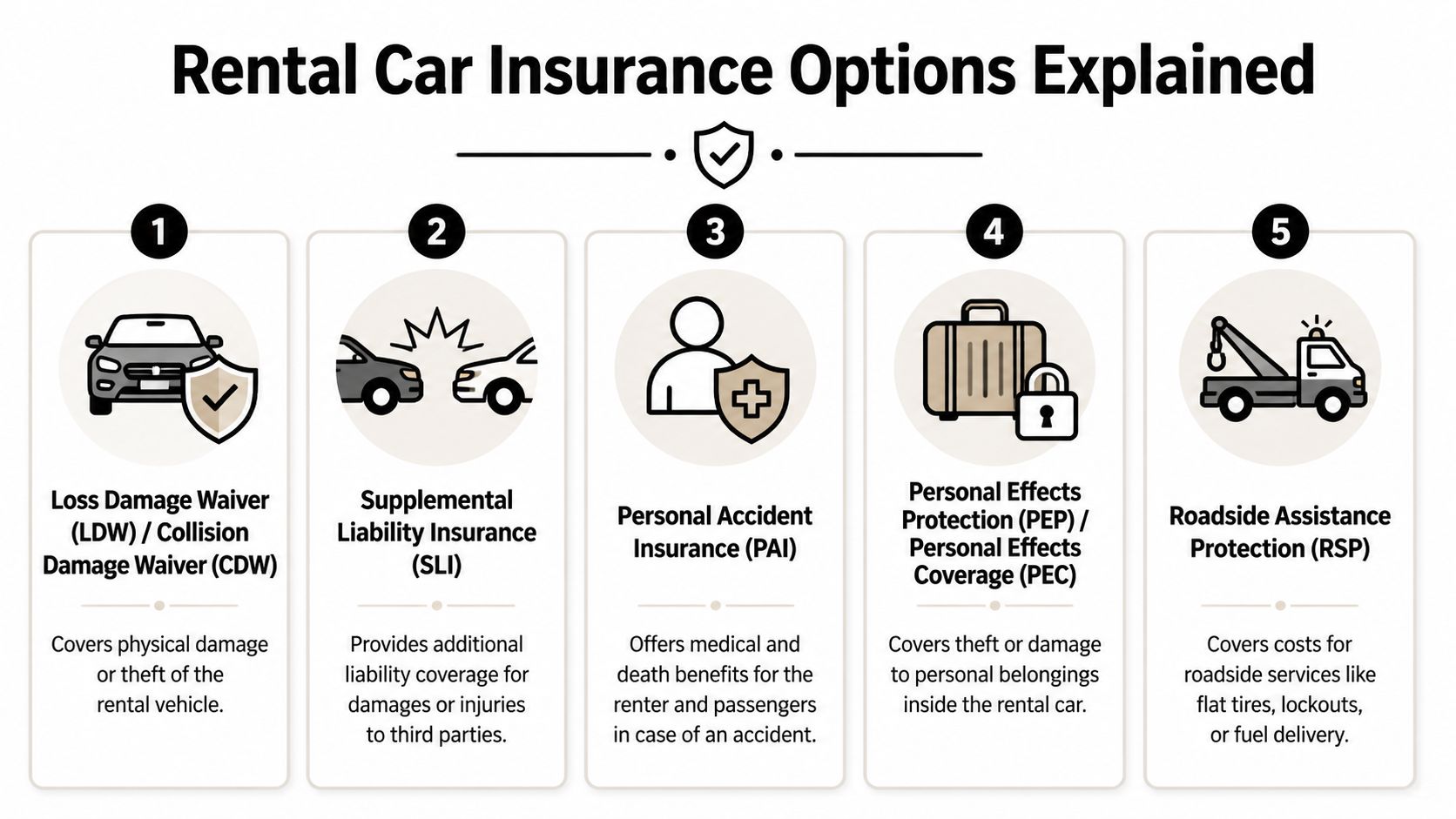
What each option really means
Here’s the plain-language version of the usual menu:
LDW or CDW
This waives or limits what you owe if the rental car is damaged or stolen. It’s not always “insurance” in the traditional sense. It’s more like the rental company agreeing not to chase you for covered damage under its rules.SLI
This adds liability protection for injuries or property damage you cause to other people.PAI
This offers accident-related benefits for you and your passengers.PEC or PEP
This applies to personal belongings in the vehicle.Roadside assistance
This helps with problems like lockouts, flat tires, or fuel delivery.
When paying extra may make sense
Not every add-on is a waste. Some are redundant. Some solve a real problem.
| Rental option | Often redundant when | Often worth considering when |
|---|---|---|
| LDW/CDW | You already have strong collision and comprehensive on your personal policy and you’re comfortable using it | You have a high deductible, no physical damage coverage, or you want to avoid a claim on your own policy |
| SLI | You already carry strong liability limits on your personal auto policy | Your liability limits are low or you’re worried about a serious loss |
| PAI | You already have health coverage or similar protection elsewhere | You want added accident benefits and know exactly what is and isn’t duplicated |
| PEC/PEP | Your belongings may already be protected under another policy | You want rental-specific property protection and have confirmed the limits |
The expensive one that can still be smart
LDW gets dismissed a lot because it’s pricey. That criticism is fair. But there’s a practical reason some drivers still buy it.
If you damage the rental car and use your personal auto policy, you may owe your deductible and put a claim on your own insurance history. For some renters, paying for the waiver is less about the rental car itself and more about keeping the claim off their personal policy.
If you hate paying for overlap, skip redundant products. If you hate claim headaches, the damage waiver can buy convenience.
The one people decline too quickly
Many renters focus on the rental car and ignore liability. That’s backwards. Damage to the rental is frustrating. A serious injury claim can be financially much bigger.
So when you ask does car insurance cover rental, don’t stop at “Will my policy cover the car?” Ask the more important question too: “If I hurt someone, how much protection do I really have?”
Critical California Car Insurance Rules for Renters
You land at Burbank, Oakland, or San Diego, grab your rental, and the counter agent asks whether you want extra coverage. If you live in California, that question is not just about the rental car. It is really a question about how much of your own money is exposed if something goes wrong.
California minimums can leave a large gap
A lot of national articles say your personal auto policy may extend to a rental, then stop there. For California drivers, that answer is incomplete.
California’s required liability minimums are low. The California Department of Insurance minimum coverage explanation shows how little liability protection a bare-minimum policy provides. In a multi-car crash, an injury claim, or a newer vehicle property damage claim, those limits can run out fast.
Liability works like the fence around your savings. A short fence still counts as a fence. It just does not do much if the problem is bigger than the fence is tall.
That is why the rental counter’s liability option deserves more attention than many California renters give it. If your own policy carries low limits, Supplemental Liability Insurance may be the product that protects your finances, not just the rental car.
Your deductible still applies
California drivers also get surprised by the cost on the damage side.
If your personal policy covers the rental for collision or other damage, your deductible usually follows you. A $500 or $1,000 deductible on your own car usually means the same out-of-pocket amount if the rental is damaged. AAA’s rental car insurance explanation also notes that a rental damage claim may go through your own auto policy.
That creates a real trade-off. The rental company’s damage waiver can feel expensive at the counter, but the math changes if using your own policy means paying a high deductible and adding a claim to your insurance history.
For some drivers, buying the waiver is less about overpaying for convenience and more about avoiding a deductible hit and keeping a rental mishap off their own record.
If you want a clearer sense of how limits, deductibles, and optional protections fit together, this guide to California auto insurance coverage options can help.
California catastrophe risk adds another layer
California has hazards that generic rental advice barely mentions.
Wildfire smoke, fast-moving fire zones, road closures, falling debris, and earthquake-related damage can create unusual claim questions. Some policies and some card benefits have exclusions or narrow wording around earth movement, hazardous use, or where the vehicle was being driven when the loss happened. That does not mean rental damage from those events is never covered. It means you should not assume every policy responds the same way.
A renter driving from Los Angeles to Tahoe in mild weather faces a different risk profile than a renter heading into a high-fire area during a severe wind event. California drivers benefit from checking the details before the trip, not at the counter with a line behind them.
A short California decision table
| Situation | Risk to watch | Why it matters |
|---|---|---|
| Renting with low liability limits | Liability gap | A serious injury or property damage claim can exceed California minimums quickly |
| Renting with a high deductible | Out-of-pocket cost | Your own policy may cover the rental, but you still pay the deductible first |
| Renting in wildfire or earthquake-sensitive areas | Coverage wording | Policy exclusions and card benefit limits may matter more than renters expect |
| Renting a vehicle much newer or more expensive than your own | Eligibility or valuation issue | Your policy or card benefit may not treat every rental vehicle the same way |
Cheap insurance feels efficient until a rental claim exposes the gap between “legal minimum” and “financially safe.”
Your Pre-Rental Insurance Checklist
This is the part to do before your trip, not while a rental employee is waiting for an answer.
Check your own auto policy first
- Pull up your declarations page. Confirm whether you carry liability only, or also collision and coverage for other incidents. If you don’t have physical damage coverage on your own car, don’t assume the rental car is protected.
- Ask your insurer one direct question. “Does my car insurance cover rental for personal use, and are there any vehicle, location, or time-limit restrictions?”
- Confirm the rental period. If your trip is long, ask whether your policy’s rental extension has a consecutive-day cap.
Read your credit card benefit guide
Don’t rely on memory. Read the benefit terms for the exact card you’ll use.
Focus on these points:
- Whether the benefit is primary or secondary
- Whether you must decline the rental company’s waiver
- Which vehicle types are excluded
- How the card handles loss-related charges tied to rental damage
- Whether the benefit applies in the place you’re renting
Check California-specific exclusions
Some policies exclude earth movement or fire damage unless specific endorsements are added, and credit card coverage may also have voids for off-road or hazardous conditions. That makes it smart to verify your exact protection before renting in wildfire-prone parts of California, as explained in this review of rental car coverage gaps and disaster-related exclusions.
If you want more practical consumer reading before your trip, browse these California insurance guides.
Inspect the car like your deposit depends on it
It might.
- Photograph every side of the vehicle before leaving the lot.
- Capture the roof, wheels, windshield, and interior if possible.
- Make sure existing damage is listed on the rental form.
- Repeat the photo set when you return it.
That step won’t change your policy terms, but it can prevent a dispute about when damage happened.
Take the pictures even if the car looks clean. The best claim is the one you never have to argue about.
Decide before the counter asks
Write your own answer in advance:
- If your personal policy is strong and your deductible is manageable, you may decline some add-ons.
- If your liability limits are thin, SLI may deserve attention.
- If you don’t want any claim touching your own auto policy, LDW may be worth the price to you.
The best rental decision is usually made at home, not under fluorescent lights at the airport.
Secure Your Coverage with Confidence
You land at LAX after a long flight, walk to the rental counter, and get the question that catches a lot of California drivers off guard: “Do you want to add coverage today?” At that moment, the central issue is not whether rental car insurance exists. It is whether your current protection leaves you paying out of pocket after a crash, theft, fire, or a claim that climbs past your liability limits.
The clearest answer to “does car insurance cover rental” is that your coverage may follow you, but it may not follow you all the way. Your auto policy, your credit card benefit, and the rental company’s add-ons each cover different slices of the risk. They work more like overlapping umbrellas than one big shield. If one umbrella is small, the rain still gets through.
For California drivers, the money side of this decision matters more than many national articles admit. A state-minimum policy can satisfy the legal rule and still leave a large bill after a serious accident. Your deductible can also turn a minor scrape into an expensive week. And if your trip takes you through wildfire areas or regions where natural disaster claims create delays and disputes, small policy details matter a lot more than they do on a simple weekend airport rental.
Confidence begins before your trip, rather than at the rental counter. Review what your auto policy pays for. Review what your credit card benefit excludes. Then compare those details with the rental company’s options and ask one practical question: which risk would hurt your budget the most if it happened tomorrow?
Sometimes the right answer is keeping your own policy and declining extras. Sometimes paying for added liability or a damage waiver is the cheaper choice once you factor in your deductible, potential rate increases, and the hassle of filing a claim on your own policy. The goal is not to buy everything. The goal is to avoid the expensive gap.
One small example shows how these details add up. Lost or damaged keys can become a surprisingly costly problem with modern fobs and programming fees. If you want a broader look at that issue, this practical guide to car key protection is useful reading. It is UK-focused, but the lesson carries over well. Small exclusions can produce big bills.
If you want to compare your current policy before your next trip, get a California insurance quote online for rental car protection and review your liability limits, deductible, and disaster-related risks before you pick up the keys.
If you want a no-obligation policy review, Mai & Associates can help you sort out whether your current auto insurance is enough for rental cars, whether your liability limits make sense for California, and whether bundling auto, home, renters, or life insurance could improve both protection and price. The agency serves drivers and households across California with same-day quotes, multilingual support, and practical guidance customized to your actual risks, including wildfire and earthquake concerns.