Do you need insurance to rent a car? A Handy Guide to Coverage and Costs
You're standing at the rental car counter, keys waiting, and then comes the question that always feels like a pop quiz: "Would you like to purchase our insurance?" It’s a high-pressure moment, and the answer isn't a simple yes or no.
Legally, you can't just drive off the lot without any insurance. California law mandates that rental companies provide the state's minimum liability coverage with every vehicle. But here’s the catch: that only covers damage you might cause to other people or their property. It does absolutely nothing for the rental car itself, leaving you on the hook for every scratch, dent, or worse.
Your Rental Car Coverage Options, Demystified
Making that split-second decision at the rental desk can be stressful, but it doesn't have to be. A little homework before you go is the key to driving away with confidence, knowing you're properly covered without paying for things you don't need.
The bottom line is simple: you are legally and financially responsible for the vehicle you rent. The good news? You probably have several sources of protection already in place. The tricky part is figuring out what those are and whether they're enough for your trip.

Where Does Your Protection Come From?
Think of your rental car coverage like a layered shield. You might not need to buy a brand-new one at the counter if you have a strong one built from different pieces. Let's break down where your coverage can come from.
To give you a quick overview, here are the main places people get their rental car coverage.
Your Rental Car Insurance Options at a Glance
| Coverage Source | What It Typically Covers | Key Consideration |
|---|---|---|
| Your Personal Auto Policy | Extends your existing collision, comprehensive, and liability limits to the rental car. | This is often your strongest, primary coverage, but you need to confirm your California auto insurance includes it. |
| Credit Card Benefits | Damage to or theft of the rental car (CDW/LDW). Usually secondary coverage. | You must pay for the entire rental with that specific card and decline the rental company's CDW. |
| Rental Company Insurance | Offers various waivers (CDW/LDW), liability supplements, and personal effects coverage. | Convenient but often the most expensive option. Great for filling specific gaps in your coverage. |
| Homeowners/Renters Policy | Your personal belongings if they are stolen from the rental car. | It doesn't cover the car itself, only the "stuff" you have inside it. |
Each of these options has its own job to do, and understanding them is the first step toward making a smart choice.
The biggest mistake we see is people either buying expensive, redundant coverage out of fear or, worse, declining everything and driving away completely exposed.
The goal is to find that smart middle ground—where you're fully protected but not overpaying for it.
This guide will walk you through how your personal California auto insurance, credit card perks, and even your home insurance or renters insurance can work together to protect you. We’ll show you how to check what you already have, which is the secret to not wasting money at the rental counter.
An independent agent at Mai & Associates can be a huge help here. Before you even book a car, we can review your current California auto insurance, home insurance, and even life insurance to see where you stand, helping you make a confident and cost-effective decision every single time.
Understanding the Four Types of Rental Car Coverage

Standing at the rental counter can be stressful. The agent starts throwing around acronyms like CDW, LDW, and SLI, and suddenly you’re faced with a high-pressure decision. But it doesn't have to be confusing.
Let's break down the four main ways you can cover a rental car. Think of it less as a confusing menu and more like a checklist. You just need to figure out which boxes are already checked before you get to the counter.
The Collision Damage Waiver (CDW/LDW)
First, you have the rental company's own offer: the Collision Damage Waiver (CDW), which is sometimes called a Loss Damage Waiver (LDW). Here's what trips most people up: this is not insurance.
It’s exactly what it sounds like—a waiver. When you buy it, the rental company is waiving its right to come after you for money if their car is damaged, stolen, or vandalized on your watch. It covers the rental car itself.
Accepting the CDW means if the car gets a dent or is totaled, you can hand back the keys and walk away without a bill for repairs or for the time the car is out of service ("loss of use"). If you decline it, you’re on the hook for those costs.
Supplemental Liability Insurance (SLI)
While the CDW is about protecting the rental car, Supplemental Liability Insurance (SLI) is about protecting you from the financial fallout of an accident you cause. It’s for damage you do to other people’s property or for injuries they sustain.
As we mentioned, California rentals include a basic, state-minimum level of liability coverage. The problem is, those minimums are very low and can be wiped out instantly in a serious accident, leaving your personal assets exposed.
SLI dramatically boosts that protection, typically up to $1 million. This is a wise move for anyone with significant assets to protect or for renters who don't own a car and therefore don't have a personal auto insurance policy to fall back on.
Your Personal Auto Insurance Policy
For most car owners, your personal California auto insurance is the first place to look. If you already have collision and comprehensive coverage for your own vehicle, it very often extends to rental cars you use for personal trips.
This is a game-changer. It means your own policy could cover a wreck or theft in the rental, and you’d only be responsible for your deductible. This alone can save you from paying for expensive and redundant coverage at the counter.
But—and this is a big but—you can't just assume you're covered. This uncertainty is a major reason why 15% of rentals are cancelled and no-show rates can hit 30% in peak seasons. The details in your car insurance policy are what matter.
Key Takeaway: Your personal auto policy is your first line of defense, but you must confirm its specific terms. Policies may not cover business travel, long-term rentals, or certain types of vehicles like moving trucks.
Before you book, make a quick call to your insurance agent. Ask them directly if your collision, comprehensive, and liability limits apply to your rental. If you're fuzzy on any of the terms they use, our insurance glossary can help clear things up.
Your Credit Card Benefits
The last piece of the puzzle might already be in your wallet. Many credit cards include rental car protection as a perk, but how it works is absolutely critical.
Usually, this coverage is secondary. That means it will only pay for costs that are left over after your personal auto insurance has paid out, like your deductible. Some premium travel cards, however, offer primary coverage, which is far more valuable. It kicks in first, so you don't even have to file a claim with your personal insurer, potentially saving you from a rate hike.
To use this benefit, you almost always have to decline the rental company’s CDW/LDW and pay for the entire rental with that specific card. Just like with your personal policy, call your card issuer before you travel. Confirm what they cover, the limits, and if there are any restrictions on vehicle types or countries.
How Your California Auto Policy Protects You
For most folks in California, the answer to the rental car insurance question is already sitting in their glove box. If you carry comprehensive and collision coverage on your own car, that protection often extends to a rental, acting as your first and best line of defense.
Think of your personal California auto insurance policy as covering you as a driver, not just the one car you own. When you rent a standard sedan for a weekend getaway, your policy essentially "travels" with you. This means if the rental gets dinged in a parking lot or, worse, stolen, your own insurance can step in to cover the repairs or replacement, after you pay your deductible.
Knowing this is a huge benefit. It gives you the confidence to politely decline the rental company's expensive Collision Damage Waiver (CDW), which can easily save you $15 to $30 per day.
When Your Auto Policy Is Not Enough
But before you automatically say no at the rental counter, you need to know where your personal policy's protection ends. Assuming you're covered without confirming the details is a classic mistake that can lead to a massive financial headache.
There are a few common scenarios where your personal auto insurance will leave you high and dry:
- Business Travel: Personal policies are just that—personal. If you're renting a car for a work conference or to visit a client, your own insurance almost certainly won't cover it.
- Exotic, Antique, or Large Vehicles: Your policy for a Toyota Camry isn't designed to cover a rented Ferrari, a vintage convertible, or a 26-foot moving truck. Coverage is typically limited to vehicles of a similar size and value to your own.
- Long-Term Rentals: That weekend getaway is one thing, but if you need a car for a month or two, your policy's protection likely expires. Most only cover short-term rentals, usually defined as 30 consecutive days or less.
- International Travel: While you're generally covered anywhere in the U.S. and Canada, your policy stops at the border. Renting a car in Mexico or anywhere overseas means you'll need to secure local insurance.
The smartest thing you can do is make a quick, five-minute call to your insurance agent before you travel. Just ask them directly: "Does my policy's comprehensive and collision coverage extend to a rental car? Are there any vehicle type or location restrictions?" Getting that clear answer is the best move you can make.
The Hidden Perk of Your Home or Renters Insurance
So your auto policy covers the rental car itself, but what about all the stuff you have inside it? If a thief smashes a window and makes off with your laptop, camera, and luggage, your car insurance won't do a thing to replace those personal items.
This is where your home insurance or renters insurance policy swoops in with an unexpected save.
Most homeowners insurance and renters insurance policies include personal property coverage, which protects your belongings from theft or damage, even when you're away from home.
- How It Works: Say your suitcase gets stolen from the trunk of the rental. You can file a claim against your home insurance or renters policy to get reimbursed for the value of your stolen items, minus your deductible for that policy.
- The Connection: Your policies work as a team. The auto insurance covers the smashed car window, and your home insurance or renters insurance covers the stolen laptop that was on the passenger seat.
Understanding how these coverages fit together is the key to being fully protected without overpaying. Knowing the ins and outs of California insurance empowers you to use the policies you already have to build a complete safety net for your next trip.
Using Credit Card Benefits to Your Advantage
You might already have a great rental car insurance plan and not even know it. It's often hiding right there in your wallet. Many credit cards come with rental car coverage as a free perk, but whether that perk is truly valuable comes down to one make-or-break detail: is the coverage primary or secondary?
Getting this right is the key to using your card's benefits effectively. It determines who has to pay up first if you get into an accident.
Primary vs. Secondary Coverage: The Key Difference
Think of it this way: Primary coverage is your first line of defense. If you have a card with primary coverage, it steps up to the plate to handle the claim directly. You won’t even have to file a claim with your personal California auto insurance provider.
This is a huge deal. It means you get to sidestep your personal policy’s deductible and, more importantly, you avoid having a claim on your record that could jack up your insurance rates for years.
Secondary coverage, on the other hand, waits on the sidelines. It only kicks in after your own auto insurance has paid out. Its job is to help clean up the remaining costs, like your deductible or other out-of-pocket fees your main policy won’t cover.
A card with primary coverage acts as a shield for your personal car insurance policy. It handles the financial hit from a rental car incident, keeping your driving record clean and your insurance rates stable.
This is why you absolutely need to know what your card offers before you walk up to that rental counter. The difference could easily be hundreds, if not thousands, of dollars.
How to Confirm and Use Your Card's Benefits
You can’t just assume your card has you covered. A few minutes of prep work before you rent a car will give you total peace of mind.
Here’s exactly what you need to do to check and use your coverage:
- Call the Number on Your Card: Before you travel, flip your card over and call the customer service number. Ask to speak with a benefits administrator who can give you the real details on your policy.
- Ask the Right Questions: Don't settle for a simple "yes, you have coverage." You need specifics.
- "Is my rental car coverage primary or secondary?"
- "What's the maximum amount covered for damage or theft?"
- "Are there any vehicle exclusions? What about luxury cars, large SUVs, or trucks?"
- "Does this coverage work in the country I'm renting in?"
- "Is there a limit on the rental period, like 15 or 30 days?"
- Decline the Rental Company's CDW/LDW: This part is non-negotiable. To make your credit card's insurance active, you must decline the Collision Damage Waiver (CDW) or Loss Damage Waiver (LDW) the rental agent offers you. If you accept their waiver, it instantly voids your card’s benefit.
- Pay for the Entire Rental With That Card: The whole rental cost must be paid for with the same credit card that provides the insurance benefit.
With so many people booking rentals on their phones these days, it's easy to blow past these details. While around 25% of renters are savvy enough to use cards with primary coverage, many others don't realize the fine print, like how their personal policy might not cover certain trucks or international rentals. You can learn more about car rental trends and statistics to stay ahead of the curve. By taking these quick verification steps, you can be sure you're not caught off guard.
Making the Right Choice for Your Situation
Okay, we've broken down all the different types of coverage. Now for the real question: do you need insurance to rent a car? The answer isn't a simple yes or no. It really comes down to what coverage you already have and the specifics of your trip.
Let's walk through a few common scenarios I see with California drivers. Think of this as a mental checklist to help you feel confident the next time you're standing at that rental counter.
Scenario 1: The Well-Covered Californian
This is someone who has a solid California auto insurance policy with both comprehensive and collision. To top it off, they also carry a credit card that offers primary rental car insurance.
If this sounds like you, your decision is pretty straightforward. Your personal car insurance is your foundation, and your credit card steps in as the first line of defense for any damage to the rental itself. It’s a great combination that provides nearly seamless protection.
- Politely decline the rental company’s Collision/Loss Damage Waiver (CDW/LDW). Your credit card has this covered.
- Decline the Supplemental Liability Insurance (SLI). Your personal policy’s liability limits are almost always enough for a personal trip.
- Just remember, you must pay for the entire rental with that specific credit card to activate its primary coverage.
Scenario 2: The Liability-Only Driver
Now, what if you own a car but only carry the minimum liability coverage California requires? This means your personal auto insurance policy has no comprehensive or collision, so it won’t pay a dime for damage to the rental car you’re driving.
This creates a major gap. Any dings, dents, or serious damage to the rental vehicle would come directly out of your own pocket.
- You should absolutely accept the rental company's CDW/LDW to cover the vehicle.
- The one exception is if you happen to have a credit card with primary rental coverage. If you use it to pay, you can decline the CDW.
- Your personal liability should still transfer, but if you have a high net worth, getting the SLI for extra protection is a smart move.
This decision tree gives you a visual for figuring out whether your credit card coverage is primary or secondary.
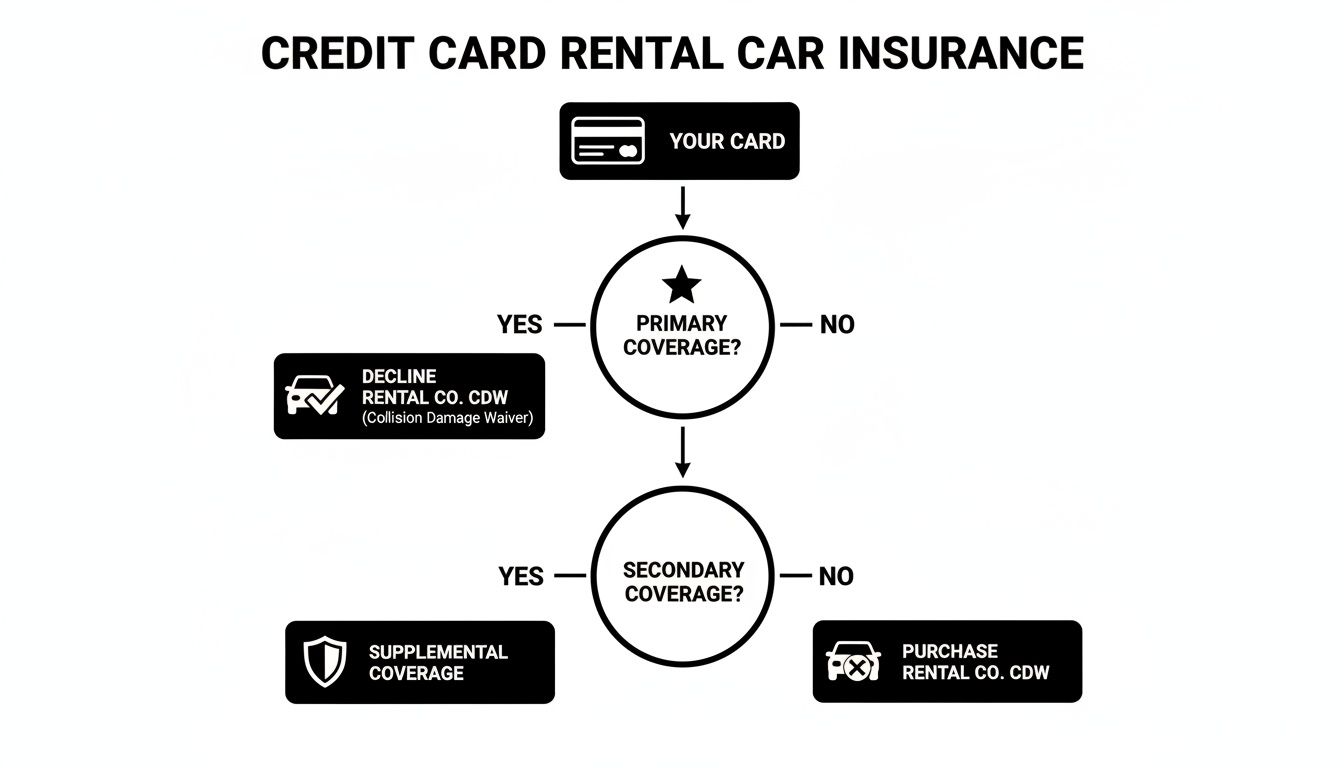
The flowchart makes it clear: a card with primary coverage is a powerful tool, saving you from buying the rental company's waiver. A card with secondary coverage is more of a safety net for your personal policy's deductible.
Scenario 3: The Business Traveler
Renting for work is a whole different ballgame. Your personal California auto insurance is written for personal use, and it will almost certainly deny a claim that happens during a business trip.
Never assume your personal policy covers a work trip. It’s a costly mistake that can leave both you and your employer on the hook for thousands.
Before you book that rental for your next conference, you have to check your company's travel policy. Many larger employers have a corporate insurance plan that automatically covers rental cars for employees on official business. If they don't, the responsibility falls on you.
- First step: Clarify your company’s insurance policy before you rent.
- If your employer has you covered, simply follow their instructions.
- If you are not covered by a corporate policy, you must purchase both the CDW/LDW and the SLI from the rental agency. No exceptions.
Finally, a quick note on international travel. Insurance is critical, but it's not the only piece of the puzzle. When you're planning to drive abroad, always check the International Driving Permit requirements for your destination country. Having the right documents is just as important as having the right coverage.
Get a Free California Insurance Review

The single best way to save money and skip the stress at the rental counter is knowing exactly what you're covered for before you even leave your house. Instead of guessing whether you need insurance to rent a car, you can just grab the keys and go with complete confidence. That's where working with an independent California insurance expert like Mai & Associates can make a world of difference.
We've all been there—standing at the counter, feeling pressured to make a split-second decision that could cost you hundreds. Our team helps you avoid that situation entirely. We specialize in reviewing your current policies to give you a clear, straightforward picture of your protection, ensuring you aren't paying for coverage you don't need or, worse, leaving yourself exposed to a massive financial risk.
A Complete Look at Your Protection
True peace of mind doesn't come from a single policy; it comes from understanding how all your coverage works together. We don't just look at one piece of the puzzle.
Our no-obligation review digs into everything:
- California Auto Insurance: We’ll confirm whether your comprehensive and collision coverage actually extends to rental cars. We'll also check for any fine-print limitations, like restrictions on the type of vehicle or how long you can rent it.
- Home and Renters Insurance: Does your policy cover your personal belongings if they’re stolen from a rental car? It's a common gap that most people don't think about until it's too late.
- Liability and Life Insurance: Our experts will look at your liability limits and even your life insurance to make sure your personal assets are properly shielded from a lawsuit and your family is protected.
By examining your entire insurance portfolio—from car insurance to home insurance—we can spot critical gaps that a quick glance at a single policy would never reveal. This complete approach ensures you have solid protection for whatever happens on the road.
We know insurance can feel overwhelming. That’s why our multilingual team is here to help in English, Spanish, Armenian, Russian, and Vietnamese, making it simple and clear for all Californians. We can provide instant rate comparisons and same-day quotes from multiple top-rated carriers, so you know you're getting great protection at a fair price.
Ready to find out exactly where you stand? Get in touch with Mai & Associates to receive a free, same-day insurance quote and a personalized analysis. You'll be able to drive your next rental with the confidence that only comes from being fully prepared.
Frequently Asked Questions About Rental Insurance
Even after you've done your homework, a few last-minute questions always seem to surface at the rental counter. Let’s clear up some of the most common ones so you can grab the keys and go with total peace of mind.
What Happens if I Crash Without Enough Insurance?
This is the scenario everyone dreads, and for good reason. If you're underinsured, you're on the hook for the full cost of repairing the rental car. But it doesn't stop there. The rental company can also bill you for "loss of use"—the money they lose every day the car is out of service—plus any damage you cause to other people or their property.
These costs can spiral into the tens of thousands of dollars in the blink of an eye. It’s a massive financial risk that just isn’t worth taking.
Does My Renters Insurance Help with a Rental Car?
That's a great question, and it highlights how different policies work together. Your renters insurance doesn't cover damage to the rental car itself, but it’s still incredibly valuable.
The personal property coverage in a renters policy is what protects your stuff—like a laptop, camera, or luggage—if it gets stolen from the rental. Think of it this way: your auto insurance protects the car, and your renters insurance protects the valuables you put inside it.
This is a perfect example of how different policies, like home insurance and car insurance, work together. One covers the vehicle, while the other protects your personal items, creating a more complete safety net.
Can I Use My California Auto Insurance in Another State?
Absolutely. Your personal California auto insurance travels with you. In almost all cases, the coverage you have for your own car extends to a rental driven anywhere in the United States and Canada.
Just remember, the moment you cross the border into Mexico or rent a car overseas, that protection usually stops. International rentals are a whole different ball game.
For a deeper dive into the legal side of things, this is a helpful guide on what can happen if you try to rent a car without insurance.
What If I Don't Own a Car at All?
If you don't own a car, you don't have a personal auto policy, which means you're starting from scratch with zero coverage. You have no liability protection and no coverage for damage to the rental car itself.
In this situation, your safest bet is to purchase both the Supplemental Liability Insurance (SLI) and the Loss Damage Waiver (LDW) from the rental company. It might feel expensive, but it ensures you’re legally allowed to drive and won't face a devastating bill if something goes wrong.
Have more questions like this? We've answered dozens of them on our FAQ page.
The best way to know for sure what you need is to understand what you already have. Mai & Associates offers a complimentary, no-obligation review of your current California auto insurance, home insurance, and life insurance policies to find any potential gaps. Visit us online to compare rates and get a same-day quote at https://cahomeauto.com.