Do I Need Life Insurance? A California Guide for 2026
You’re probably already paying for the insurance that feels urgent.
Car insurance because California requires it. Home insurance because your lender does. Renters insurance because replacing everything after a fire or theft would be painful. Maybe earthquake coverage is on your radar. Maybe you’ve reviewed a California Fair Plan policy and thought, “I should really tighten up the rest of our protection too.”
Then life insurance comes up, and the question gets fuzzy fast.
If you’re asking do i need life insurance, you’re not really asking about a product. You’re asking a much more practical question. If something happened to me, would the people I care about be financially okay?
That’s the right question. In California, where housing costs are high, many families rely on two incomes, and extended family support is common, the answer matters more than people think.
Is Life Insurance a Priority for Your California Family
A common California money conversation sounds like this.
One person is reviewing the mortgage payment. Someone else is looking at the car insurance renewal. There’s a tab open for college savings, another for home insurance, and maybe one more for renters insurance if the family hasn’t bought yet. Life insurance gets pushed to the side because it doesn’t feel immediate.
That hesitation makes sense. Life insurance can feel abstract until you tie it to real bills.
A couple in Costa Mesa might be juggling a mortgage, daycare, gas, groceries, and two cars. A renter in Glendale might be helping parents with expenses while trying to keep monthly costs under control. A family in Escondido might be thinking about wildfire risk, home coverage gaps, and whether they can absorb one more premium. In each case, the life insurance question isn’t separate from the rest of the insurance conversation. It sits right next to auto insurance, home insurance, and renters insurance because all of them protect financial stability.
The problem is that many households still have a gap. Approximately 52% of American adults own some form of life insurance, leaving over 100 million people uninsured or underinsured. For families, 47% would struggle with living expenses within six months of a primary wage earner’s death, according to the 2025 life insurance statistics compiled by Choice Mutual using LIMRA and Life Happens data.
That number matters because it turns a vague concern into a household risk. If your income helps pay the rent, mortgage, utilities, debt, childcare, or everyday living costs, life insurance deserves a place on your list.
Practical rule: If someone would need your income, your services at home, or your financial help to keep life running, life insurance is worth a serious look.
For many California families, it isn’t an extra. It’s part of the same protection plan that already includes car insurance, homeowners insurance, renters coverage, and emergency savings.
What Life Insurance Is Really For
Life insurance is a financial safety net for the people who would feel your loss in dollars as well as in grief.
That’s the plain-English version.
If you pass away while a policy is active, the insurer pays a death benefit to the beneficiary you chose. Your family can use that money for whatever they need most. That flexibility is what makes life insurance useful.

The simplest way to think about it
Think of life insurance like a fire extinguisher for your finances.
You hope your family never needs it. You don’t buy it because you expect disaster tomorrow. You buy it because the cost of being unprepared is much bigger than the cost of planning ahead.
That safety net usually helps with things like:
- Replacing income so a spouse or partner can keep paying monthly bills
- Paying housing costs like rent or a mortgage
- Handling debts so survivors aren’t forced into rushed decisions
- Covering final expenses which is one reason many people start by researching funeral insurance when they want protection focused on end-of-life costs
- Buying time so your family doesn’t have to make major financial moves while grieving
What people often get wrong
Many people assume life insurance is only for parents with young kids.
That’s one important group, but it’s not the only one. Life insurance is really about financial dependence, not just parenthood. If a partner relies on your paycheck, if your parents count on your help, if your co-signed debt would fall on someone else, or if your death would create immediate costs for loved ones, the purpose is the same.
Another point of confusion is this: people think of life insurance as “money for after I die,” which makes it sound distant and hard to value. A better way to frame it is this: it protects your family’s current life. Their home. Their routine. Their breathing room.
Life insurance doesn’t erase loss. It can prevent a second crisis, the financial one, from hitting right after the first.
Where it fits with your other insurance
Auto insurance pays after a car accident. Home insurance helps after property damage. Renters insurance helps replace belongings and cover certain losses in a rental.
Life insurance protects the income stream and financial support that make the rest of your life work.
That’s why people in California often find that life insurance belongs in the same conversation as home insurance, renters insurance, and car insurance. These policies do different jobs, but they all serve the same goal. Keeping one hard event from turning into a much larger financial setback.
The Two Main Types of Life Insurance Explained
Many people shopping for life insurance run into the same fork in the road. Term life or whole life.
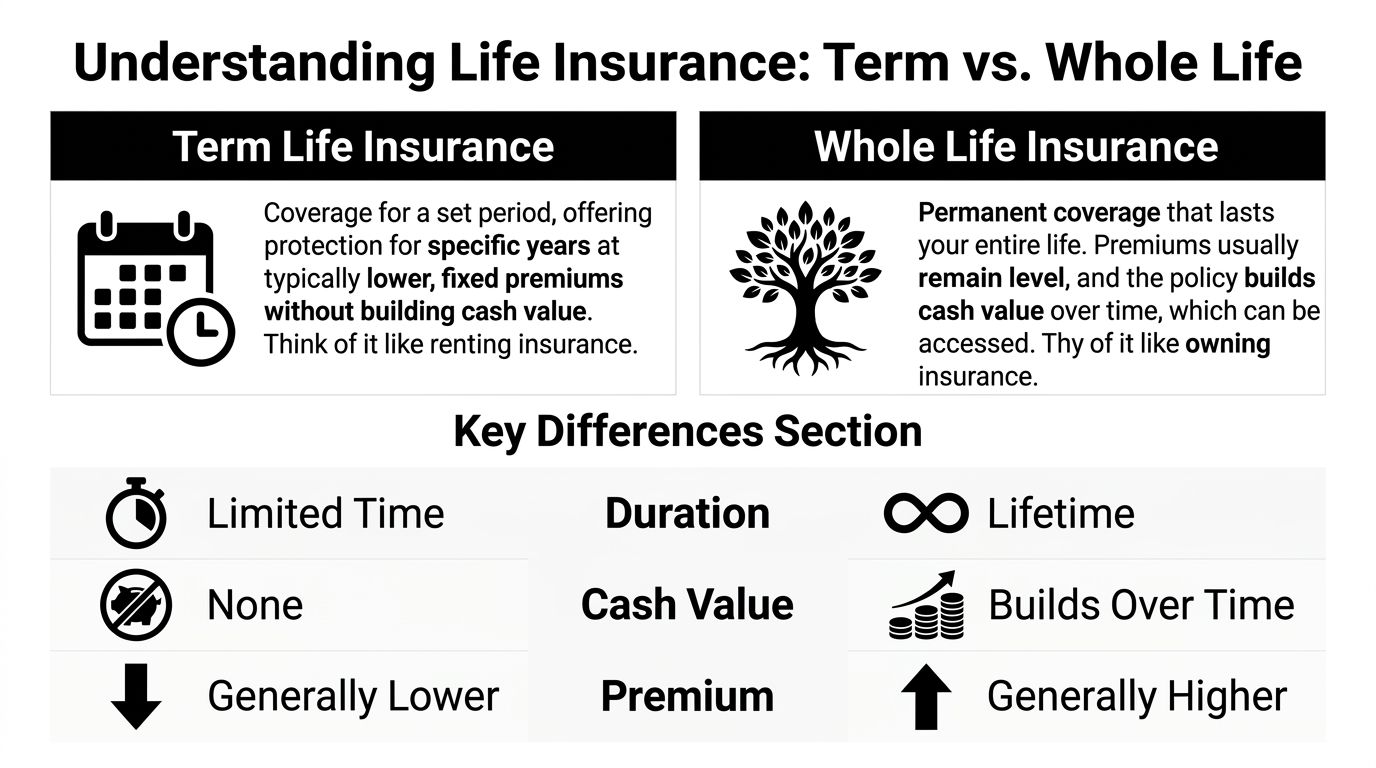
A simple comparison helps. Term life is a bit like renting. Whole life is a bit like owning.
That comparison isn’t perfect, but it gives you the right starting point.
Term life insurance
Term life covers you for a set period. You choose the term, keep paying the premium, and if you die during that term, the death benefit is paid to your beneficiary.
For many families, term life is the most direct tool for covering the years when financial risk is highest. That usually means the years when you’re paying off a mortgage, raising children, supporting a partner, or carrying meaningful debt.
People often like term life because it’s easier to understand. The policy is built around protection, not around an investment feature.
Why term life appeals to many buyers
- Focused protection: It covers the years when your family would be most exposed financially.
- Cleaner budgeting: Premiums are generally easier for households to fit into a monthly budget than whole life premiums.
- Straightforward purpose: It’s designed to create a death benefit, not to serve as a long-term cash-value product.
Whole life insurance
Whole life is a form of permanent coverage. It’s designed to stay in force for life if you keep up with the required premiums. It also includes cash value, which builds over time inside the policy.
People often get confused by this. The cash value feature can sound attractive, but it also changes the cost and the role of the policy. Whole life is not just paying for insurance protection. You’re also paying for the policy’s internal value component.
Some buyers want that permanence. Others prefer to keep insurance and investing separate.
Side-by-side comparison
| Feature | Term life | Whole life |
|---|---|---|
| Coverage length | Set period | Lifetime, if kept in force |
| Cash value | No | Yes |
| Typical budget fit | Usually easier for cost-conscious households | Usually higher cost |
| Main use | Income protection during key financial years | Lifelong coverage with added cash value |
Which one fits your situation
For a lot of Californians, term life lines up well with real-life obligations.
A couple buying a home in Westlake Village may want coverage that lasts through the mortgage years. A parent with young children may want coverage through the years when the kids still rely on their income. A renter with limited budget may want the most protection they can reasonably afford.
Whole life tends to appeal to buyers who care strongly about permanent coverage, want the policy to stay in place for life, or like the idea of building value inside the policy itself.
Bottom line: If your main goal is protecting your family during your working years, term life often feels more natural. If your main goal is permanent coverage and you’re comfortable with a higher premium, whole life may be worth exploring.
The question to ask before choosing
Don’t start with the policy type. Start with the job you need the policy to do.
Ask yourself:
- Who would need money if I died?
- For how many years would they need it?
- Do I want pure protection, or do I specifically want a permanent policy with cash value?
If you answer those first, the term versus whole life decision becomes much less mysterious.
Who Needs Life Insurance in California Common Scenarios
Some people know immediately that they need life insurance. Others don’t see it until they walk through an ordinary life situation and realize how many people depend on them.
In California, those situations show up in a lot of forms.

The homeowner with a large mortgage
A family buys a home, settles into the monthly payment, and starts building routines around school, work, and bills. Life insurance may not feel urgent because everything is working.
But one income loss can change the picture quickly.
For a homeowner with a $500,000 California mortgage, the death of a primary earner can cause the household’s debt service coverage ratio to plummet, triggering foreclosure risk within 6-12 months. Life insurance is a primary tool to prevent this, yet 52% of households with over $200k in debt are underinsured, according to this California mortgage and life insurance discussion from UPHelp.
For many homeowners, that’s the clearest answer to do i need life insurance. If your paycheck helps keep the home, your life insurance protects more than a person. It protects housing stability for the people staying behind.
The parent of a young child
A new baby changes the question immediately.
Now it’s not just about replacing one salary. It may also be about preserving childcare, keeping a parent from rushing back to work, or making sure the surviving adult has room to keep the household functioning.
This is often where people first realize life insurance belongs next to the rest of their family protection plan. The same way you review auto insurance after adding a teen driver or home insurance after a remodel, you should review life insurance after a child enters the picture.
The renter who thinks life insurance is only for homeowners
A renter in Glendale or Westlake Village might assume life insurance can wait until they buy a home.
Not necessarily.
If your partner depends on your income to pay rent, utilities, car payments, or debts, you can still leave a real financial gap behind. Renters insurance protects belongings. Life insurance protects the person trying to keep paying for the apartment after one income disappears.
That’s why renters should ask the same basic question homeowners ask. If I’m gone, who gets the bills?
The adult child helping aging parents
Some Californians send money to parents every month. Others help with groceries, prescriptions, or housing costs. That support may not feel formal, but it’s still financial dependence.
If your parents count on your income support, life insurance can help replace that help for a period of time. This matters even if you don’t have children of your own.
The federal employee or public-sector worker
Employer coverage can be helpful, but people often overestimate how far it goes or how portable it is. If you work in a federal role and want to compare workplace coverage with personal coverage, this guide on life insurance options for federal employees is a useful starting point.
A personal policy can give you more control over the amount, the beneficiaries, and whether coverage stays with you if your job changes.
The business owner or self-employed Californian
If your household depends on business income, your death can affect both family cash flow and the company itself.
A self-employed contractor, agency owner, or shop owner may need life insurance for two reasons at once. One is family support. The other is business continuity, especially if the business would struggle to keep operating or settle obligations without that person.
For readers who want a California-specific starting point for comparing personal policy paths, this resource can help: https://cahomeauto.com/life-insurance-california
The people who need life insurance most aren’t always the ones who fit a textbook example. They’re often the ones whose income holds several other lives together.
How to Calculate Your Life Insurance Needs
The hardest part for many people isn’t deciding whether they need coverage.
It’s figuring out how much.
Some people buy too little because they choose a number that “sounds reasonable.” Others delay buying anything because the math feels intimidating. A simple framework works better.

Start with the quick estimate
A common shortcut is to think in terms of a multiple of income.
That’s useful because it gives you a rough starting point, not a final answer. If you’re asking do i need life insurance and you want a first pass, income replacement is usually the cleanest place to begin.
But income by itself doesn’t tell the whole story. Some households carry major debt. Others have strong savings. Some parents want to fund years of household support. Others mainly want the mortgage covered.
Use the DIME method
A practical way to estimate need is the DIME method.
| Part | What to include |
|---|---|
| Debt | Loans, credit obligations, and shared debts that would burden survivors |
| Income | Money your family would need to replace your earnings for a period of time |
| Mortgage | The amount needed to help protect the home or rental stability |
| Education | Future education support you want to leave for children |
This method helps because it forces you to think in real categories, not in abstract guesswork.
Here’s how people usually apply it:
- Debt: Add debts that would not comfortably disappear from your household budget.
- Income: Estimate how much of your earnings your family would need replaced.
- Mortgage: Decide whether you want the home paid off, partially protected, or supported for several years.
- Education: Include any amount you want set aside for a child’s schooling.
The advisor method you may hear about
Financial professionals often use something more technical called Human Life Value, or HLV. For a 35-year-old Californian earning $120,000, their HLV could be $1.8-$2.2 million, according to this Human Life Value explanation and California example.
That figure is useful because it frames the question in economic terms. What would your family lose if your future earnings disappeared?
You don’t need to run a complex formula to benefit from the idea. The takeaway is simple. Coverage should reflect the financial value your life provides to others, not just a random round number.
A simple way to pressure-test your estimate
After you come up with a number, ask these three questions:
- Would this amount keep my family in the home or rental without immediate panic?
- Would it buy them time to grieve and reorganize life without rushing major decisions?
- Would it clear the debts and obligations I most worry about leaving behind?
If the answer is no, the estimate is probably too low.
For more California insurance planning resources beyond life coverage, this guide hub is useful: https://cahomeauto.com/guides
A good coverage amount isn’t the smallest number you can buy. It’s the number that gives your family options when they need them most.
Factors That Determine Your Life Insurance Cost
The price of life insurance isn’t random. Insurers look at a set of risk factors and use them to decide your premium.
That matters because some factors are fixed, but others are connected to choices, timing, and the kind of policy you buy.
The biggest pricing drivers
A few items usually matter most:
- Your age: Buying younger usually means lower premiums because insurers see less immediate risk.
- Your health history: Current health and medical background affect pricing because they influence expected risk.
- Tobacco use: Smoking and similar habits often increase cost.
- Policy type: Term life and whole life are priced differently because they do different jobs.
- Coverage amount: More death benefit usually means a higher premium.
- Term length: With term life, a longer coverage period can change the price.
- Lifestyle and occupation: High-risk activities or dangerous work can affect how an insurer views the application.
What this means in real life
Two people can ask for the same death benefit and get very different quotes.
A younger applicant in strong health who wants term coverage may see a much more approachable premium than someone older, with health concerns, applying for a permanent policy. That doesn’t mean life insurance is out of reach for the second person. It means policy design matters.
This is one reason people should be careful about asking friends, “What do you pay?” Their answer may not be useful for your situation.
What you can control
You can’t control your age moving forward, which is exactly why waiting often makes the decision harder.
You can control things like when you apply, how much coverage you request, whether term or whole life better matches your goals, and whether you compare more than one carrier. You can also review your broader insurance picture. Households often make better decisions when life insurance is evaluated alongside home insurance, auto insurance, car insurance, and renters insurance rather than as a stand-alone product.
The most common pricing mistake
People often shop only by monthly premium.
That’s understandable, but it can backfire. A cheaper policy that leaves a major gap isn’t really cheaper if your family can’t use it to stay afloat. The better question is whether the premium fits your budget and whether the death benefit solves the problem you’re trying to protect against.
How to Get Life Insurance in California with Mai & Associates
Buying life insurance feels bigger than it is. Most of the stress comes from not knowing what the process looks like.
In practice, it usually comes down to three decisions. How much coverage you want, how long you need it, and which carrier offers the best fit for your situation.
Step one is gathering the basics
Start with your financial picture.
List who depends on your income, what debts would remain, whether you want to protect rent or a mortgage, and whether this policy needs to work alongside your existing auto insurance, home insurance, or renters insurance. If you live in a wildfire-prone area or already have a California Fair Plan setup for the home, it helps to review your overall protection strategy together instead of treating every policy separately.
Step two is comparing policy options
At this point, many buyers get stuck on internet advice.
One site says term is always best. Another pushes permanent coverage. A better approach is to compare actual quotes from multiple carriers and see how each option lines up with your needs, budget, and timeline. The right answer often depends on whether you need straightforward income replacement, mortgage protection, final expense support, or a more lasting policy structure.
Step three is getting guidance from a licensed California agency
A local agency can help you compare carriers, explain applications in plain language, and point out gaps between what you think you have and what you have.
That’s especially useful in California, where people often need to coordinate several policy types at once. You may be reviewing car insurance for a new vehicle, homeowners insurance for a house in a higher-risk area, renters insurance for a move, and life coverage for a growing family. Having one place that understands how those pieces fit can save time and reduce mistakes.
If you want to start with a no-pressure quote process, use https://cahomeauto.com/get-insurance-quote
Buying life insurance doesn’t have to be dramatic or complicated. It’s usually a matter of matching a real household need with a policy that fits the budget.
California Life Insurance FAQs
Some of the most important life insurance questions don’t come from textbook examples. They come from messy real life.
California families often have blended households, aging parents, job-based coverage, housing pressure, and wildfire concerns all happening at the same time.
Is life insurance through work enough
Sometimes. Often, no.
Many Californians overlook nuanced needs. 25% of Californians care for aging parents, and employer policies often cap at 1-2x salary, which is insufficient for blended families or those in high-cost areas, according to this life insurance discussion from Navy Federal.
That cap is the issue.
If your household would need several years of income support, mortgage help, or a buffer for children, a work policy may be a nice foundation but not the full answer. Another concern is portability. Employer coverage may change or end when your job changes.
Do stay-at-home parents need life insurance
Often, yes.
A stay-at-home parent may not bring in a paycheck, but they provide childcare, transportation, scheduling, home management, and stability. If that parent died, the surviving adult might need to pay for many of those services or reduce work hours to cover them.
That means there can still be a real financial loss even when there isn’t a traditional salary.
What if I’m single and don’t have kids
You may still need coverage if anyone would carry a financial burden after your death.
That could mean a parent who co-signed a loan, a partner who shares rent, or relatives who would need to cover your final expenses. If no one depends on your income, you have no shared debts, and you have enough assets set aside for end-of-life costs, the need may be lower. But the answer isn’t automatically no just because you don’t have children.
What about blended families
Blended families often need more intentional planning than traditional cookie-cutter advice suggests.
When there are stepchildren, prior obligations, shared housing costs, or support responsibilities from earlier relationships, the question isn’t just how much insurance to buy. It’s also who the beneficiaries should be and whether the policy setup matches your actual family structure.
This is one area where generic online guidance can create problems if it oversimplifies your situation.
I support my parents a little. Does that count
Yes, if your support matters to their monthly life.
Many people dismiss this because the amount doesn’t feel formal enough. But regular help with groceries, rent, medications, or utilities is still dependence. If your absence would force your parents into financial strain, life insurance may be appropriate.
I live in a wildfire-prone area. Does that change my life insurance need
It can change the conversation even if it doesn’t change the basic purpose.
Families in high-risk areas often already feel stretched by home insurance decisions, deductibles, and Fair Plan issues. That pressure can push life insurance off the table. But if your household is already carrying housing-related risk and limited financial slack, the loss of one income can be even harder to absorb.
In other words, wildfire exposure doesn’t replace the need for life insurance. In some households, it makes the broader protection plan more important.
Should renters think about life insurance too
Yes, if someone depends on their income.
Renters sometimes assume life insurance is only part of homeownership planning. It isn’t. The question is still whether your death would leave unpaid obligations or force someone else to scramble to cover recurring bills.
How often should I review my policy
Review it after major life changes.
That usually means marriage, divorce, a new child, a home purchase, a job change, a large new debt, or taking on financial support for parents or other relatives. Life insurance shouldn’t be frozen in time if your responsibilities have changed.
If you want answers to related California coverage questions beyond life insurance, this resource is helpful: https://cahomeauto.com/faq
If you’re sorting through life insurance, car insurance, home insurance, renters insurance, or a California Fair Plan review, Mai & Associates can help you compare options, spot coverage gaps, and get clear guidance from a licensed California team. Their agents serve clients across the state with multilingual support and no-obligation quotes, so you can protect your household without guesswork.