Deductible Car Insurance Definition: A Simple Guide for California Drivers

Think of your car insurance deductible as your contribution to a repair bill after an accident. It's the set amount you agree to pay out of your own pocket before your insurance company starts paying. This upfront cost is a fundamental part of how your California auto insurance policy works, and it's a concept that applies across other policies like home insurance and renters insurance as well.
What Is a Car Insurance Deductible in Simple Terms

The easiest way to grasp the deductible car insurance definition is to think of it like a co-pay you might have for a doctor's visit. You pay that small, fixed amount first, and your health insurance takes care of the rest. A car insurance deductible functions the same way, but for fixing your car.
It’s the specific amount you’re responsible for after a claim is approved. Choosing this amount is a balancing act between how much you pay for your premium and how much coverage you have when you need it, whether for car insurance or other types of California insurance.
Where Deductibles Apply
It's a common misconception, but deductibles don't apply to every single part of your California car insurance policy. You'll typically only deal with a deductible when you file a claim under coverages that protect your own vehicle.
- Collision Coverage: This is what pays to fix your car if you hit another vehicle or an object, like a guardrail or a telephone pole.
- Comprehensive Coverage: This coverage handles damage from just about everything else—think theft, vandalism, a tree branch falling on your hood, or storm damage.
Here's the crucial part: Your liability coverage, which pays for injuries and property damage you cause to other people, does not have a deductible. If you're found at-fault for an accident, your insurer steps in to cover those costs for the other party without you having to pay a deductible on that portion of the claim. This is a key difference from other policies, like life insurance, which operate on entirely different principles.
Getting these details straight is the first big step in really understanding your auto policy. For more help with insurance lingo, take a look at our complete glossary of definitions.
The Connection Between Deductibles and Premiums

When it comes to managing your insurance costs in California, the single most important relationship to understand is the one between your deductible and your premium. The best way to think of them is like two ends of a seesaw—when one goes up, the other must come down.
This simple, inverse relationship is the core of how car insurance pricing works.
By choosing a higher deductible, you're essentially telling your insurance provider, "I'm willing to handle a larger portion of the repair bill myself if something happens." This lowers the insurance company's risk, and in return, they give you a break on your premium. You pay less month to month.
On the other hand, a lower deductible means you’ll have less to worry about paying out-of-pocket after an accident. Because the insurer is taking on more of the potential financial burden, your regular premium will be higher to compensate for that added risk.
How This Choice Impacts Your Budget
Getting this balance right has never been more critical for your auto insurance. With the average cost for full coverage in the U.S. recently hitting a record $2,101 per year, your deductible is one of the best tools you have to keep your policy affordable. You can see exactly how different choices affect rates in our comprehensive guide to California auto insurance.
Let's break it down with a straightforward example for a driver here in California.
- Higher Deductible ($1,000): You agree to pay the first $1,000 of any covered repair. Your reward is a lower insurance premium, which saves you money on every bill. This can be a smart move if you keep a healthy emergency fund.
- Lower Deductible ($500): You only have to come up with $500 for a repair after an incident. This offers more peace of mind for unexpected expenses, but it comes at the cost of a higher monthly premium.
Choosing a deductible isn't just a random guess; it's about finding the sweet spot for your own finances. You're balancing what you can comfortably pay today for your premium against what you could realistically afford to pay tomorrow after an accident. It puts you in control.
It's easy to get tangled up in the details of a car insurance policy, and one of the most common points of confusion is which parts actually have a deductible. Here’s a simple way to think about it: a deductible is your share of the repair bill for damage to your own car.
That means you’ll only be looking at a deductible when you file a claim under the two coverages designed to fix or replace your vehicle. These are often bundled together in what people call a "full coverage" policy, but they protect you from very different types of mishaps.
Collision and Comprehensive Coverage
The two main coverages with deductibles are Collision and Comprehensive. When you set up your policy, you'll choose a separate deductible for each one.
- Collision Coverage: This is for—you guessed it—collisions. It kicks in to pay for repairs if your car is damaged in a crash with another vehicle or if you accidentally hit an object, like a guardrail or a telephone pole.
- Comprehensive Coverage: Think of this as the "everything else" coverage. It handles damage from non-crash events, many of which are completely out of your control. We're talking about theft, vandalism, fire, hail, or even hitting a deer on a quiet California road.
It's actually pretty common for people to pick different deductible amounts for each. For example, you might opt for a lower comprehensive deductible because those claims, like a rock chipping your windshield, can feel more random and frequent.
Crucially, liability coverage does not have a deductible. This is the part of your policy that pays for the injuries and property damage you cause to other people in an accident where you're at fault. Your insurance company covers those costs up to your policy limits, and you don't have to pay anything out-of-pocket first. Getting this distinction right is key to understanding what you’ll be financially responsible for after an accident.
How Deductibles Work in Real-World Scenarios
Theory is one thing, but seeing how a deductible plays out with real numbers is where it all clicks. Let's walk through three common situations a California driver might face. These examples will show you exactly how your deductible choice affects your wallet when you actually need to use your car insurance.
Scenario 1: The Major Collision
Picture this: you're in a serious accident on a packed California freeway. The body shop gives you the bad news—the repair bill is a whopping $4,500. Fortunately, you have a $1,000 collision deductible.
Here's how it works. You'll pay the first $1,000 of the repair bill directly to the shop. Think of it as your share of the cost. Once you’ve covered your part, your insurance company steps in and pays the remaining $3,500. Your deductible is essentially the key that unlocks your policy's benefits for those big, expensive repairs.
Scenario 2: The Minor Fender-Bender
Now, let's imagine a less dramatic incident. You get into a minor fender-bender in a crowded parking lot, and the damage is quoted at $800. Your collision deductible is still $1,000.
In this case, since the cost to fix the damage ($800) is less than your deductible ($1,000), your insurance policy won't pay out. The entire repair bill is on you. This is why many drivers choose not to even file a claim for minor damage—it wouldn’t result in a payout and could still impact their future rates.
The core principle is simple: Your insurance only pays out when the covered damages exceed your chosen deductible amount. This is the fundamental trade-off at the heart of your policy.
Scenario 3: The Non-Accident Event
Finally, let's say a thief smashes your car window to grab your gym bag. Replacing the glass will cost $600. This kind of damage falls under your comprehensive coverage, which has a lower $250 deductible.
The math is straightforward:
- Total Repair Cost: $600
- Your Deductible: $250 (This is what you pay out-of-pocket)
- Insurance Payout: $350 (This is what your insurer covers)
This scenario highlights why it can be smart to set different deductible amounts for collision and comprehensive coverage. Seeing these real-world examples makes it easier to choose the right policy for your needs. For more practical advice, check out our full library of helpful insurance guides tailored for California drivers.
Choosing the Right Deductible for California Drivers
Picking the right deductible isn't about finding some magic number—it's about figuring out what makes sense for your wallet and your peace of mind. This decision requires a candid look at your savings, your car's value, and how much risk you're comfortable shouldering, especially here in California where costs for auto insurance, home insurance, and renters insurance can be high.
It's one thing to understand the deductible car insurance definition, but it's another to apply it. The real question is: what amount could you pay out-of-pocket tomorrow without breaking a sweat? If a surprise $1,000 bill would throw your finances into chaos, then a lower deductible is probably your best bet, even if it means a slightly higher premium.
Factors for California Drivers to Consider
Living in California throws a few unique curveballs into the mix. We've got dense city traffic and repair costs that can be higher than in other parts of a country. A minor fender-bender on a gridlocked LA freeway is a real possibility, which could mean you're more likely to actually use your coverage.
As you weigh your options, ask yourself these questions:
- What does your emergency fund look like? Your deductible should never be more than you can comfortably pull from savings without notice. If you don't have it, don't choose it.
- How much is your car actually worth? If you're driving an older car with a modest resale value, it might not make financial sense to pay higher premiums for a super-low deductible.
- What’s your personal risk tolerance? Are you the type who’d rather pay a little more each month for the assurance that you're covered? Or do you prefer to save on premiums and handle smaller hits yourself?
This visual really helps clarify how a claim gets split up.
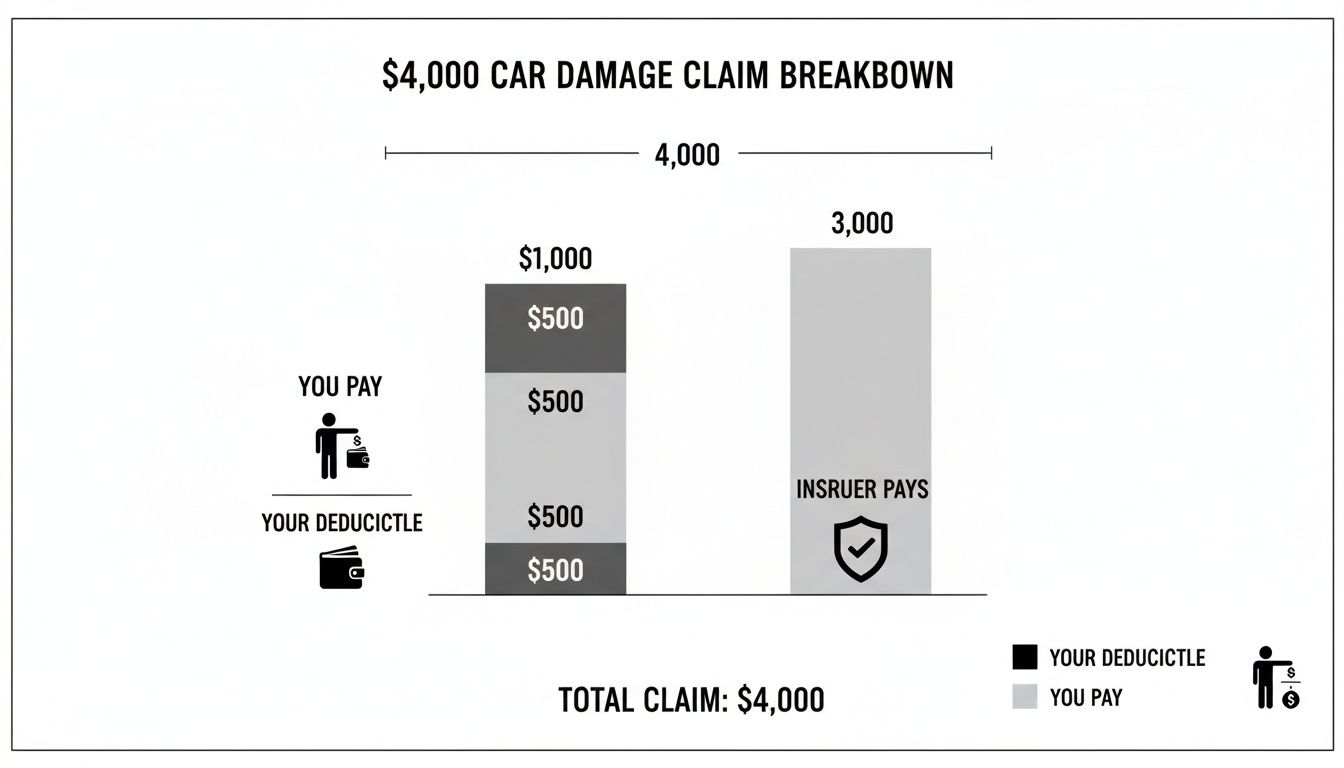
As the chart shows, your deductible is simply your share of the repair bill. You cover that first, and then your insurance company steps in to handle the rest.
A savvy move we often recommend to our California clients is to open a separate savings account just for their deductible. Tucking that money away lets you enjoy the lower premiums of a higher deductible without the stress of scrambling for cash when you need it.
In the end, the perfect deductible is one that fits your budget while letting you sleep at night. The best way to see how different amounts affect your premium is to compare them side-by-side. You can get a free, no-obligation insurance quote with us to find that sweet spot.
Answering Your Top Deductible Questions
Even after you’ve got the basics down, a few questions about deductibles almost always pop up. Let's tackle some of the most common ones we hear from California drivers to make sure you're feeling confident about your policy.
Do I Have to Pay a Deductible If I Didn't Cause the Accident?
This is a big one. The short answer is: yes, at first. To get your car back on the road quickly, you'll pay your collision deductible directly to the repair shop.
Then, your insurance company gets to work. They will go after the at-fault driver's insurance company to get back all the money they paid out—including the deductible you covered. This process is called subrogation, and when it’s successful, you get a check in the mail refunding your deductible.
Can My Collision and Comprehensive Deductibles Be Different Amounts?
Absolutely, and it's a smart strategy many drivers use. You might choose a higher deductible for collision coverage, since those claims are often more expensive, and in return, you get a lower premium.
At the same time, you could keep a lower comprehensive deductible. This makes it more affordable to handle smaller claims for things like a cracked windshield or vandalism.
This mix-and-match approach lets you balance your monthly premium savings with real-world financial protection. It’s a great way to tailor your policy to your personal budget and peace of mind.
What Happens If the Repair Bill Is Less Than My Deductible?
If the repair cost is lower than your deductible amount, you'll need to pay the full bill yourself. Your insurance doesn't kick in for anything below that threshold.
This is why most people don't bother filing a claim for a minor fender bender. There’s no payout from the insurer, and making a claim could still affect your rates down the line.
Is a Higher Deductible Always the Best Option?
Not for everyone. A higher deductible is a guaranteed way to get a lower premium, but it also means you’re taking on more financial risk. The right choice for your California car insurance really comes down to what you can comfortably afford to pay out of pocket at a moment's notice.
If coming up with $1,000 or $2,000 for a sudden repair would put you in a tough spot financially, then the small monthly savings might not be worth the risk.
Figuring out the fine print of an auto policy can feel overwhelming, but you're not in it alone. The team of licensed agents at Mai & Associates is here to help you navigate all your California insurance needs, from auto and home insurance to renters and life insurance. We are here to help you find that perfect sweet spot between great coverage and an affordable price. You can visit us online to compare quotes from top carriers and build a policy that gives you true protection.