Decreasing Term Life Insurance: A California Homeowner's Guide for 2026
Think of your biggest financial obligation—for most California families, that’s the mortgage. Now, imagine a life insurance policy designed to shrink right alongside that loan balance. This is exactly what decreasing term life insurance does.
It’s a specialized type of coverage where the death benefit goes down over time, usually on a set schedule. While the coverage amount decreases, your premium payments almost always stay the same, giving you a predictable and often very affordable way to protect a specific debt.
A Financial Tool Built for a Specific Job

Unlike standard life insurance that pays out a fixed amount, a decreasing term policy is crafted for one primary mission: covering a large debt that you're actively paying down. Its main goal is to ensure your loved ones aren't saddled with that liability if an income earner were to pass away.
In a state like California with its high property values, a mortgage is a massive financial responsibility. This type of policy acts as a dedicated safety net, making sure your family could pay off the house and stay in their home without financial strain during an incredibly tough time. It complements your home insurance by protecting your family's ability to keep the home itself.
How It Shields Your Family From Debt
While mortgages are the most common reason people get this coverage, it's a flexible tool for other significant loans that have a clear end date.
Here are a few other common uses:
- Small business loans: It can protect your partners or family from having to cover business debts you took on to launch or grow your company.
- Large personal loans: This could cover private student loans or financing for a major home renovation, ensuring the debt doesn't outlive you.
The death benefit is specifically structured to mirror the amortization schedule of your loan. This alignment is the key to its affordability—you're never paying for more coverage than you actually need. You can find more in-depth information on decreasing term life insurance to see how the numbers work.
Of course, this is just one piece of your financial puzzle. A good advisor helps you look at the big picture. Here at Mai & Associates, we help clients across California assess their entire situation, from home insurance and auto insurance to the right life insurance strategy for their family. If you come across any unfamiliar terms, our comprehensive glossary is a great resource.
To really understand where decreasing term fits, it helps to compare it directly with the most common type of term insurance.
Decreasing Term vs. Level Term A Quick Comparison
The table below breaks down the fundamental differences between decreasing term and level term life insurance, helping you see which might be a better fit for your goals.
| Feature | Decreasing Term Life Insurance | Level Term Life Insurance |
|---|---|---|
| Death Benefit | Declines over the policy's term | Remains the same for the entire term |
| Primary Purpose | To cover a specific, decreasing debt | To provide a fixed sum for any need |
| Typical Cost | Generally lower initial premiums | Higher premiums than decreasing term |
| Best For | Mortgage protection, business loans | Income replacement, education funds |
As you can see, the choice isn't about which one is "better," but which one aligns with your specific financial protection needs.
How Decreasing Term Coverage Actually Works
Let's get practical. The real magic of decreasing term life insurance isn't in a textbook definition—it’s in how it works for a major life event, like buying a house. It’s a tool built for a very specific job.
Picture a family right here in California taking that exciting step: they’ve just closed on their first home with a $500,000, 30-year mortgage. That loan is by far their biggest financial responsibility, and they need a plan to make sure the family keeps the home if one of them were to pass away unexpectedly.
They decide on a 30-year decreasing term policy with a starting death benefit of $500,000, perfectly matching their new loan. What’s really attractive is the premium. Even as their coverage amount drops over the years, their monthly payment—let’s say $28 per month—is locked in for all 30 years. That kind of predictability makes budgeting a whole lot easier.
Mirroring Your Mortgage Balance
This type of policy is specifically designed to shadow the amortization schedule of a loan. In the first few years of a mortgage, you've paid off very little principal, and your loan balance is at its highest. That’s also when your financial risk is at its peak. Your policy reflects this, providing the maximum death benefit when you need it most.
As the years and monthly payments go by, you chip away at the mortgage balance. The life insurance coverage is built to shrink right alongside it, making sure the payout is always enough to cover what’s left on the loan, but not so much that you're paying for extra insurance you don't need.
It's a smart, efficient design. The whole point is to keep you from being over-insured. As your mortgage debt shrinks, so does your insurance coverage for that specific debt.
Because the insurance company's potential payout gets smaller every year, decreasing term life insurance is typically one of the most affordable options out there. For instance, a policy might start with a $500,000 death benefit to cover a new 30-year mortgage, with the coverage amount tapering off as the loan is paid down. If you want to dive deeper into the cost structure, you can learn about the specifics of decreasing term life insurance from Thrivent.
A Look at Coverage Over Time
To see this in action, let's look at how our California family's $500,000 policy and mortgage might look at different points over the 30-year term. Notice how the death benefit tracks the loan balance, while the premium never changes.
| Policy Year | Approximate Mortgage Balance | Approximate Death Benefit | Monthly Premium |
|---|---|---|---|
| Year 1 | $495,000 | $500,000 | $28 |
| Year 10 | $405,000 | $410,000 | $28 |
| Year 20 | $260,000 | $265,000 | $28 |
| Year 29 | $25,000 | $30,000 | $28 |
You can see the death benefit stays just a bit ahead of the outstanding loan, giving the family a small but helpful cushion. By the time they get to year 29, the massive financial risk is gone, and the policy reflects that.
This precise alignment is what makes decreasing term such a targeted strategy for debt protection. It's just one piece of the puzzle, but an important one. You can explore more ways to protect your family's finances by checking out our other insurance guides. Building a complete safety net often means finding the right mix of home insurance, car insurance, and life insurance.
Who Is This Type Of Insurance Built For?
Decreasing term life insurance isn't for everyone, but for some people, it's the absolute perfect fit. Think of it as a specialized financial tool, built to provide affordable coverage for large debts that get smaller over time. It’s a smart choice for individuals and families who have a clear payoff plan for a specific loan and want to protect against it.
The classic example, and its most common use, is mortgage protection. Especially here in California, a mortgage is a huge financial weight. This type of policy is designed to lift that weight, ensuring that if an income earner passes away, their family can pay off the house and stay put, without facing financial ruin.
The Ideal Candidates for Decreasing Term Coverage
While mortgage protection is the headline act, decreasing term life insurance is just as useful for other big, structured debts. The key is that the loan has a set repayment schedule, just like a mortgage.
Let's look at a few real-world scenarios for people in California:
- First-Time Homebuyers: Imagine a young couple buying their first condo in Escondido with a 30-year mortgage. A decreasing term policy can be set up to mirror their loan balance, giving them crucial peace of mind for less money than a level term policy of the same initial amount. This is often purchased alongside their initial home insurance.
- Entrepreneurs and Small Business Owners: A business owner in Costa Mesa takes out a significant startup loan. This insurance acts as a safety net, protecting their family and partners from being on the hook for that business debt if the unexpected happens.
- Families Financing Higher Education: Parents who take out substantial private loans for their child’s college degree can use this policy to cover the balance. It ensures the debt doesn't become a burden for their surviving family members or the student.
The core idea is simple: as the debt shrinks, so does the coverage. This chart shows exactly how a policy can be designed to track a declining mortgage balance over 30 years.
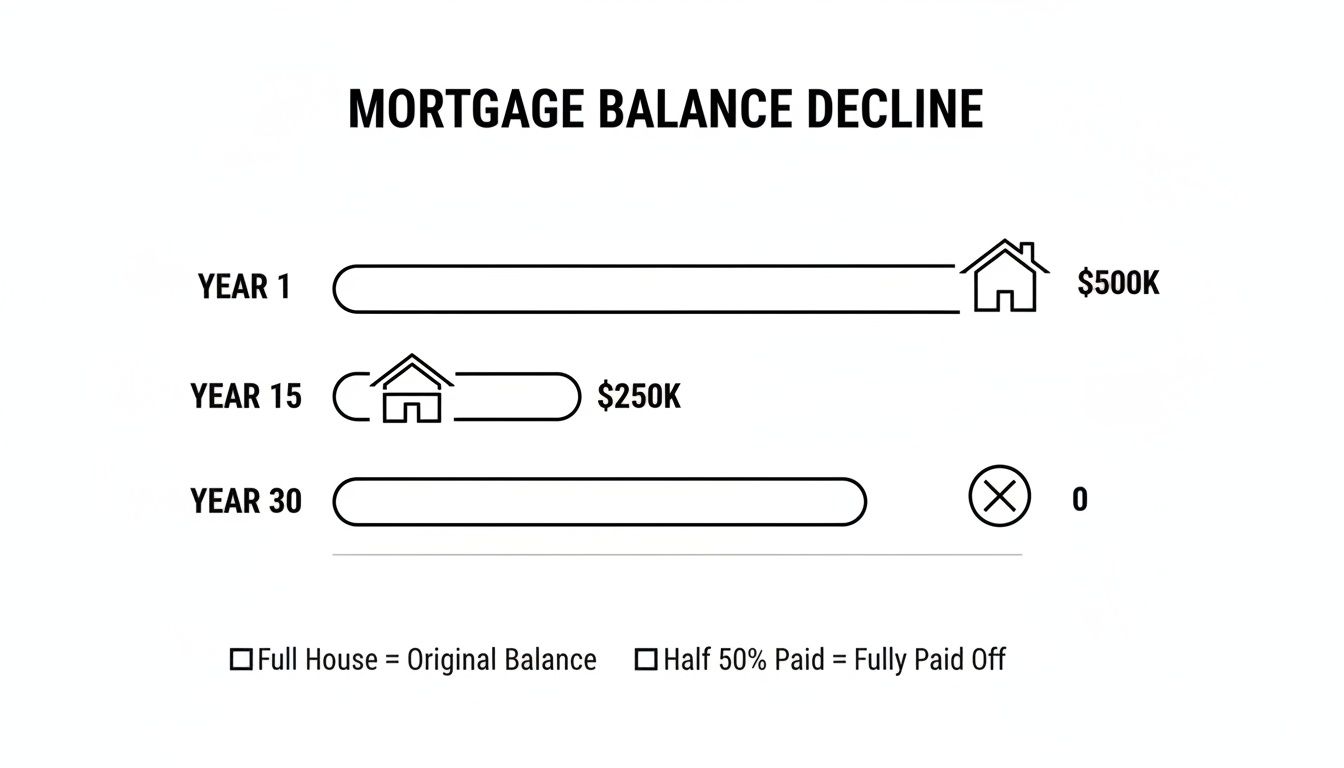
As you can see, the financial risk is highest right at the beginning and then steadily drops to zero. That’s precisely the liability a decreasing term policy is built to cover.
Matching the Tool to the Financial Job
It all comes down to using the right tool for the right job. If your main goal is to shield your family from a specific, shrinking debt, a decreasing term policy is often the most efficient and budget-friendly tool you can find.
You might also encounter a version called credit life insurance, which is sometimes offered by banks or other lenders. It's essentially a decreasing term policy that pays off a specific loan if the borrower dies. While you pay the premium, the lender is typically the beneficiary. When it’s bundled into a mortgage, it’s often called mortgage decreasing term insurance. The trend toward finding straightforward insurance is clear—in 2015, 71% of consumers researched life insurance online, a figure that was projected to jump to 92% by 2025. You can discover more insights about life insurance trends from the Insurance Information Institute.
This policy is for the person who says, "I just want to make sure the house is paid off if something happens to me." It’s a no-frills, mission-focused approach to life insurance.
It’s all about pinpoint protection. Instead of paying higher premiums for a large, level death benefit that might be more than you need for the debt, you pay for exactly what's required. This makes it a great piece of a larger financial safety net that might also include your home insurance, auto insurance, and other life insurance policies. For cost-conscious Californians looking to solve a very specific problem, it’s a strategic choice.
The Real Pros and Cons of Decreasing Term
No insurance policy is a one-size-fits-all solution, and decreasing term life insurance is a perfect example of that. It's a specialized product, and knowing its strengths and weaknesses is the only way to figure out if it truly fits your family's financial plan. Think of it this way: sometimes you need a specialized wrench for a single, important bolt, not an all-purpose multi-tool.
The biggest draw, by far, is its affordability. Because the payout shrinks over the years, the insurance company’s risk also goes down. They pass those savings directly to you, resulting in lower premiums than you'd find on a level term policy with the same starting face value.
This makes it a fantastic tool for families on a tight budget who have one major, specific debt they need to cover—most often, a mortgage. It’s laser-focused protection, so you aren't paying for extra coverage you might not need two decades from now.
Key Advantages of Decreasing Term
The appeal goes well beyond the low price tag. The very design of this policy comes with a few powerful upsides.
- Budget-Friendly Fixed Premiums: Even though your coverage is dropping, your monthly or annual premium almost always stays the same. That predictability is a huge plus, making it easy to budget for the long haul with no surprises.
- Targeted Coverage Prevents Overpayment: You’re paying to protect a debt that is also shrinking. This efficiency means you avoid being over-insured—a common mistake when people buy a massive level policy just to cover a mortgage that’s being paid down every month.
- Peace of Mind for Major Debts: There's a real comfort in knowing your single largest debt is handled. It guarantees your family won’t have to worry about selling the house or draining savings to make mortgage payments if you're no longer there.
A decreasing term policy is designed with one mission: to pay off a specific debt. Its value lies in its focused, no-frills approach to financial protection, ensuring your biggest liability doesn't become your family's biggest burden.
Important Disadvantages to Consider
Now, for the trade-offs. The very features that make decreasing term so affordable are also its biggest limitations. You absolutely have to go in with your eyes open to these potential downsides.
The most significant issue is its inflexibility. That declining coverage amount is set in stone. You can’t just hit pause on the decrease, and you certainly can't increase the benefit if your life changes—like if you have another child or take on a new business loan.
Another thing to remember is how much the policy’s value to your loved ones shrinks over time. A policy that pays out $500,000 in year one might only be worth $50,000 toward the end of its term. While that perfectly matches a declining mortgage balance, it leaves very little left over for anything else, like final medical bills, funeral expenses, or just day-to-day living costs. It won't cover ongoing needs like home insurance or car insurance premiums for the surviving family.
Finally, just like any other term life product, it builds no cash value. The premiums you pay are purely for the death benefit protection. You can’t borrow against it or cash it out like you could with a whole life policy. If you’re fuzzy on the differences between policy types, we have straightforward answers in our comprehensive FAQ section.
What Factors Determine Your Premium Costs
So, how much is this actually going to cost? It's the most common question I get, and for good reason. You know that decreasing term life insurance is a cost-effective way to cover a big loan, but you need to know what that looks like for your budget.
Insurance companies don’t pull your monthly premium out of thin air. They're in the business of risk assessment. The process is a lot like underwriting a loan—they look at a specific set of factors to predict the likelihood of having to pay out a claim. The lower your risk profile, the lower your rate. It's as simple as that.
Let’s break down exactly what they look at.
The Core Factors That Shape Your Rate
Every insurance quote is built on a handful of key personal and policy details. Understanding these helps you see why your rate is what it is and how much control you have over the cost.
Here are the main drivers behind your premium:
- Your Age: This is the big one. Statistically speaking, a younger person is less likely to pass away during the policy's term. That’s why starting early locks in the best possible rates.
- Your Health: Insurers will review your medical history, any current conditions, and your family's health history. They might also require a quick medical exam. Someone in great health will always get a better rate than someone with chronic health issues.
- Your Lifestyle: What you do for fun and the habits you keep matter. Do you smoke? That alone can make your premium 30-50% higher. Do you have a risky hobby like skydiving or rock climbing? That will also be factored into your rate.
- Initial Coverage Amount: The starting death benefit is a major component. A $750,000 policy designed to cover a mortgage in Los Angeles will naturally have a higher premium than a $250,000 policy for a smaller loan in a different part of the state.
- Term Length: A longer-term means the insurance company is on the hook for a longer period. Because of that extended risk, a 30-year term will cost more per month than a 15-year term for the same initial coverage amount.
Sample Premiums in California
Seeing some real numbers can help put this all into perspective. The table below shows some sample monthly premiums for a healthy, non-smoking individual in California looking for a $400,000, 20-year decreasing term life insurance policy.
| Age | Estimated Monthly Premium |
|---|---|
| 30 | $18 - $25 |
| 40 | $25 - $35 |
| 50 | $50 - $70 |
As you can see, the rates can be surprisingly affordable, especially for younger applicants. This is a huge part of why decreasing term insurance remains such a practical tool for families.
From 1989 to 2013, ownership of term life policies saw a significant drop, particularly among lower-income households. Decreasing term life insurance addresses this by offering fixed premiums that stay level even as the death benefit shrinks, providing stability where other policies see costs rise. You can read more about these term life insurance trends from the Chicago Fed.
This cost-effective structure provides a crucial financial safety net, allowing you to protect your biggest asset—your home—without breaking the bank. This is where working with an independent agency like Mai & Associates really pays off. We can instantly pull quotes from all the top carriers to find the most competitive premium for your exact situation, making sure you get the best deal on your life insurance, right alongside your auto insurance and home insurance policies.
Finding The Right Policy In California

Alright, you've done the homework and have a good grasp of how decreasing term life insurance works. So, what’s next? How do you actually find the right policy here in California? It’s one thing to understand the concept, but it's another to lock in a plan that truly protects your family without costing you a fortune.
The process kicks off with getting quotes. While online calculators give you a ballpark idea, a real quote requires you to share specific details about your health and lifestyle. This information is then used by the insurance company during underwriting to figure out your final premium. It can feel a little invasive and complicated, which is precisely why having an expert in your corner makes all the difference.
The Advantage Of An Independent Agency
You could go straight to a big-name insurance carrier, but there's a much smarter way to shop. Working with an independent agency changes the game completely. Think of it this way: a direct agent works for one company, but an independent agent works for you. Their job is to scan the entire market, pulling offers from dozens of top-rated carriers to find the perfect fit for your needs and budget.
This is especially true when shopping for California insurance. An agent with deep roots here knows the landscape, from the concerns of a homeowner in San Diego to the needs of a small business owner in Sacramento. They see the big picture and can help you bundle your life insurance with your auto insurance and home insurance for a more cohesive plan and potential savings.
Going it alone is like trying to buy a house without a real estate agent. An independent agent acts as your professional advocate, sorting through the options, decoding the fine print, and making sure your policy aligns perfectly with your financial goals.
That’s exactly what we do here at Mai & Associates. Our licensed agents provide instant rate comparisons and can often get you a same-day quote, cutting through the noise and saving you time. We're not just selling policies; we're consultants dedicated to building a financial safety net for your family. And because California is so diverse, we offer support in English, Spanish, Armenian, Russian, and Vietnamese, ensuring you get clear advice you can trust.
Building Your Complete Safety Net
A decreasing term life insurance policy is a fantastic tool, but it’s just one piece of your financial puzzle. A real safety net protects everything you’ve worked so hard for. Your car insurance covers you on the road, your home insurance or renters insurance protects your biggest investment, and your life insurance secures your family’s financial future when you're no longer there.
By looking at all your policies as a whole, an expert can spot dangerous gaps in your coverage and find opportunities to bundle policies for significant savings. It’s about making sure every piece works together. Whether you’re in Glendale, Escondido, Westlake Village, or Costa Mesa, we’re here to help you connect all the dots.
To protect your family’s legacy, you need to know all your options. You can learn more about life insurance in California right here in our comprehensive guide. Let us help you compare quotes and build a plan that brings you and your loved ones true peace of mind.
Frequently Asked Questions
It’s completely normal to have questions when you’re looking into something as specific as decreasing term life insurance. It’s a specialized tool for a particular job, so let's clear up some of the common questions we get from California families every day.
Can I Convert My Decreasing Term Policy to a Permanent One?
That’s a great question, and the answer is… maybe. It all comes down to a feature called a conversion rider.
If your policy includes this rider, you have the green light to switch your term coverage to a permanent policy (like whole life) down the road, and you won't have to go through another medical exam. This can be a lifesaver if your health takes a turn or your financial needs change. Not every policy offers it, though, so you absolutely have to check for that conversion option before you sign on the dotted line.
What Happens If I Pay Off My Mortgage Early?
First of all, congratulations! Paying off your home loan ahead of schedule is a huge win. When that happens, your decreasing term policy doesn't just disappear. It’s still in force for the original term you chose.
The main job it was hired for—covering that mortgage debt—is done. So, you’re at a crossroads and have a couple of choices:
- Keep the policy: The death benefit is smaller now, but it can still offer a helpful financial safety net for your loved ones.
- Cancel the policy: Since the mortgage is gone, you could simply stop paying the premiums. The policy will lapse, and you'll have that money back in your monthly budget.
Is the Death Benefit Payout Tax-Free?
Yes. In nearly every case, the money your beneficiaries receive from a life insurance payout is completely free of federal income tax. This is a cornerstone benefit of all life insurance, whether it’s covering your mortgage, your home insurance deductibles, or replacing your income.
That tax-free status means your family gets every single dollar intended for them, without a surprise tax bill eating into the funds they need.
Why Do My Premiums Stay the Same if My Coverage Is Dropping?
This is probably the most common point of confusion, but the logic is actually pretty simple. Insurers are playing the long game.
The core concept of a decreasing term policy is leveling the cost over the entire term. The premium is calculated based on the average risk over the full 20 or 30 years, creating a single, predictable payment from start to finish.
Think of it this way: the insurance company's risk is highest at the beginning when the death benefit is largest. By averaging the cost over the entire 20- or 30-year term, they make the policy much more affordable for you in those crucial early years. It’s a trade-off that gives you a stable, budget-friendly payment for protecting a long-term debt.
Trying to figure out all the fine print of California insurance on your own can be tough. The licensed agents at Mai & Associates are here to help you see how all the pieces—auto insurance, home insurance, and life insurance—fit together to protect your family. To get a no-obligation quote and see your options side-by-side, visit us at https://cahomeauto.com today.