Unlock Your Declaration Page of Insurance Secrets

A lot of people only look at their insurance when something changes. You buy a car, renew your home policy, move into a new apartment, or get a mortgage document asking for proof of coverage. Then a thick packet lands in your inbox or mailbox, and it feels like legal paperwork instead of something useful.
The good news is that you usually do not need to read every page first. Start with the declaration page of insurance. That single page, or short set of pages, gives you the clearest snapshot of what you bought, who is covered, what property is insured, what your limits are, what your deductibles are, and what you are paying for.
For California drivers, homeowners, renters, and families reviewing life insurance paperwork, this document is more significant than many realize. It helps you catch mistakes early, compare quotes correctly, and understand whether your protection fits real risks like wildfire, earthquakes, lenders’ requirements, or the way you use your vehicle.
What Is a Declaration Page of Insurance?
Your declaration page of insurance is the summary sheet for your policy, similar to a receipt and label for a major purchase. You may have a long owner’s manual in the box, but the summary tells you what you bought.
Insurance carriers often place this page near the front of the policy package because it is the fastest way to confirm the essentials. You can usually find your name, policy number, effective dates, insured address or vehicles, coverage types, limits, deductibles, endorsements, and premium.
The modern version of the declarations page took shape in the mid-20th century, and its form was solidified by the 1940s through the Insurance Services Office, as explained in this overview of the insurance declarations page. That standard format is one reason many auto insurance and home insurance documents feel similar even when they come from different carriers.
For day-to-day use, this is the page most policyholders return to. If you want to learn more insurance basics in plain language, the guides at https://cahomeauto.com/guides are a helpful starting point.
Consider this:
- The policy booklet contains the rules.
- The declaration page shows your specific choices.
- Your ID card or evidence of insurance serves a different purpose and is not the same thing.
If you own a home, rent an apartment, insure a car, or review a life insurance policy summary, learning to read this page gives you control. It turns insurance from a mystery into a checklist.
Tip: If you only have two minutes to review a policy, spend those two minutes on the declaration page first.
Decoding Every Section of Your Insurance Dec Page
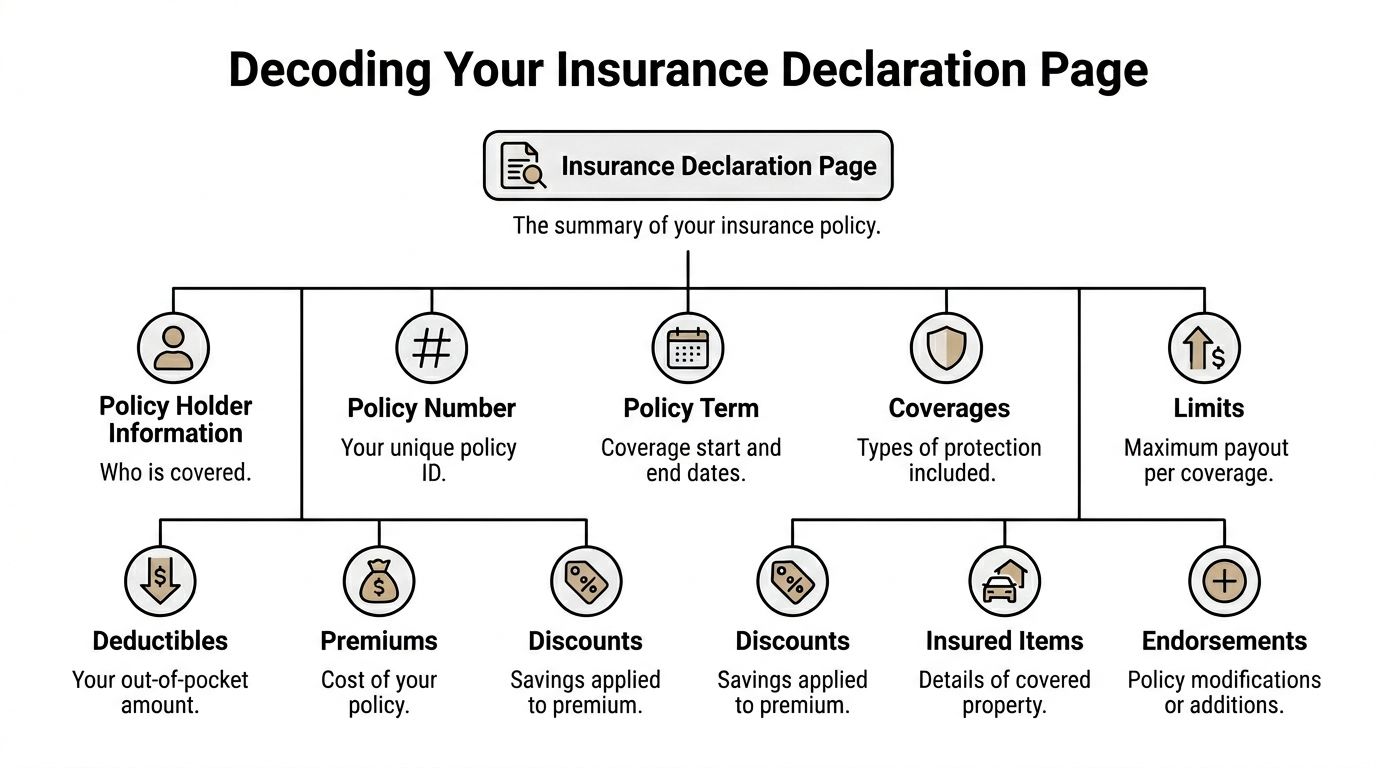
An insurance dec page works a lot like a car dashboard. Every section is a gauge or warning light. You do not need to memorize everything, but you do need to know what each part is telling you.
The names and policy details
Start at the top. This area usually shows the named insured, policy number, and policy period.
The named insured is the person, or people, who own the policy. If your spouse should be listed and is missing, that matters. If a home is in a trust or a vehicle is titled a certain way, the naming should match the actual ownership interest.
The policy period tells you when coverage starts and ends. If you are changing carriers, this date matters because even a short gap can create problems when you need proof of continuous insurance.
The insured property or vehicle information
This section identifies what is covered.
On an auto policy, you will usually see each car with details such as year, make, model, and VIN. On a homeowners policy, you will see the property address. On renters insurance, you may see the rental address and form type.
This sounds basic, but it is one of the most common places where policyholders find a mismatch. A wrong VIN, wrong address, or omitted vehicle can create trouble when you file a claim or when a lender reviews your records.
Coverage types and limits
Many readers slow down here, and for good reason. Limits tell you the maximum your policy will pay for a covered type of loss, subject to the policy language.
Think of a limit like the ceiling in a room. You can stand under it, but you cannot go higher than it. If the damage or liability goes above that ceiling, the difference may come out of your pocket.
For auto insurance, your dec page may list liability, physical damage (other than collision), collision, uninsured motorist, and other coverages. For home insurance, you may see dwelling, personal property, liability, loss of use, and other structures.
If you want plain-language definitions for these terms, the glossary at https://cahomeauto.com/glossary can help.
Deductibles
A deductible is the amount you pay before the insurer pays on a covered claim, where that coverage applies. A simple way to explain it is this: the deductible is your share of the first part of the loss.
Coverage limits and deductibles directly affect out-of-pocket costs, and U.S. averages show auto physical damage (other than collision) and collision deductibles at $500, while homeowners deductibles commonly fall in the $1,000 to $2,500 range, according to Progressive’s explanation of insurance declaration pages.
Picture a deductible as the front gate to claim payment. If the gate is set at $500, you cover that first portion. After that, the insurer steps in for covered damage up to the policy limit.
Endorsements and special additions
Endorsements modify the standard policy. They can add, remove, limit, or clarify coverage.
This matters in California because important protections may appear here instead of in the basic policy layout. Earthquake coverage, special property add-ons, and other changes often show up through endorsements.
If your dec page lists an endorsement code and you do not understand it, ask for the actual endorsement form. The declaration page tells you it exists. The endorsement language tells you what it does.
Premium breakdown and discounts
This section shows the cost of the policy, and in many cases, how the cost is divided among vehicles or coverage parts.
People often focus here first, but price only means something when you know what was purchased. A lower premium may be the result of lower limits, removed coverage, or a higher deductible.
When you compare auto insurance or home insurance quotes in California, always compare the dec pages side by side. Otherwise, you may think you found savings when you accepted less protection.
Mortgagee, lienholder, or loss payee
If you finance a home or car, another party may have a financial interest in the insured property. That is why you may see a mortgagee, lienholder, or loss payee listed.
This section confirms who else has a stake in the property and who may receive claim-related notice or payment in certain circumstances. If your lender information is wrong, fix it quickly.
A simple reference table
| Section Name | What It Means | Why It Matters for Californians |
|---|---|---|
| Named Insured | The person or people who own the policy | Names should match real ownership and household needs |
| Policy Number | Your unique policy identifier | You need it for service requests and claim conversations |
| Policy Period | Start and end dates of coverage | Important when switching carriers or proving no lapse |
| Covered Vehicles or Property | What the policy insures | Helps prevent issues caused by wrong VINs or addresses |
| Coverage Types | The protections included | Shows whether your auto, home, or renters policy fits your risks |
| Limits | The most the policy may pay for a covered loss | Critical when comparing quote quality, not just price |
| Deductibles | What you pay first on covered claims | Affects affordability when damage happens |
| Endorsements | Policy changes or add-ons | Often where California-specific options appear |
| Premium | What the policy costs | Useful only when read alongside limits and deductibles |
| Mortgagee or Lienholder | Lender or finance company interest | Needed for homes with mortgages and financed vehicles |
Key takeaway: A declaration page of insurance is not just paperwork. It is your quickest audit tool.
Visual Examples of Auto and Home Insurance Dec Pages
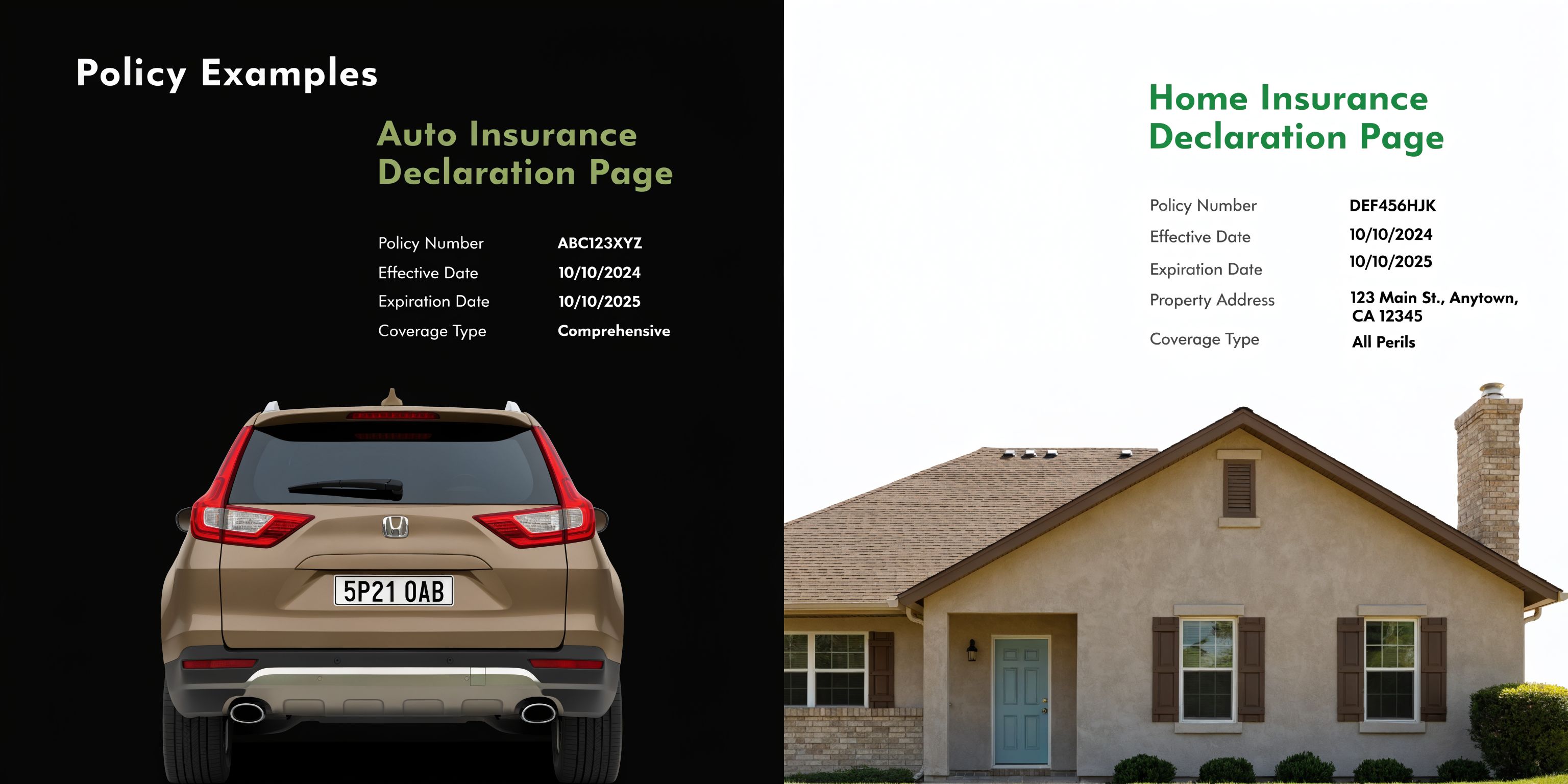
Reading definitions is helpful. Seeing where the information sits on the page is even better.
What to spot on an auto policy
On a California auto insurance dec page, your eyes should move in this order:
First, confirm the policy period. Then check the drivers and the vehicle list. After that, find the liability section, then physical damage and collision, then any optional coverages or endorsements.
If you are reviewing car insurance, these are the practical questions to ask:
- Are all drivers listed correctly
- Is the correct vehicle shown by VIN
- Do the coverages match what you thought you purchased
- Are the deductibles comfortable for your budget if a claim happens
A common confusion point is that not every vehicle on the same policy has to carry identical coverage. One car might have collision and other physical damage coverage, while an older car might not. That is why you need to review each vehicle line, not just the total premium.
What to spot on a home policy
A homeowners dec page usually feels more compact, but it contains different kinds of detail.
Check the insured address first. Then review the property description, dwelling coverage, personal property, liability, and any added endorsements. If you have a mortgage, make sure the lender appears correctly.
For California home insurance, many readers get stuck on one issue: they see a policy amount and assume every type of damage is covered the same way. That is not how home insurance works. The declaration page shows major categories, but exclusions and special endorsements still matter.
Why renters and life insurance look different
Renters insurance dec pages often center on personal property, liability, and loss-of-use style protections rather than a building structure. Life insurance usually uses a different summary format, so the layout may not look like auto or home insurance even though the purpose is similar.
That difference is normal. The key is the same. You are looking for the summary that states who is covered, what benefit applies, and when the policy is active.
Using Your Dec Page to Compare California Insurance Quotes
If you are shopping for coverage, your current declaration page is one of the strongest tools you have. It helps a new agent quote the same protection instead of guessing what you need.
Without it, quote comparisons often go sideways. One carrier may reduce limits. Another may raise deductibles. A third may remove an endorsement you forgot you had. The premium looks cheaper, but the policy is not equivalent.
The apples-to-apples method
Use your declaration page as your benchmark. Hand it to the new agent and ask for a quote that mirrors it first. Then, if you want options, ask for carefully explained alternatives.
A clean comparison should answer these questions:
- Are the liability limits the same
- Are deductibles the same
- Are the same vehicles or property addresses listed
- Are endorsements or added coverages being matched
- Is the quoted price based on the same policy term and insureds
This is especially important in California auto insurance and home insurance because a small change in structure can produce a very different premium.
Why this matters when claims happen
When a claim is filed, adjusters use the declarations page to verify what coverage was active on the loss date and determine claim eligibility, which is why it functions as the foundational claims document, as described in this discussion of how adjusters use the declarations page.
That is the practical reason to compare quotes carefully. If the declaration page is the first checkpoint in a claim, then the quality of what lands on that page matters.
A real-world shopping mindset
Do not ask only, “What is the cheapest quote?”
Ask:
- What changed from my current policy
- What did I gain
- What did I give up
- Would I be comfortable with this version if I had a claim next month
For renters insurance, this can mean checking whether liability and personal property amounts stayed comparable. For homeowners, it means looking closely at the structure coverage and endorsements. For auto insurance, it means comparing per-vehicle coverage, not just the overall policy total.
Tip: A cheaper quote is only a better quote if the protection still fits your real risk.
Navigating California-Specific Declaration Page Details
California policies deserve a closer read than many generic articles suggest. Wildfire exposure, earthquake questions, Fair Plan arrangements, lender requirements, and regional market shifts all make the declaration page more important here.
How a Fair Plan dec page can differ
A standard homeowners dec page usually gives readers a broad summary of multiple core protections. A California Fair Plan dec page can feel narrower and less intuitive.
According to this explanation of how to read insurance declarations pages, including Fair Plan differences, Fair Plan dec pages often show limited coverage, such as basic fire peril only, higher deductibles typically ranging from 2% to 5% of dwelling value, and mandatory endorsements for earthquake or expanded perils.
That is where confusion starts. A homeowner may see a declarations page, see a premium, and assume the policy resembles a regular homeowners package. But the protection may be much more limited.
What California homeowners should check first
If your home is in a wildfire-prone area, review the dec page with a highlighter and look for these items:
- Policy form type: Confirm whether you have a standard homeowners policy, a Fair Plan policy, or a layered arrangement with separate supplemental coverage.
- Named perils and endorsements: If the page references endorsements for expanded perils or earthquake coverage, request the forms and read them.
- Deductible structure: A percentage-based deductible feels different from a flat deductible. Many homeowners do not notice the difference until they need the policy.
- Property address and mortgagee information: These details need to be exact for lender and claims purposes.
Earthquake and wildfire details
California policyholders often assume earthquake coverage is part of a normal homeowners package. It often is not. If earthquake protection matters to you, the declaration page should prompt a follow-up question, not end the conversation.
Wildfire-related concern works the same way. The declaration page may show broad categories, but the key substance can sit in the endorsement wording and deductible design.
A useful mental model is this:
- The declarations page tells you the menu
- The endorsement tells you the recipe
If you only read the menu, you may miss ingredients that matter.
Why generic advice misses the California reality
A national article may tell you that the declaration page is simple. For many California property owners, it is only simple on the surface.
The page may summarize a policy that works alongside another policy. It may reference endorsements without explaining their practical effect. It may show a deductible in a format that looks harmless until you connect it to the dwelling amount.
That is why California homeowners should read the declaration page less like a receipt and more like a map. You are checking not only what is present, but also what is absent.
Key takeaway: In California, the most important words on a homeowners declaration page are often the ones that signal limited coverage or separate endorsements.
How to Request Your Insurance Declaration Page
Many people know they need the document and still are not sure how to get it. The process is usually simple, but you need to ask for the right thing.
Three reliable ways to get it
Log in to your carrier portal. Most insurers place policy documents inside the online account area. Look for labels such as “policy documents,” “declarations,” “dec page,” or “renewal packet.”
Call customer service. Use the number on your insurance card or billing notice and ask for the full declarations page, not just proof of insurance.
Contact your agent. If you bought the policy through an agent, they can often email the current declarations page quickly and may also help identify whether you are looking at the newest version.
What to say when you request it
Keep the request direct. You can say:
“I need the current declarations page for my auto policy.” “I need the declarations page for my homeowners policy, including endorsements if available.” “I need the prior term dec page and the current one.”
That wording matters because some carriers may otherwise send an ID card, a billing statement, or a generic proof-of-insurance letter.
Common mistakes to avoid
- Do not accept only the ID card. That card proves active auto insurance, but it does not show the full coverage summary.
- Do not rely on an old renewal packet. Make sure you have the current document if a change was made mid-term.
- Do not forget all policy types. If you are comparing insurance as a bundle, gather your auto, home, renters, and any other relevant summaries together.
If you are requesting a life insurance summary, ask for the policy schedule or current summary page if the carrier does not use the term declarations page.
Common Questions About Insurance Declaration Pages
Small issues around insurance paperwork can create big delays. These are the questions people ask most often when they are trying to compare quotes, fix an error, or understand what document they need.
How do I get a dec page from a previous insurer
Start with the old carrier’s online portal if you still have access. If not, call customer service and ask for prior declarations pages by policy term. If the old policy came through an agent, contact that office too.
California insurers often require 3 to 5 years of prior insurance dec pages for accurate risk assessment, and a 2025 J.D. Power study found 40% of shoppers struggle to obtain them, delaying quotes by 7 to 10 days, according to this article on obtaining prior dec pages for quotes.
If you want more insurance Q&A in one place, see https://cahomeauto.com/faq.
What if I find a mistake on my dec page
Act quickly. Contact the carrier or agent and point out the exact error in writing.
Focus on items that affect eligibility or claims handling, such as:
- Wrong name spelling
- Missing driver
- Wrong VIN
- Incorrect property address
- Unexpected coverage removal
- Deductible or limit that does not match what you requested
Ask for a revised declarations page after the correction is processed.
Can my dec page change during the policy term
Yes. If you add a vehicle, change a deductible, add an endorsement, update a lender, or make another policy change, the carrier may issue an updated declarations page.
That is why it helps to save each version. Think of it as a running record of your coverage decisions.
Is a declaration page the same as proof of insurance
No. This causes a lot of confusion.
Your auto ID card is generally the document you keep handy for driving-related proof. The declaration page is more detailed and is better for reviewing coverages, limits, deductibles, and premium breakdown.
Why does life insurance sometimes look different
Life insurance often uses a different summary format and may not present a document labeled “declaration page” the way auto or home policies do.
That does not mean you are missing something. Ask the insurer for the policy summary, schedule page, or current coverage statement. The goal is the same. You want a concise document that confirms the owner, insured, benefit, riders, and active dates.
Tip: If a carrier sends a document that only proves the policy exists, ask again for the page that shows the actual coverage details.
Secure Your Best California Coverage with Mai & Associates
A declaration page of insurance provides an advantage. It shows what you have, where the gaps may be, and whether a quote is comparable. For California drivers, homeowners, renters, and families reviewing life insurance options, that clarity matters.
It also helps you avoid two expensive mistakes. Paying for protection you do not understand, or saving money by accidentally giving up coverage you would want in a real claim.
If you want to compare policies wisely, start with the declarations page. Use it to confirm names, dates, vehicles, property details, limits, deductibles, endorsements, and lender information. For California property owners, pay extra attention to Fair Plan details, earthquake questions, and wildfire-related endorsements. For auto insurance shoppers, use the page to get a true apples-to-apples quote.
When you are ready to review your options, request a quote through https://cahomeauto.com/get-insurance-quote.
If you want a licensed California team to review your current declaration page, compare auto, home, renters, or life insurance options, and help you understand Fair Plan, wildfire, or earthquake details in plain language, contact Mai & Associates. They offer no-obligation guidance, multilingual support, and practical help for Californians who want coverage that makes sense.