Cost of Life Insurance: A 2026 California Guide

You’re trying to make smart money decisions in California. Rent or mortgage is high. Car insurance matters because you need to drive. Home or renters insurance matters because one loss can wreck your savings. Then life insurance comes up, and a lot of people freeze because they assume it’s expensive.
That reaction is common, but it often starts with the wrong assumption.
A family in Glendale, Escondido, or Costa Mesa might sit at the kitchen table and ask the same questions: Can we cover the mortgage if one income disappears? What happens to the car payment? Would the kids stay in the same school? Could the surviving spouse keep up with everyday bills? Life insurance belongs in that conversation right next to auto insurance, home insurance, and renters insurance, because all of those policies protect a different part of your financial life.
Demystifying Life Insurance Costs for Californians
A lot of Californians think life insurance is something they’ll deal with later, after they buy a home, after the kids arrive, or after their income rises. The problem is that “later” usually costs more, and waiting often comes from confusion rather than actual price.
For younger adults, that confusion is huge. Young adults age 30 and under overestimate term life insurance costs by 10 to 12 times, and that misunderstanding contributes to a 40% need-gap affecting about 100 million Americans (Reinsurance News reporting LIMRA data).
That’s a big reason so many families go without coverage they could probably fit into the budget.
Why this matters in California
California households rarely manage one risk at a time. They’re juggling several at once.
- Drivers need reliable car insurance because commuting, school drop-offs, and weekend errands depend on it.
- Homeowners need protection for the house, belongings, and liability.
- Renters need a low-cost way to protect personal property and shield themselves from loss.
- Families with dependents need life insurance because income loss can hit harder than a damaged car or a stolen laptop.
When you’re planning personal finance, life insurance shouldn’t feel like a mysterious extra bill. It’s part of the same protection strategy as your other core policies.
The real question isn’t “Is it expensive”
The better question is, “What kind of policy fits my life right now?”
A healthy person in California may find that term life fits the budget much more comfortably than expected. That’s especially true when the goal is simple income protection during working years, while kids are young, or while a mortgage is still large.
Practical rule: If someone depends on your paycheck, the cost of life insurance deserves a real look, not a guess.
People also get stuck because they compare the wrong products. They hear the price of a permanent policy, assume all life insurance works that way, and walk away. That’s like pricing a luxury SUV when what you need is a dependable commuter car.
If you want a broader view of how coverage decisions fit together, this collection of California insurance resources is a useful place to start: https://cahomeauto.com/guides
The 6 Key Factors That Determine Your Premium
Life insurance pricing works a lot like building a car. The base model has one price. Then your choices change the final number.
Choose a different engine, a bigger frame, or extra features, and the cost moves. Life insurance does the same thing. The insurer looks at the policy design and at you, the person being insured.
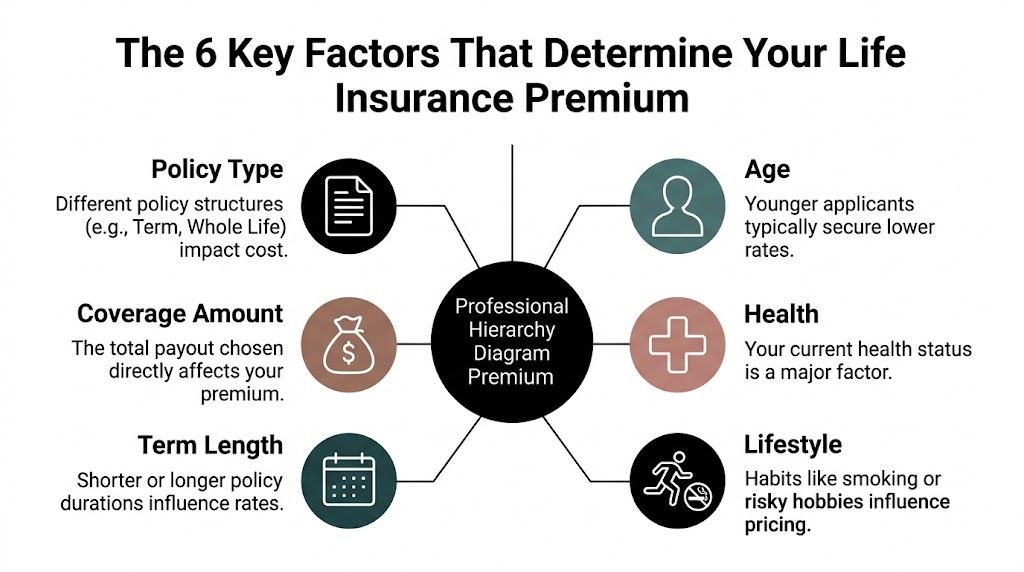
Policy type
The first pricing decision is the kind of policy you buy.
Term life insurance is usually the lower-cost option because it covers you for a set period, such as 20 years. Whole life insurance usually costs more because it lasts for life if premiums are paid and includes a cash value component.
The structure matters because you’re not only buying a death benefit. With permanent coverage, you’re also paying for features that don’t come with basic term coverage.
Coverage amount
This one is simple. More coverage usually means a higher premium.
But there’s an important detail people miss. The cost per unit of coverage can become more efficient at higher amounts. In the verified market data, the per-$100,000 cost drops from $12.15 for $250,000 of term coverage to $9.80 for $1 million (Reinsurance News reporting LIMRA data).
That doesn’t mean everyone should buy the largest policy possible. It means you should price the amount you need instead of assuming a larger policy is automatically wasteful.
Term length
A policy with a longer term can cost more than one with a shorter term because the insurer is taking on risk for more years.
If your main goal is to protect your family until your children are grown or until the mortgage balance is more manageable, the right term often lines up with that window. You don’t want to pay for years you don’t need, but you also don’t want coverage ending too early.
Age
Age is one of the strongest pricing factors.
In plain terms, younger applicants usually get lower premiums because insurers see them as lower risk. That’s why buying earlier can be one of the simplest ways to keep costs down.
Buy life insurance when you’re insurable and healthy, not when the need feels most urgent.
Health
Your current health helps shape your rate class. Insurers may look at your medical history, prescriptions, build, blood pressure, and other underwriting factors.
The big takeaway is that health affects eligibility and price. Two people the same age can see different premiums if one has a cleaner health profile.
Lifestyle
Smoking is one of the clearest examples. Verified pricing data shows smokers can face sharply higher term life costs, which is one reason tobacco use has such a strong effect on premiums (Guardian Life life insurance cost guide).
Lifestyle can also include risky hobbies or job-related exposures. For many Californians, that becomes especially relevant in construction, agriculture, or other physically demanding work.
If some of these terms sound technical, this insurance glossary can help translate the language into plain English: https://cahomeauto.com/glossary
How Much Life Insurance You Really Need in California
The hardest part of shopping for life insurance usually isn’t the quote. It’s figuring out the amount.
Many people pick a number because it sounds substantial. In California, that can be dangerous. A policy that seems large on paper may not go very far once you account for housing costs, debts, and lost income.
About 48% of U.S. families are significantly underinsured, with average coverage falling about $200,000 short of actual needs (Cusumano Insurance).

Start with the bills your family can’t avoid
Think about obligations that would still exist if your income disappeared.
A California family often starts here:
- Housing costs like rent or mortgage payments
- Daily living expenses such as groceries, utilities, fuel, and childcare
- Debt payments including car loans, credit cards, or personal loans
- Education goals if you want to help a child stay on track
- Final expenses so loved ones don’t have to scramble for cash
This is why life insurance is closely connected to home insurance, renters insurance, and car insurance. Each policy covers a different kind of financial shock. Life insurance covers the one that can affect every other bill at the same time.
Use a practical decision frame
A clean way to estimate need is to think in layers instead of formulas.
Income replacement
If your family depends on your paycheck, ask how long they’d need support. For some households, the key years are when children are young. For others, it’s the period until a mortgage is lower or retirement savings are stronger.
Debt protection
Would your spouse or partner need to pay off a car, cover rent, or keep up with a mortgage on one income? If the answer is yes, your coverage should reflect that burden.
Child-related costs
Young kids change the math fast. Childcare, after-school costs, and future education can all stretch a survivor’s budget.
A useful target isn’t the biggest number you can buy. It’s the amount that prevents financial disruption for the people who rely on you.
Don’t let “perfect” stop “good”
Some middle-income families assume that if they can’t afford the ideal policy, there’s no point buying any coverage. That’s usually the wrong move.
A practical approach is to buy a term policy that handles the most serious risks now, then review and increase coverage later if income grows. Partial protection is often far better than no protection at all.
California households do this kind of staged planning in other areas already. You may start with a basic renters insurance policy, then move to broader home coverage after buying a house. Life insurance can work the same way.
If you want to compare options built specifically for this state, this California life insurance page is a useful next reference: https://cahomeauto.com/life-insurance-california
Sample Life Insurance Monthly Costs in 2026
Numbers help. They turn life insurance from an abstract idea into something you can compare to a streaming bill, a cell phone plan, or one dinner out.
The examples below use verified pricing for healthy non-smokers buying 20-year term life insurance. They are averages, not guaranteed quotes. Your actual rate can change based on underwriting, health, and other details.
Estimated Monthly Life Insurance Premiums for Healthy Non-Smokers 20-Year Term
| Age | Gender | Coverage Amount | Average Monthly Premium |
|---|---|---|---|
| 30 | Female | $250,000 | $15.17 |
| 30 | Female | $500,000 | $22.98 |
| 30 | Female | $1,000,000 | $36.90 |
| 30 | Male | $250,000 | $18.19 |
| 30 | Male | $500,000 | $29.32 |
| 30 | Male | $1,000,000 | $48.89 |
| 40 | Female | $250,000 | $21.66 |
| 40 | Female | $500,000 | $35.27 |
| 40 | Female | $1,000,000 | $60.65 |
| 40 | Male | $250,000 | $25.39 |
| 40 | Male | $500,000 | $42.94 |
| 40 | Male | $1,000,000 | $75.24 |
These sample rates come from verified market pricing published by Guardian Life’s life insurance cost guide.
What these numbers tell you
The clearest takeaway is affordability. For example, a healthy 30-year-old female averages $22.98 per month for $500,000 of 20-year term coverage, while a healthy 30-year-old male averages $29.32 per month in the same product category, based on the same Guardian pricing data.
The second takeaway is timing. The age 40 examples are higher than the age 30 examples, which shows why buying earlier can matter.
The third takeaway is scale. The jump from $250,000 to $500,000, or from $500,000 to $1 million, isn’t always as dramatic as people expect. That’s why it’s smart to quote the amount you need instead of guessing what will be “too expensive.”
Term life versus whole life
Whole life pricing is very different. Verified cost data shows permanent coverage is often much higher than term coverage for the same face amount.
Here are a few examples from the same verified data set for age 30 whole life:
| Age | Gender | Coverage Amount | Average Monthly Premium |
|---|---|---|---|
| 30 | Female | $250,000 | $206 |
| 30 | Female | $500,000 | $408 |
| 30 | Female | $1,000,000 | $801 |
| 30 | Male | $250,000 | $238 |
| 30 | Male | $500,000 | $472 |
| 30 | Male | $1,000,000 | $920 |
That doesn’t make whole life bad. It means it serves a different purpose and fits a different budget.
For many working families, term life is the product that gets meaningful protection in place without putting pressure on the monthly budget.
Practical Strategies to Lower Your Life Insurance Premiums
You have more control over the cost of life insurance than many realize. You can’t control your birth date, but you can make choices that influence the premium you’re offered.
The best savings move is often simple. Don’t wait until life gets more complicated.

Buy while your profile is stronger
Life insurance usually gets easier to buy when you’re younger and healthier. If you already know people depend on your income, acting earlier can help you lock in a better rate.
That matters for new parents, homeowners, and even renters who share expenses with a partner. The longer you delay, the more chances there are for a health change that affects pricing.
Choose term length carefully
A longer term can be useful, but only if it matches a real need.
If your main goal is to protect your family until the kids are adults or until a home loan feels manageable, pick a term that lines up with that period. Overshooting can mean paying for coverage years you may not need.
Improve what you can before applying
Underwriting looks at your current profile, not your intentions. So if you know you’re planning changes, timing matters.
Consider steps like these before applying:
- Stop tobacco use if you can, because smoking can raise costs sharply.
- Stay consistent with medical care so managed conditions look stable.
- Review prescriptions and health records for accuracy.
- Apply when your health picture is at its best, not during a rough patch.
Small improvements in how an insurer views your risk can change the rate class you qualify for.
Ask for the right amount, not the cheapest number
People sometimes chase the lowest premium and end up underinsured. That can backfire.
A slightly higher monthly payment for a more realistic death benefit can protect a family far better than a bargain policy that leaves major gaps. The sweet spot is enough coverage to keep your household stable without stretching your budget too far.
Shop with your whole budget in mind
Life insurance doesn’t exist in isolation. California households are balancing auto insurance, home insurance, renters insurance, and everyday costs.
That’s why budgeting matters. If you’re trying to make room for another policy without creating stress elsewhere, this guide on how to create a family budget that works is a practical resource.
Work with someone who can compare carriers
This matters more in California than people realize.
Different insurers evaluate applicants differently. One company may be more comfortable with a certain health history, occupation, or build than another. The same person can look acceptable to one carrier and less appealing to another.
That’s especially important if your profile isn’t perfectly straightforward. Comparison shopping can help you find a better fit instead of assuming the first quote reflects the whole market.
Special Considerations for California Residents
California adds a few layers to life insurance shopping that national articles often gloss over. The broad rules still apply, but local realities can change how carriers look at your application and how you should think about protection.
The biggest examples are occupation, geography, and the way life insurance fits with your other policies.
High-risk jobs can change the picture
California has a large workforce in construction, agriculture, transportation, and physically demanding field work. Those jobs can affect underwriting.
Most articles say risky jobs may increase premiums, but they stop there. Verified guidance notes that many resources don’t quantify the impact for common California occupations like construction or agricultural work, and that an independent agency may identify carriers that don’t heavily penalize those occupations, potentially saving families hundreds per year on premiums (Western & Southern on factors affecting life insurance cost).
If you work in one of those fields, don’t assume every carrier will treat you the same. Ask how your occupation is classified and whether another insurer handles that class more favorably.
Wildfire areas raise practical questions
Many California homeowners already think about wildfire when they review home insurance. It’s reasonable to ask whether location affects life insurance too.
The answer can depend on the carrier and the broader risk profile. What matters most is not making assumptions from your home insurance experience. A home in a wildfire-prone area may face one set of underwriting concerns for property coverage, while life insurance focuses more on the insured person’s health, occupation, and overall risk.
That said, Californians in higher-risk regions still benefit from a coordinated protection strategy.
Your policies should work together
A strong insurance plan doesn’t treat life insurance as separate from everything else.
Consider how these pieces connect:
- Car insurance helps protect income and assets after an accident.
- Home insurance protects the place your family lives and the equity you’ve built.
- Renters insurance protects belongings and adds liability coverage at a modest cost.
- Life insurance helps replace income so the family can keep paying for all of the above.
The most resilient financial plan doesn’t rely on one policy. It combines several policies that each handle a different kind of loss.
California cost of living changes the stakes
Housing, commuting, and household costs can make the loss of one income especially severe here. That doesn’t always mean buying the biggest possible policy. It does mean being honest about what your family would face if one paycheck stopped.
For many households, a practical term policy fills the biggest gap. Then auto, home, or renters coverage handles the rest of the day-to-day risks.
Find Your Affordable California Life Insurance Rate Today
A lecture on why protecting family matters is often unnecessary. They need a clear answer to one question: what will it cost me?
The good news is that the cost of life insurance is often more manageable than expected, especially if you’re looking at term coverage, choosing a realistic amount, and applying before age or health make the policy more expensive.
A few ideas should stick with you:
What to remember
- Price depends on understandable factors like age, health, policy type, term length, coverage amount, and lifestyle.
- California families need to size coverage carefully because housing and living costs can make a policy feel smaller than expected.
- You can influence the premium by applying earlier, improving your health profile where possible, and comparing insurers instead of taking one quote at face value.
- Life insurance belongs in the same financial conversation as car insurance, home insurance, and renters insurance.
The next step is personal. Sample tables are useful, but your real rate depends on your own profile.
If you’re ready to see actual options, request a California insurance quote here: https://cahomeauto.com/get-insurance-quote
A good quote review should do more than give you a number. It should help you answer three things clearly:
- How much coverage makes sense for my household
- Which policy type fits my budget
- How this policy fits with my other insurance choices
When those answers are clear, life insurance stops feeling confusing. It becomes one more practical tool for protecting the people who count on you.
Mai & Associates helps Californians compare affordable options for life insurance, auto insurance, home insurance, and renters insurance in one place. If you want a personalized quote, a policy review, or guidance in English, Spanish, Armenian, Russian, or Vietnamese, their licensed team can help you compare carriers and find coverage that fits your budget and your life.