Lower Your Cost of Flood Insurance in 2026
Flood insurance usually costs about $786 to $1,064 per year nationally, while California averages about $1,079 per year, or roughly the upper end of that range. But that “average” can be misleading because your actual cost of flood insurance depends heavily on where the home sits, how it's built, and whether you choose an NFIP policy or a private one.
That matters more than most first-time buyers expect. 99% of U.S. counties have experienced a flood since 1996, and the average NFIP claim is $68,000 according to Flood Insurance Guru's flood cost breakdown. In California, flood risk isn't limited to beachfront homes. Atmospheric rivers, overwhelmed storm drains, creek overflow, and post-wildfire debris flows can all trigger damage.
A lot of buyers assume their homeowners policy handles water damage. Usually, it doesn't if the water came from flooding. Renters run into the same surprise. Even if you already shop carefully for California home insurance, renters insurance, car insurance, auto insurance, or life insurance, flood is often a separate decision.
That’s why it helps to treat flood coverage as one part of your full insurance picture, not a side issue. If you ever need to document what you own after a loss, a practical starting point is using a home inventory software guide, and if flood terminology feels confusing, a plain-English insurance glossary can make the language easier to decode before you compare quotes.
Understanding Your Flood Risk and Potential Costs
California buyers often ask one simple question: “How much will flood insurance cost me?” The honest answer starts with the statewide average, then gets much more personal.
The broad benchmark is useful. California sits above the national average, and that reflects the state's mix of coastal exposure, inland flooding, and burn-scar runoff. But average pricing is like hearing the average price of a house in California. It's directionally helpful, but it doesn't tell you what your home will cost.
Why standard policies leave a gap
A standard homeowners policy usually covers certain kinds of sudden water damage inside the house, such as a pipe burst. It generally does not cover flood damage from rising water outside the home. Standard renters policies also typically exclude flood.
That distinction confuses people because all “water damage” sounds similar in everyday conversation. Insurance separates it by cause. If heavy rain causes water to enter because the ground overflowed, a creek spilled over, or runoff rushed downhill after a wildfire, that often falls into the flood category instead.
Practical rule: If water touches the ground before entering the structure and affects multiple properties or a broad area, insurers often treat it as flood, not a standard home claim.
Why California flood risk surprises buyers
Some buyers only worry if they're near the ocean. That’s too narrow. A home can face flood exposure from rivers, drainage systems, low-lying streets, or debris flow after a fire stripped vegetation from nearby hillsides.
The better way to think about flood risk is this:
- Coastal risk: Storm surge and wave-driven water can affect shoreline areas.
- Inland risk: Rivers, creeks, and drainage overflow can affect neighborhoods far from the beach.
- Post-fire risk: Burn scars can change how fast water and mud move downhill.
- Urban runoff risk: Pavement and dense development can push water where it has nowhere to go.
Why the average cost isn't enough
Two homes with similar square footage can have very different flood premiums because flood insurance isn't priced like ordinary shopping for finishes or neighborhood prestige. It’s priced around water exposure, building details, and coverage choices.
That’s why a quote matters more than a statewide average. The cost of flood insurance for one buyer may feel modest. For another, it may become a major budget line item that affects escrow, lender requirements, and how they structure the rest of their California insurance portfolio.
The 5 Key Factors That Determine Your Flood Insurance Premium

Flood insurance pricing feels mysterious until you know the levers behind it. Think of flood zones like tiers in a game map. Some areas are on the easy level, some are on the hard level, and the insurer prices the policy based on how likely the water is to reach your home and how expensive the damage could be.
In California, that difference is substantial. High-risk flood zones A or V average $1,161 annually, while moderate-to-low risk zones B, C, or X average $622 annually, an 87% differential, according to Policygenius' California flood insurance analysis.
1. Flood zone
This is usually the first thing lenders, agents, and insurers check. Your flood zone is a FEMA-based risk label tied to location.
If you're in a higher-risk zone, the insurer expects a greater chance of future loss. If you're in a moderate or lower-risk zone, pricing often improves. That doesn't mean “safe.” It means less likely compared with the highest-risk categories.
A simple analogy helps. Think of flood zones like parking a car in different places overnight. A locked garage, a driveway, and a busy street all hold the same vehicle, but the risk environment changes the insurance math.
2. Building characteristics
Two neighboring homes can still price differently. Insurers also look at how the structure interacts with water.
Important details often include:
- Building Height: A home sitting higher relative to expected flood levels may price more favorably.
- Foundation type: Slab, crawlspace, or raised design can affect exposure.
- Lowest floor setup: The way lower levels are built and used matters.
- Basement presence: Basements often increase flood concerns.
Even small elevation differences can matter. The same Policygenius source notes that property elevation is critical, and even a change of a few inches can significantly affect federal flood insurance costs.
The flood map tells you the neighborhood story. The building details tell the house story.
3. Coverage limits and deductible
This is one of the few areas where you have direct control. If you choose higher limits, the premium usually rises. If you choose a higher deductible, the premium may drop, but you'll pay more out of pocket if a flood happens.
First-time buyers sometimes confuse this with trying to insure the full home value exactly the same way they would under homeowners insurance. Flood policies can work differently because flood losses often damage part of the structure rather than leveling the entire home.
4. Replacement cost and property specifics
The insurer also considers what it would cost to repair or rebuild damaged portions of the home. A more expensive structure usually means more potential claim cost.
This is one reason the cost of flood insurance becomes especially important in California. Home values and rebuilding costs can be high, even in places that don't “look” flood-prone.
5. Prior claims history
Past flood losses can shape how an insurer sees future risk. A property with a flood history may raise more questions during underwriting than a similar home without one.
That doesn't always mean you can't get coverage. It means the quote process may require more care, more comparison shopping, and sometimes better documentation.
NFIP vs Private Flood Insurance Which Is Cheaper
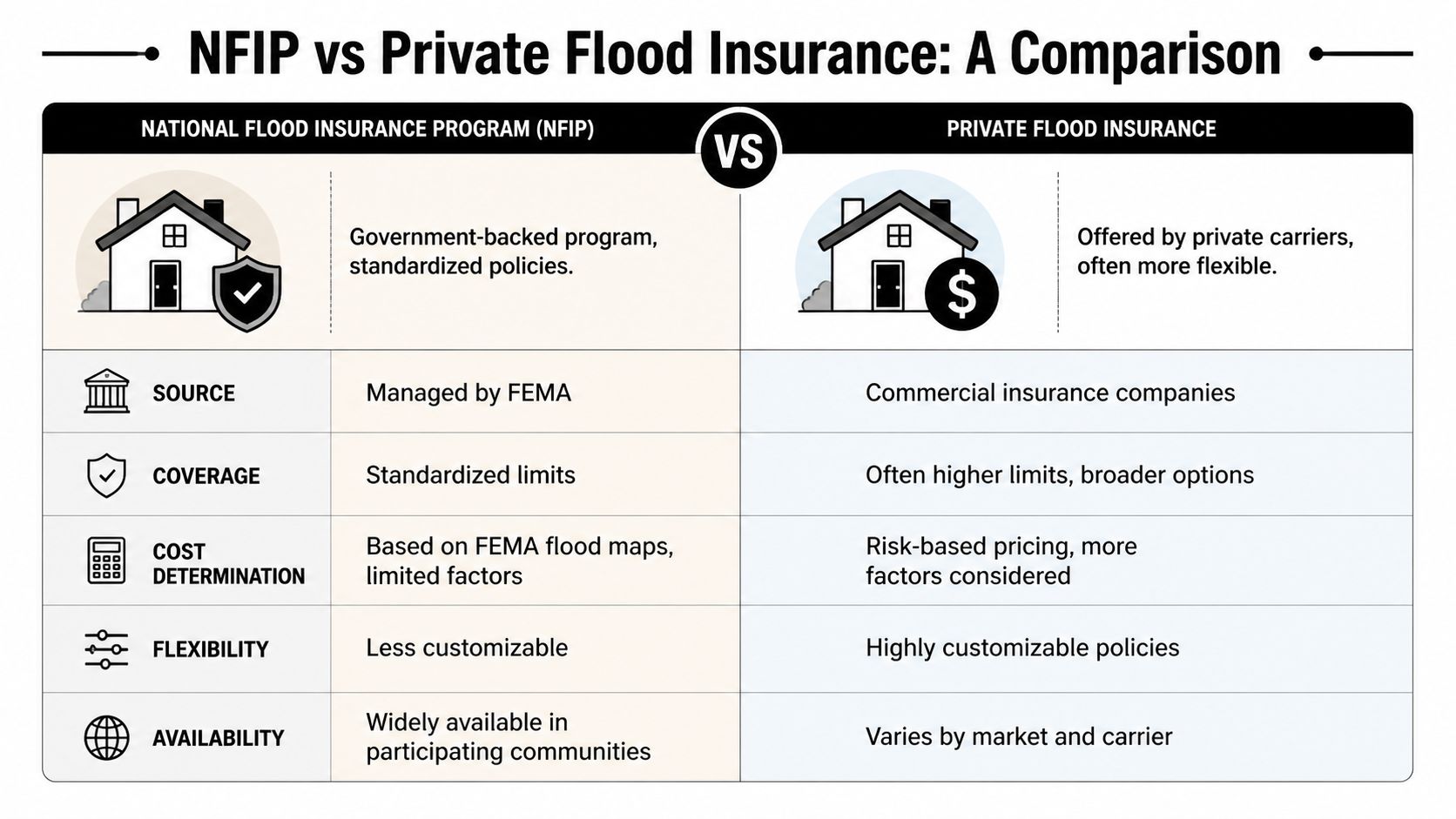
A lot of California buyers assume flood insurance means one thing: the government program. That used to be closer to true. Today, buyers often have two paths to compare: NFIP and private flood insurance.
Neither is automatically cheaper in every situation. The right answer depends on your zone, home characteristics, lender requirements, and how much coverage you need.
Where private policies can win on price
The private market has grown partly because some carriers price certain properties more competitively. According to the New York Fed's flood insurance overview, select private carriers offer average annual premiums as low as $335 to $449, compared with an NFIP average of over $900. The same source notes that the NFIP has paid out roughly $50 billion but covered only 35% of direct property damages, which helps explain why some buyers look for broader private options.
That doesn't mean private is always the bargain. In some cases, the NFIP may still be the better fit because of availability, lender familiarity, or underwriting acceptance.
Coverage differences matter just as much as price
Here’s where many first-time homebuyers get tripped up. They compare premium only, then miss the bigger issue: coverage limits.
NFIP policies have firm caps. If your home would need more than that limit to rebuild flood-damaged portions, a lower premium may not be the better value.
| Feature | NFIP (National Flood Insurance Program) | Private Flood Insurance |
|---|---|---|
| Program type | Government-backed, standardized program | Sold by commercial insurers |
| Typical pricing direction | Can be higher depending on risk and rating structure | Can be cheaper for some properties |
| Coverage limits | Standardized caps, including $250,000 dwelling and $100,000 personal property | Often offers higher limits |
| Customization | More standardized | Usually more flexible |
| Best fit | Buyers who need a familiar, widely accepted option | Buyers who want higher limits or more tailored pricing |
When to compare both, not choose blindly
If you're buying in California, comparing NFIP and private flood insurance side by side is often the smartest move. That’s especially true if you already juggle other coverages like homeowners insurance, renters insurance, auto insurance, life insurance, California Fair Plan coverage, or earthquake protection.
A flood policy doesn't exist in a vacuum. It affects your total insurance budget.
- If your lender requires flood coverage: Ask whether both NFIP and private policies are acceptable.
- If your home value is high: Check whether NFIP caps leave a gap.
- If you're in a moderate-risk zone: A private quote may come in lower.
- If you want simpler standardized coverage: NFIP may feel easier to understand.
Don't compare flood insurance the way you'd compare two identical gas stations. Compare it the way you'd compare two mortgages. Price matters, but structure matters too.
After a flood loss, claim handling can also become overwhelming. If you want a plain-language view of the recovery process, this guide to expert help from For The Public Adjusters is useful for understanding what property owners often face after serious water damage. For broader policy comparisons, a practical next step is reviewing other California insurance guides.
Flood Insurance Cost Examples Across California
The statewide average doesn't prepare you for how different one California quote can look from another. The Insurance.com California flood insurance guide says the average California NFIP premium is around $901 to $940 annually, but it also notes that a moderate-risk Sacramento location might average $461. The same source points out that NFIP dwelling coverage caps at $250,000, which can be a real limitation in California's property market.
Here’s how that plays out in real life.
Example one: Inland moderate-risk buyer in Sacramento
A first-time buyer in a moderate-risk Sacramento-area location may see a much lower premium than the statewide average. That often surprises people because Sacramento has waterways and flood history, so buyers assume every quote will be expensive.
Nuance matters. A moderate-risk location, a favorable structure setup, and reasonable coverage choices can all push the price down. For a buyer like this, the biggest question may not be “Can I afford flood insurance?” but “Should I buy more than the lender requires?”
Example two: Coastal homeowner needing more than NFIP allows
Now take a buyer looking at a higher-risk coastal property. The premium may be much higher, and the home itself may be worth far more than the NFIP dwelling cap.
That creates a different decision. The issue isn't just the annual premium. The issue is whether the policy can cover enough of the building to make a meaningful difference after a flood loss.
A cheaper flood policy isn't helpful if the coverage ceiling stops far below the amount you'd need to repair the home.
Example three: Buyer near a wildfire burn scar
This is one of the most California-specific situations. A home doesn't need to sit near the ocean or a major river to have serious flood concerns. If a recent wildfire changed the terrain uphill, heavy rain can send water, mud, and debris downhill fast.
These homes often require closer review because buyers may already carry other specialized policies or endorsements. Flood then becomes one more part of a multi-hazard insurance puzzle.
What these examples teach
The same article from Insurance.com makes the core point well: local variation is huge. That means you shouldn't rely on ZIP-code assumptions or online chatter from buyers in a different part of the state.
A useful checklist for California buyers looks like this:
- Check the exact address: Nearby homes can still land in different risk situations.
- Ask about dwelling limit adequacy: Especially important for higher-value homes.
- Review lender requirements: Required coverage and recommended coverage aren't always the same.
- Look at total insurance budget: Flood, home, wildfire-related coverage, and earthquake decisions affect one another.
For buyers already balancing California home insurance, renters insurance for a prior property, car insurance, or even long-term planning like life insurance, flood coverage works best when it fits into the whole picture instead of being treated as a last-minute closing item.
Smart Strategies to Lower Your Flood Insurance Costs
Most buyers have more control over the cost of flood insurance than they think. You may not be able to move the house, but you can often improve the way the policy is structured.
One of the most overlooked moves is comparing flood insurance as part of a bigger California insurance review. The ValuePenguin California flood insurance overview notes that private flood insurers may offer rates as low as $600 per year with higher limits than the NFIP, and that optimized combinations with other policies can reduce total insurance outlay by 10% to 20%. The same source says about 30% of California NFIP policies are in moderate or low-risk zones averaging $622, where private options may provide better value.
Raise the deductible carefully
A higher deductible often lowers premium. This can be a smart move if you have emergency savings and want to reduce annual cost.
But don't choose a deductible just because the premium looks attractive. Pick one you could realistically afford after a real flood, at the same time you may also be dealing with temporary housing or cleanup costs.
Re-check your coverage limits
Some buyers overinsure flood relative to the risk they're trying to cover. Others underinsure because they focus only on lender minimums.
A better approach is to ask: what part of the building and contents am I trying to protect from a flood event? That answer may not mirror the limits on your homeowners policy.
Compare private quotes if you're in a lower-risk area
Moderate and lower-risk California locations are often where comparison shopping pays off most. If your home fits the kind of risk profile private insurers like, you may find a lower premium, higher limits, or both.
That can be especially important for buyers who already carry multiple policies and want the full portfolio to make sense financially.
Review flood with the rest of your insurance portfolio
This is the unique California step many people skip. If you already have a homeowners policy, a California Fair Plan setup because of wildfire exposure, earthquake coverage, auto insurance, renters insurance on another residence, or life insurance for family protection, flood should be reviewed alongside all of it.
Why? Because the underlying goal isn't just buying one more policy. It's avoiding gaps, avoiding duplicate spending, and making sure your full protection plan fits your budget.
Good insurance planning isn't about buying the most policies. It's about lining up the right policies so each one does its job.
If flood is part of your home planning, it's smart to review it together with your broader California home insurance options instead of treating it as a separate afterthought.
Get a Clear Flood Insurance Quote for Your California Property
The biggest lesson is simple. The average cost of flood insurance is a starting point, not an answer. Your actual premium depends on the address, the flood zone, the building, the deductible, the coverage limit, and whether NFIP or private flood insurance fits better.
That matters because standard home, renters, and auto policies don't fill this gap. If flood is a real possibility for your property, waiting until after closing or after storm season usually makes the decision harder and more expensive emotionally.
The practical next step is getting a quote built around your exact property and comparing more than one option. If you want a faster way to do that, you can request a personalized California insurance quote and review flood coverage in the context of your full insurance needs, including homeowners, renters, auto, and life protection.
If you want help comparing flood insurance for a California home, condo, or rental property, Mai & Associates can review NFIP and private options, look for coverage gaps, and help you fit flood protection into your broader auto, home, renters, and life insurance budget.