Cost of earthquake insurance california: What Impacts Your Rate and How to Save

When people ask about the cost of earthquake insurance in California, the honest answer is: it depends. There’s no simple, one-size-fits-all price. For a typical single-family house, you could be looking at a range anywhere from $800 to over $5,000 annually, and that comes with a deductible structure that’s very different from your standard home policy.
Your Guide to California Earthquake Insurance Costs

If you live in California, you know earthquakes are just part of the deal. What many homeowners don't realize until it's too late is that their standard home insurance policies almost always exclude damage from ground shaking. This leaves a massive financial gap that only a dedicated earthquake policy can close. Think of it as your financial backstop, ready to help you rebuild your home and replace your belongings when the unthinkable happens.
Getting a handle on the cost is the first step. Earthquake insurance isn't priced like your car insurance or even your regular home insurance; its premiums are calculated using a unique formula based entirely on seismic risk.
A Quick Look at the Numbers
According to recent data, the average annual cost for earthquake coverage on a single-family home in California hovers around $1,874. But that's just an average. The actual price can swing wildly depending on where you live, what your home is made of, and how old it is.
For example, premiums in Los Angeles tend to be higher because of the well-known seismic activity. On the other hand, a homeowner in San Diego might see a lower average premium of around $1,739. These regional differences are a huge part of the pricing puzzle.
An earthquake policy is less like a standard insurance plan and more like a catastrophic financial tool. Its primary job is to prevent a total financial wipeout from a major disaster, which is why the structure of its premiums and deductibles is so different from what you might be used to with your auto insurance.
Because this insurance is designed for severe, widespread disasters, the policy itself is built differently. The biggest surprise for most people is the deductible. Instead of a flat dollar amount, it’s a percentage of your home's total insured value, usually somewhere between 5% and 25%. Getting your head around this is crucial—a higher deductible will lower your yearly premium, but it also means you'll pay more out of pocket before your coverage kicks in.
To make these numbers a bit clearer, here’s a quick snapshot of what you can generally expect when looking into earthquake insurance costs in California.
California Earthquake Insurance at a Glance
This table provides a quick summary of estimated annual premium ranges and typical deductible percentages for California homeowners.
| Metric | Typical Range |
|---|---|
| Estimated Annual Premium | $800 – $5,000+ |
| Deductible Percentage | 5% – 25% of Dwelling Coverage |
These figures give you a solid starting point for understanding what to budget for this essential protection.
What Factors Determine Your Insurance Premium
Ever wonder why your neighbor a few blocks over pays a completely different price for earthquake insurance? It’s a common question. Unlike standard home insurance or auto insurance policies, earthquake coverage isn't priced with a broad brush. Instead, insurers zoom in on a very specific set of risks tied directly to your property.
They’re essentially trying to answer one big question: how will your home hold up when the ground starts shaking? This isn't just guesswork; it's a careful calculation based on your home's unique vulnerabilities. The single biggest piece of the puzzle is location. If your home sits near an active fault line, the risk is obviously higher, and your premium will reflect that. This is why costs can swing so wildly from one zip code to the next.
Your Home’s Structural DNA
Beyond where you live, the physical makeup of your house plays a huge part. Insurers take a hard look at what I call the "structural DNA" of your property—its age, the materials it's built with, and the type of foundation it sits on. Each of these details tells a story about how resilient it might be.
Older homes, especially those built before the 1980s when modern seismic codes became the norm, are often a bigger gamble for insurers. They just weren't built with the same reinforcements we use today. The construction materials matter, too.
- Construction Type: A classic wood-frame house has a bit of flex, allowing it to move with the seismic waves rather than fighting them. A rigid brick or masonry home, on the other hand, can be brittle and is more likely to crack or collapse under stress. That flexibility often means a lower premium for wood-frame homes.
- Foundation: Is your house properly bolted to its foundation? If not, it can literally slide off during a major quake, which is about as catastrophic as it gets. An unbolted foundation is a huge red flag for any underwriter.
- Number of Stories: Taller homes can be more vulnerable to the swaying motion of an earthquake than single-story structures, which can also nudge the final price up.
Taking Control with Seismic Retrofitting
The good news? You're not just stuck with the hand you were dealt. One of the most powerful things you can do to lower your earthquake insurance premium is to seismically retrofit your home. When you strengthen your house against shaking, you're reducing the insurer's risk—and they'll often pass those savings right back to you. For more deep dives on protecting your assets, check out our collection of California insurance guides.
Making your home more seismically sound is a direct investment in both your physical safety and your financial well-being. Actions like foundation bolting or reinforcing cripple walls can lead to premium discounts of up to 25% with some carriers.
So, what kind of upgrades actually move the needle on your rates? Here are the big ones:
- Foundation Bolting: This anchors the wooden frame of your house to its concrete foundation, preventing that disastrous sliding motion I mentioned earlier.
- Bracing Cripple Walls: Many older homes have short, unbraced walls between the foundation and the first floor. Reinforcing these "cripple walls" is one of the most effective retrofits you can do.
- Installing Shear Walls: Think of these as structural panels that help your walls resist the back-and-forth rocking forces of a quake.
Once you understand what the insurers are looking for, you can see your premium not just as a fixed cost, but as something you have a measure of control over.
Understanding Your Coverage and Deductibles
When you first look at an earthquake insurance policy, the deductible can be a real head-scratcher. It doesn't work like the flat-dollar deductible on your auto insurance or standard home insurance. Instead, think of it as your share of the risk—the amount you agree to pay out-of-pocket for damages before your insurance coverage kicks in.
This deductible is always a percentage, not a fixed number. You'll typically see options ranging from 5% to 25% of your home's total dwelling coverage. So, if your home is insured for $500,000, a 10% deductible means you're responsible for the first $50,000 of repairs. It's a trade-off: picking a higher deductible will lower your yearly premium, but it also means a much bigger financial hit right after a disaster.
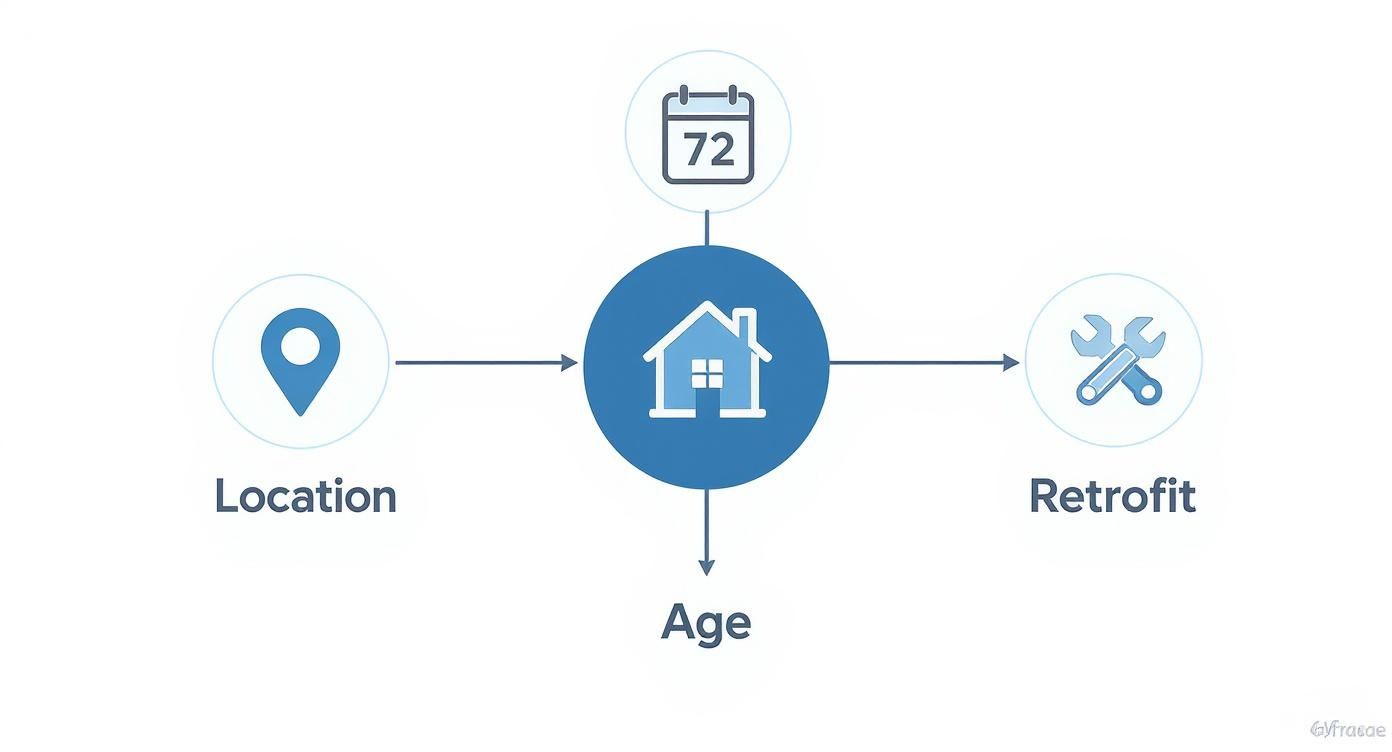
Insurers look at several key factors to figure out your specific risk and premium. As the image above shows, things like your home's exact location, its age, and whether you've done any seismic retrofitting are all pieced together to build your unique risk profile.
The Three Pillars of Your Policy
Knowing the cost is one thing, but understanding what you're actually paying for is everything. A solid California earthquake policy rests on three core pillars of protection. Getting this mix right is what makes a policy truly valuable when you need it most.
- Dwelling Coverage: This is the heart of your policy. It's the money set aside to repair or completely rebuild your house after an earthquake.
- Personal Property Coverage: This part helps you replace the stuff inside your home that gets damaged or destroyed—think furniture, clothes, TVs, and computers.
- Additional Living Expenses (ALE): If an earthquake makes your home unlivable, ALE is a lifesaver. It covers the cost of temporary housing, meals, and other essential living costs while your home is being repaired.
Striking the right balance between these coverages and your deductible is where you can really shape a policy to fit your needs. For a more detailed breakdown of these and other common insurance terms, you can explore our detailed California insurance glossary.
Choosing your deductible is a strategic financial decision. If a home has $700,000 in dwelling coverage with a 15% deductible, the homeowner is on the hook for the first $105,000 in structural damage. This structure is what helps make insurance for truly catastrophic events more affordable for everyone.
This percentage-based system is fundamental to how earthquake insurance works in California. It has its roots in how organizations like the California Earthquake Authority (CEA) first began structuring policies, and understanding it is the key to managing your financial exposure.
Ultimately, the goal is to find that sweet spot—a policy that offers real, meaningful protection without breaking your budget. You want to land on a deductible you can realistically manage while ensuring you have enough coverage for your home, your belongings, and the potential costs of being displaced. That's how you build a financial safety net that will be there for your family.
Standalone Policies Versus Endorsements
When it comes to protecting your home from an earthquake, you've got two main routes you can take. You can either add an endorsement to your existing homeowners policy, or you can purchase a completely separate standalone policy. Figuring out the difference is key to getting the right coverage without overpaying.
Think of an endorsement as an add-on to your current policy. It’s a rider that attaches directly to your home, renters, or condo insurance, which means you’re still dealing with one company and one bill. Many people like this for its simplicity—it’s easy to manage when your home insurance and car insurance are all in one place. The downside? Sometimes the coverage limits and deductible options aren't as flexible as a dedicated policy.
The Rise of Specialized Policies
Here in California, the standalone policy has become the go-to option for a reason. After the devastating 1994 Northridge earthquake, many traditional insurance companies got spooked by the massive financial risk and stopped offering endorsements altogether. This market gap led to the creation of the California Earthquake Authority (CEA), a publicly managed but privately funded organization designed to handle this specific risk.
Today, most major insurers in California work with the CEA. So, when you ask your agent for a quote on earthquake coverage, they're typically offering you a standalone policy from the CEA. This setup has a few big advantages:
- Custom-Fit Coverage: Standalone policies, particularly from the CEA, give you a lot more control over your deductibles and coverage amounts.
- Seismic Expertise: These policies are built by people who live and breathe earthquake risk, so the terms are tailored specifically to the challenges we face in California.
- Market Stability: The CEA model spreads the financial risk across dozens of participating insurance companies. This ensures that the money will be there to pay out claims, even after a catastrophic event.
A standalone policy gives you focused protection designed specifically for earthquakes. An endorsement, on the other hand, tucks earthquake coverage into your existing insurance package. The right choice really boils down to whether you prioritize specialized coverage or streamlined billing.
Making the Right Choice for Your Needs
The path you choose will affect both your protection and the long-term cost of earthquake insurance in California. An endorsement might feel easier on the surface, but a standalone policy could provide stronger coverage or even a better rate, especially if your home has unique risk factors.
The best move is always to compare quotes for both options. An experienced agent can walk you through the pros and cons of each, making sure the decision you make fits your budget while properly protecting your home, your car insurance needs, and your family’s financial future.
Actionable Strategies to Lower Your Insurance Costs

While the cost of earthquake insurance in California can feel like a tough pill to swallow, you have more control over your premium than you might realize. A few smart moves can make your home safer and your policy significantly more affordable. The single best thing you can do is reduce the insurance company's risk by strengthening your home against shaking.
This process is called seismic retrofitting, and it's all about making structural upgrades to help your house hold up when the ground moves. Insurers love to see this. Why? Because a retrofitted home is far less likely to end up as a pile of rubble, which is why they reward homeowners with some serious discounts on their premiums.
Make Your Home More Resilient
Taking proactive steps to fortify your property is, without a doubt, the number one way to get a better rate. Insurance carriers have a clear preference for homes brought up to modern seismic safety standards. Here are the key projects that make the biggest difference:
- Foundation Bolting: This is a big one. It involves anchoring your home's frame to its concrete foundation, which stops it from sliding off during a quake. Think of it as the bedrock of seismic safety.
- Bracing Cripple Walls: Many older California homes sit on short, unbraced walls between the foundation and the first floor. Reinforcing these “cripple walls” with plywood or specialized hardware adds a huge amount of stability where it's needed most.
- Securing Your Water Heater: It sounds small, but strapping your water heater to the wall is crucial. It keeps the unit from toppling over, which can otherwise lead to devastating fires or floods.
These upgrades aren't just about protecting your investment—they translate directly into lower insurance premiums. It's a win-win.
Financial and Policy Adjustments
Beyond physical upgrades, you can also tweak your policy to find savings. The most straightforward way is to choose a higher deductible. By agreeing to cover a larger slice of potential repair costs out-of-pocket, you lower the insurer's immediate risk, and they'll thank you with a lower annual premium.
Another tried-and-true tactic is bundling. Most insurance carriers will give you a discount for bringing more of your business to them. When you combine your earthquake policy with your auto insurance, home insurance, or even life insurance, you can often unlock savings on all of them. It also makes paying your bills a lot simpler.
Don't forget to look into grant programs. The Earthquake Brace + Bolt (EBB) program, for instance, can give eligible California homeowners up to $3,000 to help pay for a seismic retrofit. This can make the upfront cost of fortifying your home much more manageable and sets you up for long-term insurance savings.
Finally, it’s important to understand the broader market. It's no secret that insurance costs have been on the rise. An uptick in seismic events and skyrocketing rebuilding costs—thanks to inflation on materials and labor—have pushed premiums higher statewide. You can read more about the California earthquake insurance cost increase to get a better sense of these trends. By putting the strategies above to work, you can actively push back against these rising costs.
Finding the Right California Insurance for Your Needs
Figuring out the California insurance market can feel like trying to solve a puzzle, but you don't have to go at it alone. As we've seen, the cost of earthquake insurance in California isn't a one-size-fits-all number. Understanding your options is the single most important step you can take to protect your home and your family, and an independent insurance agent is your best ally in this process.
When you work with a trusted advisor, you get a clear view of the entire landscape. They can pull quotes from multiple carriers, including the CEA, and help you piece together a policy that strikes the perfect balance between cost and coverage. That kind of expert guidance is invaluable, not just for earthquake protection, but for your entire insurance strategy.
Building Your Complete Safety Net
A good agent helps you see the big picture. They’re trained to spot potential gaps in your coverage and find opportunities to bundle policies, which can often lead to significant savings while strengthening your protection. It’s all about making sure your different policies work together as a cohesive shield.
Whether you're focused on protecting your house or planning for your family's financial future, a comprehensive strategy is key. A knowledgeable agent helps you build a solid plan that protects what matters most by integrating all the essential pieces:
- Home Insurance: The bedrock of your property protection.
- Auto Insurance: Your safeguard on the road.
- Renters Insurance: For protecting your personal belongings when you rent.
- Life Insurance: To provide lasting financial security for your loved ones.
An independent agent is more than just a salesperson; they're your personal advocate. Their job is to translate confusing policy jargon into clear, straightforward choices. Their goal is to align your home insurance, car insurance, and other coverages with your actual life and budget, ensuring you're not just insured—you're properly protected.
Ready to find the right coverage at the right price? You can get a personalized California insurance quote from our team to see how we can help you build your complete safety net.
A Few Common Questions We Hear All The Time
When it comes to earthquake insurance, a lot of questions pop up. It's a confusing topic for many California homeowners, so let's clear up a few of the most common ones we get asked every day.
Do I Legally Have to Buy Earthquake Insurance in California?
Nope, there's no state law that forces you to buy earthquake insurance.
However, your mortgage lender might have a different opinion. If you live in a high-risk area, they can (and often do) require you to have it as a condition of your loan. While the state doesn't mandate it, going without coverage means you're on the hook for 100% of the repair or rebuilding costs if a major quake hits.
Wait, Doesn't My Homeowners Policy Already Cover Earthquakes?
This is probably the single most dangerous assumption homeowners make. The answer is a hard no.
Standard home insurance, renters insurance, and condo policies in California specifically exclude damage caused by the ground shaking. They might cover a fire that starts because of an earthquake, but the cracked foundation, collapsed walls, and other structural damage? That's not covered at all.
Without a specific earthquake policy, your standard home insurance offers zero coverage for structural damage caused by an earthquake. This is the single biggest gap in coverage for most California residents.
What Exactly Is the California Earthquake Authority (CEA)?
The California Earthquake Authority (CEA) is a really important player in this space. It's a publicly managed, privately funded organization that provides the vast majority of earthquake policies in the state.
Think of it this way: after the devastating 1994 Northridge earthquake, many private insurance companies got spooked and stopped offering earthquake coverage. The CEA was created to fill that gap. Today, most big-name insurers you already know and trust for your home insurance or auto insurance partner with the CEA, so you can buy a CEA policy directly through your local agent.
I'm a Renter—Do I Need This?
Absolutely. Your landlord's insurance covers the building itself, but it does absolutely nothing for your personal belongings.
Imagine an earthquake shakes your apartment building. The structure might be covered, but your destroyed couch, shattered TV, and broken laptop are your responsibility. A renters insurance policy with an earthquake add-on protects your stuff and can also provide money for temporary housing if you're forced to move out during repairs.
Understanding your options is the first step toward complete protection. At Mai & Associates, our licensed agents specialize in creating insurance plans that cover your home, auto, and family's future, aligning the right coverage with your budget. Protect what matters most by visiting us at https://cahomeauto.com for a no-obligation quote today.