Compare California Insurance Rates for Auto, Home, and More
If you want to get the best deal on your California car insurance, you first have to understand why prices are getting so high. It's not just you—factors like inflation and sky-high repair costs are pushing average premiums through the roof. This new reality means that just renewing your old policy isn't good enough anymore; you have to be a little more strategic to find affordable coverage for all your California insurance needs.
Why California Auto Insurance Premiums Are Rising

Did your latest car insurance bill give you sticker shock? You're definitely not alone. Drivers all over the Golden State are seeing huge jumps in their premiums, and it’s a trend fueled by some pretty powerful economic shifts. Getting a handle on these root causes is the first step toward finding better, more affordable protection for your vehicle.
The biggest driver here is inflation. The cost of everything involved in fixing a car—from a mechanic's time to the price of a single part—has shot up. Cars today are also packed with advanced tech like sensors, cameras, and onboard computers, which means even a simple fender-bender can turn into a ridiculously expensive repair job. When repair costs go up, so do insurance claims, and insurers pass that expense right back to you in the form of higher premiums.
The Financial Squeeze on Drivers
This new normal is putting a real strain on household budgets. California's auto insurance rates have climbed dramatically over the past couple of years, thanks to more frequent claims and the rising cost of repairs. As of June 2024, the average annual cost for a full coverage policy in California hit about $2,417. That’s a staggering jump from roughly $1,666 in 2023, marking a nearly 45% increase in just one year. You can dig into more data on these rising insurance costs to see the full picture.
In this kind of market, actively shopping for a new policy isn't just a smart move—it's a financial necessity. The days of just letting your policy renew without a second thought are long gone.
The single biggest mistake California drivers make is assuming their current insurer is still offering them a competitive rate. Loyalty rarely pays off in today's market; diligent comparison is where the real savings are found.
Key Factors Behind the Rate Hikes
A few key things are working together to push rates higher. Once you see what they are, it becomes clear why getting multiple quotes for your car insurance—and even other policies like your home or renters insurance—is absolutely essential.
Key Factors Driving Higher California Auto Insurance Rates
The table below breaks down the main culprits behind the recent premium increases you're likely seeing on your renewal notice.
| Influencing Factor | Impact on Your Premium |
|---|---|
| Inflation and Repair Costs | Higher prices for parts and labor mean more expensive claims, which insurers pass on to customers through higher rates. |
| Increased Claim Severity | Modern cars with advanced safety features cost significantly more to repair after an accident, driving up the average claim amount. |
| Regulatory Adjustments | Changes in state insurance regulations can affect how carriers calculate risk and set prices across California. |
| More Accidents Post-Pandemic | With more drivers back on the road, accident frequency has returned to, and in some cases surpassed, pre-pandemic levels. |
Given how fast things are changing, using a modern comparison tool is the most practical way to fight back against these rising costs. Instead of spending hours calling one agent after another, you can get accurate, side-by-side quotes from multiple top carriers instantly. This puts the power back in your hands, allowing you to find serious savings and lock in the best protection without all the usual hassle.
Decoding How Your Insurance Rate Is Calculated
Ever wonder why auto insurance quotes can feel so all over the map? It might seem like carriers are just pulling numbers out of a hat, but there's a specific logic behind it all. When you get down to it, calculating your premium is all about assessing risk.
Insurers are essentially trying to predict the likelihood that you'll need to file a claim. The higher they perceive that risk, the higher your premium will be. Several key factors go into this calculation, and understanding them puts you in the driver's seat.
Your Personal Profile and Driving Record
The factors that carry the most weight are the ones directly tied to you. Your driving history is, without a doubt, the most important piece of the puzzle. A clean record free of accidents and moving violations is your single best asset for securing a great rate on your car insurance.
In fact, California law mandates a Good Driver Discount of at least 20% for drivers who qualify. Safe driving literally pays off.
Your age and the number of years you've been licensed also play a huge role. Statistically, younger and less experienced drivers are involved in more accidents, and that risk is reflected in their premiums. The numbers tell the story: a 16-year-old in California might pay an average of $7,174 a year for full coverage, while a 25-year-old pays closer to $3,866. The cost typically continues to drop with age, bottoming out around $2,862 for a 60-year-old. You can dive deeper into California's car insurance cost trends on Bankrate.com.
Your Vehicle and How You Use It
What you drive is just as important as how you drive. Carriers look closely at the car itself, considering things like:
- Make and Model: It's no surprise that a high-performance sports car or a luxury sedan costs more to repair or replace than a standard commuter car. This directly impacts the price of your collision and comprehensive coverage.
- Safety Features: Does your car have anti-lock brakes, multiple airbags, or an anti-theft system? These modern safety features can often qualify you for some nice discounts.
- Age of Vehicle: As a general rule, older cars are cheaper to insure because their replacement value has depreciated over time.
How you use your vehicle is also a major factor. Your annual mileage gives the insurer a clear picture of your time on the road. If you have a long daily commute, your exposure to potential accidents is much higher than someone who primarily works from home, and your rate will reflect that.
A common mistake is underestimating your annual mileage to get a lower quote. In the event of a claim, an insurer may investigate and could deny coverage if they find a significant discrepancy, deeming it misrepresentation.
Where You Live and Your Coverage Choices
Believe it or not, your zip code can have a significant impact on your premium. Insurers look at local data for things like theft, vandalism, and the frequency of accidents. Living in a busy urban center like Los Angeles often leads to higher rates than in a quiet suburb simply due to the higher volume of traffic and crime risk.
Finally, the coverage you choose is what truly builds your policy and your price. California has state-mandated minimum liability limits, but most people need more protection. Adding higher limits or crucial coverages like collision and comprehensive will increase your premium, but they’re essential for protecting your financial well-being. To get clear on what these terms mean, check out our insurance glossary.
You can also adjust your deductible—the amount you pay out-of-pocket on a claim. A higher deductible will lower your premium, but you need to be comfortable paying that amount if something happens. The goal is always to find that perfect balance between solid protection and a price that fits your budget.
Comparing Real Rates Across California Cities and Insurers
Your zip code is one of the biggest—and most misunderstood—factors driving your car insurance premium. It’s a strange thought, but two people with the exact same driving record and vehicle can get wildly different quotes simply because they live in different neighborhoods. Let's dig into just how much your address and your choice of insurer can swing your final price, using real-world scenarios from across the Golden State.
Getting a handle on these variations is how you find real savings. When you compare California auto insurance rates, you’re doing more than just pitting companies against each other; you’re seeing how each one weighs the risks tied to your specific area. Things like local traffic patterns, accident frequency, and even car theft statistics all get factored into their math.
This infographic gives a great visual breakdown of the other core elements that build your insurance profile.
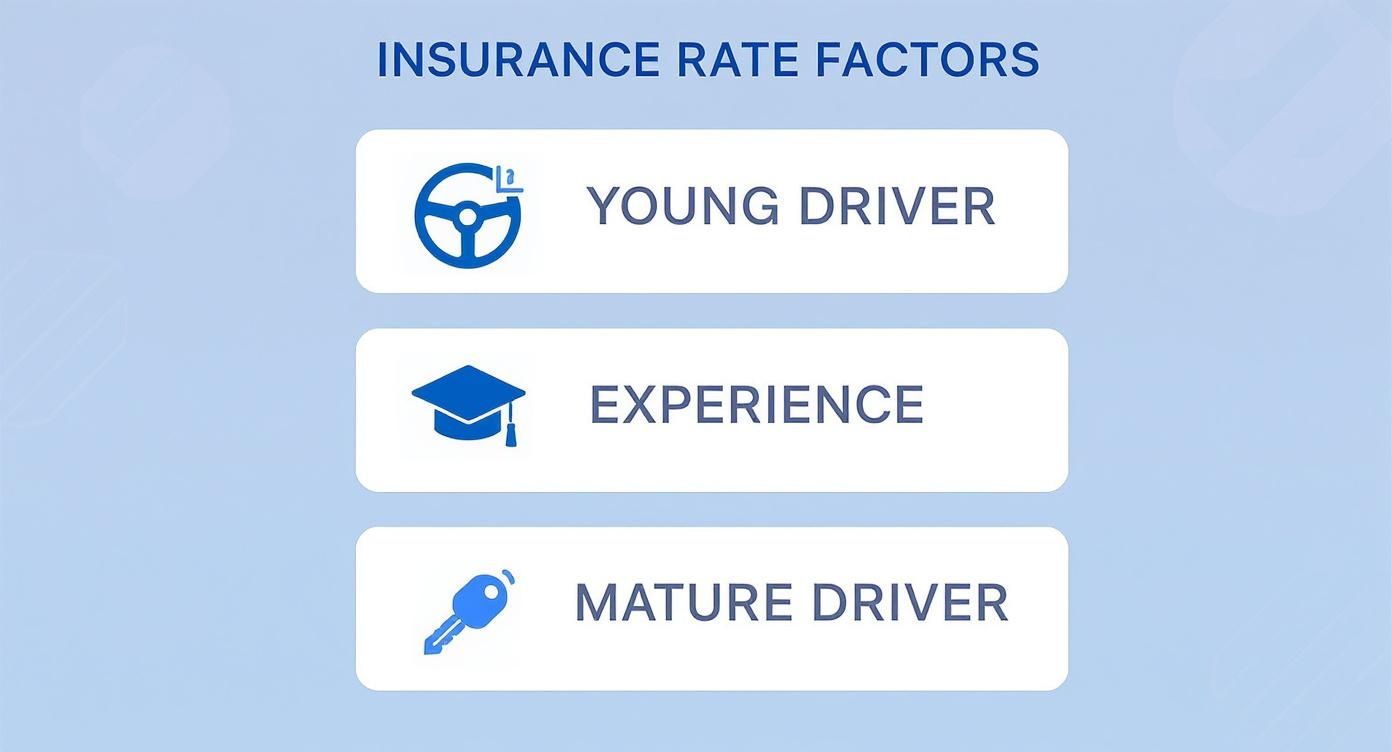
As you can see, factors like your age and how long you've been driving are foundational. More experienced, mature drivers almost always see more favorable pricing.
Geographic Rate Disparities in California
The difference in what you'll pay for your California insurance from one city to another can be truly staggering. A driver living in a quiet, rural town is almost guaranteed to pay less than someone in a dense urban center, even if everything else about them is identical. This is precisely why shopping around isn't just a good idea—it's a powerful financial strategy.
Data from Experian.com highlights this perfectly. Drivers in San Diego and Bakersfield see similar average annual premiums, coming in around $1,820 and $1,829, respectively. But head over to Los Angeles, and that average jumps to a whopping $3,066 a year for comparable coverage.
Numbers like these prove that taking the first quote you get, especially if you live in a high-cost area, is an expensive mistake. The cost of auto insurance in Los Angeles can be nearly double that of other major cities, which makes it absolutely critical for LA drivers to compare their options.
Here's a pro tip: The best deals often come from carriers that specialize in or have a strong presence in your specific metropolitan area. A company with the best rates in Sacramento might not be the most competitive option down in San Francisco.
Sample Rates by City and Driver Profile
To put this into perspective, let's look at some sample annual premiums for full coverage policies. These are just estimates, of course, but they do a great job of showing how rates shift based on where you live and what stage of life you're in.
This table gives a snapshot of potential costs and really drives home why you have to compare California auto insurance rates to find the best deal for your situation.
Sample Annual Full Coverage Rates by California City and Driver Profile
| City | 25-Year-Old Single Driver | 40-Year-Old Married Couple | 65-Year-Old Retiree |
|---|---|---|---|
| Los Angeles | $3,150 | $2,750 | $2,400 |
| San Francisco | $2,900 | $2,500 | $2,250 |
| San Diego | $2,450 | $2,100 | $1,850 |
| Sacramento | $2,200 | $1,900 | $1,700 |
| Bakersfield | $2,350 | $2,050 | $1,800 |
As the table shows, a young driver in Los Angeles could easily pay over $900 more per year than someone their age in Sacramento for the exact same coverage. That’s a massive difference. Even for a retiree, the savings between cities can add up to hundreds of dollars every single year.
The Carrier Variable: Why Different Insurers Offer Different Prices
Location is just one piece of the puzzle. The insurance carrier you choose is the other. Every company has its own secret sauce—a unique algorithm for calculating risk. One insurer might see a certain car model as high-risk, while another might offer fantastic rates in a zip code where they've had very few claims.
This is why it's so important to get quotes from a mix of both big national brands and smaller regional insurers. Working with an independent agency like Mai & Associates is a huge advantage here, because we can pull quotes from multiple carriers all at once. It saves you the legwork and gives you a much wider view of the market, which dramatically improves your odds of finding that perfect policy that balances great protection with a price you can feel good about.
Your Step-By-Step Guide to an Accurate Quote Comparison
If you want to compare California auto insurance rates the right way, you need a plan. Just plugging your info into a few websites will give you prices, but it won't give you clarity. The real goal is to find a policy that delivers genuine value—the sweet spot where solid protection meets a fair price.
Think of it like getting quotes from contractors to build a deck. You wouldn't just ask for a price; you'd give them a detailed blueprint. Without one, you’ll get wildly different bids based on different assumptions, making a true "apples-to-apples" comparison impossible. Your insurance is no different.
Step 1: Get Your Information in Order
Before you even think about getting a quote, pull together all your key details. Having this stuff on hand from the start makes the whole process smoother and, more importantly, ensures every insurer is quoting you based on the exact same information. This is the secret to getting reliable, consistent numbers.
Here’s your pre-comparison checklist:
- Driver Details: Grab the full name, date of birth, and driver's license number for every single person in your household who will be on the policy.
- Vehicle Information: The VIN (Vehicle Identification Number) for each car is a must-have. Also, jot down the year, make, model, and current odometer reading.
- Driving Records: You need to be upfront about any accidents, tickets, or claims within the last five years for all drivers. Insurers will pull your record anyway, so honesty here prevents surprises later.
- Your Current Policy: This is your best friend. Your current declarations page spells out your exact coverage limits, deductibles, and any extras you have. It’s the perfect baseline for what you're about to shop for.
Step 2: Decide What Coverage You Actually Need
Your current policy is a great starting point, but it might not be what you truly need moving forward. California’s state minimum liability coverage ($30,000/$60,000/$15,000) is almost never enough to protect you if a serious accident happens. This is your chance to match your protection to your financial reality.
Think through these crucial coverage decisions:
- Liability Limits: How much do you have to lose? Most financial experts will tell you to carry at least $100,000/$300,000/$100,000 in liability coverage to protect your savings, home, and future earnings.
- Deductibles: This is the amount you'll pay out-of-pocket if you file a collision or comprehensive claim. A $1,000 deductible will lower your premium more than a $500 one, but make sure it’s an amount you could comfortably pay tomorrow.
- Optional Coverages: Do you need those extras? Think about rental car reimbursement, roadside assistance, or uninsured/underinsured motorist protection. Decide which of these add-ons are non-negotiable before you start shopping.
Key Insight: An "apples-to-apples" comparison means every quote you get is for the exact same set of liability limits, deductibles, and optional coverages. A cheaper quote is worthless if it leaves you dangerously underinsured.
Step 3: Let a Modern Comparison Tool Do the Legwork
Once you have your blueprint, it's time to see what the market can offer. Instead of spending hours on the phone or filling out the same form on a dozen different websites, the smartest move is to use an independent agency's online tool. This lets you enter your information once and see multiple, directly comparable quotes from a whole lineup of top-rated carriers.
This is how you put the market to work for you. By working with an agency that partners with a wide range of insurers, you get a bird's-eye view of your options for car insurance, home insurance, and even life insurance. It’s the fastest path to finding the company that offers the most competitive rate for your specific driver profile and zip code.
Ready to see how the numbers stack up? You can start your personalized insurance quote comparison right now and see what different carriers are willing to offer you today. This simple step takes the guesswork out of the process and puts the best deals at your fingertips.
Practical Ways to Lower Your Insurance Premiums

Knowing how insurance rates are calculated is one thing, but actually taking control of your premium is where the real savings begin. While you can't change your age or erase a past accident, there are plenty of factors you can influence right now. With a few smart adjustments, you can significantly cut what you pay for quality car insurance.
The trick is to stop passively accepting your annual renewal notice and start actively managing your policy. Insurers have a ton of discounts and options, but they aren't always shouting them from the rooftops. It’s on you to know what to ask for and how to structure your coverage to get the most bang for your buck without leaving yourself exposed.
This section is your toolkit. We'll walk through proven methods that make a real financial difference, from simple policy tweaks to bigger-picture strategies.
The Power of Bundling
One of the easiest wins is bundling your policies. Insurance carriers love when you bring them more business, and they reward that loyalty with some serious discounts. When you combine your auto insurance with your home insurance or renters insurance, you can often slice up to 20% off both policies.
It also just makes life simpler, consolidating your bills into one place. And don't forget other policies—if you have life insurance, ask if that can be bundled in, too. The more policies you bring under one roof, the more valuable you are to that carrier, and the more leverage you have.
Hunt Down Every Single Discount
Carriers offer a laundry list of discounts, but you usually have to ask for them. So many drivers miss out on big savings simply because they don't know what they're eligible for. As you compare California auto insurance rates, make it a priority to run through every possible discount with the agent.
Here are the most common ones you should be asking about:
- Good Driver Discount: This is the big one. California law actually requires insurers to offer a discount of at least 20% to drivers with a clean record. Keeping your driving history clean is the single most important thing you can do to save money.
- Good Student Discount: Got a high schooler or full-time college student on your policy? If they keep a "B" average or higher, you could see a nice little drop in your premium.
- Low Mileage Discount: If you have a short commute or work from home, you’re driving less than the average Californian. Let your insurer know, because you might qualify for a low mileage discount.
- Multi-Car Discount: Insuring more than one vehicle with the same company almost always brings down the rate for each car.
- Defensive Driving Course: Completing an approved defensive driving course can sometimes earn you a small discount. This is often a great option for mature drivers looking to save a few bucks.
- Vehicle Safety Features: Modern cars with anti-theft systems, airbags, and anti-lock brakes are safer and less likely to be stolen, which means they are cheaper to insure.
Your goal is to stack these discounts. A few percent here and there might not sound like much, but together they can easily add up to hundreds of dollars in savings each year.
Get Strategic with Your Deductibles
Your deductible is what you pay out-of-pocket on a collision or comprehensive claim before your insurance kicks in. It’s a simple trade-off: the higher your deductible, the lower your premium.
For instance, bumping your deductible from $500 to $1,000 can often lower that portion of your premium by 15% to 30%. It’s a fast and effective way to see immediate savings on your bill.
But—and this is a big but—you have to be honest with yourself. Only choose a deductible you can comfortably pay tomorrow without breaking a sweat. Before you make the switch, take a look at your emergency fund. If you don't have the cash on hand to cover the higher deductible, it's not a smart move.
By combining these three core strategies—bundling, hunting for discounts, and setting a smart deductible—you can build a much more affordable insurance plan. This proactive approach ensures you're not just getting coverage, but getting the best possible value for your money.
Common Questions About Comparing Car Insurance in California
Trying to make sense of California insurance can feel overwhelming, especially when the rates seem to change on a whim. Getting clear, honest answers to your questions is the first step to feeling confident when you compare California auto insurance rates. Let's tackle some of the most common things real drivers ask, so you can make a choice that protects both you and your wallet.
Answering these questions upfront ensures you're not just chasing a low price, but actually finding a policy that will be there for you when you need it most.
How Often Should I Compare California Auto Insurance Rates?
You should definitely shop around for auto insurance rates at least once a year, usually right before your current policy is set to renew. But some life changes are big enough that you should start comparing rates right away, since they can completely change your risk profile and open the door to big savings.
It’s time for an immediate rate check if you're:
- Moving to a new zip code
- Buying a new car
- Adding a driver to your policy (especially a teenager!)
- Seeing a change in your driving record (like an old ticket finally dropping off)
- Getting married or divorced
Insurance companies are constantly updating their rates and discounts. The carrier that gave you the best deal a year ago might not even be in the top five for you today. The only way to know for sure you aren't overpaying is to regularly check the market.
I see it all the time: California drivers just assume their renewal offer is the best they're going to get. A quick comparison often uncovers hundreds of dollars in annual savings with a different company for the exact same coverage.
Will Getting Multiple Quotes Hurt My Credit Score?
Nope, not at all. Shopping for car insurance quotes will absolutely not damage your credit score. When you ask for a quote, insurance companies do what's called a "soft pull" or "soft inquiry" on your credit information. This is totally different from the "hard inquiry" that happens when you apply for a new credit card or a loan.
Soft inquiries are only visible to you on your credit report and have zero impact on your score. That means you can—and absolutely should—get quotes from as many insurers as you need to without worrying about your credit. It's a completely risk-free way to find the lowest possible rate.
What Is the Difference Between a Captive and an Independent Agent?
Understanding this distinction is a game-changer when you want to truly compare California auto insurance rates. A captive agent is someone who works for a single insurance company, think State Farm or Farmers. They can only sell you products and offer you prices from that one carrier.
An independent agent or agency, like us at Mai & Associates, works with dozens of different insurance companies. This setup means we can shop the entire market for you. We pull quotes from a whole spectrum of carriers to find the best blend of coverage and cost for your unique situation. This gives you way more options and a much better shot at finding a great deal on everything from auto insurance to home insurance.
Is California's Minimum Liability Coverage Really Enough?
Technically, carrying the state-minimum liability coverage will keep you legal to drive, but in reality, it is almost never enough to protect you financially if you cause a serious accident. California's minimums—$30,000 for injuring one person, $60,000 for injuring multiple people, and just $15,000 for property damage—can be used up in a flash.
Think about it: if you cause a crash that totals someone's brand-new $40,000 SUV, your $15,000 property damage limit leaves you on the hook for the remaining $25,000. And if someone is seriously hurt? Medical bills can easily skyrocket into the six figures. A bare-bones policy puts your savings, your home, and your future wages in serious jeopardy. Nearly every financial expert will tell you to carry much higher liability limits to be properly protected.
Should I Bundle Other Policies Like Home or Renters Insurance?
Yes! Bundling is one of the simplest and most powerful ways to save money. When you get multiple policies from the same insurance company—like combining your auto insurance with your home insurance, renters insurance, or even life insurance—most carriers will give you a pretty hefty multi-policy discount.
This discount can be as high as 20% and often applies to both of your policies, which really multiplies your savings. On top of that, bundling just makes life easier by letting you manage your insurance with one company. It's a smart move for almost any Californian. For more in-depth answers, check out our comprehensive insurance FAQ page.
Ready to see how these insights can translate into real savings? The team here at Mai & Associates is ready to help you navigate the market and find the right fit. We do the comparison shopping for you, pulling rates from multiple top-rated companies to make sure you get fantastic coverage at a price you'll love.
Compare Your California Insurance Rates Instantly with Mai & Associates
Article created using Outrank