A Savvy Driver's Guide to Compare California Auto Insurance Quotes
When you start to compare California auto insurance quotes, the first number you see—the monthly premium—is just the tip of the iceberg. To do this right, you have to dig deeper into the coverage limits, deductibles, and even the insurance company's reputation for handling claims. The only way to get a clear picture is to line up quotes with the exact same coverage levels from several different carriers. This is how you find the real value, not just the cheapest price.
Your Guide To Comparing California Auto Insurance Quotes

Trying to find the right California insurance can feel overwhelming. You've got dozens of companies throwing ads at you, each promising the best deal. But here’s the reality: the rate you get for car insurance is deeply personal. It's a complex calculation based on your specific life details and how an insurer weighs risk for various policies, from auto insurance to home insurance.
Jumping on the lowest quote without understanding what you're actually buying is a recipe for disaster. It can leave you dangerously exposed when you need your policy the most.
This guide will break it all down for you. We’ll give you a straightforward, practical way to compare auto insurance quotes that goes way beyond the price tag. Think of it as your roadmap to making a smart, confident decision that truly protects you and your family.
Key Factors in Your Quote
Before you can compare quotes effectively, you need to understand what the insurance companies are looking at. These are the core factors that build your risk profile and ultimately determine how much you'll pay for your auto insurance.
- Driving Record: This is a big one. A history of accidents or tickets tells an insurer you're more likely to file a claim, which means higher premiums. On the flip side, a squeaky-clean record almost always earns you a "good driver" discount.
- Location (ZIP Code): Where you park your car at night matters. If you live in a dense urban area with lots of traffic and higher crime rates, you'll generally pay more than someone in a quiet, rural town.
- Vehicle Type: The car you drive has a direct impact on your rate. A brand-new sports car is going to cost a lot more to insure than a 10-year-old sedan, simply because it's more expensive to repair or replace. Safety features can help bring that cost down.
- Coverage Choices: The limits, deductibles, and extra coverages you choose are the levers you can pull to adjust your premium. This is where you have the most control, but also where you can accidentally leave yourself underinsured.
Let’s put these pieces together. The table below gives you a quick overview of how these factors work and what you can do about them.
Key Factors Influencing Your California Auto Insurance Quote
| Factor | Why It Matters | How to Optimize |
|---|---|---|
| Driving History | Your past driving is the best predictor insurers have for your future risk. | Keep your record clean. It's the most powerful tool you have for lower rates. |
| Vehicle Information | The cost to repair your car, its theft rate, and its safety ratings all get factored in. | Look for cars with high safety ratings and good anti-theft systems. |
| Your Location | Insurers track claim frequency, theft, and accident data right down to your ZIP code. | If you have a garage or secure parking, make sure you ask for a garaging discount. |
| Coverage Levels | Higher limits and lower deductibles cost more but give you much better financial protection. | Find a smart balance between what you can afford and the protection you truly need. |
Getting a handle on these four areas is the first step. Once you know what drives your rate, you're in a much better position to compare offers intelligently and find the right fit for your situation.
Why You Can't Skip Comparing Quotes in California's Wild Insurance Market
Shopping for car insurance in California isn't like anywhere else. The Golden State has a uniquely complex market, tangled with high population density, specific state regulations, and financial pressures that make rates swing wildly from one carrier to the next. Just accepting your renewal or grabbing the first quote you see for your California insurance is a recipe for overpaying, sometimes by a lot.
Think about our major cities—Los Angeles, San Francisco, San Diego. The sheer number of cars on the road means more accidents. Insurers know this and price their policies down to the ZIP code. Your neighbor, with the same car and driving record, could be paying a completely different premium just because they're with a different company. This is why you absolutely have to compare California auto insurance quotes; you need to find the carrier that views your specific neighborhood most favorably.
On top of that, we have a stubborn problem with uninsured drivers. When they cause an accident, insured drivers and their insurance companies often foot the bill through Uninsured Motorist claims. This risk gets passed down to everyone, pushing all our premiums higher.
Rising Costs and New Laws Are Shaking Things Up
Beyond the traffic and coverage gaps, the basic cost to fix things is skyrocketing. Cars today are loaded with expensive sensors and tech. What used to be a simple bumper replacement can now easily turn into a multi-thousand-dollar repair bill. And, of course, medical costs are always climbing, which drives up the potential cost of any injury claim.
This constant churn of rising risk and cost means insurers are always shuffling their rates. A company that offered you a great deal last year might have had a rough claims season in your area and hiked their prices. Meanwhile, another insurer might be hungry for new business and offering deep discounts to get it.
This already volatile market is about to get its biggest jolt in years. A new law, Senate Bill 1107, is set to drastically increase the state's minimum liability requirements starting in 2025. Every single driver will be required to carry more coverage, and that means rates will go up.
California is the country's biggest auto insurance market, with over 13.1 million registered vehicles in 2023. That generated more than $36.5 billion in premiums for just liability and physical damage coverage last year alone. The massive scale is exactly why comparing quotes is so vital—small differences in how a carrier prices your risk can lead to huge savings. For example, the average annual cost for minimum liability coverage is around $670 right now. But once Senate Bill 1107 takes effect on January 1, 2025, that average is expected to jump by up to 54%, pushing it past $1,000 a year.
The Smartest Way to Save: Bundle Your Policies
In a market this expensive, bundling your policies is one of the most powerful ways to cut your costs. When you compare California auto insurance quotes, don't just look at your car. Ask what that insurer can offer for your home insurance or renters insurance, too.
Most carriers offer significant discounts, often between 10-25%, for combining your car insurance with other policies like life insurance. This is where working with an independent agency like Mai & Associates really pays off. We can instantly compare bundled vs. standalone quotes across dozens of carriers to pinpoint the combination that gives you the best protection for the lowest price. It’s the surest way to avoid overpaying in California’s tough market.
For a complete breakdown of your options, take a look at our comprehensive guide on auto insurance in California.
Deconstructing Your Auto Insurance Quote Beyond The Price Tag
When you first compare California auto insurance quotes, that monthly premium is the number that jumps off the page. It’s tempting to grab the lowest price and call it a day, but that’s one of the riskiest assumptions you can make.
The truth is, two quotes with the exact same price can offer drastically different levels of financial protection. The real value of a policy doesn't show up on the quote page; it shows up after an accident. A cheap premium is often a red flag for dangerously low coverage limits, high deductibles, or missing protections.
To make a smart choice, you have to look past the monthly cost and dig into the details. This "apples-to-apples" comparison is the only way to be sure you're buying real security, not just a piece of paper.
The Core Four Coverage Types
Think of these as the building blocks of your financial safety net. Every standard auto policy is built around four key coverages, and understanding what each one does is the first step to properly evaluating any quote.
- Liability Coverage (Bodily Injury & Property Damage): This is the one coverage legally required in California. It’s not for you; it’s for the other people you might injure or whose property you might damage in an at-fault accident. You'll see it listed with numbers like 15/30/5—that’s the maximum payout in thousands for a single person's injuries, total injuries per accident, and property damage, respectively.
- Uninsured/Underinsured Motorist (UM/UIM): This is what protects you. If you're hit by a driver with no insurance or not enough to cover your medical bills, this coverage steps in. With so many uninsured drivers on California roads, this is a protection you don’t want to be without.
- Collision Coverage: This pays to repair or replace your car after a crash, no matter who was at fault. Whether you back into a pole or are involved in a multi-car pileup, collision is what gets your vehicle fixed.
- Comprehensive Coverage: Often called "other than collision," this covers damage from things besides an accident. We're talking about theft, vandalism, fire, a tree branch falling on your roof, or hitting a deer.
If any of these terms are murky, our straightforward insurance glossary breaks down every part of your policy in simple terms.
Limits and Deductibles: The Real Cost Drivers
The price you pay is directly tied to your coverage limits and your deductibles. These two numbers dictate the balance between what the insurer pays and what you pay out-of-pocket when you file a claim.
A limit is the absolute maximum an insurance company will pay for a covered claim. A policy with just the state minimum liability limits might be cheap, but one serious accident can blow past those amounts in a heartbeat, leaving you on the hook for the rest.
A deductible is what you pay first before your collision or comprehensive coverage kicks in. A higher deductible, like $1,000, will lower your monthly premium. A lower one, like $250, will raise it.
Key Takeaway: Think of higher liability limits and a manageable deductible as a strategic investment. You might pay a little more each month, but you’re buying a much stronger shield against a financially crippling accident.
As this chart shows, the cost of even minimum insurance is rising fast, which makes it even more critical to understand exactly where your money is going.
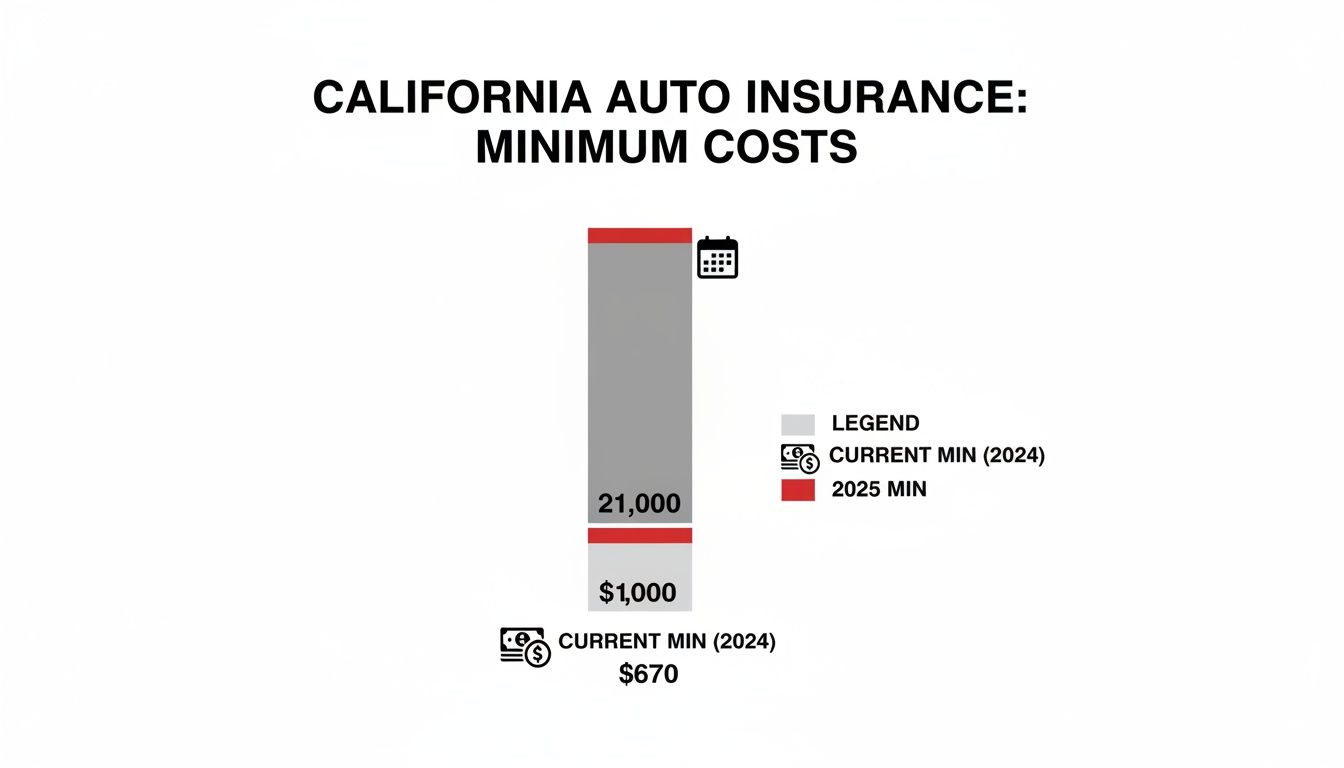
This jump in average costs highlights why you can't just focus on price. You have to find the best value for your dollar.
To illustrate this, let's look at a real-world example of two quotes with the same monthly price but vastly different protection levels.
Sample Quote Comparison: Same Price, Different Protection
| Coverage Type | Quote A (Basic Protection) | Quote B (Enhanced Protection) |
|---|---|---|
| Liability Limits | 15/30/5 (State Minimum) | 100/300/50 (Recommended) |
| UM/UIM Coverage | 15/30 (Matches Liability) | 100/300 (Matches Liability) |
| Collision Deductible | $1,500 | $500 |
| Comprehensive Deductible | $1,500 | $500 |
| Rental Reimbursement | Not Included | Included ($40/day) |
| Monthly Premium | $125/month | $125/month |
As you can see, Quote B offers significantly more robust liability protection and a much lower out-of-pocket cost for repairs, all for the same price. This is exactly why you have to look beyond the premium.
Policy Endorsements: Optional But Powerful Add-Ons
Beyond the core four, policies can be customized with endorsements, sometimes called riders. These are add-ons that cover specific situations and can be a lifesaver after an accident.
Common endorsements to look for include:
- Rental Reimbursement: Covers a rental car while yours is in the shop after a covered claim. Invaluable if you don't have a spare vehicle.
- Roadside Assistance: Provides towing, flat tire changes, battery jumps, and lockout services.
- Medical Payments (MedPay): Helps with medical bills for you and your passengers, regardless of who caused the accident.
When you're comparing quotes, check to see which endorsements are included. A quote that seems a bit higher might already bundle in rental coverage, making it a much better value in the long run.
When you start shopping for car insurance in California, you'll notice right away that the quotes you get are all over the map. That’s because your premium isn’t just some random number; it's a direct reflection of you. Insurance companies feed your personal details into a complex risk model, and understanding what they're looking for is the first step to getting a better rate.
Some of these things you can change, and some you can't. The trick is knowing where to focus your energy to make the biggest dent in your premium. Let's pull back the curtain on what really drives your California insurance costs.
Your Driving Record and Experience
This is the big one. More than anything else, insurers look at your driving history to predict how likely you are to file a claim in the future. A clean record—no at-fault accidents, no DUIs, no recent tickets—is your golden ticket to the lowest rates and the best "good driver" discounts.
On the flip side, a single speeding ticket or fender bender can send your premium climbing. Your age and years behind the wheel also matter immensely. Statistically, younger drivers are simply riskier, which is why they pay more until they've proven themselves to be safe and responsible on the road.
For example, a 20-year-old driver in Los Angeles might see quotes double or even triple those offered to a 40-year-old with a spotless record, even for the same exact car and coverage.
Your Geographic Location
It might seem strange, but where you park your car at night can have a massive impact on your insurance bill. Carriers analyze claim data right down to the ZIP code, tracking everything from fender benders and theft to vandalism. This is why someone living in a packed urban center like Glendale will almost always pay more for auto insurance and home insurance than a driver in a quieter suburb like Escondido.
This all comes down to localized risk. Insurers are looking at:
- Traffic Density: More cars on the road simply means a higher chance of a collision.
- Crime Rates: If your neighborhood has a reputation for car break-ins or theft, your comprehensive coverage will cost more.
- Weather Patterns: Areas prone to things like flash floods or wildfires can also see slightly higher rates.
You can't exactly move to get a cheaper rate, but this factor explains why prices can vary so much from one town to the next.
The Vehicle You Drive
What you drive is just as important as how you drive. When calculating your rate for auto insurance, carriers look closely at your car's make, model, and year. A brand-new luxury SUV with a high-tech sensor suite will cost a fortune to repair compared to a 10-year-old sedan, so you can bet its collision and comprehensive coverage will be priced accordingly.
Here's what's on their checklist:
- Repair Costs: Cars with expensive, specialized parts are pricier to insure.
- Theft Rates: Some models are, unfortunately, a magnet for thieves, which drives up their risk.
- Safety Ratings: A vehicle packed with proven safety features like airbags and anti-lock brakes can often earn you a discount.
- Engine Power: A high-performance sports car is statistically more likely to be involved in a high-speed accident.
Other Important Personal Details
Beyond those three main pillars, a few other details help finalize your quote. While California prohibits insurers from using your credit score to set rates, other personal factors still come into play.
Your annual mileage is a perfect example. Someone with a long daily commute simply spends more time on the road, increasing their odds of getting into an accident. Drive less, and you can often qualify for a low-mileage discount.
Even your marital status can nudge the needle; married drivers, statistically, file fewer claims. And don't forget bundling. When you combine your auto insurance with your home insurance, renters insurance, or life insurance, carriers see you as a more stable, loyal customer and typically reward you with their biggest discounts.
A Step-By-Step Process For Comparing Quotes Effectively
To really compare California auto insurance quotes the right way, you need a game plan. Just diving in headfirst is a recipe for confusion and usually ends with a policy that doesn't actually protect you when you need it most. By following a simple, methodical process, you can turn a complicated chore into a straightforward exercise that lands you the best possible value.
This is the exact same structured approach we use in our consultative reviews at Mai & Associates, where the whole point is clarity and helping you make a smart decision. It all starts with getting your ducks in a row before you even ask for the first quote.
Step 1: Gather Your Essential Information
Before you start clicking through online forms or calling agents, pull together all the necessary details. Having this stuff ready not only speeds things up but also guarantees the quotes you get are actually accurate.
Here's what you'll need:
- Driver's Licenses: The license number and birthdate for every driver going on the policy.
- Vehicle Identification Numbers (VINs): You'll need the VIN for each car to give insurers the exact make, model, and trim level.
- Current Policy Details: Your current insurance declaration page is gold. It shows your existing coverage limits, which is the perfect baseline for comparison.
- Driving History: Be ready to be upfront about any accidents or tickets for all drivers over the last three to five years.
Once you have this handy, you’re ready for the most important part of the whole process—deciding what you actually need.
Step 2: Define Your Ideal Coverage Levels
This is huge: never start shopping without knowing what you want to buy. The cheapest quote you see will almost always be for state-minimum coverage, and that's a dangerously low amount if you're ever in a serious accident. Instead, figure out your ideal liability limits, deductibles, and any optional coverages before you see a single price tag.
A solid starting point for most California drivers is liability coverage of 100/300/50, which is far more realistic protection than the bare-bones state minimum. For your deductible, think about what you could comfortably pay out-of-pocket tomorrow—something like $500 or $1,000 is common. This prep work allows you to ask every carrier for a quote on the exact same coverage, making your comparison a true "apples-to-apples" evaluation.
Honestly, this is the most critical part of the entire process. When you set your own coverage standards first, you stop yourself from getting tempted by a low price that comes with a ton of risk. It puts you in the driver's seat.
Step 3: Ask The Right Questions Every Time
Whether you're using an online tool or talking to a person, a quote should be more than just a number. It's the start of a conversation. A price is just a price; you need to understand the company and the policy behind it.
Make sure you ask these key questions every single time:
- What discounts am I eligible for? Don't just assume they've all been applied. Ask about specific ones: good driver, multi-policy (home insurance, renters insurance, life insurance), good student, and low-mileage discounts.
- What does your claims process look like? Find out how you file a claim, who your point of contact is, and what their typical turnaround time is. A cheap policy isn't worth much if the claims experience is a nightmare.
- Are there different payment plan options? Some insurers give you a nice discount for paying the premium in full upfront. It’s a simple way to save.
- What are the key policy exclusions? This is a big one. Ask what situations are not covered. Understanding the exclusions now prevents a nasty surprise when you actually need to file a claim.
Step 4: Avoid These Common Pitfalls
Even with a solid plan, it's easy to trip up. Watch out for these common traps that can lead you to paying too much or ending up with a policy that doesn't do its job.
A major pitfall is overlooking the power of bundling. A standalone car insurance quote might look cheaper at first glance, but the multi-policy discount you get from bundling often delivers much bigger savings and better overall value. Another classic mistake is forgetting to review your policy every year. Your life changes—you move, get a new car, or your kid starts driving—and your insurance needs to keep up.
By following this simple, structured approach, you can navigate the market with confidence. When you're ready to see how it works in real-time, you can start with a fast and easy California insurance quote from our team to see multiple options side-by-side.
How an Independent Insurance Agency Makes Shopping Simple

Let's be honest: who has the time to fill out the same repetitive forms on a dozen different insurance websites? Working with an independent insurance agency means you can hand that entire task over to an expert. This not only saves you a massive amount of time but often results in better coverage at a better price.
The key difference is who the agent works for. Captive agents are employed by a single insurance company, so they can only sell that company's products. Independent agents, on the other hand, work for you. At Mai & Associates, we get you quotes from a whole roster of top-rated carriers almost instantly, making them compete for your business.
It’s More Than Just a Price List
Getting a bunch of quotes is just step one. The real value comes from the personalized advice you get from a licensed professional who can help you make sense of it all. Our agents take the time to review your options with you, explaining what all the complex policy details actually mean for you and your family.
This conversation goes far beyond just finding the cheapest car insurance. We get a sense of your entire financial situation, which helps us spot potential risks and coverage gaps you might not have even considered.
Think of an independent agent as your personal insurance advisor. Our job is to cut through the jargon and give you clear, straightforward advice so you can be confident you’re not just insured, but truly protected.
We help you compare California auto insurance quotes in the context of what you actually need, making sure your protection is solid and complete.
Unlocking Serious Savings with Smart Bundling
One of the easiest ways to bring down your premium is by bundling your policies. We’re experts at finding the best carrier combinations for your auto insurance, home insurance, renters insurance, and even life insurance. By looking at everything together, we can often find multi-policy discounts that add up to significant savings.
Our team also has deep knowledge of the specific challenges we face here in the California insurance market, from navigating wildfire risk to finding the right earthquake coverage. These are often complex situations where a captive agent just won't have the options you need.
Plus, with a team that speaks English, Spanish, Armenian, Russian, and Vietnamese, we can give you clear guidance in the language you're most comfortable with. It's all about making the process less stressful while saving you time and money.
Common Questions About Comparing Auto Insurance
Diving into the world of California insurance definitely brings up a lot of questions. Getting straight answers is the only way to feel confident when you compare California auto insurance quotes. Let's walk through some of the most common things drivers ask us.
How Often Should I Compare Car Insurance Quotes?
My rule of thumb? Shop your insurance at least once a year, right before your policy renews. That's the bare minimum.
But honestly, the best time to look for new quotes is whenever life changes. You should definitely get fresh quotes if you:
- Move to a new neighborhood or city.
- Buy a different car.
- Add a driver to your policy (especially a teenager!).
- Get married.
- Change your commute distance significantly.
Any of these events can completely change how an insurer sees your risk, and the company that was cheapest last year might not be the best fit anymore.
Will Getting Multiple Quotes Hurt My Credit Score?
Nope, not at all. Shopping for car insurance quotes will not ding your credit score.
When you ask for a quote, insurance companies do what’s called a "soft pull" on your credit history. This is different from the "hard inquiry" that happens when you apply for a credit card or a loan. Soft pulls don't show up to lenders, so you can get as many quotes as you want without worrying about a negative impact.
The real difference between a quoting website and an agent is the guidance. A website spits out prices. A good agent gives you context to make sure that price is for a policy that actually protects your financial life, which might include bundling your home insurance or renters insurance.
Why Did My Rate Go Up If I Have a Clean Record?
It’s one of the most frustrating things to see your premium climb even when you haven’t had a single ticket or accident. This happens all the time, and it’s usually due to factors that have nothing to do with you personally.
Your rate can increase because of broad rate adjustments approved for the whole state, the rising cost of car parts and medical treatments in your area, or even just more accidents happening in your specific ZIP code. This is precisely why it’s so critical to shop around regularly for all your California insurance needs, from auto insurance to life insurance—it keeps the insurance companies honest.
For more answers, take a look at our complete insurance FAQ page.