Compare Auto Insurance Rates by Zip Code: 2026 Guide
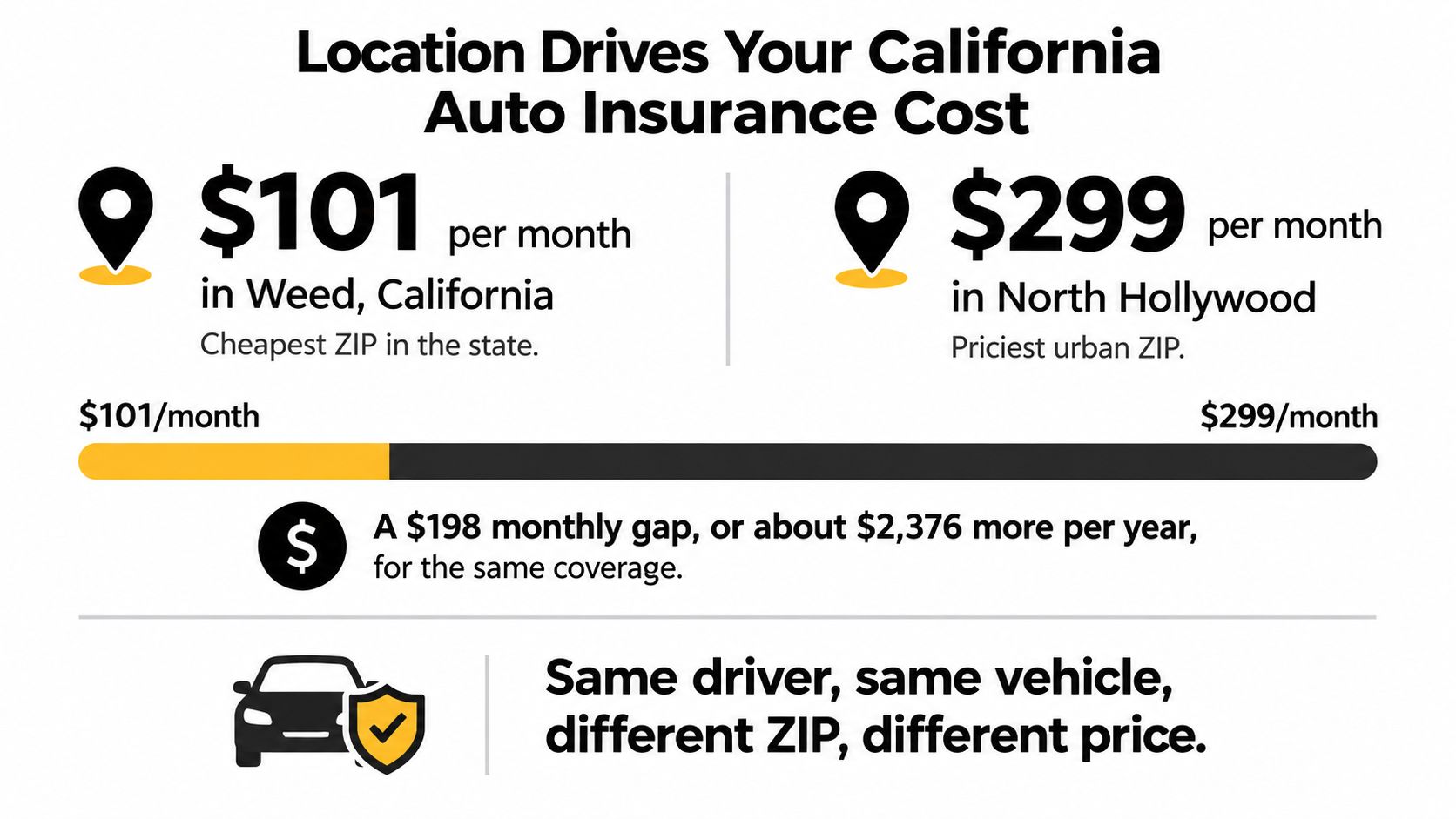
California full-coverage premiums range from $101 per month in Weed to $299 per month in North Hollywood, so location alone can create nearly a threefold spread. To compare auto insurance rates by ZIP code accurately, use your exact garaging ZIP, match the same coverage across carriers, and investigate the territory behind the quote.
That range changes how California drivers should shop. A citywide average may look useful, but it can conceal major differences between neighborhoods, especially in dense markets such as Glendale and Los Angeles. Insurers don't price every address in isolation. They use approved rating territories, claims experience, traffic patterns, theft exposure, weather risk, and the driver and vehicle details attached to the address.
The practical question isn't just, “Which ZIP code is cheapest?” It's, “Why does this ZIP receive this rate, and does another carrier evaluate the same territory differently?” That distinction helps you find a genuine saving without weakening the protection your household needs.
Why Location Drives Your California Auto Insurance Cost
The difference between $101 per month in Weed, ZIP code 96094, and $299 per month in North Hollywood, ZIP code 91606 is $198 per month for full coverage. Those figures come from a 2026 California comparison that also reports a statewide full-coverage average of $139 per month. The source describes the spread as nearly threefold, which makes geography one of the first variables to test when you shop, not an afterthought. Bankrate's California insurance comparison provides the location-based figures.
ZIP codes are territory signals
An insurer uses your ZIP code to identify the rating territory where the vehicle is primarily kept and driven. That territory may include several nearby ZIP codes, or it may divide a larger urban area into smaller groups. The company then combines territory information with your driving record, age, vehicle, mileage, coverage limits, deductible, prior insurance, and claims history.
This is why two drivers with similar cars and clean records can still receive different premiums. Their addresses may fall into different approved territories, or different companies may assign different weight to the same local risk. A citywide average smooths away those differences and can leave you comparing an average that doesn't resemble your actual quote.
California's Proposition 103 limits how insurers use rating factors, but it doesn't remove geographic pricing. Location remains relevant because insurers still file and use territory-based rating plans subject to California regulation. The result is a regulated system, not a flat statewide price.
A broader national analysis illustrates how sharply ZIP boundaries can matter. Across six major insurers and ten cities, drivers in lower-income ZIP codes paid an average of $410 more per year than next-door neighbors in higher-income ZIP codes. In every city tested, at least one insurer charged $200 more for the same coverage on the other side of a ZIP-code line, while the largest reported company-level jumps reached $734 for Farmers and $661 for Allstate. Consumer Federation of America's ZIP-code pricing analysis documents those comparisons.
Practical rule: Treat your ZIP code as a starting point for comparison, not as proof that every insurer will charge the same amount.
City averages hide useful gaps
A driver in Glendale shouldn't stop after checking a Los Angeles average. The same principle applies throughout California, including neighborhoods where a short move changes the assigned territory. You can't legally or ethically use another address to obtain a lower quote, but you can ask carriers to price your correct garaging address and compare how each company handles it.
For California auto insurance, the most useful shopping habit is simple: enter the exact ZIP code, preserve identical driver and vehicle information, and compare the resulting offers from several carriers. That process reveals whether your current premium reflects a broad market pattern or a carrier-specific pricing decision.
For a California-specific starting point, review auto insurance coverage and rate options before requesting quotes. The objective isn't to chase the lowest displayed number. It's to understand what your territory costs, then find a policy that combines an appropriate price with sound liability and physical-damage protection.
Using Zip Code Search Tools to Find Your Rate
A ZIP-code tool is useful only when the information behind it matches your real situation. A quick estimate based on a city name can show market direction, but it won't tell you what an insurer will charge for your vehicle, record, household, and coverage choices. Use online tools for discovery, then verify the result with a complete quote.
Start with a clean quote file
Before opening a carrier website or comparison platform, gather the information that controls the quote. You don't need to guess or simplify details just to move faster.
- Exact garaging ZIP: Use the address where the vehicle is normally kept, not a nearby ZIP that appears cheaper.
- Vehicle information: Have the year, make, model, trim, safety equipment, ownership or lease status, and approximate annual mileage available.
- Driver history: Prepare license information, tickets, accidents, claims, and the date your current policy began.
- Coverage structure: Record your current liability limits, uninsured motorist selections, physical damage deductibles, and optional protections.
- Household details: List regular drivers and any vehicles insured elsewhere, because omissions can make a quote look artificially low.
Enter the exact same details each time. If one quote uses a lower deductible or fewer listed drivers, you're not comparing carriers. You're comparing different policies.
Check carriers separately
Run the ZIP through multiple carrier websites and at least one comparison service. Aggregators can quickly show which companies want your profile, while direct carrier quotes can clarify underwriting questions and available endorsements. Neither source should be treated as the final answer by itself.
A practical sequence looks like this:
- Record the baseline: Save your current premium, limits, deductibles, discounts, renewal date, and claims information.
- Request the first estimates: Enter the exact ZIP and complete the vehicle and driver fields rather than accepting default assumptions.
- Repeat the same profile: Keep coverage limits and deductibles constant across each carrier.
- Investigate outliers: A quote that is much lower may omit an endorsement, use a different deductible, or require information that wasn't captured in the first screen.
- Ask for a complete proposal: Confirm the final premium, payment plan, fees, exclusions, and effective date before cancelling anything.
Don't confuse an initial quote range with a bound policy. Companies may verify motor vehicle records, prior coverage, garaging information, and claims details before finalizing the premium. A quote tool helps you identify candidates. A licensed review helps you determine whether the candidate actually fits.
You can use Mai & Associates' insurance quote request to submit your California ZIP code and coverage needs for a more direct comparison. Whether you work with an agent or contact carriers yourself, insist on written details for the same limits and deductibles.
A lower quote is useful only after you prove that it buys the same protection.
What Actually Causes Rate Differences Between Neighbors
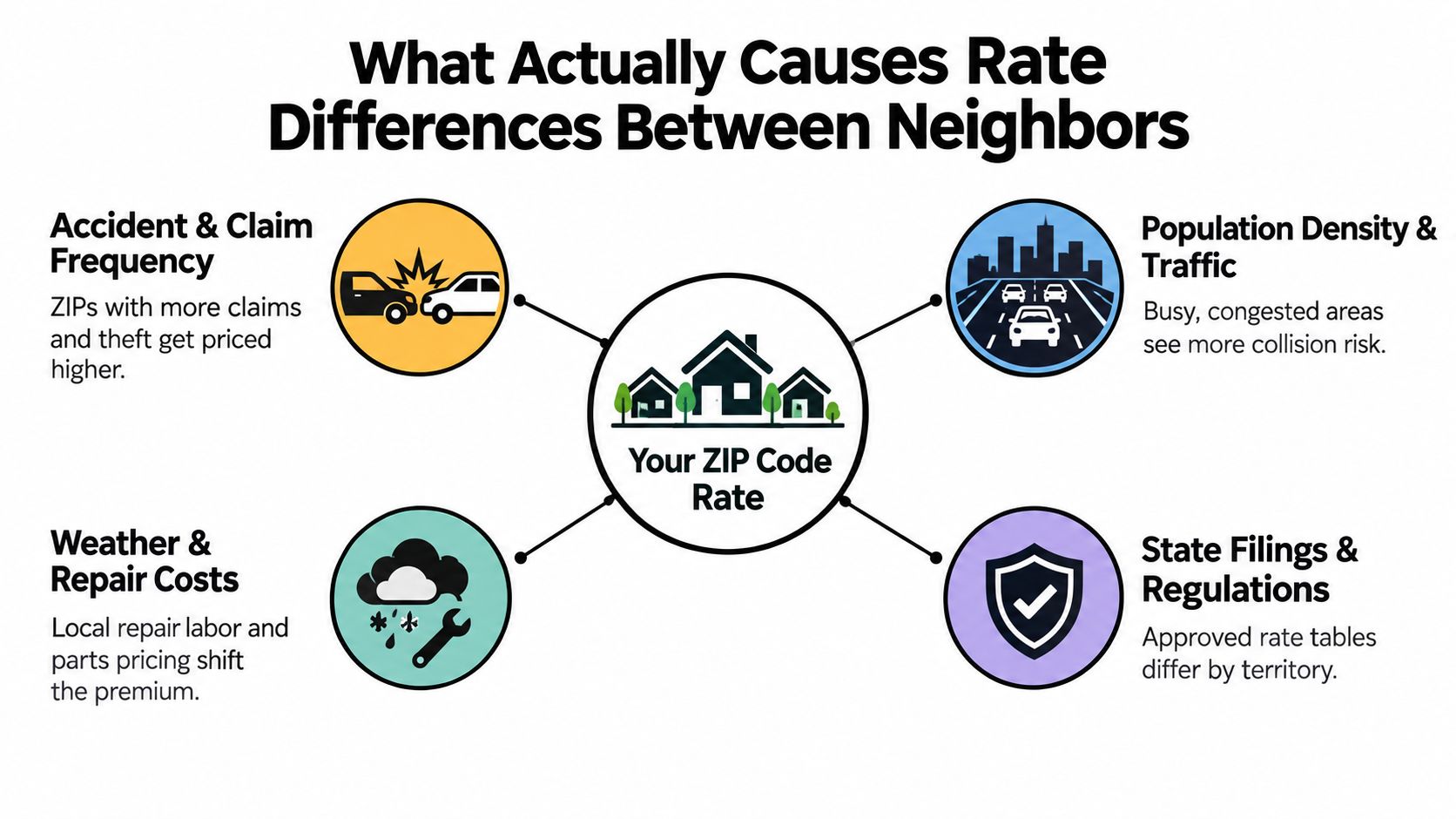
ZIP-code pricing reflects more than a map boundary. Insurers study the loss experience associated with a territory, then apply that information through filed rating plans. A territory with frequent or expensive claims can cost more even when an individual driver has never caused an accident.
The main inputs usually fall into four connected groups.
Claims and theft shape the territory
Insurers examine how often policyholders in an area file claims and how costly those claims become. Collision frequency, bodily injury losses, claims beyond collision, and vehicle theft all influence the expected cost of covering vehicles kept there. A neighborhood with more theft can affect non-collision pricing, while dense collision activity can influence liability and collision costs.
That doesn't mean every resident is personally responsible for the area's claims. The insurer is estimating the risk attached to the territory, then refining it with individual factors. Your clean record matters, but it doesn't erase the territory's loss history.
Traffic changes exposure
Busy streets, freeway connections, tight parking, and concentrated commuting can create more opportunities for crashes and damage. A vehicle that sits in one ZIP overnight may also travel through several other areas during the day, but the garaging address remains an important rating input.
Territory grouping makes the process less granular than many consumers assume. An insurer may combine nearby ZIP codes into one rating territory, while another company may draw its boundaries differently. Two neighboring homes can therefore receive different prices, and two carriers can produce different territory results for the same home.
Weather and repair costs matter
California's risk profile varies by region. Wildfire exposure, severe weather, water damage, and local conditions can affect total losses, while repair labor, parts availability, and shop pricing influence the cost of settling vehicle claims. These factors may not be visible in a basic ZIP-code search, but they can appear in the final carrier quote.
For homeowners, the same location question can extend beyond car insurance. California renters insurance averages $177 per year, compared with a $170 national average, and city averages in the cited survey range from $155 in Anaheim, Chula Vista, Irvine, Oxnard, San Diego, and Santa Ana to $213 in Los Angeles and $220 in Oakland. NerdWallet's California renters insurance survey shows why local shopping also matters for renters coverage.
Prop 103 doesn't make every territory equal
California insurers must operate within state regulation, but approved rating territories still produce geographic differences. In practice, your ZIP search is a way to identify the territory attached to your address. It doesn't reveal every formula, and a carrier generally won't price your policy by allowing you to select a preferred neighboring ZIP.
The same location can also affect property insurance differently. The California FAIR Plan is a last-resort option for eligible wildfire-prone homeowners, not broad replacement coverage. A 2024 explainer states that the property must be in California and occupied at least 50% of the time, and that the policy typically covers actual cash value losses for fire, lightning, internal explosion, and smoke. MoneyGeek's California FAIR Plan explanation lists location, construction, structure condition, distance to a fire station, claims history, coverage needs, and deductible among the factors affecting rates.
The lesson is practical. A ZIP-code gap is real, but it isn't an explanation by itself. Ask which territory applies, which coverage is being compared, and whether the carrier's underwriting view creates a better result for your specific profile.
Online Quotes Versus Working With a Local Agent
Online quote tools and local agents solve different parts of the shopping problem. A website gives you speed and a useful first comparison. An agent gives you context when the quote changes unexpectedly, the policy has several drivers, or the apparent saving comes from thinner protection.
Where online tools work well
Online systems are efficient for straightforward shoppers. You can enter a ZIP code, vehicle, and driving profile, review several price snapshots, and quickly identify carriers worth investigating. They also make it easy to test legitimate changes, such as a different deductible or a bundled renters policy, without making a phone call for every variation.
The limitation is interpretation. A comparison screen may not explain why one carrier asks about garaging, annual mileage, prior insurance, or household drivers in a different way. It may also present a low premium before the carrier verifies the details.
Where an agent adds value
A licensed California agent can compare the quote structure, not just the premium. That means checking liability limits, uninsured motorist protection, full coverage and collision deductibles, rental reimbursement, roadside assistance, permissive use, and exclusions. The agent can also explain whether a territory issue, claims record, vehicle classification, or coverage choice is driving the difference.
This matters most when your circumstances aren't simple:
- Multiple vehicles: The cheapest carrier for one car may not be the cheapest household combination.
- Teen or occasional drivers: Listing and usage details can change eligibility and pricing.
- Recent move: A new garaging ZIP may produce a different territory assignment.
- Prior claim or lapse: Underwriting questions can make an online estimate unreliable.
- Home or renters coverage: Bundling may change the total household cost, but only if both policies remain suitable.
- High-risk property exposure: Auto shopping may need to happen alongside a review of home, wildfire, or earthquake protection.
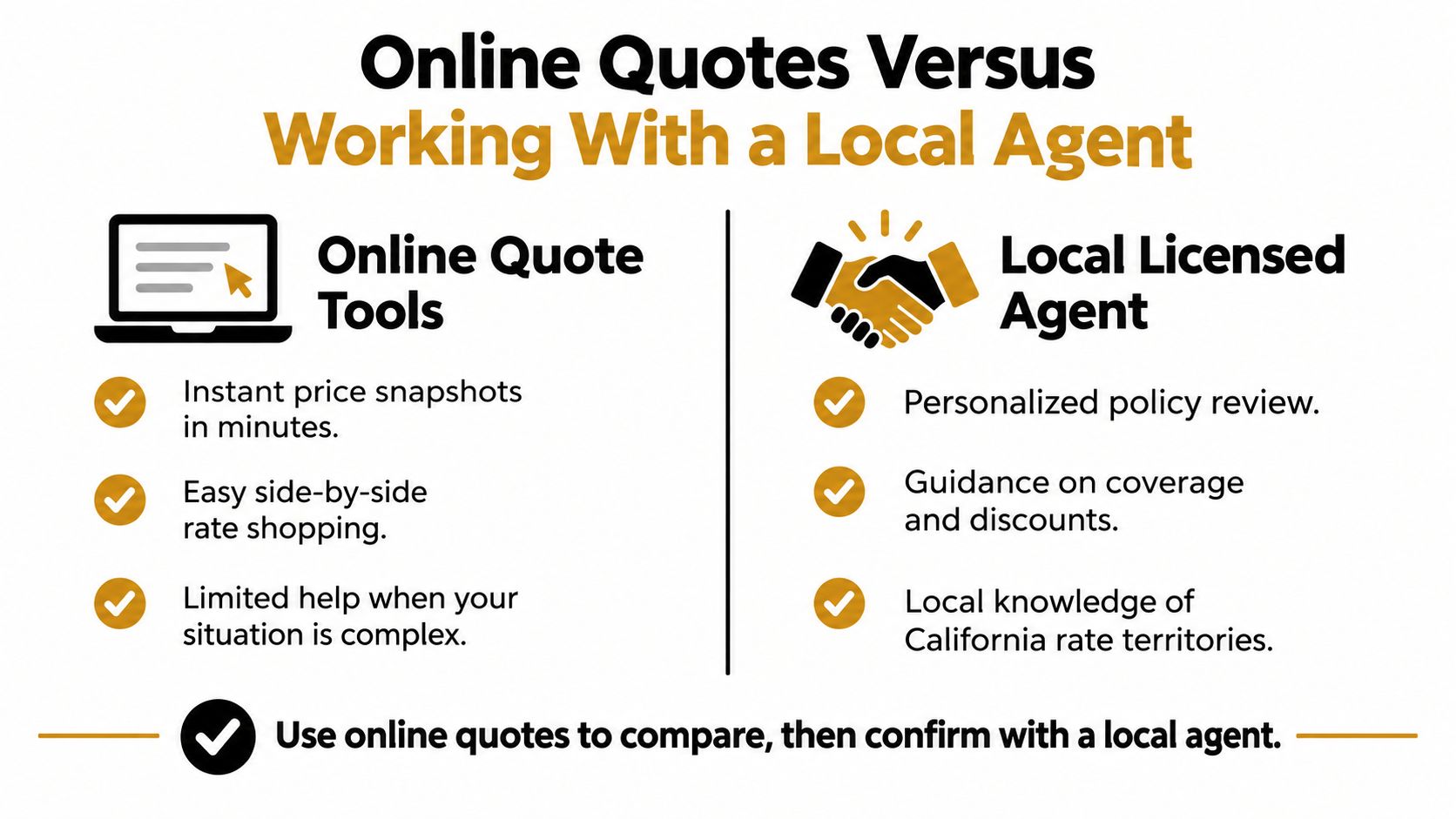
Use online quotes to find the gap. Use a professional review to confirm that the gap isn't caused by missing coverage.
The strongest approach combines both methods. Start online to learn the market, then ask a local agent to reproduce the comparison with matching limits and deductibles. You keep the speed of digital shopping without treating an incomplete quote as a final recommendation.
How to Interpret Your Quote and Spot Hidden Gaps
A quote comparison becomes useful when every row describes the same risk transfer. Put each carrier's offer into a simple worksheet and compare the policy terms before you compare the total premium.
| Item to compare | What to verify |
|---|---|
| Liability | The bodily injury and property damage limits match |
| Uninsured motorist | The limits, rejection choices, and included protections match |
| Vehicle damage | Comprehensive and collision are included or excluded consistently |
| Deductibles | Each deductible is identical, including any special glass or theft terms |
| Optional benefits | Rental reimbursement, roadside service, and equipment coverage are identified |
| Discounts | Each discount has a clear eligibility condition |
| Payment | The total policy cost, installment charges, and payment schedule are visible |
Find the false bargain
The most common mistake is accepting a lower premium that reduces limits or raises a deductible. That may be reasonable for a driver with a deliberate risk plan, but it isn't a fair comparison if the other quote provides stronger protection.
Look for vague descriptions such as “standard coverage,” “basic protection,” or an unexplained territory label. Ask the carrier to identify the garaging address, the rating territory used, the assumptions about mileage, and the reason a discount applies. You don't need the insurer's proprietary formula, but you do need enough detail to understand the offer.
Your current declarations page is the best baseline. Copy its limits and deductibles into every new quote, then create a second comparison with any changes you are seriously considering. This separates a carrier price difference from a coverage change.
Turn the rate gap into a decision
If one insurer is materially cheaper with equivalent terms, ask your current carrier whether it can review the policy for missed discounts or outdated information. Don't expect the company to match another carrier, and don't change your address information to influence the result. Accurate garaging data protects you from claim problems later.
Use clear insurance terminology when asking questions. The California insurance glossary can help you decode terms such as liability, deductible, collision, and uninsured motorist coverage.
A sound decision has three parts: the premium is affordable, the policy terms are comparable, and the carrier's underwriting assumptions are accurate. If one of those is missing, the cheapest number on the screen isn't yet the best value.
Getting Same-Day Quotes and multilingual Support From Mai and Associates
A Glendale driver comparing ZIP codes may discover that a nearby territory produces a different quote, but that observation alone doesn't identify the right policy. The driver still needs to confirm the garaging address, match liability limits, check deductibles, and determine whether the lower offer remains available after the carrier reviews the complete application.
That is where a local agency can make the comparison more practical. Mai & Associates has offices in Glendale, Westlake Village, Escondido, and Costa Mesa, and serves California clients with auto, home, renters, and life insurance. The agency compares rates from multiple top-rated carriers, provides same-day quotes, and offers a 24-hour response guarantee according to the publisher information.
A clearer path from estimate to policy
The process should begin with the information that affects the territory and the coverage, not with a promise of a particular price. A driver can provide the correct ZIP code, vehicle details, driving history, current declarations page, and the limits they want to preserve. An agent can then compare offers using consistent assumptions and explain why the premiums differ.
That explanation is especially valuable when a quote changes after an address update or when one carrier treats a Glendale neighborhood differently from another. The agent can separate a territory effect from a deductible change, discount difference, vehicle classification, or underwriting requirement.
The team supports conversations in English, Spanish, Armenian, Russian, and Vietnamese. Multilingual service can make it easier for families to understand liability limits, household-driver rules, discounts, and the relationship between auto coverage and other policies.

Compare the household, not just the car
A ZIP-code review can uncover savings opportunities across more than auto insurance. A renter may compare car and renters coverage together, while a homeowner may need to review home insurance, wildfire protection, earthquake options, or the California FAIR Plan separately. Life insurance can also belong in the broader household protection conversation, although it isn't priced through the same auto territory system.
Bundling can be helpful when the combined policies fit the household, but it shouldn't justify accepting unsuitable coverage. Ask for the standalone and combined premiums, review the limits on every policy, and check whether a discount depends on keeping all policies active.
For a direct review of your address-based quote comparison, use the Mai & Associates contact page. Bring your current declarations page and the quotes you've collected so the agent can compare like for like rather than starting with incomplete estimates.
Mai & Associates compares California auto insurance rates across multiple carriers and helps drivers review auto, home, renters, and life insurance needs in one conversation. Visit Mai & Associates to request a same-day quote review, ask about multilingual support, and find out whether your ZIP code is affecting your premium.