Commercial Umbrella Insurance: A CA Business Guide
A lot of California business owners already understand personal insurance better than they realize. You know your auto insurance has liability limits. You know your home insurance protects your property but also includes personal liability. You may even carry renters insurance or life insurance because one bad event can ripple through your finances.
What many owners don't realize is that their business works the same way. It has liability limits too. And when a serious injury claim, commercial car accident, or advertising-related lawsuit blows past those limits, the gap doesn't disappear. Your business pays it, and in the wrong situation, your personal assets can feel exposed too.
That helps explain why businesses are paying more attention to this coverage. The global commercial umbrella insurance market was valued at USD 47.0 billion in 2024 and is projected to reach USD 78.6 billion by 2033, with North America leading the market, according to commercial umbrella insurance market data. Small businesses aren't buying commercial umbrella insurance because it's trendy. They're buying it because standard limits can run out.
Protecting Your Business from the Unthinkable
A California café owner serves hundreds of customers a week. A boutique in Orange County ships orders, hosts events, and posts ads online. A contractor in Glendale has employees driving between job sites. Each of these businesses can look stable on the surface and still be one bad claim away from a financial shock.
The hard part is that nothing about the business has to feel reckless for this to happen. A customer slips. An employee causes a crash while running an errand for work. A claim lands that is far larger than the liability limits on the policies you already carry. That is when commercial umbrella insurance stops sounding optional and starts looking like a financial seat belt.
Why familiar insurance limits can create false comfort
A common perception is to anchor on the fact that one already has insurance. That's understandable. If you already pay for business liability coverage, commercial auto insurance, or a business owner's policy, it feels like you've checked the box.
But insurance isn't just about whether you have a policy. It's also about how much protection that policy provides before it stops paying.
Think about your personal car insurance. If you caused a severe accident and your liability limits were too low, the claim wouldn't politely shrink to fit your policy. Your business faces that same problem, except commercial claims can involve customers, employees, vendors, vehicles, leased spaces, and public advertising.
A business can survive a normal claim. A catastrophic claim is different. It tests whether your liability limits match real-world lawsuit exposure.
The bigger goal is asset protection
Commercial umbrella insurance matters because it can help separate a bad lawsuit from a business-ending loss. For owners who are also thinking broadly about risk, legal structure, and long-term planning, this practical overview of effective business asset protection strategies is a useful companion to the insurance side of the conversation.
If you've ever reviewed your home insurance, renters insurance, or life insurance with the question, "What happens to my family if the worst case happens?" you're already thinking the right way. Commercial umbrella insurance applies that same mindset to your business.
What Is Commercial Umbrella Insurance Really
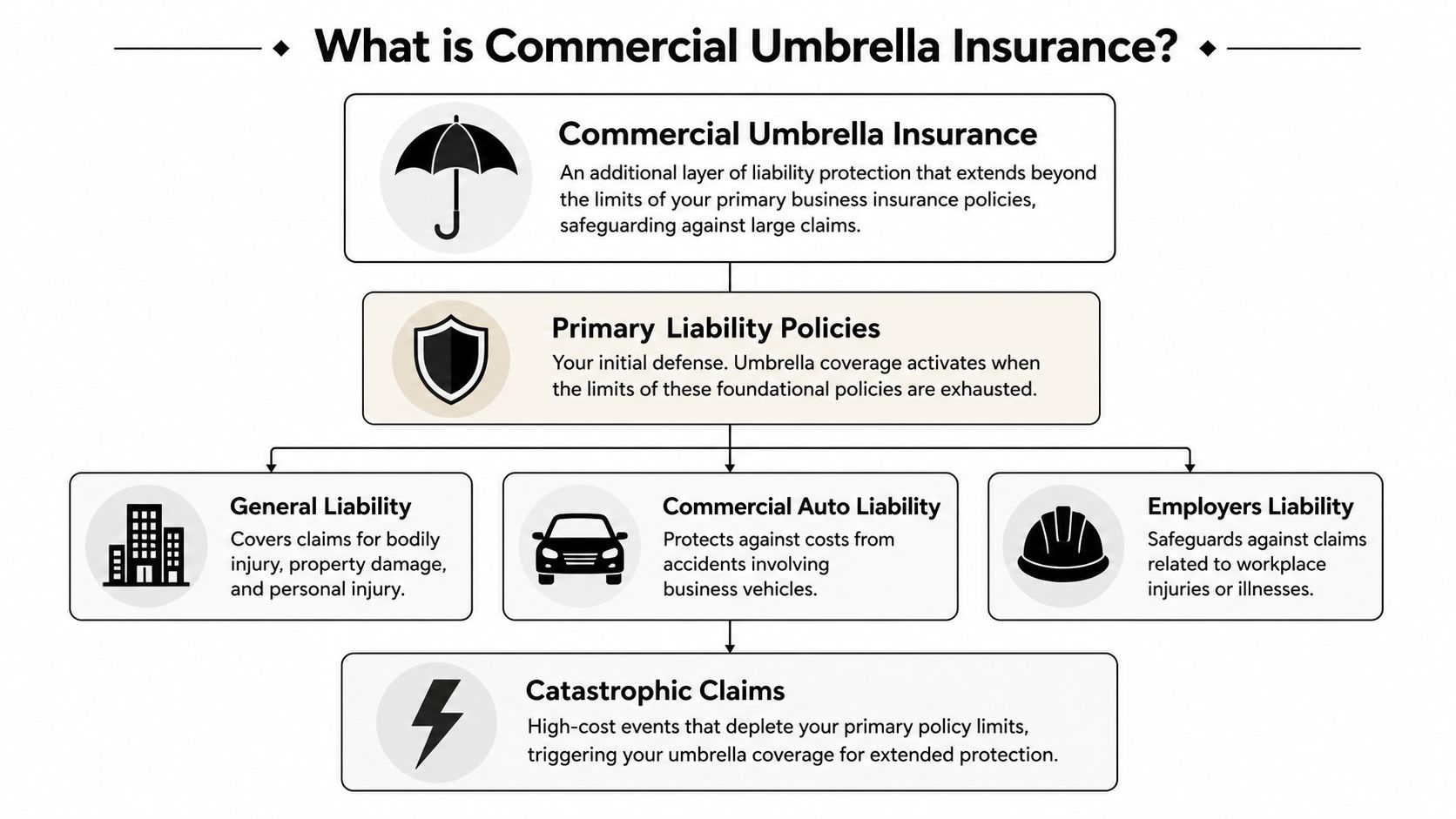
Commercial umbrella insurance is an extra layer of liability protection that sits above certain primary business policies. It doesn't replace those policies. It waits behind them and steps in when their limits have been used up.
The easiest way to think about it is with a personal insurance analogy. Your business has its everyday protection, similar to how your personal auto policy handles ordinary claims. Commercial umbrella insurance is the backup layer for the claim that's anything but ordinary.
It sits on top of other liability policies
Commercial umbrella insurance generally responds after the limits of underlying policies, such as general liability, commercial auto liability, or employers liability, have been exhausted. It can also provide drop-down coverage in some situations to help fill certain gaps. Travelers gives a simple example: if a business faces a $1.5 million lawsuit and a $1 million primary policy is paid out, the umbrella can cover the remaining $500,000, subject to its terms and limits, as described in Travelers' explanation of commercial umbrella insurance.
That "sits on top" idea is the key. It is not the first policy to respond. It is the policy that helps when the first layer isn't enough.
If terms like retained limit, underlying policy, or follow form sound technical, a plain-language insurance glossary for California coverage terms can help decode the vocabulary before you review quotes.
Why people confuse it with just "more coverage"
Sometimes it is more coverage. But that's not the whole story.
A lot of owners hear the word umbrella and assume it only raises limits. In practice, a true commercial umbrella can do two jobs:
- Extend limits: It adds another layer above eligible primary policies.
- Help with certain gaps: In some cases, it can broaden protection beyond what a strict excess policy would do.
That second point is where confusion starts. If you think you're buying a broad umbrella but end up with a narrower excess policy, you may have less protection than you expected.
Practical rule: Don't ask only, "How much extra limit am I getting?" Also ask, "Does this policy only follow the underlying policy, or can it drop down in some situations?"
Why this matters for businesses with vehicles
For many California businesses, the biggest everyday liability exposure isn't inside the office. It's on the road. A florist making deliveries, a consultant driving to clients, or a contractor with pickups on the freeway all create exposure under commercial auto insurance.
That's why commercial umbrella insurance often matters most to owners who already understand personal car insurance. You already know a severe crash can produce costs far beyond what feels reasonable. The business version of that risk can be larger and more legally complicated.
Primary Liability Versus Umbrella Coverage Explained
Primary liability insurance and commercial umbrella insurance work together, but they aren't interchangeable. One handles the first layer of a covered claim. The other is built for the claim that punches through that first layer.
Here's the side-by-side view.
Primary Liability vs. Commercial Umbrella Insurance
| Feature | Primary Liability (General & Auto) | Commercial Umbrella Insurance |
|---|---|---|
| Purpose | First-line protection for covered liability claims | Additional liability protection above certain underlying policies |
| Activation trigger | Responds first when a covered claim happens | Responds after underlying liability limits are exhausted |
| Coverage scope | Tied to the specific policy, such as general liability or commercial auto | Can apply across multiple liability lines and may be broader in some cases |
| Relationship to other policies | Stands on its own as the base policy | Depends on underlying policies being in place |
Primary policies handle ordinary claim flow
Your general liability policy is designed for common third-party claims like bodily injury or property damage tied to your operations. Your commercial auto policy handles covered liability involving vehicles used in the business.
These are the policies that receive the initial claim, assign defense, and start paying up to their limits. If you're already familiar with how personal auto liability works, the same basic logic applies to business vehicle exposure. This overview of California auto insurance basics can help connect the personal side to the commercial side.
Umbrella is broader than standalone excess
This is the part many owners miss.
According to IRMI's discussion of commercial umbrella structure, standalone excess liability usually extends the limit of a single underlying policy, while commercial umbrella insurance can provide broader, horizontal protection across multiple lines such as general liability, auto, and employers liability. In some cases, it can also offer superior terms that help address gaps in primary coverage.
That means an umbrella is not just "a bigger general liability policy." It can be a shared upper layer across different liability exposures.
A plain-language way to remember the difference
Use this shortcut:
- Primary liability is your ground floor.
- Excess liability is a taller ceiling over one room.
- Commercial umbrella insurance is a higher roof over several rooms, and sometimes it covers awkward gaps between them.
That difference matters if your business has mixed exposures. A retailer with foot traffic, a service firm with employees driving, or a landlord-facing tenant business may have liability risks coming from several directions at once.
When an owner says, "I just want more coverage," the better question is, "More coverage for which policy, and with what terms?"
Why broader protection matters in California
California businesses often combine public interaction, vehicle use, leased premises, digital marketing, and contract requirements. A primary policy solves one part of that risk picture. Commercial umbrella insurance is often valuable because real claims don't always stay neatly inside one box.
If your business has more than one way to get sued, you're usually not looking for only a bigger limit. You're looking for a smarter top layer.
Real-World Claim Scenarios in California
Abstract explanations only go so far. Commercial umbrella insurance makes more sense when you see how a claim can develop in an ordinary California business.
The delivery crash
A small restaurant in Los Angeles owns a vehicle for catering deliveries. One afternoon, an employee rear-ends another car on the freeway while making a business run. Several people are hurt, and the injuries are serious.
The restaurant's commercial auto policy responds first. Defense costs start building. Medical claims climb. Settlement pressure grows. Then the owner learns the claim may go beyond the auto policy's liability limit.
That is the moment commercial umbrella insurance becomes the difference between "our insurance is handling it" and "we may have to fund the rest ourselves."
The slip-and-fall that turns into a major lawsuit
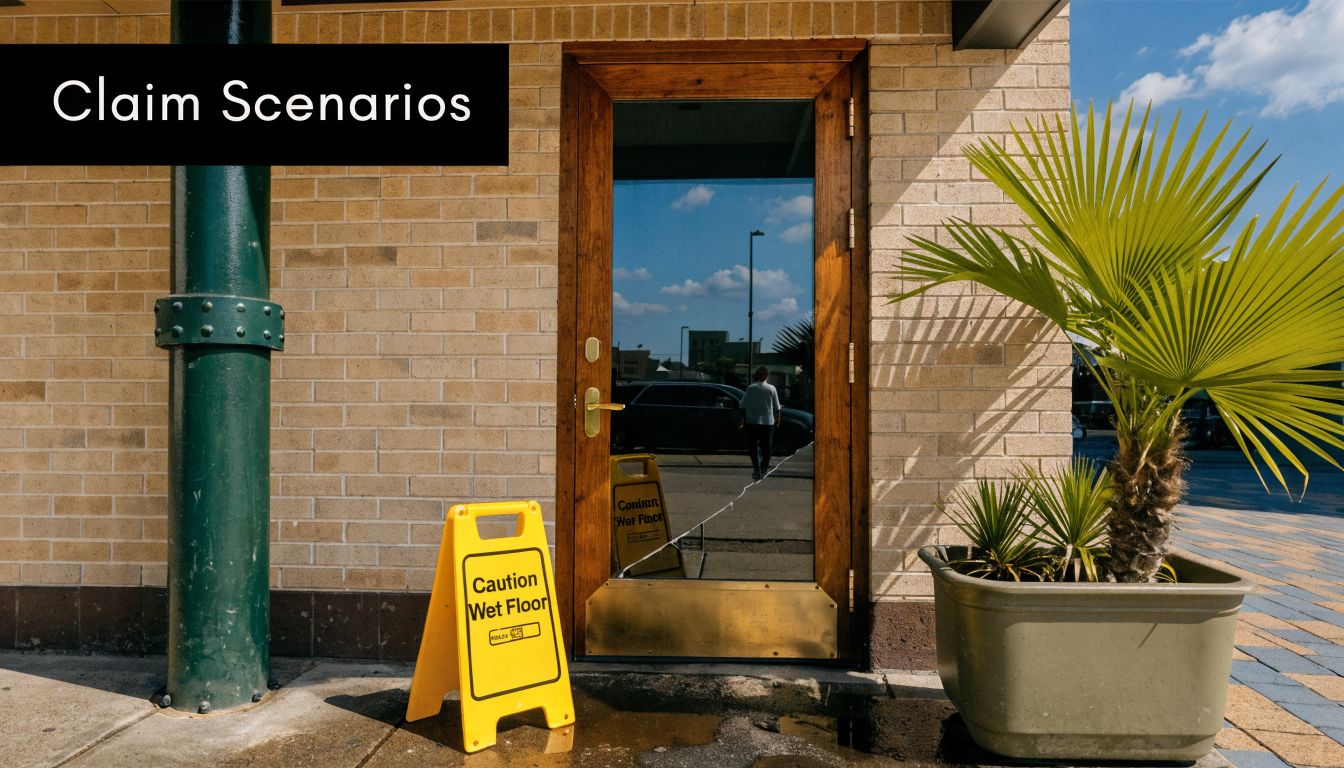
A neighborhood retailer in Orange County has a rainy day entrance problem. A customer slips near the front door, suffers a major injury, and later alleges the business failed to maintain safe conditions.
The claim starts as a premises liability issue under general liability. At first, it sounds like something standard coverage should handle. Then the injury proves more severe than anyone expected, and the lawsuit seeks damages far above what the owner had mentally prepared for.
Primary coverage was never the problem. The size of the claim was.
Some of the most dangerous claims begin as routine incidents. The severity shows up later, after medical treatment, legal review, and demand letters.
The ad claim no one saw coming
A boutique e-commerce business in San Diego runs social media ads and promotional campaigns. A competitor claims the ads caused reputational harm and files suit over advertising-related allegations.
This kind of claim catches owners off guard because it doesn't look like the classic injury scenario people associate with liability insurance. But lawsuits aren't always about a crash or a fall. They can stem from how a business markets itself, what it publishes, and how a dispute is framed.
This is why owners need to understand that some umbrella policies may help with gaps that a strict following-form excess policy would not. The wording matters. The structure matters. And the business owner who buys "extra limit" without understanding the policy may discover the difference at the worst possible time.
What these stories have in common
Each scenario starts with a normal business activity:
- Driving for work
- Serving the public on-site
- Advertising and promoting the business
None of these activities sound exotic. That's the point.
Commercial umbrella insurance is not for bizarre edge cases only. It's for ordinary businesses facing an unusually expensive version of an ordinary risk.
Who Needs This Coverage in California and How Much
Some industries obviously need commercial umbrella insurance. Contractors, trucking operations, and manufacturers are easy examples because the liability exposure is visible and often severe.
But many California owners who need this coverage don't see themselves as high-risk at all. They just have the kinds of exposures that can produce large claims when something goes wrong.
Businesses that should pay close attention
Commercial umbrella insurance deserves a hard look if your business falls into any of these groups:
- You have vehicles on the road: Delivery businesses, home service companies, mobile professionals, and any firm with employees driving for work face liability that can grow quickly after a severe accident.
- You interact with the public: Retail stores, cafés, salons, fitness studios, and offices with regular visitors all carry premises exposure.
- You sign contracts: Landlords, clients, and vendors sometimes expect higher liability limits than your base policy provides.
- You advertise actively: Businesses with websites, digital campaigns, and public-facing branding can face claims that aren't limited to physical accidents.
- You own meaningful assets: The more you've built, the more there is to protect. That can include business savings, future earnings, and the stability that supports your household.
For fleet-heavy operations, this guide for fleet owners on insurance is a useful outside resource because vehicle exposure often drives the need for higher liability protection.
California owners should think beyond the business itself
Small business owners often separate personal and business risk in their minds. Legally and financially, those worlds can feel a lot closer during a serious lawsuit.
If your company takes a major uncovered hit, that stress doesn't stay inside the business. It affects cash flow, payroll decisions, household savings, and your ability to keep paying for the things your family depends on, including your home insurance, car insurance, and longer-term planning like life insurance.
That is why commercial umbrella insurance is often a business decision with personal consequences. It helps protect the enterprise, but it also helps protect the life built around that enterprise.
How much coverage should you carry
There isn't one perfect number for every business. The right amount depends on what you do, how people interact with your business, how often vehicles are used, what contracts require, and what assets you are trying to shield from a worst-case lawsuit.
A practical way to think about the limit is to ask:
- What is our largest realistic liability event?
- Which primary policy would respond first?
- What happens if that policy is exhausted?
- How much business and personal financial strain could we absorb on our own?
The answer usually isn't found by guessing. It comes from reviewing the actual exposures.
Decision filter: Buy limits based on the size of a bad claim, not the size of the premium you hoped to pay.
The current market makes planning harder
The umbrella market is tighter than many owners expect. According to this report on umbrella carrier capacity issues, some carriers have reduced single-policy limits from $10 million to $25 million down to as low as $2 million to $3 million, and premium rate increases can range from 20% to 300% depending on the business and loss profile. In some cases, businesses must stack multiple policies to reach the total protection they want.
That matters for California buyers because it means waiting until a contract lands on your desk or a renewal gets difficult can leave you with fewer options. Planning early gives you more room to structure coverage intelligently.
Your Practical Guide to Getting Covered in California
Buying commercial umbrella insurance doesn't have to feel mysterious. The process gets easier when you treat it like a risk review instead of a shopping sprint.

Start with the policies you already have
Before you ask for umbrella quotes, review your existing liability foundation.
Look at your general liability, commercial auto, and any employers liability exposure. Check the liability limits, the named insured, the business activities described, and whether all regular vehicle use is insured the way you think it is.
If you're ready to start that review with an agent, a California insurance quote request is the practical first step.
Build your worst-case claim list
Many owners shop based on what happened last year. Umbrella decisions should be based on what could happen on your worst day.
Write down the events most likely to create a large lawsuit. For example:
- A severe company vehicle crash: Especially if employees drive daily or travel in dense traffic.
- A major customer injury on-site: Common for retail, hospitality, and service businesses.
- A claim tied to marketing or operations: Less obvious, but still capable of creating expensive legal problems.
This exercise isn't about fear. It's about clarity.
Ask the question many buyers skip
Not every policy marketed as upper-layer liability protection works the same way. One of the most common mistakes business owners make is confusing umbrella insurance with excess liability. As explained in The Hartford's overview of when businesses need commercial umbrella coverage, umbrella policies can drop down in some cases to cover risks excluded by the primary policy, while strict following-form excess policies cannot. That difference can create major coverage gaps, including around professional services or non-owned vehicle use.
Ask your agent directly whether the quote is for a true umbrella, an excess policy, or a structure that mixes both.
If you don't know whether the policy can broaden coverage or only mirror the underlying terms, you don't yet know what you're buying.
Gather the information an underwriter will want
This part is simple but important. Have these ready:
- Loss history: Any recent claims or incidents.
- Business details: Operations, locations, payroll, and vehicle use.
- Current declarations pages: Your existing liability policies matter because the umbrella sits above them.
- Contract requirements: If a landlord or client requires higher limits, share that wording early.
Good information upfront usually leads to cleaner quotes and fewer surprises later.
Work with an independent agency that can compare options
In a tight market, the value of an independent agency is straightforward. One carrier may be restrictive on your class of business, another may be more flexible, and a third may offer a better fit when auto exposure is the main issue.
This is especially useful in California, where owners often need help coordinating personal and business protection in one broader plan. Someone who already understands your auto, home, renters, or life insurance concerns can usually explain the business side in a way that feels more familiar and practical.
Frequently Asked Questions About Commercial Umbrella Policies
Is commercial umbrella insurance required by law
Usually, no. But legal requirement isn't the only standard that matters. A landlord, client, or vendor contract may require higher liability limits than your base coverage provides, and commercial umbrella insurance is often how businesses meet that requirement.
Is commercial umbrella insurance the same as a personal umbrella policy
No. A personal umbrella is built to sit above personal policies like your home or auto insurance. A commercial umbrella is built around business liability policies such as general liability and commercial auto.
That distinction matters because the exposures are different. Your family car and your delivery van don't create the same insurance problem.
Can a very small business or solo operator still need it
Yes. Size doesn't eliminate liability severity.
A solo consultant who drives to clients, a small retailer with foot traffic, or a home-based business owner who signs contracts can all face claims that feel outsized compared with the scale of the company. Very small businesses often assume commercial umbrella insurance is for bigger firms only. That's one of the most common and costly misconceptions.
Does it cover everything once primary limits are exhausted
No. It is still a liability policy with terms, conditions, and exclusions. It isn't a magic policy that covers every kind of loss. It needs to be reviewed in connection with the underlying policies below it.
Can it help with legal defense costs
It often can in connection with covered liability claims, depending on how the policy is written. That is one reason wording matters so much on upper-layer liability coverage.
How do I know whether my current limits are enough
You won't know from the premium alone. You need to compare your current liability structure to your real-world exposures, contracts, vehicle use, customer interaction, and assets at risk. If you want to review the broader insurance questions people commonly ask before making changes, this California insurance FAQ page is a useful place to start.
Commercial umbrella insurance is easiest to understand when you stop treating it like a technical add-on and start treating it like catastrophe planning for a business you care about.
If you want help reviewing your business liability limits alongside your personal auto, home, renters, or life coverage, Mai & Associates can compare options from multiple carriers, provide same-day quotes, and walk you through coverage choices in English, Spanish, Armenian, Russian, or Vietnamese.