Commercial Auto Liability Insurance: Your 2026 Guide
You might be shopping for coverage because your business has reached that awkward stage. You're using a personal car for client visits, an employee runs errands in their own vehicle, or you just bought a work truck and realized your personal car insurance probably isn't built for business use.
That instinct is right. In California, commercial driving exposure shows up long before a company has a fleet. A contractor with one pickup, a florist with a delivery van, a consultant driving to appointments, and a property manager sending staff between sites can all face liability that lands on the business, not just the driver.
Commercial auto liability insurance transitions from insurance jargon to practical protection. If your vehicle use touches your business, you need to know what California requires, where the common gaps are, and how to choose limits that protect your company instead of just checking a box. If you want broader California insurance guidance beyond business vehicles, Mai & Associates also publishes helpful California insurance guides for drivers, homeowners, renters, and families comparing auto insurance, home insurance, renters insurance, car insurance, and life insurance.
Why Your Business Needs More Than Personal Car Insurance
A common mistake is assuming a personal auto policy will handle a work-related accident as long as the vehicle is privately owned. Sometimes it won't. If the trip was for business, the insurer may treat the use differently than ordinary personal driving. That creates a coverage problem right when you need help most.
Think about a simple example. Your employee uses her own car to drop off supplies to a client. On the way back, she rear-ends another driver at a stoplight. The damage looks minor, but the other driver later claims neck and back injuries and hires an attorney. What felt like a fender bender has turned into a business liability issue.
The financial stakes are not small. The average auto liability claim for bodily injury reached $28,278 in 2024, and bodily injury severity increased 9.2% from 2023 to 2024, according to Conning's commercial auto market update. That's why relying on a personal policy is risky. A single accident can create medical bills, lost wage claims, legal expenses, and pressure on your business cash flow.
Where owners usually get caught off guard
Small business owners often assume they need commercial coverage only if they have:
- A company fleet with multiple vehicles
- A truck with signage wrapped in the business name
- A full-time delivery operation moving goods all day
In reality, the exposure starts much earlier.
If you drive to job sites, transport tools, carry inventory, pick up materials, or send employees on errands, you've crossed into business use. Personal car insurance and commercial auto liability insurance are built for different risk profiles. Personal policies focus on everyday private driving. Business policies are designed for larger claim exposure, different usage patterns, and the possibility that the business itself gets named in a lawsuit.
Practical rule: If the trip helps your business make money, serve a client, or support operations, assume you should review it under a commercial lens.
That doesn't mean every business needs the same setup. It means you shouldn't guess. The right answer depends on who drives, what they drive, and how the vehicle fits into your work.
What Commercial Auto Liability Actually Covers
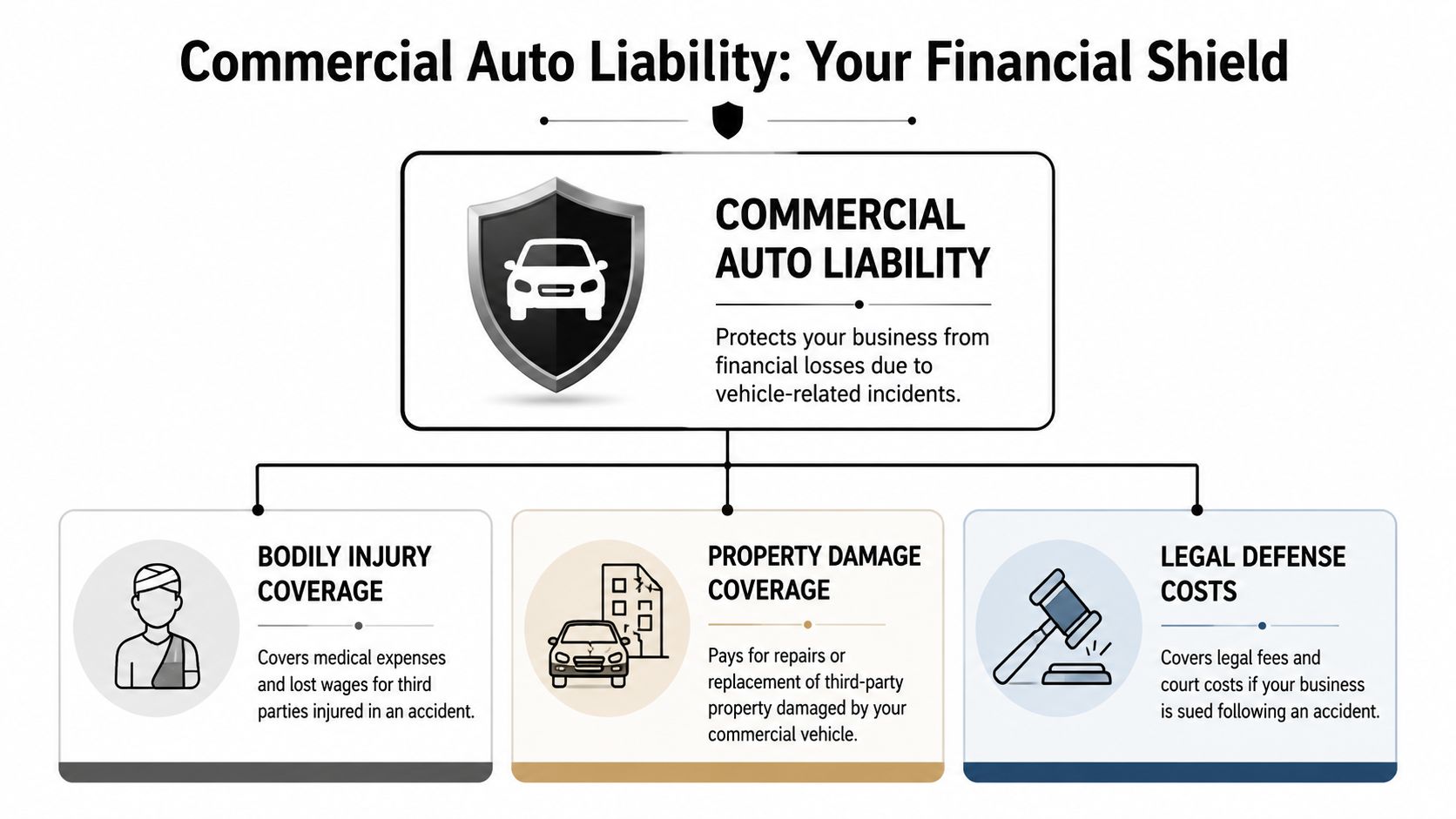
Commercial auto liability insurance works like a financial shield around your business when your driver causes harm to someone else. It's there to handle third-party claims. In plain language, it pays when your business vehicle use injures another person or damages someone else's property and your business is legally responsible.
The core idea is simple, but the terms confuse people. A good place to start is with an insurance glossary of common coverage terms so the policy language feels less intimidating.
The two core parts of liability coverage
Commercial auto liability insurance is built on two pillars: bodily injury liability and property damage liability, as explained by Progressive Commercial's coverage overview.
Here's what each part does.
| Coverage part | What it pays for | Real-world example |
|---|---|---|
| Bodily injury liability | Medical bills, rehabilitation costs, and lost wages for other people injured in an accident you caused | Your delivery driver hits another car and the other driver needs treatment |
| Property damage liability | Repair or replacement costs for someone else's vehicle or property | Your work van backs into a storefront sign or another car |
A delivery van example
Say your bakery van is making a morning delivery in Los Angeles. Your employee turns too wide and clips a parked car, then knocks over part of a fence.
Property damage liability would typically respond to the parked car and the fence because both belong to someone else.
Now change the example slightly. The parked car's owner is standing nearby and gets hurt trying to move out of the way. Bodily injury liability would typically address that person's injury claim if your driver was at fault.
This coverage protects you from claims made by other people. It usually does not pay to repair your own vehicle.
That distinction matters. Business owners often hear “commercial auto insurance” and assume it covers everything involving the vehicle. It doesn't. Liability coverage is about damage or injury you cause to others. Damage to your own vehicle usually falls under other parts of the policy, if you buy them. Injuries to your own employees can involve other coverages too, depending on the facts.
The part many people forget
When an accident gets messy, liability insurance often does more than pay a repair bill. It can also help with legal defense costs when someone sues the business after a crash. That's one reason the policy matters even for companies with only one or two vehicles.
A useful way to remember it:
- Bodily injury protects you from injury claims by others
- Property damage protects you from damage claims by others
- Legal defense helps when the dispute moves beyond the accident scene
If you keep that framework in mind, the policy starts to make sense. It isn't a general car repair plan. It's protection against the financial consequences of hurting someone else or damaging their property while doing business.
Understanding California's Legal Insurance Requirements
California sets a legal floor for liability coverage, but that floor is only the beginning. Many owners hear the minimum and assume that's what they should buy. Legally, it may be enough to register and operate. Financially, it may leave the business exposed.
In California, all commercial auto policies must legally provide at least 30/60/15 coverage: $30,000 for bodily injury per person, $60,000 for bodily injury per accident, and $15,000 for property damage per accident, according to GEICO's California commercial auto requirements page.
What 30/60/15 means in plain English
Those numbers are shorthand:
- 30 means up to $30,000 for one injured person
- 60 means up to $60,000 total for all injured people in one accident
- 15 means up to $15,000 for property damage in one accident
That sounds clear until you apply it to a real claim. If your employee causes a crash involving two injured people, those bodily injury limits can get used up quickly. If your truck damages a newer vehicle, a gate, or a storefront, the property damage limit may also feel very small.
Minimum legal coverage keeps you compliant. It doesn't guarantee your business is well protected.
California minimum vs recommended business protection
A practical way to look at it is to separate the legal minimum from what many businesses choose for stronger protection.
California Minimum vs. Recommended Commercial Auto Liability Limits
| Coverage Type | California State Minimum | Recommended for Small Businesses |
|---|---|---|
| Bodily Injury Liability per person | 30/60/15 includes $30,000 per person | Higher limits are often worth considering based on contracts, assets, and driving exposure |
| Bodily Injury Liability per accident | 30/60/15 includes $60,000 per accident | Many small businesses look beyond minimum split limits when one accident could involve multiple injuries |
| Property Damage Liability | 30/60/15 includes $15,000 property damage | Higher property damage protection can make sense for work in dense urban areas and around expensive vehicles |
| Combined Single Limit option | Not part of the basic 30/60/15 minimum | Some businesses prefer a higher CSL for simpler, broader liability protection |
Many California businesses also have contracts that require more than the state minimum. A landlord, general contractor, property manager, or enterprise customer may require higher liability limits before they let you operate on-site.
Some California uses require much more
Not all commercial vehicles follow the same standard. California requirements rise for certain operations.
For example, Business.com's state commercial auto overview notes that passenger-carrying commercial transport operators in California must carry combined single limit coverage of $750,000 for 1 to 7 passengers, $1.5 million for 8 to 15 passengers, and $5 million for 16 or more passengers.
Separate rules also apply to specialized hauling. Walkup, Melodia, Kelly & Schoenberger's summary of California commercial vehicle requirements explains that commercial vehicles transporting oil within California intrastate lines with a gross vehicle weight over 10,000 pounds must carry at least $1,000,000 in liability insurance, while hazardous materials transport requires $5,000,000.
If you're comparing policies, it helps to review your vehicle class and use alongside broader California auto insurance options for businesses and drivers. The right answer depends on more than registration status. It depends on what the vehicle does for your business.
Who Really Needs This Insurance in California
Some owners think commercial auto liability insurance is only for fleets with logos on the doors. That's too narrow. In California, many of the riskiest situations involve businesses that barely think of themselves as “commercial auto” users.
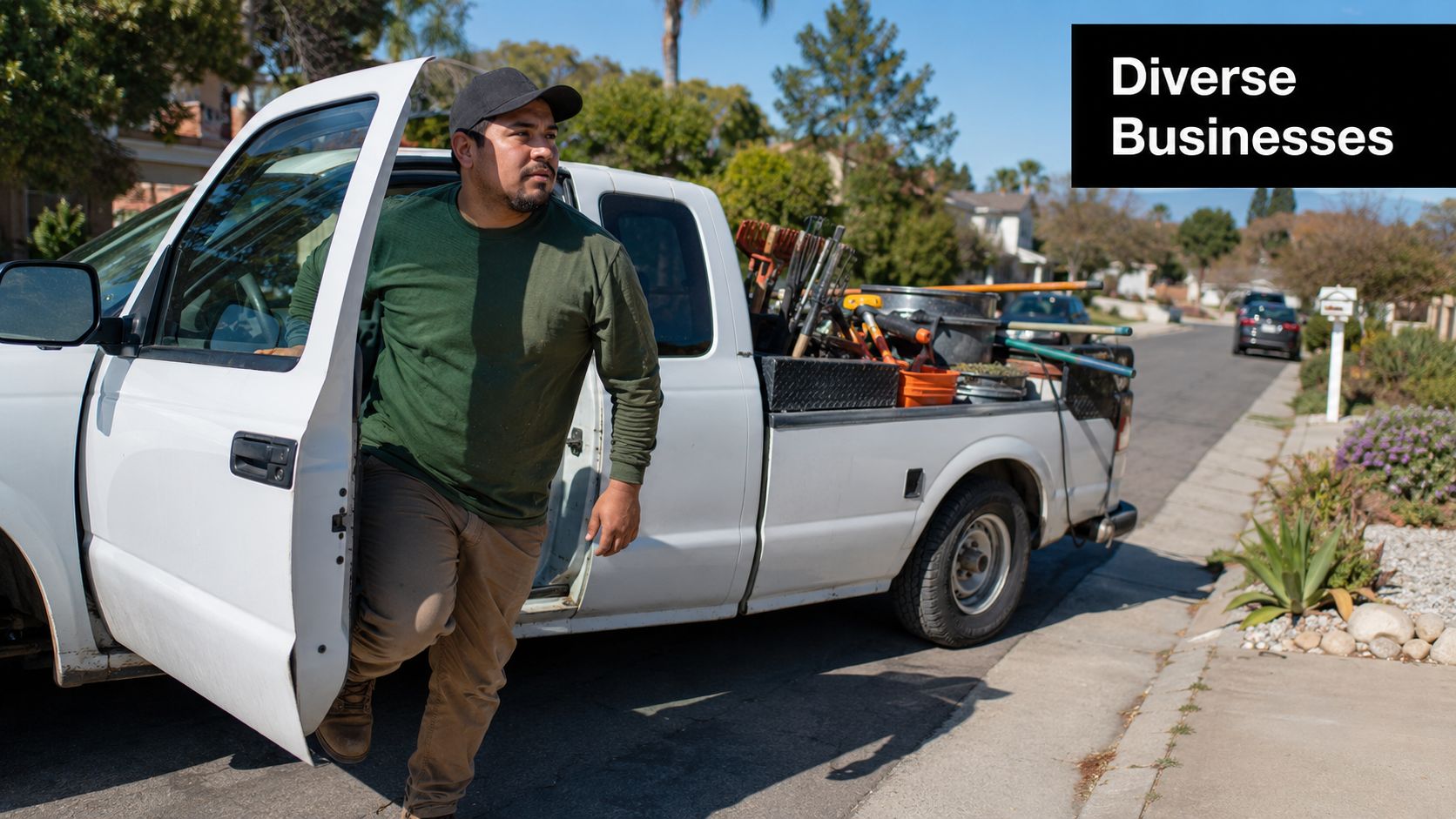
A freelance consultant driving to a client meeting can create business liability. So can a real estate assistant running documents across town, a caterer using an SUV for drop-offs, or a handyman borrowing a truck for a materials pickup. If the trip is tied to business activity, the business can get pulled into the claim.
The overlooked risk of non-owned vehicles
Many small companies have a blind spot. They think, “We don't own the car, so we don't have the exposure.” That's often wrong.
A significant coverage gap exists when employees use personal vehicles for work. Industry data shows 34% of small business liability claims arise from these non-owned vehicle incidents, as the Insurance Information Institute's small business vehicle insurance guide explains. This is why many businesses need to ask about non-owned auto liability or a Drive Other Car endorsement.
Here are some California examples where that question matters:
- Office staff using personal cars to deposit checks, pick up supplies, or visit another location
- Managers renting vehicles during conferences, inspections, or temporary projects
- Owners borrowing a truck from a friend or relative for a business errand
- Service businesses whose workers move between appointments in their own cars
If someone is driving for your business, ownership of the vehicle doesn't erase your liability exposure.
It's not just about insurance
Safer operations help reduce claim frequency too. If your company runs vans, pickups, or service trucks, route planning matters. Businesses that want to cut wrong turns, missed stops, and distracted in-cab navigation can review tools for optimizing truck routes from OnRoute as part of a broader fleet safety process.
You don't need a fleet manager title to need this coverage. You just need business activity tied to vehicle use. That's why California contractors, outdoor service providers, delivery businesses, mobile service providers, consultants, and property-related businesses all need to take the question seriously.
Key Factors That Determine Your Insurance Costs
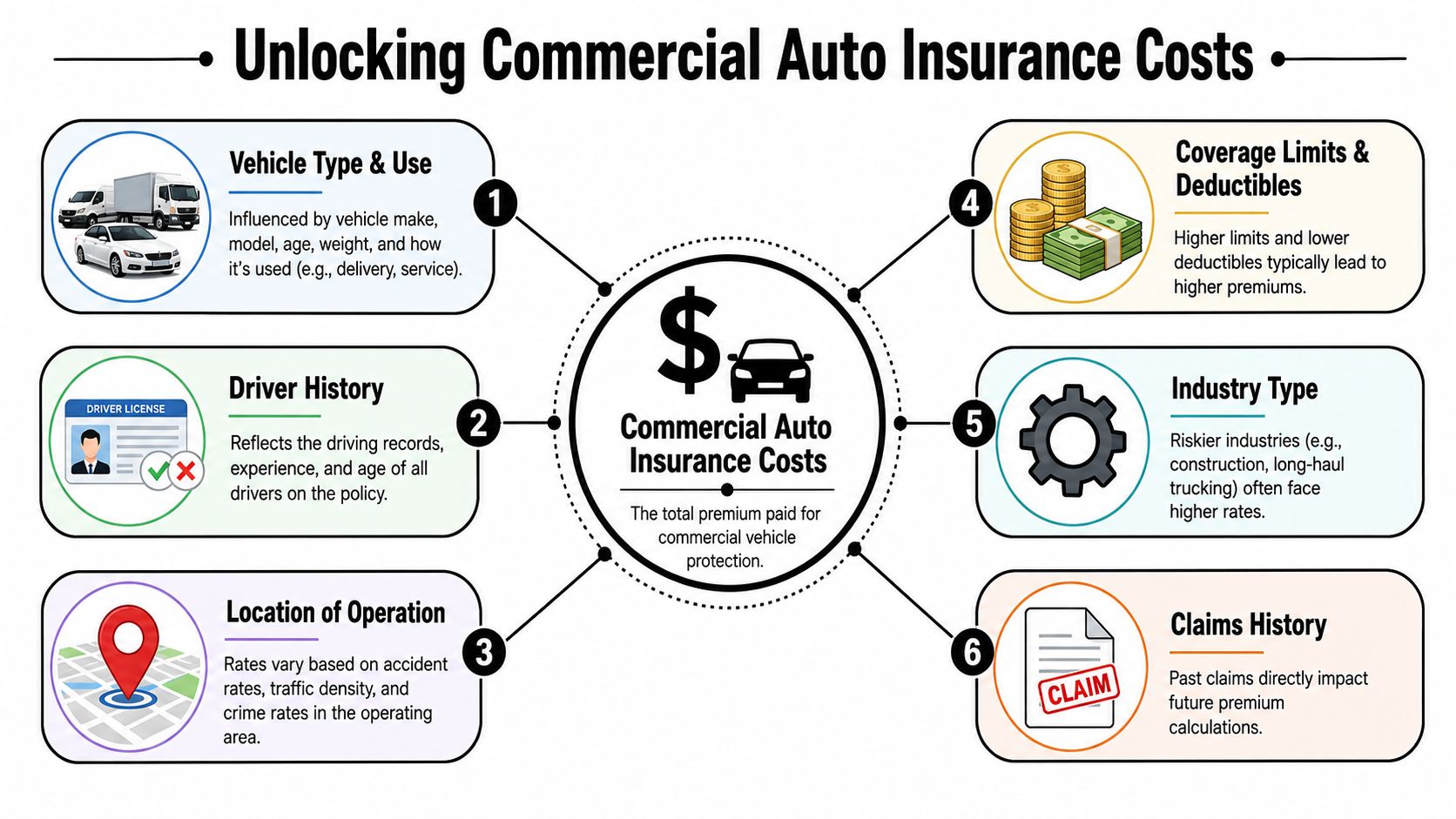
Commercial auto insurance pricing can feel mysterious until you know what underwriters are looking at. The premium isn't random. It reflects how likely the insurer thinks a claim is, and how expensive that claim could become.
A useful benchmark helps. Commercial auto insurance in California averages about $154 per month, or $1,843 annually, based on Insureon's California commercial auto cost data. That number is a starting point, not a promise. Your actual premium may be lower or higher depending on your operation.
The biggest pricing drivers
Most insurers focus on a handful of practical details.
Vehicle type and use
A sedan used for occasional client visits isn't the same risk as a dump truck, cargo van, or passenger shuttle. Weight, use, hauling, and daily mileage all affect how the insurer evaluates exposure.Driver history
The driving records of owners and employees matter. A clean record usually helps. Frequent violations or prior accidents can make a policy more expensive or harder to place.Industry
A consultant and a contractor may both own pickups, but their work creates different patterns of risk. Some industries involve heavier tools, more jobsite driving, or tighter schedules that can increase claim exposure.Location in California
Dense traffic, parking conditions, theft exposure, and driving environments differ across the state. A business operating mostly in central urban areas may present a different profile than one working in smaller communities.Coverage limits and deductibles
Higher liability limits generally cost more, but they also buy more protection. Deductible choices affect some parts of a policy as well, depending on the coverages you add.Claims history
Past claims shape how underwriters see future risk. One loss won't tell the whole story, but a pattern usually gets attention.
What you can do to control costs
You can't change every rating factor, but you can improve your profile.
Choose drivers carefully
Review motor vehicle records before someone starts driving for the company.Create a written vehicle-use policy
Spell out who can drive, when they can drive, and what conduct isn't allowed.Maintain vehicles on schedule
Tire, brake, and light issues often turn ordinary trips into avoidable claims.Match the vehicle to the job
Using the wrong vehicle for hauling or service calls creates unnecessary risk.Review limits with intent
Don't buy coverage by habit. Buy it based on your assets, contracts, and actual operations.
Better pricing usually starts with better risk habits, not just better shopping.
The same disciplined review you'd use for car insurance on your family vehicles should apply here. For many California households, that broader review also opens useful conversations about bundling personal auto, home insurance, renters insurance, and life insurance around the same time.
A Step-by-Step Guide to Quotes and Claims
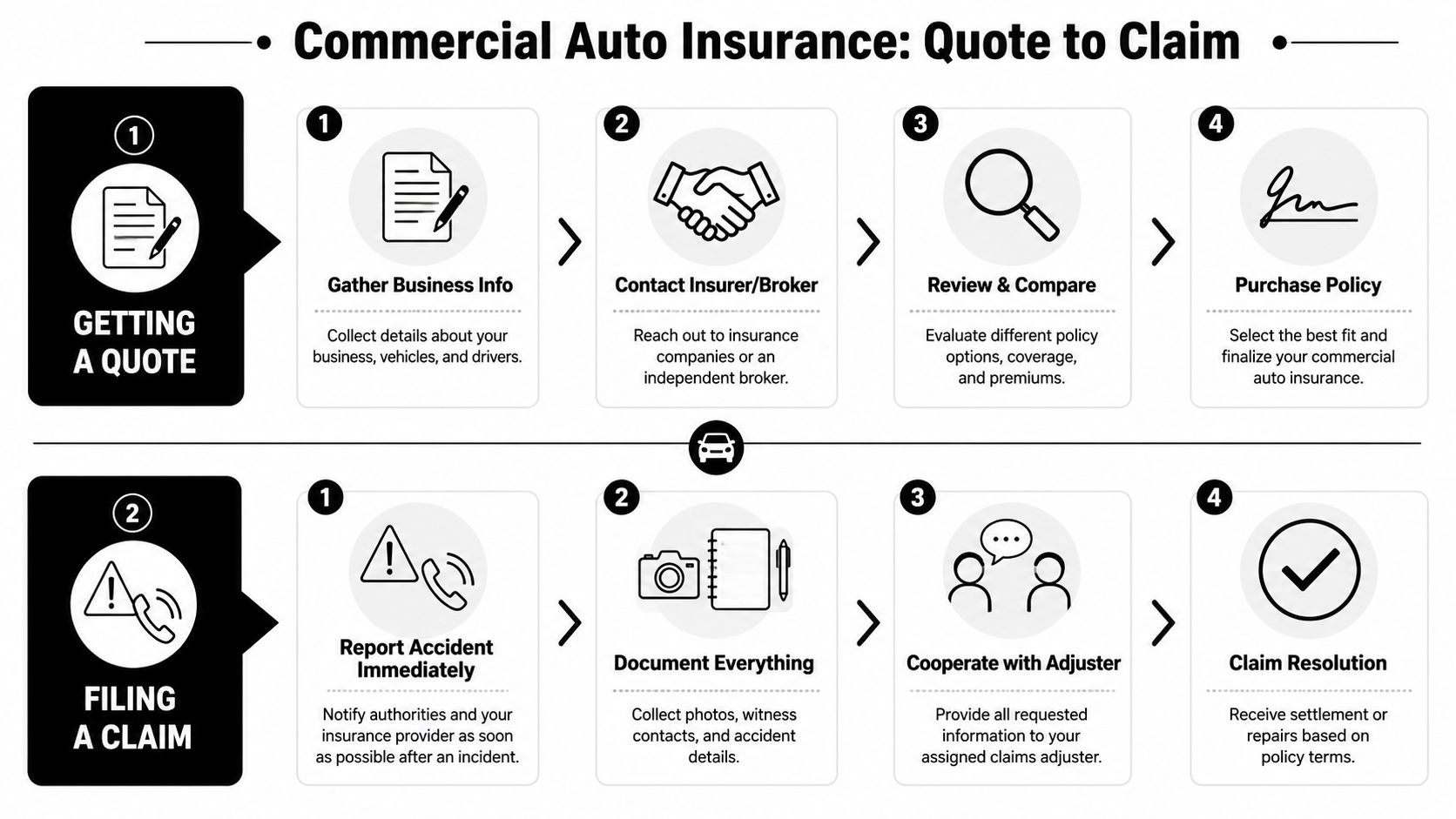
Buying a policy is easier when you gather the right information first. Filing a claim is easier when your team already knows what to do. Both processes reward preparation.
How to get a useful quote
A rushed quote usually produces a rushed policy. If the insurer doesn't understand your vehicles and business use, the proposal may miss key exposures.
Start with this checklist:
Business details
Legal business name, address, type of work, and how vehicles support operationsVehicle information
Year, make, model, VIN, ownership status, and how each vehicle is usedDriver list
Everyone who may drive for the business, including owners and occasional driversUsage patterns
Service radius, delivery activity, jobsite travel, passenger transport, and whether employees use personal cars for workCurrent insurance documents
Prior declarations pages and loss history, if you already have coverage
Once you have that ready, compare options instead of grabbing the first quote. Working with an independent agency can help because it allows you to review different carriers, limits, and endorsements side by side. If you're ready to begin that process, you can request a commercial and personal insurance quote in California.
What to do right after an accident
Claims go more smoothly when drivers follow a simple routine.
Get people to safety first
Call emergency services when needed. If the scene is unsafe, move only if it can be done safely and lawfully.Report the accident promptly
Notify law enforcement when appropriate, then notify your insurer as soon as possible.Collect facts at the scene
Gather names, contact information, vehicle details, witness information, and photos.Avoid admitting fault on the spot
Be polite and factual. Let the investigation determine liability.Tell your employer or manager immediately
Don't let a driver “handle it later.” Delay creates problems.Keep records organized
Save estimates, repair information, correspondence, and claim numbers in one place.
A clean claim file starts at the roadside, not days later at the office.
Businesses that manage several vehicles often benefit from a written accident-response procedure. For ideas on repair coordination, documentation, and post-collision workflow, fleet operators may find Premier Fleet Repair's playbook useful as a practical reference.
A good policy matters. A good process matters too. The two work together.
Partner with Mai & Associates for Your California Insurance Needs
Commercial auto liability insurance looks simple from a distance, but California business owners know the details matter. The legal minimum may not be enough. Vehicle use matters. Employee driving matters. Contract requirements matter. One wrong assumption can leave a gap that doesn't show up until after an accident.
That's why many Californians want an agency that can look at the full picture. Mai & Associates helps clients compare coverage from multiple carriers, review where personal auto stops and business exposure begins, and find practical options that fit the budget. That matters for a business owner shopping for commercial coverage, and it also matters for families comparing auto insurance, car insurance, home insurance, renters insurance, and life insurance in California.
The agency's California focus is a real advantage. Mai & Associates serves clients across the state, offers multilingual support in English, Spanish, Armenian, Russian, and Vietnamese, and helps customers understand coverage instead of just picking a policy from a price list. For drivers, homeowners, renters, and families, that consultative approach can make it easier to spot gaps, review limits, and choose coverage that fits real life.
If you want affordable California insurance without guessing your way through the fine print, expert guidance helps. A strong insurance plan should protect your business on the road and your life at home.
Mai & Associates makes it easy to compare California coverage for commercial auto, personal auto, home insurance, renters insurance, car insurance, and life insurance in one place. Visit Mai & Associates to request a no-obligation quote, review your current policies, and get help from a licensed California agent who can match coverage to your budget and your real-world risks.