Combined Single Limit: A California Driver's Guide
A combined single limit is one flexible pool of liability money for a single accident, while split limits divide that protection into separate buckets like 100/300/100. So if you have a $300,000 CSL, that one amount can be used across bodily injury and property damage claims from the same crash.
If you're shopping for California car insurance right now, this is one of those policy details that's easy to skip past. The problem is that it can make a real difference when an accident doesn't fit neatly into categories, which is how many serious claims look.
As a California insurance agent would explain it at the kitchen table, the question isn't just, "What does CSL mean?" It's, "If I cause a bad accident, how well does my coverage protect my car insurance liability, my savings, my home, and the rest of my financial life?" That's where combined single limit becomes more than insurance jargon. It becomes part of a bigger asset-protection strategy that can connect your auto insurance, home insurance, renters insurance, and even long-term financial planning.
What Is a Combined Single Limit in Auto Insurance?
A combined single limit, often shortened to CSL, is a single pool of coverage for liability claims from one accident. That pool can be used for bodily injury to other people and damage to other people's property, instead of separating those costs into fixed compartments.
Think of one account instead of separate envelopes
The easiest way to understand combined single limit is this:
- CSL is one checking account: the insurer can draw from one shared amount for covered liability losses from the accident.
- Split limits are separate envelopes: one envelope for injury to one person, one for all injuries in the accident, and another for property damage.
A commercial auto reference explains it plainly. A policy written as 100/300/100 means $100,000 per injured person, $300,000 total for all injuries in one accident, and $100,000 for property damage, while a $300,000 CSL can be applied flexibly across all covered losses from that same accident, as outlined in biBERK's explanation of CSL versus split limits.
That sounds technical, but the practical takeaway is simple. A combined single limit lets the money go where the loss is.
Why people get confused
Most drivers understand liability coverage in broad terms. They know it helps pay when they injure someone else or damage someone else's car. Confusion usually starts when they see multiple numbers on one policy and a single number on another.
Here's where a lot of California drivers pause:
If both policies are meant to cover liability, why would one use three numbers and the other use one?
Because they organize the same type of protection differently. One structure is rigid. The other is flexible.
If you're comparing policy wording and want a broader refresher on how liability fits with collision, non-collision, and other protections, it can help to browse common vehicle protection plans. For California-specific insurance terms, a quick insurance glossary also helps decode the language without the legalese.
Why CSL matters beyond your car
Liability insurance isn't about fixing your own vehicle. It's about protecting you from what you may owe other people after an at-fault accident.
That means the structure of your liability limit can affect whether a claim stays within your policy or spills into your own finances. For many Californians, that risk reaches beyond the car itself. It can touch:
- Your home equity
- Your savings
- Your wages
- Your future financial plans
Practical rule: The point of a combined single limit isn't that it's magical. It's that it gives your liability coverage more room to respond to the shape of a real accident.
Combined Single Limit vs Split Limits A Clear Comparison
Some policies are easier to compare once you stop reading insurance language and start looking at how the money is boxed in. That's the heart of the CSL versus split limits decision.
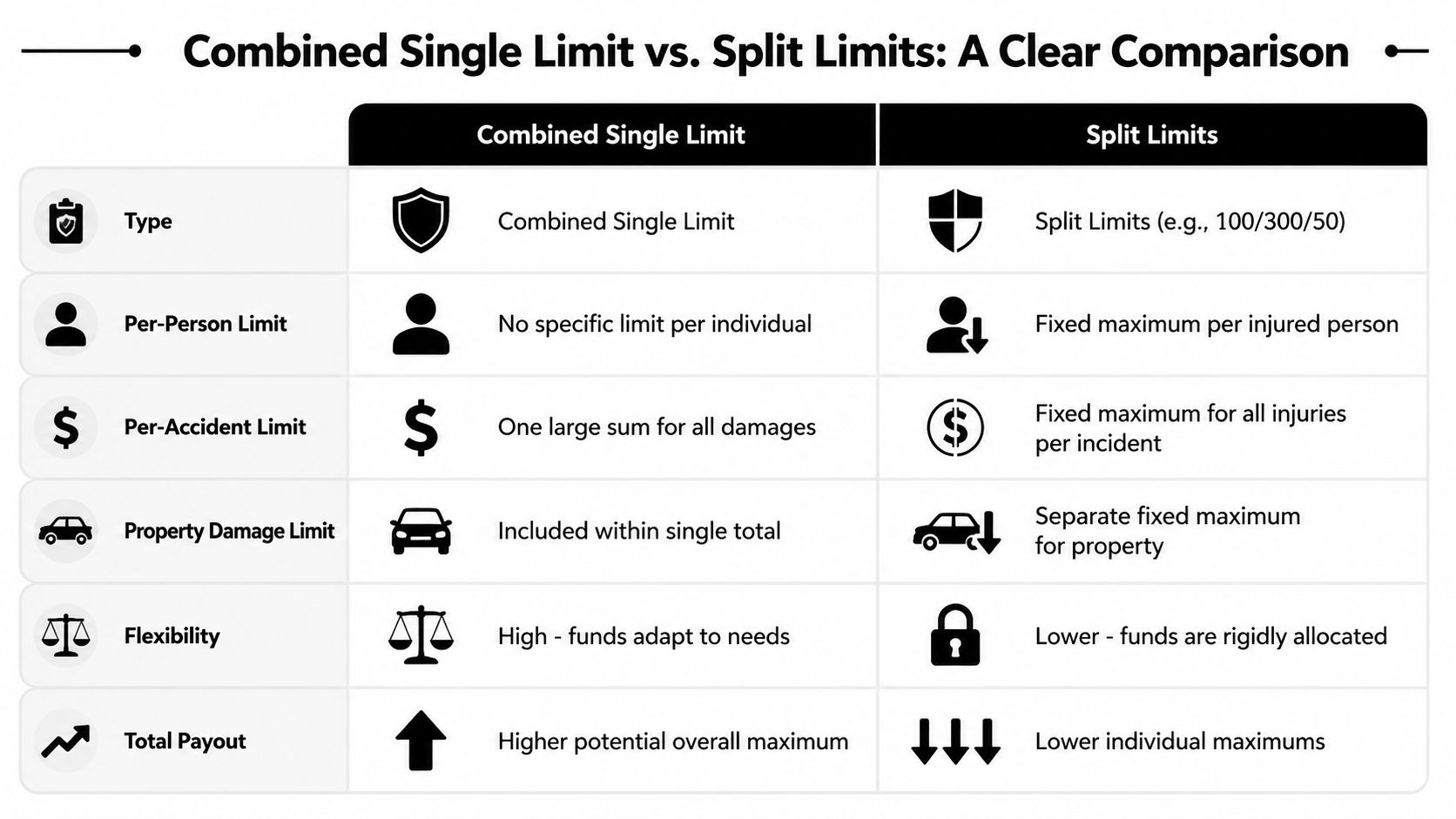
CSL vs split limit coverage at a glance
| Feature | Combined Single Limit (CSL) | Split Limit |
|---|---|---|
| How it's written | One total dollar amount for the accident | Three numbers such as 100/300/100 |
| Bodily injury handling | Draws from one shared pool | Limited by per-person and per-accident injury caps |
| Property damage handling | Draws from the same shared pool | Limited by a separate property damage cap |
| Flexibility | High | Lower |
| Best fit | Drivers who want fewer coverage mismatches | Drivers who prefer fixed categories |
| Main risk | One severe event can use up the full pool | One category can run out while another still has unused funds |
Where CSL has the edge
The strongest technical advantage of combined single limit is flexibility. A commercial auto insurance explanation notes that when one part of a claim is unusually large, such as a totaled vehicle plus minor injuries, the insurer can apply more of the limit to property damage without leaving unused injury capacity stranded in a different bucket, as described in this FAQ on CSL in commercial auto insurance.
That one point answers a lot of real-world confusion.
Say your policy has generous injury buckets but a smaller property damage bucket. If you hit a newer vehicle, damage a fence, and push another car into a storefront, property damage can become the problem fast. With split limits, you may still have unused injury protection sitting there that can't be shifted over. With a combined single limit, the insurer can use the shared pool where the claim needs it.
Where split limits still appeal to some drivers
Split limits aren't "wrong." They just work differently.
Some people like seeing clear, separate categories because the structure feels easier to budget around. Others may find split-limit options when comparing policy choices and focus first on premium. But lower upfront cost can come with a trade-off if the claim falls heavily into one bucket.
A few practical contrasts:
- If one person has serious injuries: split limits can hit the per-person cap even if the total injury limit is higher.
- If property damage is unusually high: split limits can run into the property cap while injury funds remain unused.
- If losses are balanced: either structure may respond reasonably well, depending on the total amount purchased.
A policy structure doesn't protect assets by itself. The structure and the limit amount have to work together.
If you're comparing forms and liability options from different carriers, a broader set of California insurance guides can help you read those quotes more critically.
How CSL Works in Real-World California Accidents
The theory makes more sense once you put it on an actual California road.

In California, the minimum auto liability structure is $30,000/$60,000 for bodily injury and $15,000 for property damage. A serious crash can quickly exhaust those limits, and a CSL policy can also be exhausted by one severe event, which is why the amount you choose matters so much, as explained in Jerry's discussion of combined single limit coverage.
Scenario one with heavy property damage
You rear-end one vehicle in dense traffic, and that impact pushes cars together. Several vehicles are damaged. The people involved have relatively minor injuries, but the repair bills are large.
With split limits, the property damage portion is confined to its own bucket. If that bucket runs out, unused injury limits don't automatically rescue the shortfall.
With combined single limit, the shared pot can lean harder into the property damage side because that's where the accident generated most of its cost.
Often, drivers say, "I thought I had enough coverage." What they usually mean is they had enough in total somewhere on paper, but not enough in the category that got stressed.
Scenario two with one badly injured person
Now take a different crash. You're turning in a busy urban area and hit a pedestrian. Property damage is modest, but one person suffers severe injuries.
A split-limit policy can run into the per-person bodily injury limit even if the overall bodily injury total for the accident looks larger. A combined single limit doesn't carve out a separate per-person cap in the same way. The total accident pool can be directed toward the covered losses from that event, up to the overall policy limit.
That doesn't mean CSL is unlimited. It isn't. It just means it doesn't box the money into as many rigid sub-limits.
When claims are messy, combined single limit usually behaves more like real life. Split limits behave more like accounting categories.
What California drivers should take from this
The state minimum structure may satisfy the legal requirement, but it doesn't mean it matches your actual exposure on California roads. That's especially true if you commute in crowded metro areas, drive around newer vehicles, or have assets you'd want to shield from a lawsuit.
A few practical reminders:
- Minimum legal coverage isn't the same as adequate protection
- A combined single limit can still be too low if the number itself is small
- Serious accidents don't ask whether your policy is organized conveniently
If you want to compare liability structures with the broader context of your own policy, a dedicated California auto insurance resource can help you line up the details before a claim does it for you.
Choosing the Right Liability Limit for California Drivers
The structure matters. The amount matters more.

California's minimum liability limits are often too low for modern claim costs. Consumer guidance notes that with rising vehicle repair costs and high medical expenses, the state's $30,000/$60,000/$15,000 minimums are often insufficient, and much higher limits such as 100/300 or 250/500, plus an umbrella policy for homeowners or high-asset individuals, are increasingly recommended in Hola Car Rentals' California CSL discussion.
Start with what you're protecting
If you own very little, your risk calculation may look different from a homeowner in Glendale, a renter with growing savings in San Diego, or a family building long-term wealth in Orange County.
Think about what an at-fault accident could reach if your liability coverage falls short:
- Homeowners should think about home equity and savings.
- Renters should think about bank accounts, wages, and future earnings.
- Parents and professionals should think about how a claim could interrupt bigger financial goals.
- Anyone with a life insurance plan and a long-term protection mindset should see auto liability as part of the same financial safety net.
That last point gets missed a lot. People often shop auto insurance by itself, home insurance by itself, renters insurance by itself, and life insurance by itself. But lawsuits don't respect those silos. Liability coverage is one of the main barriers between an accident and your broader financial life.
A practical way to choose
You don't need to overcomplicate this. Ask yourself three plain questions.
- If I caused a serious crash tomorrow, what personal assets would I want shielded?
- Would California minimums feel remotely adequate for that risk?
- Am I better served by a flexible combined single limit and, if needed, an umbrella policy above it?
For many drivers, the answer points toward higher liability limits, not just cheaper state-minimum auto insurance.
If you're still sorting out what liability insurance pays for versus what collision or other physical damage coverage handles, this SnapClaim liability insurance overview is a helpful plain-English refresher.
When an umbrella policy belongs in the conversation
An umbrella policy usually enters the picture when basic auto liability no longer feels large enough relative to what you own or could earn in the future.
A strong auto policy protects the first layer. An umbrella policy is often the next layer for people who have more to lose.
That matters for California homeowners, landlords, households with teen drivers, and people who want their insurance program to match their actual life. In practice, your auto liability choice can affect how well the rest of your protection plan holds together.
One option Californians use when reviewing those layers is Mai & Associates, which helps compare auto, home, renters, and life insurance options across multiple carriers so you can evaluate whether your liability limit fits the rest of your coverage.
Get Expert Guidance on Your California Insurance Policy
At this point, the key idea is simple. Combined single limit gives you flexibility, but flexibility only helps if the total amount is strong enough for your situation.
Regulators and insurers have recognized these liability structures for years, and drivers commonly compare split-limit formats such as 50/100/50, 100/300/100, or 250/500/100 against single-number CSL options. The right fit depends on your own California risk profile, as reflected in the New York Department of Financial Services opinion discussing combined single limit structures.
Good policy advice looks at the whole household
A useful insurance review shouldn't stop at the declarations page for your car. It should ask bigger questions:
- Do your auto limits line up with your assets?
- If you own a home, does your liability strategy reflect that exposure?
- If you rent, are you still protecting savings and future income?
- Would an umbrella policy make sense above your underlying auto coverage?
That's why a policy review often works best when someone looks across your coverage, not just at one line item in isolation. If you're weighing quotes, coverage structures, and household protection together, it's smart to request a California insurance quote review before renewing what you already have.
What expert analysis actually helps with
An agent can help you compare more than premium. They can help you see:
- whether a combined single limit fits your driving profile,
- whether a split-limit option creates weak spots,
- and whether your auto insurance is coordinated with your home insurance, renters insurance, or broader family protection goals.
The best liability limit is the one that still makes sense on your worst day, not just on billing day.
That matters even more in California, where claim severity can climb quickly and policy language isn't always intuitive.
If you want a no-obligation review of your auto insurance, home insurance, renters insurance, or life insurance, Mai & Associates can help you compare carrier options, check for coverage gaps, and see whether a combined single limit makes sense for your California protection strategy.