Get Classic Car Insurance California: Best Rates for 2026

If you own a classic car in California, you know it’s not just another vehicle. It’s a piece of history, a passion project, and a significant investment. So why would you protect it with a one-size-fits-all insurance policy designed for a daily commuter? Standard insurance just doesn't get it.
Classic car insurance, on the other hand, is built from the ground up for enthusiasts. It recognizes that your '66 Mustang or '57 Bel Air is an appreciating asset, not a depreciating tool for getting from A to B. Getting the right California insurance for your classic is a key part of protecting that investment.
What Makes Classic Car Insurance Different in California
Think about your standard car insurance policy. It's designed for the millions of cars on California's freeways that lose value every single day. Its main job is to cover a depreciating asset. But your classic car is different. It's a cherished collectible that often gains value over time.
For collectors across the Golden State—whether you're cruising through the streets of Los Angeles or enjoying a scenic drive up the Pacific Coast Highway—your vehicle is more than just transportation. It represents countless hours of work and a deep financial commitment. This is exactly where a standard policy falls dangerously short, highlighting the need for specialized California insurance.
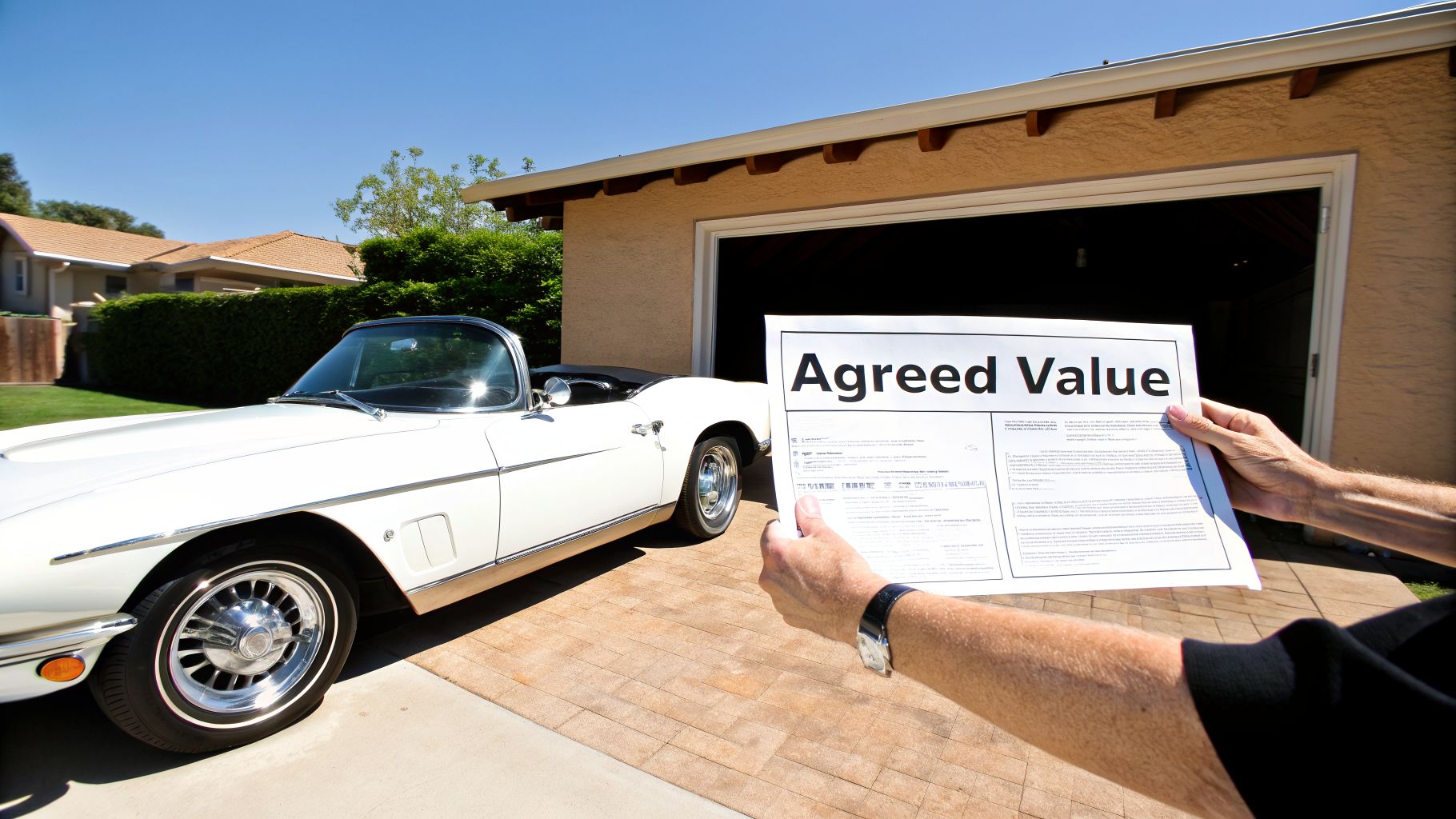
To put it into perspective, let’s quickly compare the two.
Classic Car Insurance vs Standard Auto Insurance at a Glance
This table breaks down the fundamental differences you'll find between a policy designed for your daily driver and one crafted for your prized collectible.
| Feature | Classic Car Insurance | Standard Auto Insurance |
|---|---|---|
| Valuation Method | Agreed Value (protects your investment) | Actual Cash Value (replacement cost minus depreciation) |
| Primary Use | Limited pleasure use, shows, club events | Daily commuting, errands, regular driving |
| Premiums | Often lower due to lower risk and limited use | Based on daily driving risks, commute distance, etc. |
| Eligibility | Strict requirements (age of car, storage, driving record) | Broad eligibility for most drivers and vehicles |
As you can see, the entire philosophy is different. One is about protecting an investment, while the other is about covering a utility.
Protecting Your Investment, Not Just Your Ride
The single most important difference boils down to how the insurance company values your car in the event of a total loss.
A standard policy uses Actual Cash Value (ACV). This is the car's replacement cost minus depreciation. For your 10-year-old sedan, that’s fair. For your appreciating 1969 Camaro, it's a financial nightmare. You’d get a payout far below what your car is actually worth.
This is precisely why classic car policies are built around a different, far better concept.
Agreed Value: This is the cornerstone of any good classic car policy. Before the policy even starts, you and the insurer agree on your car's specific value. This number is based on appraisals, restoration receipts, and the current collector market. If your car is declared a total loss, you get paid that exact amount. No arguments, no last-minute depreciation calculations.
This approach honors the true worth of your vehicle. It protects the thousands of dollars and weekends you've poured into finding, restoring, and maintaining your classic.
Tailored for the True Enthusiast
Insurers who specialize in classic cars know their customers. They know you probably store your car in a locked garage, not on the street. They know you're not using it for the daily grind and that you drive it carefully on the weekends. You’re a low-risk owner.
This is a big reason why classic car insurance is often surprisingly affordable. The policy is designed for how you actually use your car. If you treat your vehicle like the showpiece it is, shouldn't your insurance do the same? To see how this contrasts with everyday coverage, take a look at the fundamentals of standard auto insurance in California.
Ultimately, specialized coverage ensures your passion is properly protected, both financially and legally.
Understanding Agreed Value vs. Actual Cash Value
If there's one thing you absolutely must understand before insuring a classic car, it’s how its value is determined in a claim. This isn't some minor detail buried in the policy's fine print; it's the core difference between protecting your investment and facing a huge financial loss.
It all comes down to two very different approaches: Agreed Value and Actual Cash Value.
Think of it this way: You’ve poured your heart, soul, and a small fortune into restoring a 1967 Ford Mustang. It’s perfect. After a professional appraisal, you and your insurance company lock in an Agreed Value policy for $50,000. If your Mustang is stolen or totaled, you get a check for $50,000. Period. The value was set in stone the day you signed the policy.
That’s a world away from how your daily driver is insured. Standard policies almost always use a model called Actual Cash Value (ACV).
The Pitfall of Actual Cash Value for Classics
With ACV, an insurance payout is calculated by taking the vehicle's replacement cost and then subtracting depreciation for age and wear. This works fine for a regular car that loses value every year. But for a collector car that often gains value, ACV is a disaster waiting to happen.
Let's put your $50,000 Mustang on an ACV policy. After a total loss, the insurer would look at its age and mileage, consult a generic value guide, and likely offer you a fraction of what it's truly worth. They don't see a painstakingly restored classic; they see an old car. The thousands of dollars and hundreds of hours you invested might as well not exist.
For a classic car owner in California, an ACV policy simply doesn't recognize your vehicle as the asset it is. It treats a showpiece like a disposable commodity, leaving you with a settlement that couldn't possibly replace what you've lost.
This is exactly why an Agreed Value policy is non-negotiable for anyone serious about classic car insurance in California. It’s the only way to make sure the unique worth of your vehicle is fully protected. To see a side-by-side comparison, it's worth exploring the nuances of Agreed Value vs Actual Cash Value Insurance.
Establishing Your Car's Agreed Value
So, how do you and the insurance carrier land on that "agreed" number? It's not about picking a number out of thin air. It’s a straightforward process built on proof and professional expertise.
To lock in a fair agreed value, you’ll need to back it up with solid evidence:
- A Professional Appraisal: This is your cornerstone document. A certified appraiser specializing in collector cars will inspect your vehicle and produce a detailed report confirming its condition, authenticity, and current market value.
- Detailed Photographs: You'll need clear, high-quality photos showing every angle—interior, exterior, engine bay, and even the undercarriage. These visuals prove the car's condition.
- Documentation and Receipts: This is where your meticulous record-keeping pays off. Gather every receipt for parts, invoices for professional labor, and any logs you kept for your own restoration work.
This collection of documents removes all the guesswork. It proves the car's value, ensuring you and the insurer are on the same page from day one. Some of these California insurance terms can get a little confusing, so we've created a handy insurance glossary to help you keep things straight.
California Eligibility Rules for Collector Cars
Before you can get specialized insurance for your collector car in California, you've got to clear a few hurdles. Both insurers and the California DMV have rules that separate a true collector vehicle from just any old car. At the end of the day, these policies are built for enthusiasts who treat their cars as cherished assets, not as a way to get to work and back.
The first checkpoint is almost always the car's age. While it can vary a bit from one insurance company to the next, the magic number is generally 25 years old. That's the typical benchmark for a vehicle to be considered a "classic." Some specialty insurers might dip down to 15 years for rare exotics or limited-run models, but you can count on 25 years as the standard.
What Kind of Collector Car Do You Have?
In the world of collector cars, terms like "classic" and "antique" get thrown around a lot, but for insurance and registration, they can have very specific meanings. Understanding where your car fits helps determine your coverage needs.
- Classic Car: This is your sweet spot for vehicles between 25 and 49 years old. Think of a 1995 Porsche 911 or a 1987 Buick Grand National. These are cars that are maintained well and have some historical interest.
- Antique Car: This label is usually reserved for the old-timers—vehicles that are 50 years or older. Because of their age and historical value, they often face even tighter restrictions on use.
- Collector Car: This is the big-tent category. It covers classics, antiques, and even newer cars that are special in some way. This could be a limited-edition "modern classic," an exotic supercar, or a modified "restomod."
Just as important as age is your car's condition. You don’t need a flawless, concours-level showpiece, but it does need to be in good, drivable shape. Insurers expect the car to be well-maintained and stored securely. A project car sitting in pieces in your garage won't qualify unless you get a specific policy for restoration projects.
Understanding California's Historical Vehicle Plates
For many California collectors, a key part of the process is getting Historical Vehicle license plates from the DMV. These plates are great because they come with a one-time registration fee, but that benefit is tied to some very strict rules about how you can use your car—rules that your insurance company will care about deeply.
The California Vehicle Code is clear: cars with Historical Vehicle plates are for exhibitions, parades, and car club events. They are explicitly not for general transportation. So, if you're thinking of using your historically-plated '65 Mustang for the daily commute, think again. That's a direct violation of the vehicle code.
This visual gives you a sense of why getting the right policy type is so crucial once your car is deemed a valuable collector item.
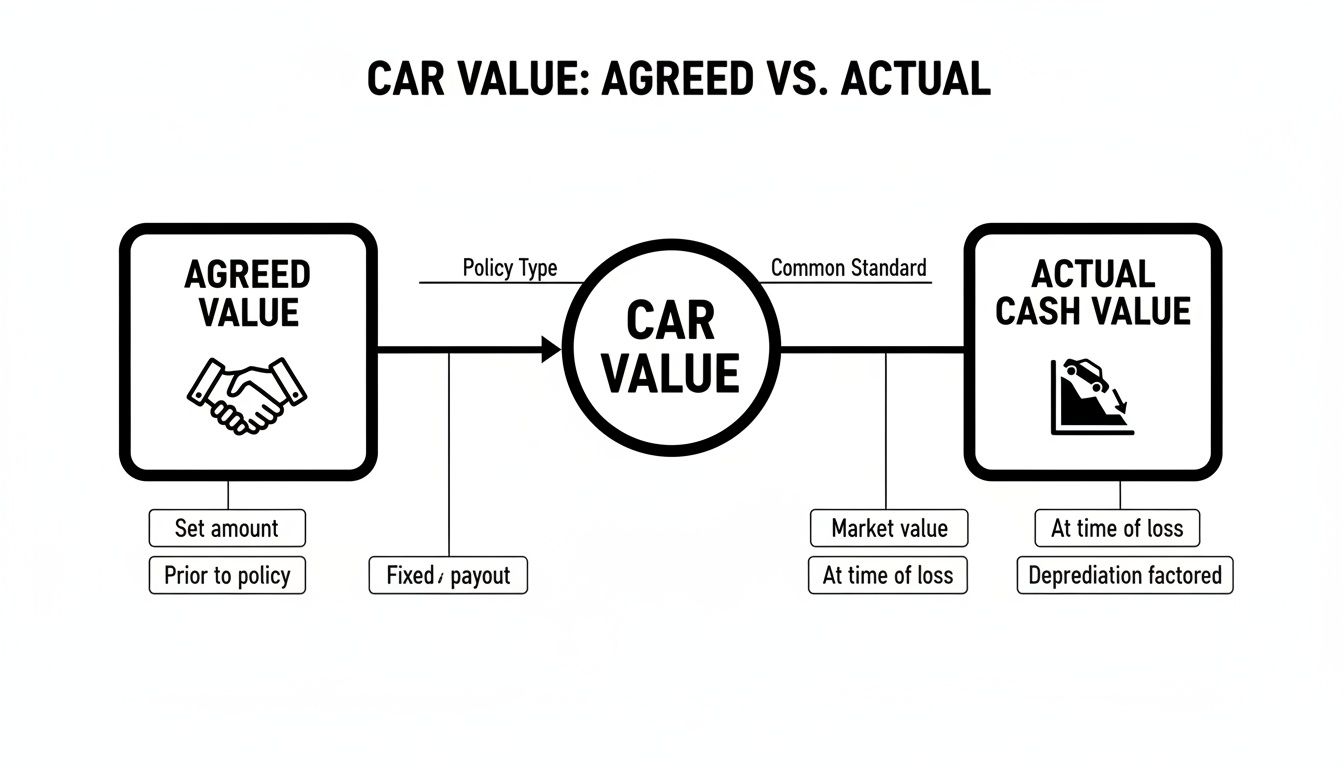
As you can see, Agreed Value locks in your car's worth, while standard Actual Cash Value lets depreciation eat away at your investment—exactly what you don't want for a classic.
How DMV Rules and Insurance Policies Work Together
Insurance companies that offer classic car insurance in California know the DMV's regulations inside and out. They design their policies around the exact same principle: your classic is for pleasure, not for errands.
This is a non-negotiable part of the deal. Your insurance policy will almost certainly mirror the state's Historical Vehicle rules, prohibiting daily driving, commuting, or any kind of business use. If you have an accident while breaking these rules, your insurer could have grounds to deny your claim entirely.
This is precisely why you'll need to show you have a separate daily driver. When you apply, the insurer will ask for proof of standard insurance on another car, truck, or SUV. It’s their way of confirming your classic is truly a weekend cruiser or show car, which is the whole reason these policies are often so affordable. Getting this right is fundamental for any collector in the Golden State.
Common Usage and Storage Requirements
Ever wonder why classic car insurance premiums are so much lower? It's not a secret pricing trick. It's a trade-off. Insurers offer this fantastic, specialized coverage because you agree to treat the car like the collector's item it is. This means following some commonsense rules about how you use it and where you keep it.
Think of it this way: your policy is built for a prized possession, not a daily workhorse. You can't use your classic to commute to the office or run daily errands. Taking your '67 Mustang to the grocery store would likely violate the terms, potentially leaving you without coverage if something happened on that trip.
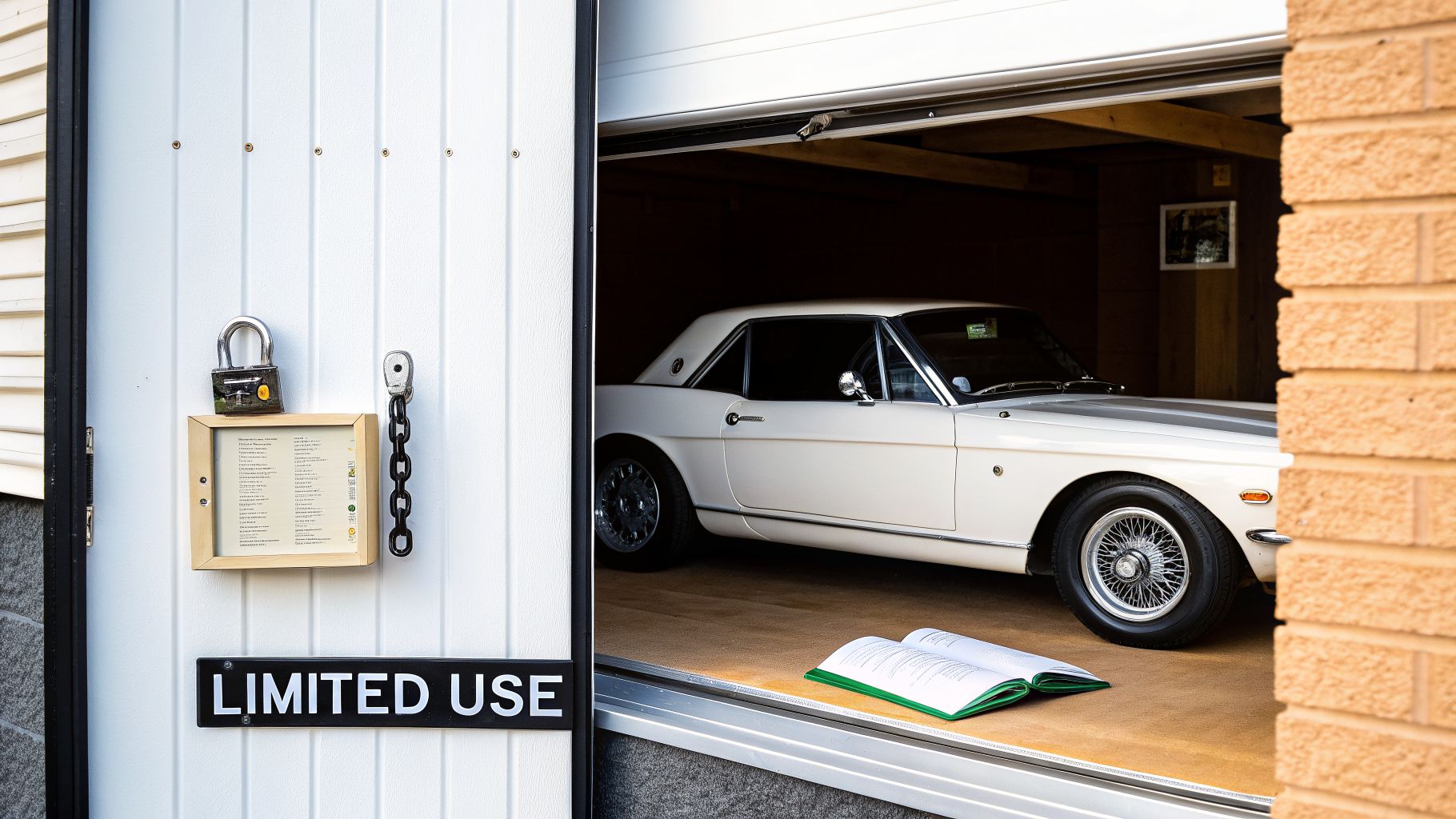
This "limited use" rule is the bedrock of classic car insurance in California. A weekend cruise down the PCH? Absolutely. Using it to drop the kids at soccer practice? That's a no-go.
Annual Mileage Limits
The first, and perhaps biggest, string attached is the mileage limit. Your standard auto insurance policy assumes you’ll be driving 10,000 miles or more each year. A classic policy works on the opposite assumption—that you’ll be driving far, far less.
Most carriers will let you pick your poison, usually offering a few different mileage plans.
- 2,500 miles per year: This is perfect for the owner whose car mostly lives in the garage, only coming out for local shows or the occasional Sunday drive.
- 5,000 miles per year: A really popular middle ground. It gives you plenty of room for more frequent pleasure drives or even some longer-distance club tours.
- Higher mileage tiers (e.g., 7,500 miles): While not as common, some insurers offer this for enthusiasts who love taking their classics on serious road trips.
Be honest with yourself here. Exceeding your mileage cap can cause major headaches during a claim. If you think you might push the limit, it’s always smarter to buy up to the next tier for peace of mind. For a deeper dive into different policy types, browse our collection of helpful guides.
Secure Storage Is a Must
Where you park your classic is just as non-negotiable as how much you drive it. Insurers insist that the vehicle be kept in a secure, fully enclosed, and locked structure. This rule is a cornerstone of the policy, as it drastically cuts down the risk of theft, vandalism, and weather damage—a key reason your premiums are so affordable.
A car parked on the street or in an open carport will almost certainly be denied classic car coverage. This is a common requirement for specialized California insurance, and it also applies to many home insurance policies where secure storage of valuables can impact your rates.
So, what counts as "approved" storage? It’s pretty straightforward:
- A private, locked garage at your home.
- A dedicated and secure rental storage unit.
- A professionally managed vehicle storage facility.
Of course, meeting the insurance requirement is just the first step. Many collectors go further, designing your dream garage for storage to create the perfect home for their investment. By following these usage and storage rules, you’re not just satisfying your policy—you’re actively protecting your automotive masterpiece.
How Classic Car Insurance Costs Are Calculated in California
Let's get straight to the question every classic owner asks: "So, what's this actually going to cost me?" You’ll probably be happy to hear that a proper classic car insurance California policy is almost always more affordable than the standard insurance on your daily driver. Sometimes, it's significantly cheaper.
Why the big difference? It boils down to risk. Insurance companies know that your classic isn’t just a car; it's a passion project. They see an owner who drives carefully, stores their vehicle securely, and pours love into its maintenance. That's a world away from a daily commuter braving rush hour traffic, and the lower premium reflects that reduced risk.
Think about it from the insurer's perspective. A cherished car that only sees 2,500 miles of sunshine a year and lives in a locked garage is far less likely to be involved in a claim than a vehicle battling the 405 every day.
Breaking Down the Premium: What Really Matters
So, how do they actually land on that final number? In California, insurers look at a handful of key factors to build a profile of your car and how you use it. Understanding these will give you a much clearer picture of your potential costs.
Here’s what they focus on most:
- The Vehicle's Agreed Value: This is the big one. The higher your car's value, the more it will cost to insure. It makes sense—a policy for a $100,000 muscle car carries more financial risk for the insurer than one for a $25,000 vintage Beetle.
- Your Annual Mileage Plan: The less you plan to drive, the more you save. A policy with a strict 2,500-mile annual limit will be noticeably cheaper than one allowing for 5,000 miles of road time.
- Storage Location: Where your car sleeps at night matters. Insurers use your ZIP code to gauge local risks like theft rates, vandalism, and even the likelihood of natural events like wildfires or flooding.
- Your Driving Record: No surprises here. A clean driving history, free of recent tickets or at-fault accidents, always helps you secure the best rate on any California insurance policy, from car insurance to life insurance.
By looking at these pieces together, the insurance carrier gets an accurate snapshot of the risk. The goal isn't just to give you a price, but to give you a fair price that reflects the care you put into your classic.
Unlocking Discounts and Savings
Beyond the main rating factors, there are plenty of discounts available that can chip away at your premium. Don't be shy about asking your agent to hunt down every last one you qualify for—they are there to reward responsible owners and active enthusiasts.
Look for common savings opportunities like these:
- Car Club Membership: Are you a member of a local Porsche club or the Mustang Club of America? Many insurers offer a discount for belonging to a recognized automotive club.
- Multi-Collector Car Policy: If you're lucky enough to own more than one classic, putting them all on a single policy is one of the easiest ways to get a significant price break.
- Anti-Theft Devices: A professionally installed alarm, a GPS tracker, or a simple kill switch shows you’re serious about security and can earn you a nice discount.
- Bundling with Other Policies: Do you have home insurance or renters insurance? Combining your classic car policy with your other household insurance is a classic way to unlock a multi-policy discount.
Compared to standard auto insurance, classic car coverage in California offers incredible value, with protection built specifically for the way you own and enjoy your car. While some companies like American Modern are known for covering a huge range of qualifying vehicles, others like Progressive's Hagerty division specialize in things like restoration projects. For more great insights, you can check out the guide to the best classic car insurance providers on AutoInsurance.com.
The best way to see how it all adds up for your specific vehicle is to talk to a knowledgeable agent who can find every credit you deserve. To see how these savings could apply to your pride and joy, you can get an insurance quote and compare real options tailored to you. You might just be surprised how affordable it is to protect your passion.
It’s Time to Find the Right Policy for Your California Classic
You’ve done the research. You understand why classic car insurance, with its agreed value protection and surprisingly affordable premiums, is the only smart way to cover your pride and joy. Now for the important part: getting that protection in place.
Finding the right policy isn't just about plugging your details into a website and picking the cheapest option. In a market as complex as California's, you need a strategy. That's where working with a real person—an expert who knows the ins and outs of collector car coverage—can make all the difference. At Mai & Associates, our licensed agents live and breathe this stuff. We get the nuances of protecting a cherished vehicle because we're enthusiasts, too.
More Than Just a Car: Covering Everything You Value
Chances are, your classic isn't your only major asset. Real security comes from knowing that your daily driver, your home, and your family's future are just as well-protected. Juggling multiple policies from different companies can be a headache, which is why many Californians prefer working with a single, dedicated agency for all their California insurance needs.
We help our clients build a complete safety net, finding them the right coverage for all aspects of their lives, including:
- Classic Car Insurance: The specialized, agreed-value policies your investment deserves.
- Standard Auto Insurance: Competitive rates for the car insurance you need every day.
- Homeowners Insurance: Protecting your biggest asset with top-tier home insurance.
- Renters Insurance: Covering your personal property and liability with affordable renters insurance.
- Life Insurance: Creating a financial foundation for your family’s future with a solid life insurance plan.
How to Beat California's Rising Insurance Rates
It's no secret that insurance costs are on the rise. Between 2023 and 2025, California saw auto insurance rates jump by over a third. The good news? Thanks to consumer protections under Proposition 103, Californians still pay about $60 less than the national average. You can read more about what’s driving these changes in this LA Times report on California auto insurance rates. In this climate, having an expert on your side is more critical than ever.
Think of an independent agency like Mai & Associates as your personal advocate. We do the heavy lifting, shopping the market and getting instant quotes from dozens of top-rated carriers. Our goal isn't just to get you covered—it's to find you great coverage at a price that makes sense.
We're a local California agency, with offices in Glendale, Westlake Village, Escondido, and Costa Mesa. Our team is ready to help in English, Spanish, Armenian, Russian, and Vietnamese to make sure the process is always clear and straightforward.
Let’s protect your classic and everything else that matters to you. Contact Mai & Associates today for a no-obligation quote and feel the confidence that comes from knowing you’ve got the right team in your corner.
Frequently Asked Questions About Classic Car Insurance
Even after you’ve got a handle on the big concepts like agreed value and usage rules, a few specific questions almost always pop up. Let's run through some of the most common queries we hear from collectors and enthusiasts across California.
Can I Insure My Modified Car or Restomod in California?
Absolutely. Most specialty insurers are well-equipped to cover modified classics and restomods, but there's one thing you have to get right: thorough documentation.
To establish an accurate agreed value that truly reflects your investment, you need a paper trail. Keep every receipt for parts and every invoice for labor. An insurer needs to see the quality of the work and understand exactly what's been done, from a modern engine swap to a custom interior. Full transparency is the only way to make sure your hard work is properly protected with the right California insurance.
What Happens if My Classic Car's Value Increases?
This is a fantastic problem to have, and it’s where an agreed value policy really shines. If you notice the market for your car is heating up or it wins a major award, don't just sit on that information—call your insurance agent.
You can request a policy review anytime, but your annual renewal is often the easiest time to make an adjustment. With a new professional appraisal or solid market data, you can increase your coverage to match the car's higher value. This keeps your policy in sync with your investment.
Don't wait for a claim to find out you're underinsured. Regularly review your policy's agreed value to make sure your coverage keeps pace with your appreciating asset. This simple step is fundamental to protecting your investment.
Do I Need a Separate Daily Driver to Qualify?
For the vast majority of classic car policies, yes. Insurers will almost always require you to own and insure at least one other standard vehicle for your daily commute and errands.
Think of it from their perspective: this requirement confirms that your classic is a pleasure vehicle, not your primary transportation. It’s the core reason the premiums are so affordable. When you apply, be prepared to show proof of insurance for your daily driver. This is a common rule when applying for specialized car insurance in California.
Is My Car Covered While Undergoing Restoration?
This is a critical question to ask before you start turning wrenches. A standard classic policy might not cover your car while it's in the middle of an active restoration.
To bridge this gap, many specialty carriers offer an endorsement called "vehicle under construction" coverage. This add-on protects the car itself from risks like fire or theft while it's disassembled and being worked on. Some policies even include a separate allowance for your stored parts. Always talk to your agent before a project begins to make sure the right coverage is in place.
Ready to protect your classic car and all your other valuable assets? As a full-service California agency, Mai & Associates can help you find the best coverage for your classic car, daily driver, home, and more. Compare quotes and get expert advice from licensed agents who understand your needs. Visit https://cahomeauto.com to get your no-obligation quote today.