Cheapest Non Owner SR22 Insurance: A California Guide
Most non-owner SR-22 policies land around $30 to $85 per month, and the filing itself usually adds a one-time $15 to $25 fee. If you qualify for a true non-owner policy, that's usually the fastest and cheapest way to satisfy an SR-22 requirement because you're insuring your liability, not a car.
If you're reading this after a license suspension notice, a court requirement, or a DMV letter, you probably don't want a long theory lesson. You want to know three things. What this is, what it costs, and how to get it handled today without overpaying.
In California, the cheapest non owner SR22 insurance is rarely just the lowest number on a screen. The better question is whether the policy is the right type, whether the carrier can file it promptly, and whether the quote includes the filing cost instead of hiding it until checkout. Speed matters. So does getting it right the first time.
What Is Non Owner SR22 Insurance and Why You Might Need It
A non-owner SR-22 is not a special kind of car insurance. It's an SR-22 filing attached to a liability policy for someone who doesn't own, lease, or regularly use a vehicle.
That distinction matters. The SR-22 is the proof your insurer sends to the state to show you carry the required liability coverage. The non-owner policy is the insurance behind that filing.
Who usually needs it in California
In practice, this usually comes up after a serious driving issue. California drivers often run into an SR-22 requirement after a DUI, driving without insurance, or another violation that triggers proof of financial responsibility.
If your situation started with an arrest and you're still trying to sort out the early legal steps, this DUI bail process guide can help you understand what happens right after the incident. That doesn't replace insurance advice, but it can make the overall process less confusing.
Why it's cheaper than an owner policy
A non-owner policy is generally less expensive because it covers liability only and does not insure a vehicle you own. One industry summary says non-owner SR-22 coverage is generally 40% to 60% cheaper than owner-based SR-22 coverage, with a 2025 estimate of about $30 to $85 per month, or roughly $360 to $1,000+ per year (non-owner SR-22 cost estimate and pricing comparison).
Practical rule: If you own a car, lease one, or have regular access to one in your household, don't assume a non-owner policy will solve your problem. It may be the wrong policy entirely.
What it usually covers:
- Bodily injury and property damage liability: Coverage for damage or injuries you cause while driving a vehicle you don't own.
- State filing support: The insurer files the SR-22 to show financial responsibility.
- No physical damage coverage: It doesn't include collision or non-collision damage for the car you're driving.
What it doesn't do:
- Cover your own vehicle: Because there shouldn't be one on the policy.
- Fix the borrowed car: Non-owner policies generally aren't built to insure the car itself.
- Replace a standard auto policy: If your real situation is owner-based, the state and insurer expect the correct policy type.
If insurance terms feel like a second language right now, a plain-English insurance glossary can help you decode the paperwork faster.
Decoding the Real Cost of California SR22 Insurance
The monthly premium gets all the attention. It shouldn't.
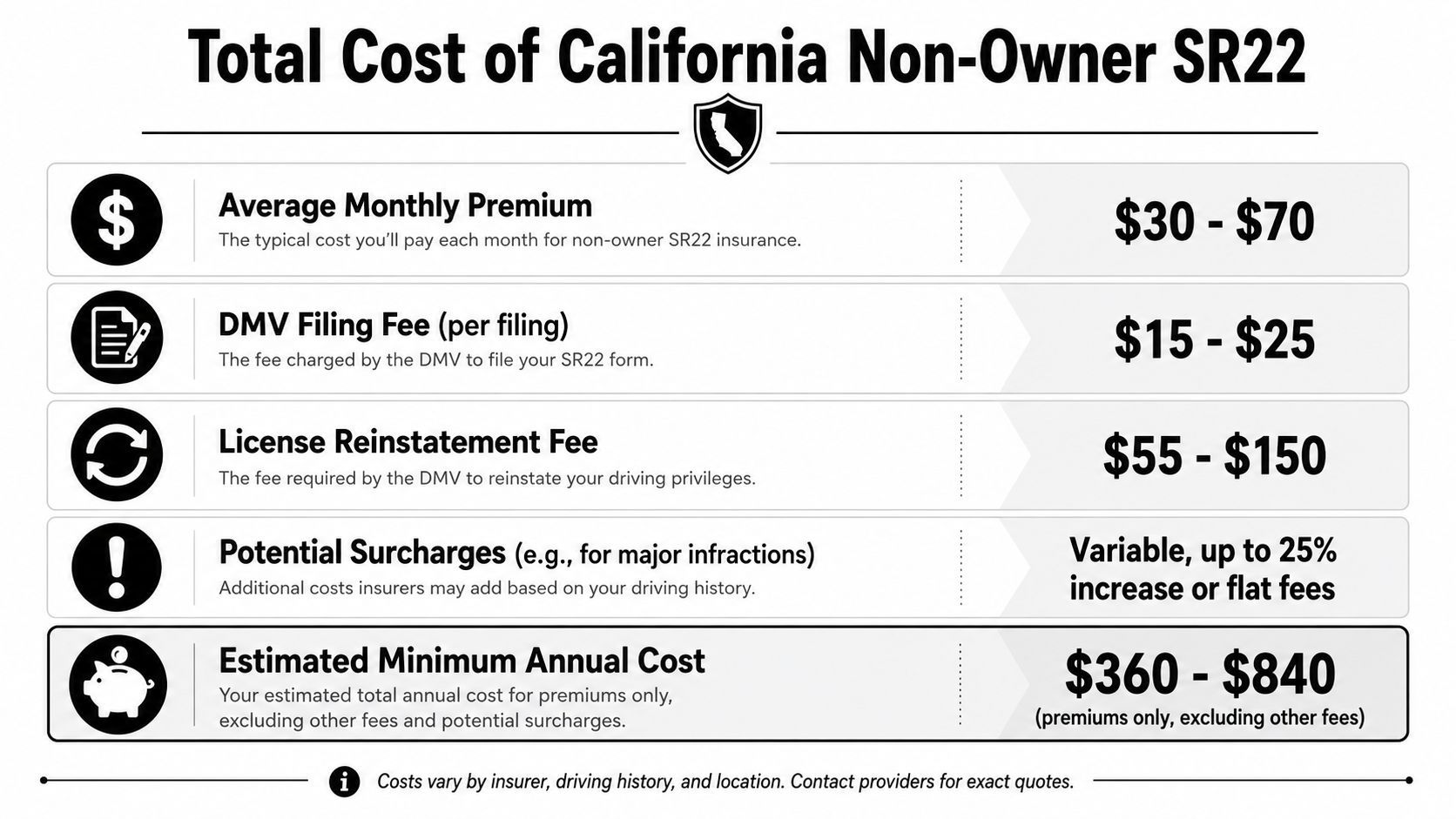
With SR-22 filings, the total cost of compliance usually includes the policy premium, the filing fee, and whatever state reinstatement steps still apply to your license. If you only compare the monthly number, you can still end up paying more overall.
The charges people miss
MoneyGeek estimates a national average of about $75 per month for non-owner SR-22 coverage, with prices ranging from $30 to $85 per month and a one-time SR-22 filing fee of about $15 to $25 (non-owner SR-22 filing fee and average cost breakdown).
That means a “cheap” quote isn't automatically cheap if:
- The filing fee is extra: Some shoppers think the quote includes everything when it doesn't.
- The filing takes too long: Delays can keep your reinstatement process from moving.
- The policy type is wrong: The cheapest invalid policy is still expensive once you have to redo it.
The real savings usually come from avoiding mistakes, hidden fees, and delays, not just shaving a few dollars off the monthly premium.
What changes your price
Insurers don't price every California driver the same way. They look at risk, filing needs, and eligibility.
| Cost Factor | Impact on Premium | Example |
|---|---|---|
| Driving history | Higher-risk violations usually increase cost | A DUI-related requirement will usually price differently than a less severe record issue |
| State filing requirement | Adds administrative cost and urgency | A carrier may quote one premium, then add the SR-22 filing fee separately |
| Eligibility for non-owner coverage | Wrong fit can eliminate the low-cost option | If you regularly use a household vehicle, you may need a different policy type |
| Carrier appetite | Some carriers price this segment more competitively | Two insurers can view the same California driver very differently |
| Speed of filing | Faster service can matter more than a slightly lower quote | Same-day electronic filing may be worth choosing over a slower low-price option |
How to review a quote like a pro
When you request California car insurance with an SR-22 filing, ask these questions in one call:
- Is this a true non-owner policy?
- Does the quoted price include the SR-22 filing fee?
- Can the filing be sent electronically the same day?
- Will this satisfy California's requirement based on my situation?
If you want a broader look at policy options before you buy, this overview of California auto insurance coverage is a useful starting point.
Your Action Plan to Find the Cheapest SR22 Policy
Panic shopping is where people waste money. The fastest path is usually a short, organized one.
Start by collecting your license number, the DMV or court notice, and the exact state requiring the filing. If you have any current policy documents, keep those nearby too. The cleaner your information, the faster an agent or carrier can tell you whether you qualify for non-owner coverage.
Step through it in the right order
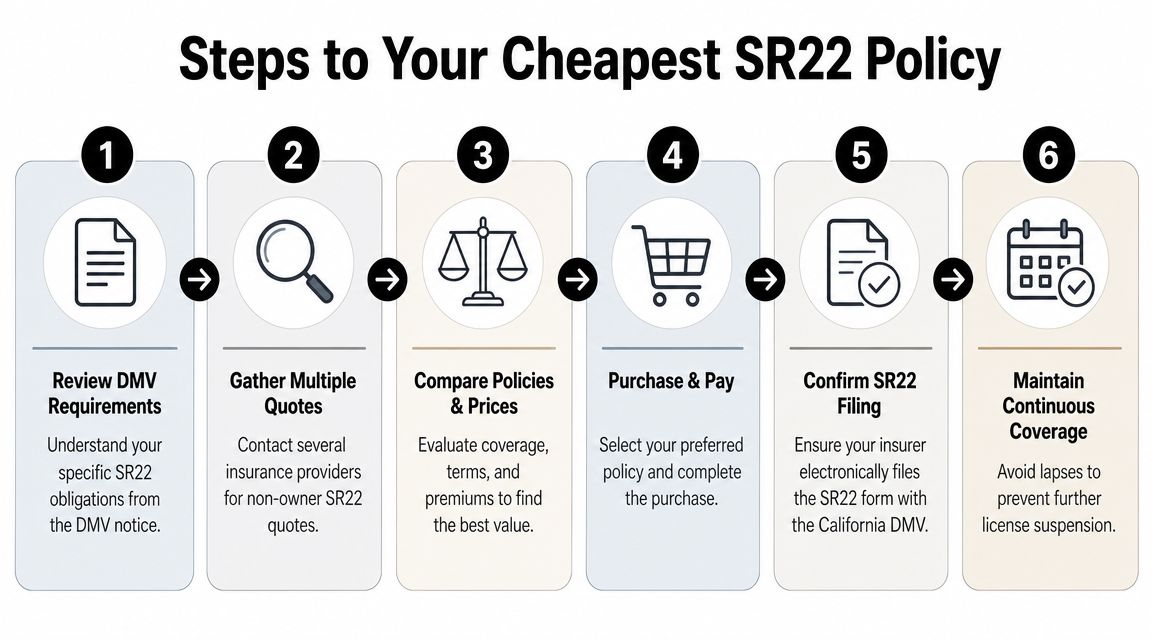
Use this sequence. It prevents the most common delays.
Confirm you qualify
A non-owner policy is only for someone who doesn't own, lease, or regularly use a vehicle. If that fact isn't true, stop there and shop for the correct policy type.Get quotes from more than one carrier
Comparison shopping matters here. Insurance.com reports sample pricing that shows how much carriers can differ, including GEICO at $360 per year for an SR-22 auto policy and State Farm at $399 per year after a DUI for a non-owner policy in its sample data. The same source also cites Insurify data showing non-owner coverage is about 37% less than liability-only insurance (carrier comparison for non-owner SR-22 pricing).Ask about filing capability, not just price
The cheapest quote doesn't help if the company can't file in the state you need or can't do it promptly.Buy the policy only after the details match your situation
Verify name, license number, filing state, and policy type before payment is processed.Confirm the SR-22 was filed
Don't assume. Get confirmation that the filing was submitted and accepted into the process.
Direct carrier vs online form vs local agency
Each shopping path has trade-offs.
Going direct to a carrier can work if you already know the exact product you need and the company offers non-owner SR-22 filings in California.
Using a lead-generation comparison form can produce lots of calls, but those systems often don't catch the policy-type issue early enough. That's where people lose time.
Working with a licensed California agency is usually the most efficient option when speed matters, because someone can verify eligibility, compare actual carrier options, and spot problems before you pay.
A good SR-22 process feels boring. That's a compliment. The details are checked, the filing goes out, and you move on.
If you want to start with a live rate search instead of calling every company yourself, request a California insurance quote online.
Smart Strategies to Lower Your SR22 Insurance Bill
Once you have valid quotes in hand, then you can work on reducing the bill. Not before.
The first money-saving move is simple. Buy the correct policy type. People sometimes chase the cheapest non owner SR22 insurance quote even when their situation calls for owner coverage. That mistake can cost more than any discount will save.
Cut waste before you chase discounts
A lower bill usually comes from eliminating unnecessary friction.
- Choose a carrier that files quickly: A slightly higher premium can still be the better value if it gets you compliant faster and avoids extra downtime.
- Make sure the quote is complete: Ask whether the SR-22 filing fee is included before you compare prices.
- Avoid policy resets: If you cancel and rewrite repeatedly while bargain hunting, you can create confusion and delays.
Use your full insurance picture
A full-service California agency can provide assistance. Even if you don't own a car today, you may still need renters insurance. If you own a home, your home insurance may deserve a review. If you're protecting family income, life insurance might already be on your list.
Bundling doesn't always mean one perfect package for every person, but it can create better overall value when the policies fit together well. It can also simplify billing, make renewals easier to track, and give you one point of contact when your SR-22 period ends and you're ready to move back into a standard California auto insurance policy.
Payment choices matter too
Ask about payment structure. Some carriers offer better overall value when you pay more upfront instead of stretching the cost across monthly installments. The right option depends on cash flow, but it's worth comparing the total spend, not just the starting monthly number.
The lowest-cost insurance setup is often the one that solves today's SR-22 issue and also fits the rest of your California insurance needs without duplicate coverage or billing confusion.
There's also a practical benefit to consolidating policies. The same office helping with a time-sensitive SR-22 filing can often help you review renters, home, or life coverage at the same time, which reduces the odds that one urgent issue causes you to overlook another.
Common Pitfalls and Mistakes to Avoid with SR22 Filings
The biggest SR-22 mistake is buying a policy that sounds right but doesn't match your actual driving situation.
A non-owner SR-22 policy is only for drivers who do not own, lease, or have regular use of a vehicle. A 2026 rate analysis cited State Farm at $33/month and USAA at $28/month for military families, but the same analysis makes the bigger point clear: eligibility comes first (non-owner SR-22 eligibility and carrier pricing examples).
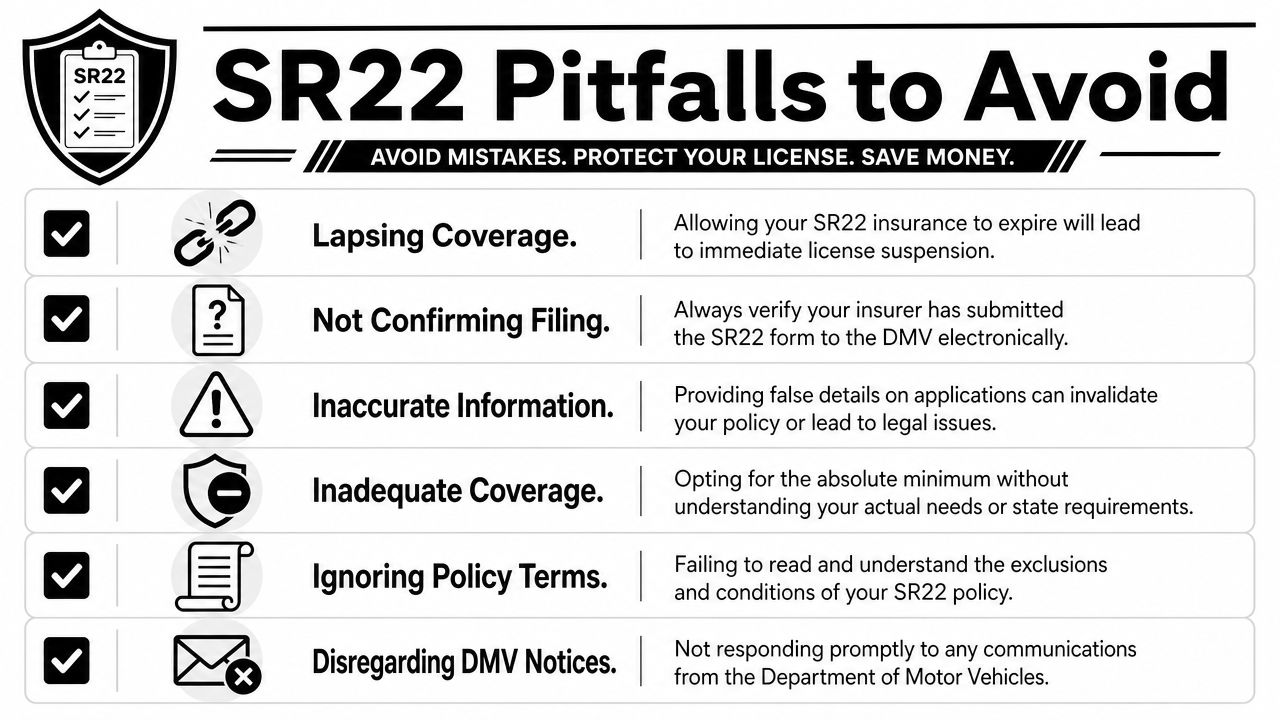
Mistakes that can cost you time and money
Some errors are obvious. Others catch people who are trying to move too fast.
- Buying non-owner coverage when you have regular access to a car: If you live with a vehicle you drive often, this is a red flag.
- Letting the policy lapse: Even a short gap can create serious compliance problems.
- Assuming the filing happened automatically: Always verify.
- Giving incomplete or inaccurate application details: Small errors can cause big delays later.
- Ignoring carrier notices: Missed mail or missed emails can turn into missed payments or canceled coverage.
What actually works
Treat the SR-22 like an active compliance requirement, not a one-time purchase.
Keep proof of the policy. Watch your payment dates. Open every notice from the insurer and the DMV. If your address, name, or license status changes, update the policy right away.
If your license reinstatement depends on the filing, don't rely on assumptions. Confirm the filing and confirm your policy stays active.
A lot of drivers also underestimate how often confusion starts with basic terminology. If you're unsure what your notices mean or whether your filing has to stay active for the full required period, review common questions first in this California insurance FAQ page.
Get Your California SR22 Sorted Today
The cheapest non owner SR22 insurance isn't just the lowest premium. It's the policy that fits your eligibility, gets filed correctly, and moves you toward compliance without delays or rework.
For California drivers, that usually means focusing on total cost and speed together. A quote that looks cheap but excludes the filing fee, uses the wrong policy type, or can't be filed promptly can end up costing more in both money and time. A clean, correct same-day process is often the actual bargain.
If you're also reviewing your broader insurance needs, this is a good moment to clean up the rest of the picture. Auto insurance, renters insurance, home insurance, and life insurance often overlap in ways people don't notice until they sit down with someone who knows California coverage well. When the policies are aligned, it's easier to avoid gaps and easier to control the total bill.
The good news is that this problem is usually fixable quickly. Once your eligibility is confirmed and the carrier is right, the filing process itself is straightforward. Most of the frustration comes from wrong assumptions, incomplete quotes, and avoidable delays.
Handle the urgent part first. Get the right policy. Get the filing submitted. Then review the rest of your California insurance setup so the same issue doesn't keep costing you money later.
If you need fast, accurate help, Mai & Associates can shop multiple carriers for your California SR-22 needs and help you review your auto, home, renters, and life insurance in one place. With multilingual support, same-day quote options, and licensed California guidance, they're a strong partner when you need the cheapest workable solution and a filing done correctly.