Cheapest Car Insurance in California
If you're hunting for the cheapest car insurance in California, you've probably heard a few names pop up repeatedly. Carriers like GEICO, Progressive, and Wawanesa are often in the running for the most competitive rates, but the real cheapest option always comes down to you—your driving record, your car, and where you live. Think of those companies as a great place to start your search for affordable California insurance.
Your Guide to California's Cheapest Car Insurance
Navigating the insurance market in the Golden State can feel overwhelming, but it's simpler than it looks once you grasp the basics. The premium you're quoted is a blend of your chosen coverage, your history behind the wheel, and yes, even your zip code. Understanding these factors is key to finding the best rates on auto insurance, and even home insurance or renters insurance.

The first thing to understand is the crucial difference between minimum liability and full coverage. State-required minimum coverage is your cheapest ticket to being legal on the road, but it only covers damages to others. Your own car gets zero protection. On the other hand, full coverage (which adds collision and comprehensive) costs more but gives you the financial backstop you need if your car is damaged.
Understanding Average Costs
So, what should you expect to pay? Looking at statewide averages gives you a solid benchmark for budgeting, though your final quote will be tailored to your specific situation. This applies across all lines of California insurance, from your car insurance to your life insurance.
One comprehensive analysis showed GEICO offering full coverage for an average of $108 per month (or $1,296 annually), making it a top contender for affordable, robust protection. This conclusion came from a deep dive into quotes from over 20 different insurers across a wide range of driver profiles.
The single most important rule for finding cheap car insurance in California is simple: shop around. Never take the first quote you get. Rates can vary by hundreds, sometimes thousands, of dollars from one company to the next for the exact same policy.
This advice isn't just for auto insurance. Bundling is one of the easiest and most powerful ways to cut your costs. Insurers love when you combine your car insurance with home insurance, renters insurance, or even life insurance, and they'll often reward you with a hefty discount. It’s a win-win that saves you money and streamlines your finances.
To give you a clearer picture, here's a quick breakdown of what California drivers pay on average for basic versus complete protection. As you look at these numbers, think about your own budget and how much risk you're comfortable taking on. For a deeper dive into policy options, feel free to explore our collection of insurance guides.
California Car Insurance Average Costs at a Glance
This table provides a quick overview of average annual and monthly car insurance costs in California, comparing minimum liability with full coverage policies to help drivers understand the price difference.
| Coverage Level | Average Annual Cost | Average Monthly Cost |
|---|---|---|
| Minimum Liability | ~$667 | ~$56 |
| Full Coverage | ~$2,668 | ~$222 |
The gap is significant, right? That difference is the price of peace of mind—knowing your own vehicle is protected against accidents, theft, and other unforeseen events.
Why Is California Car Insurance So Expensive?
If you’ve ever looked at your car insurance bill and felt a bit of sticker shock, you're definitely not alone. It’s a common experience here in California. The hunt for the cheapest car insurance in the state usually begins with one big question: why does it cost so much in the first place? It really comes down to a perfect storm of economic and geographic factors unique to the Golden State.
Getting a handle on these reasons is the first step to figuring out how to save. Insurance companies base their prices on risk, and frankly, California is just a riskier place to drive than most other states. From our jam-packed cities to the high cost of, well, everything, these factors have a direct impact on your premium for all types of California insurance.
All That Traffic Takes a Toll
California is home to some of the most crowded cities in the entire country—think Los Angeles and the San Francisco Bay Area. When you cram that many cars onto the roads, the odds of an accident simply skyrocket.
All that congestion leads to more fender-benders, more traffic tickets, and unfortunately, more serious crashes. Insurers see this massive risk and price their policies accordingly, especially if you live or work in one of these metro areas. The sheer number of cars on the road makes even a quick trip to the store riskier than it would be in a less populated state.
California’s high cost of living touches everything an insurer has to pay for after an accident. Medical bills, legal fees, car parts, and a mechanic's labor all cost more here. Those expenses get passed right back to us in the form of higher premiums.
The numbers don't lie. On average, California's car insurance rates are about 16 percent higher than what drivers pay nationally for full coverage. This gap is mostly due to our high cost of living, intense urban traffic, and an infrastructure that's constantly under strain. You can see a detailed breakdown of these differences in this analysis of insurance rates by state on Bankrate.com.
The High Price of Getting Back on the Road
Another major factor is just how expensive things are here. When an accident does happen, it costs a lot more to make things right in California.
Here’s how that directly affects your insurance bill:
- Pricey Repairs: The hourly rates for mechanics and the cost of auto parts are way higher in California. That means fixing a car after a collision is a much bigger expense for the insurance company.
- Inflated Medical Costs: If someone gets hurt, the medical bills add up fast. Everything from the initial emergency room visit to ongoing physical therapy costs more here.
Because insurers know they'll have to pay out more for every claim, they charge higher premiums upfront to cover those future costs. This isn't just limited to auto insurance; it impacts all types of California insurance. While bundling your policy with home insurance, renters insurance, or even life insurance can definitely help bring the total cost down, the starting point is just naturally higher. At the end of the day, finding truly affordable coverage in California requires a smart, strategic approach.
Comparing California's Most Affordable Insurance Companies
When you’re looking for the cheapest car insurance in California, it's easy to get fixated on the lowest quote. But the real value isn't just about the dollar amount. A truly affordable policy is one that actually protects you when you need it, without breaking the bank.
The truth is, some carriers are fantastic for new drivers, while others roll out the red carpet for homeowners looking to bundle. We're going to dig deeper than the advertised rates to see who really offers the best value for specific types of California drivers—whether you're a student in Berkeley, a homeowner in Irvine, or have a less-than-perfect driving history. The goal here is to match you with an insurer that makes sense for your life and your entire California insurance portfolio.
Who Offers the Best Value for You?
The best insurance company for your neighbor in Los Angeles could be a terrible fit for you up in Fresno. Everything from your driving record and the car you own to whether you rent or own your home plays a huge part in which insurer will give you the most competitive deal.
Let’s break down where a few of the top contenders really shine for affordable California insurance:
For Drivers with a Clean Record: If your driving history is spotless, companies like Wawanesa and GEICO should be at the top of your list. Their entire pricing model is built around rewarding safe drivers, so they often come in with some of the most aggressive rates in the state for those without recent tickets or at-fault accidents.
For Homeowners Seeking Bundles: Allstate and State Farm are powerhouses when it comes to bundling. If you're looking to combine your auto insurance with your home insurance, the multi-policy discounts are often so significant that the combined total is far cheaper than sourcing policies from two separate companies.
For Tech-Savvy Drivers: Are you a safe, low-mileage driver who doesn't mind a little technology? Progressive's Snapshot and Mercury's MercuryGO programs can be a game-changer. These telematics programs monitor your driving habits, and if you prove to be a safe driver, you can earn some serious discounts on your car insurance.
It’s no secret that California insurance can feel expensive. Factors like dense urban traffic, high repair costs, and even severe weather events all push premiums higher.
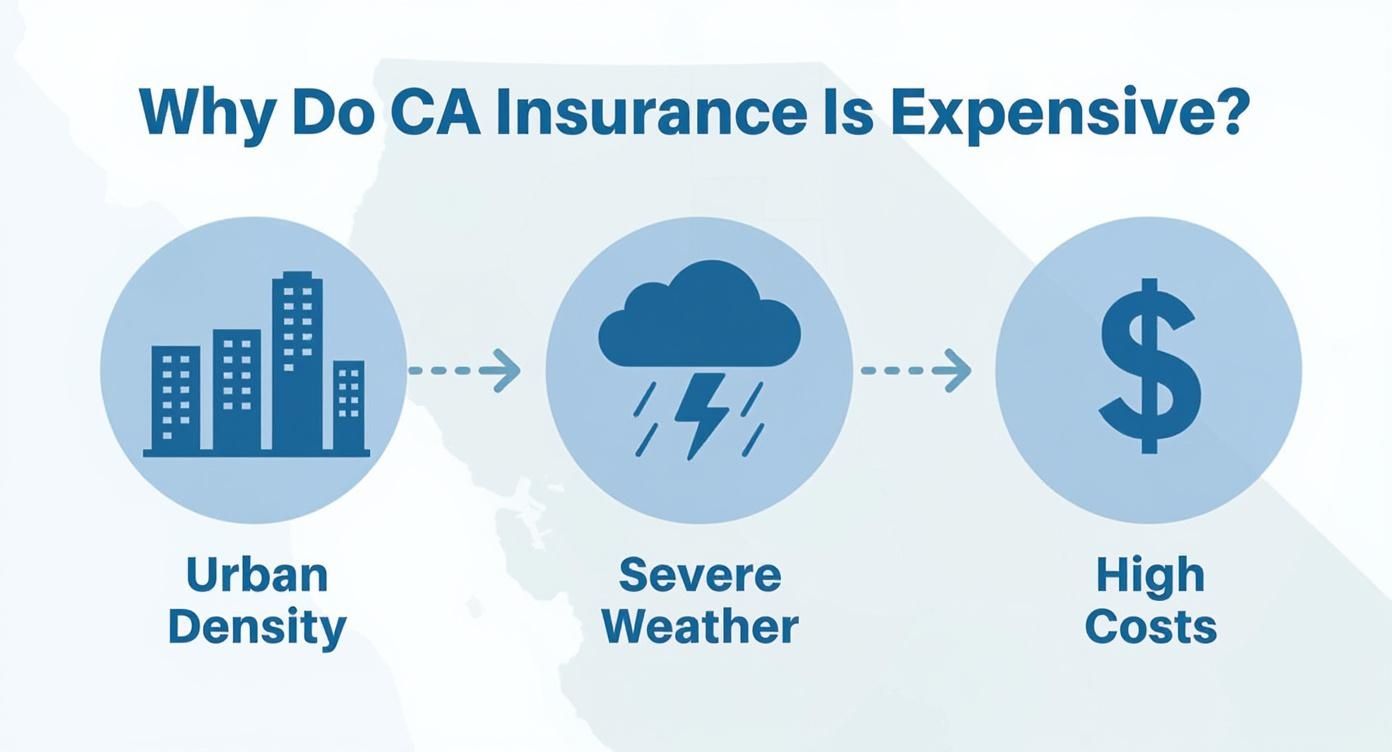
As the infographic shows, these environmental and economic pressures in the state lead directly to more expensive insurance claims, which ultimately trickles down to the price you pay for auto insurance, home insurance, and other policies.
A Deeper Look at Top Affordable Carriers
The monthly premium is just one piece of the puzzle. You also have to think about what happens when you actually need to use your insurance. How is their customer service? Is their claims process a nightmare? A slightly higher premium might be a small price to pay for a company that has your back when things go wrong.
Here's a quick breakdown to help you weigh your options:
| Insurance Carrier | Best For | Key Differentiator | Potential Drawback |
|---|---|---|---|
| GEICO | Budget-conscious drivers with clean records | Extremely competitive base rates and a slick, easy-to-use digital platform. | Customer service can feel less personal than you'd get with a dedicated local agent. |
| Progressive | Drivers seeking technology-based discounts | The Snapshot telematics program can lead to big savings for safe drivers. | Rates can climb quickly for drivers with accidents or multiple violations. |
| Wawanesa | Safe drivers looking for no-frills, low-cost coverage | Often one of the absolute cheapest options in California for good drivers. | Very limited agent availability and fewer policy add-ons than the big national brands. |
| AAA | Members who value bundling and customer service | Legendary roadside assistance and powerful multi-policy discounts. | You must be a AAA member, which adds a separate annual fee to your overall cost. |
As you can see, finding the right provider is always a balancing act. For a more comprehensive overview, you can check out our complete guide to auto insurance in California for more insights.
If there's one "secret weapon" for lowering your insurance costs, it's bundling. Combining your car insurance with renters insurance, home insurance, or even an umbrella policy can unlock discounts of 15% or more, making a huge dent in your overall expenses.
Real-World Scenarios and Recommendations
Let's put this into practice with a couple of common California driver profiles.
Scenario 1: The Young Renter in San Diego
Imagine a 24-year-old with a perfect driving record who rents an apartment. For this driver, a company like GEICO or Progressive will probably offer the lowest price for a standalone auto insurance policy. By bundling in their renters insurance, they could cut that rate even further.
Scenario 2: The Homeowning Family in Sacramento
Now think about a 45-year-old couple with two cars, a clean driving history, and a house. For them, looking at carriers like AAA or State Farm is a must. The combination of a multi-car discount and a hefty home-and-auto bundle would almost certainly provide more savings than trying to insure everything separately with different home insurance and auto insurance carriers.
At the end of the day, the "cheapest" car insurance is simply the one that is best aligned with your personal situation and discount eligibility. There's no substitute for comparing quotes from several carriers that are tailored directly to you.
How Your Profile Shapes Your Insurance Premium
Trying to find the cheapest car insurance in California is a deeply personal journey. Why? Because the price you're quoted is a direct reflection of you. Insurance companies are in the business of calculating risk, and they use a whole collection of data points—everything from your driving record to your zip code—to figure out how likely you are to file a claim. This isn't some generic formula; it's a unique financial fingerprint that sets your premium.
It's entirely possible for two drivers living on the same street to get wildly different quotes for the exact same coverage. One might have a pristine record, while the other has a recent speeding ticket. That single ticket could easily tack on hundreds of dollars to their annual cost. Understanding what goes into this calculation for your California insurance is the first step to finding real savings.
Why Your California Zip Code Matters So Much
Where you park your car at night is, without a doubt, one of the biggest factors in what you'll pay for car insurance. High-density urban areas with bumper-to-bumper traffic, like Los Angeles or the Bay Area, simply have more accidents and vehicle thefts than quieter, rural parts of the state.
This geographic risk shows up clearly in the numbers. While Experian pegs the average annual cost of car insurance in California at $2,105, that figure hides some massive local variations. For example, if you live in Los Angeles, you're looking at an average annual premium of $3,066. Meanwhile, folks in less congested cities like San Diego and Bakersfield pay much less, around $1,820 to $1,829 annually. You can explore more data on California's insurance costs to see how your city compares.
The difference in premiums between California's most and least expensive zip codes can be over $1,500 per year for the same driver and vehicle. This highlights why comparing quotes is essential whenever you move, even just a few miles away.
This regional pricing doesn't just stop with your car. The same local risk factors, like crime rates and what it costs to get repairs done, also influence prices for home insurance and renters insurance. Bundling can definitely help with a discount, but your location will always be a cornerstone of the price for each policy.
Sample Annual Car Insurance Rates by California City
To see just how much location matters, here's a quick look at how premiums for a standard full coverage policy can swing from one city to another.
| City | Average Annual Full Coverage Premium | Comparison to State Average |
|---|---|---|
| Los Angeles | $3,066 | +46% |
| San Francisco | $2,450 | +16% |
| San Diego | $1,829 | -13% |
| Bakersfield | $1,820 | -14% |
| Sacramento | $2,075 | -1% |
As you can see, simply living in a major metropolitan area like L.A. can mean paying nearly 50% more than the state average, while other cities offer significant savings.
Age and Driving Experience: Your Biggest Rate Shifters
Your age and how long you’ve been behind the wheel are two other heavy hitters in your insurance profile. Insurers lean on massive amounts of data showing a clear link between age and accident rates, making it a major pricing factor for auto insurance.
Here’s a rough breakdown of how age tends to play out:
- Teen Drivers: Insuring a teenager is notoriously expensive. They lack experience and, statistically, are just more likely to get into accidents. Adding a 16-year-old to your policy can often double the premium overnight.
- Young Adults (20-25): Rates start coming down in a meaningful way around age 25, especially for drivers who manage to keep their records clean through those early years.
- Experienced Adults (30-60): This is generally the sweet spot. Drivers in this age range are seen as the safest and most experienced, so they usually get the best rates.
- Senior Drivers (70+): You might see premiums start to creep up again for older seniors, as insurers account for potential age-related changes in driving abilities.
Of course, your driving history is just as crucial. A single at-fault accident or moving violation can wipe out years of safe-driving discounts and push you into a higher-risk tier. On the flip side, keeping your record clean for three to five years is one of the surest ways to lock in the cheapest car insurance in California.
If you want to dive deeper into how insurers define these risk factors, you can check out some common terms in our insurance glossary. At the end of the day, your personal profile is the blueprint for your premium, which is why a personalized quote is the only way to know your true cost.
Practical Strategies to Lower Your Car Insurance Costs
Knowing what goes into your premium is one thing, but actually getting that number down takes a more hands-on approach. The good news? You have more control over your car insurance costs than you might realize. By making a few smart adjustments and actively looking for savings, you can cut your bill significantly without giving up the protection you really need.

This isn't about finding one magic trick; it’s about layering several proven tactics. From fine-tuning your policy details to grabbing discounts you might not even know you qualify for, every little step can add up to hundreds of dollars in savings each year. These are the practical moves that put you in charge of building a more affordable policy that still does its job.
Optimize Your Deductible and Coverage
One of the fastest ways to see an immediate drop in your premium is to raise your deductible. This is the amount you agree to pay out-of-pocket for a collision or comprehensive claim before your insurance company starts paying. Shifting it from, say, $500 to $1,000 means you're taking on a bit more of the initial financial risk, and your insurer will reward that with a lower rate.
Of course, this strategy is all about balance. You should never raise your deductible to an amount you couldn't comfortably pay at a moment's notice.
A higher deductible is a powerful tool for savings, but only if it aligns with your financial reality. A good rule of thumb is to set it no higher than what you have stashed away in an emergency fund.
Another spot to look for savings is the coverage on your older vehicles. If you're driving a car that's paid off and has a pretty low market value, paying for full collision and comprehensive coverage might not make financial sense anymore. It's possible to end up paying more in premiums over time than the car is even worth.
Unlock the Power of Bundling
In the world of California insurance, bundling is the undisputed champ of discounts. Insurers love getting more of your business, and they offer some of their best savings to customers who bring multiple policies under one roof. When you bundle your auto insurance with another policy, it's common to see discounts of 15% or more.
Think about the policies you already have or might need:
- Home Insurance: This is the most popular and often most valuable bundle. It typically gives you the biggest discount on both your home and auto policies.
- Renters Insurance: Don't own a home? You can still save. Bundling renters insurance can knock a surprising amount off your auto premium.
- Life Insurance: Some carriers will also give you a break for bundling a life insurance policy, which helps you protect your family while saving money right now.
Putting all your policies with one carrier not only lowers your total cost but also just makes life simpler. You can get a clear picture of what you could save by getting a personalized insurance quote that compares bundling options.
Hunt Down Every Available Discount
Beyond bundling, carriers offer a whole menu of discounts that many drivers simply don't know about. These are designed to reward lower-risk behavior and specific customer profiles, so it really pays to ask your agent about every single one you could be eligible for.
Some of the most common discounts that can help you find the cheapest car insurance in California include:
- Telematics Programs: If you’re a safe driver, usage-based programs that track your driving habits through a smartphone app can earn you some deep discounts.
- Safety Feature Discounts: Does your car have anti-lock brakes, airbags, or an anti-theft device? Each of these can shave a little more off your premium.
- Professional and Affinity Groups: Many insurers offer deals to members of certain alumni associations, professional organizations, or even employees of specific companies.
- Good Student Discount: Have a young driver on your policy? If they keep a "B" average or higher in school, you can qualify for a very worthwhile discount.
Don't ever assume your insurer has automatically applied every discount you deserve. Make it a habit to review your policy once a year and directly ask what new savings opportunities are on the table.
How We Find Your Best Insurance Rate
Trying to find the cheapest car insurance in California on your own can feel like a maze. You spend hours jumping from website to website, filling out the same information over and over, and you're still left wondering if you actually found the best deal. At Mai & Associates, we step in as your personal advocate to cut through that noise and find savings you might have missed.
Our advantage comes from the strong, established relationships we have with a whole network of insurance carriers. We work with the big national names you know, but also with smaller, regional insurers who often have surprisingly competitive rates specifically for California drivers. This lets us cast a wide net and get multiple companies competing for your business, which naturally helps lower the price. We do all the legwork for you.
More Than Just a Low Price
But let's be honest—the cheapest price isn't always the best value. A policy with a rock-bottom premium is useless if it leaves you financially exposed after an accident. This is where real expertise comes in. Our licensed agents know how to look past the price tag.
We dive into the fine print, comparing complex policy details side-by-side. We make sure you understand the practical differences in things like:
- Coverage Limits: Is your liability protection high enough to truly safeguard your assets, or is it just the state minimum?
- Deductibles: We'll help you find that sweet spot between a lower monthly payment and an out-of-pocket cost you can actually handle if you need to file a claim.
- Endorsements: Are there valuable add-ons, like roadside assistance or rental car coverage, that make sense for your lifestyle?
Our mission is to find where great coverage and a great price meet. We're hunting for policies that save you money without compromising the protection you need, whether it's for your auto insurance, home insurance, or life insurance.
We handle the research, the tedious comparisons, and even the back-and-forth, saving you time and giving you peace of mind. We're here to secure a cost-effective California insurance plan that fits your life and meets all legal requirements. Think of us as your trusted guide, dedicated to finding you the best possible rate.
Your California Auto Insurance Questions, Answered
Finding affordable car insurance in California raises a lot of questions. We get it. To help you feel confident in your decision, we've put together answers to some of the most common things drivers ask. Think of this as your practical guide to getting the cheapest car insurance in California without sacrificing peace of mind.
These aren't just generic answers. They're the kind of insights that come from years of helping people just like you find the right policy. Let's dive in.
What Is the Minimum Car Insurance Required in California?
California requires every driver to carry at least a basic level of liability coverage. You’ll often hear this called “15/30/5” coverage, which is the state-mandated minimum.
Here’s a simple breakdown of what those numbers mean:
- $15,000 for injury or death to one person in an accident you cause.
- $30,000 for total injuries or deaths to multiple people in that same accident.
- $5,000 for property damage, like hitting someone else's car or fence.
While this minimum coverage keeps you legal, it offers very little real-world protection. A single fender-bender in LA traffic can easily cause more than $5,000 in damage, and medical bills from even a minor accident can skyrocket past $15,000. We almost always recommend higher limits to protect your savings and assets from a lawsuit.
Is It Always More Expensive to Insure a New Car?
You’d think so, but surprisingly, not always. It’s true that a new car’s higher value means collision and comprehensive coverage will cost more. But that’s only half the equation.
Newer cars are loaded with safety features that insurance companies love.
Insurers offer some pretty hefty discounts for things like automatic emergency braking, anti-theft systems, and lane-departure warnings. These modern safety features can actually bring your premium down, sometimes even making a new car cheaper to insure than an older model that lacks them.
On the flip side, a ten-year-old car might be a popular target for thieves or lack basic safety tech, driving its insurance rates up. It really comes down to the specific make, model, and its unique risk profile.
How Often Should I Shop for New Car Insurance?
The golden rule is to shop around at least once a year, right around 30 days before your current policy renews. Insurance rates are constantly in flux, and the company that was cheapest last year might not be this year.
Beyond that annual check-in, you should get fresh quotes anytime you have a major life change. These events can totally shift your risk profile and open the door to new discounts.
Key moments to re-shop your insurance include:
- You move to a new ZIP code.
- You buy a different car.
- You get married (or divorced).
- You add a driver to your policy, especially a teenager.
- Your daily commute or annual mileage changes significantly.
Staying on top of this ensures you’re not overpaying. A few minutes of comparison shopping can save you hundreds.
Navigating California insurance for your auto, home, or life can feel overwhelming, but you don't have to tackle it alone. The licensed agents at Mai & Associates are experts at finding affordable, high-quality coverage by shopping rates from the best carriers for you. Visit us at https://cahomeauto.com to get a no-obligation quote and see how much you could save.