Cheap Car Insurance New Drivers Can Find in California

A 16-year-old driver pays an average of $7,658 a year for auto insurance, while a 30-year-old pays $2,189, a gap of 254%, according to The Zebra's 2025 teen driving report. That single comparison explains why the search for cheap car insurance for new drivers often begins with sticker shock.
California families can still reduce the bill, but the winning strategy isn't a magic discount or choosing a recognizable insurer. It's matching the driver, vehicle, coverage, household policy, and driving history to the lowest-risk setup an insurer can price. The right approach also changes depending on whether the driver is a teenager, a first-time adult, an immigrant without U.S. history, or someone who needs an SR-22.
Why Cheap Car Insurance Feels Out of Reach for New Drivers
At age 16, average annual premiums reach $6,861, then fall to $5,057 by age 19, according to The Zebra report. A 16-year-old in North Carolina pays about $3,692 annually, showing how strongly location can change the price even when the driver's age stays the same.
Insurers price expected claim risk, not fairness. Their calculation considers age, years licensed, driving record, location, vehicle, and insurance continuity. A newly licensed adult may be more cautious than a teenager, but the carrier still has little verified driving history. A 25-year-old first-time driver therefore needs different advice from a 16-year-old.
Separate the driver into the right group before requesting quotes:
- Teen drivers: Start with a household policy, then check student and driver-training discounts. Pair the teen with a conservative vehicle, not the newest or highest-powered car.
- First-time adult drivers: Request quotes using the actual age, vehicle, garaging address, and absence of prior U.S. history. Their rates can differ materially from teen pricing.
- Immigrants without U.S. records: Years of driving abroad may not receive full credit if a carrier cannot verify continuous U.S. coverage. Ask each insurer how it handles foreign licenses, records, and prior insurance.
- SR-22 drivers: The filing must connect to the policy. An ordinary low quote may not satisfy the filing requirement and may not be comparable.
Learners should also review Fast Track Driving Lessons documents before comparing California policies. The guide helps clarify insurance paperwork as a driver moves from supervised practice to a full license.
The strongest price reductions usually come from the policy structure, vehicle choice, safe driving, and uninterrupted coverage. Compare quotes, but do not expect shopping alone to erase limited experience. Set the policy up correctly first, then pursue discounts.
The insurer is not punishing youth. It is pricing an absence of verifiable history.
California Minimum Coverage Requirements Explained
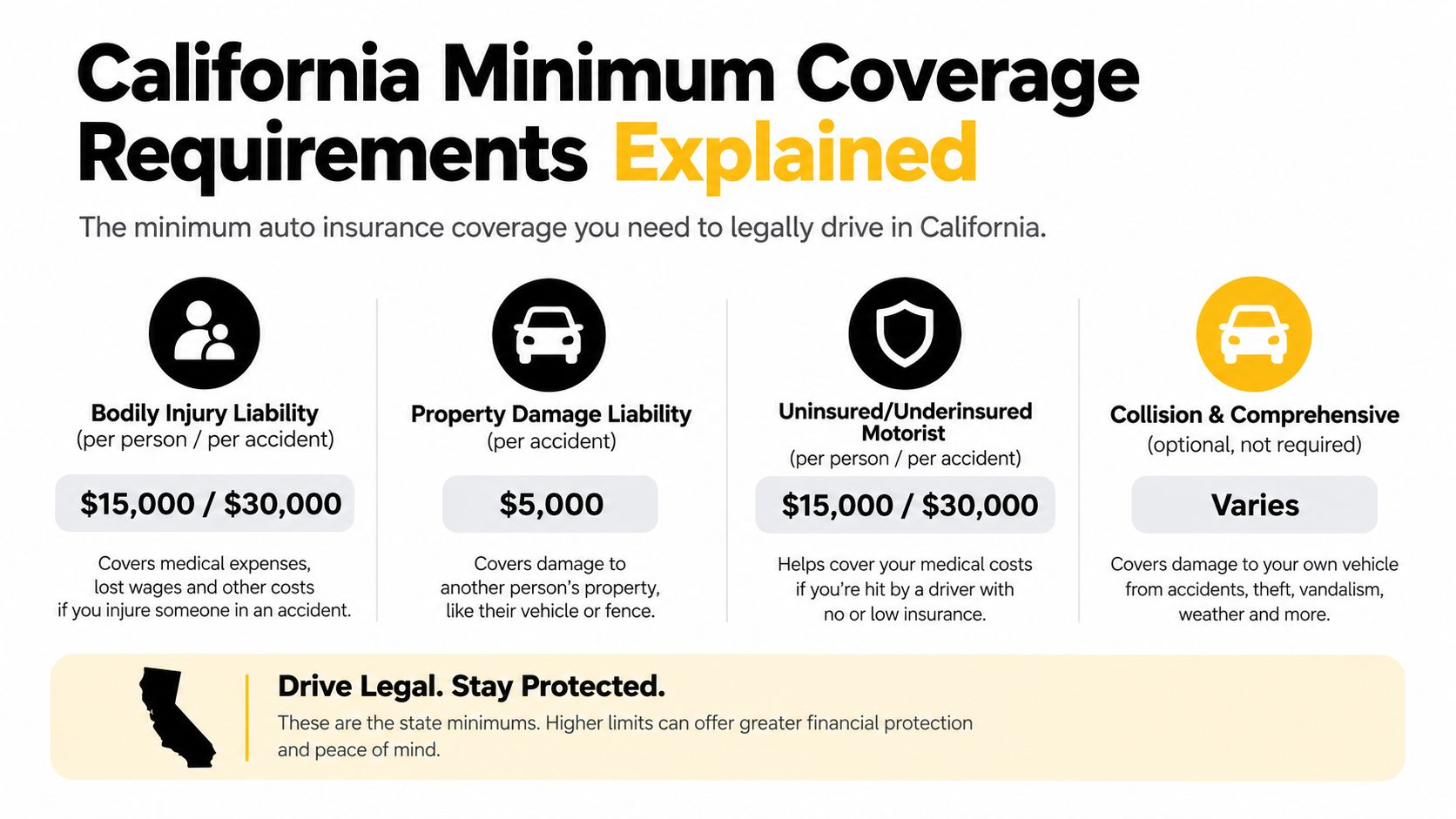
California's legal floor is straightforward. The standard minimum liability limits are $30,000 for injury or death of one person, $60,000 for injury or death of more than one person in one accident, and $15,000 for property damage, according to the California Department of Insurance's auto insurance guidance.
In plain English, the first number addresses one injured person, the second applies to multiple injured people in one accident, and the third pays for damage to another person's vehicle or property. These limits cover damage you cause to other people. They don't automatically repair your own car, pay your medical bills, or replace belongings inside the vehicle.
The legal floor isn't always a safe limit
California drivers must carry proof of financial responsibility. Driving without auto liability insurance can result in fines, license suspension, or vehicle impoundment, as the state guidance explains. A policy at the minimum level is therefore not optional protection for a new driver. It's the basic requirement for driving legally.
The problem is that a serious crash can create obligations larger than the minimum limits. If medical treatment, lost income, legal expenses, or property damage exceeds the policy limit, the driver may face personal financial exposure. New drivers often focus so heavily on finding the lowest monthly payment that they overlook this risk.
Read the practical explanation of California's new 30/60/15 insurance rules before selecting limits. Then compare the minimum policy with higher liability limits using the same vehicle and driver details. The additional premium may be reasonable, but the exact price depends on the carrier, location, record, and vehicle.
For a broader California auto insurance comparison, review California auto insurance coverage options and ask specifically what each quote pays after a serious accident.
Where SR-22 fits
An SR-22 isn't a separate insurance policy. It's a filing that confirms the driver has the required liability coverage, usually after a qualifying license or driving issue. The California Department of Motor Vehicles or a court determines when it's required.
If you need an SR-22, tell every agency before requesting quotes. A standard quote that ignores the filing requirement isn't a useful comparison. Ask about the filing process, policy eligibility, cancellation rules, and whether the policy remains valid for the vehicle you drive.
Choosing the Right Coverage Without Overpaying
The cheapest legal policy and the cheapest sensible policy aren't always the same. Liability coverage pays for damage and injuries you cause to others. Collision coverage pays for damage to your vehicle after a collision, while comprehensive coverage generally addresses non-collision losses such as theft, vandalism, fire, or certain weather-related damage.
Consider two California drivers. One owns a paid-off 2010 Toyota Corolla and could financially replace it if it were totaled. For that driver, liability-only coverage may be a rational choice if the cost of repairing or replacing the vehicle makes full coverage poor value. The driver still needs to consider the financial consequences before dropping protection.
The second driver finances a newer Honda Civic. The lender will usually require physical damage coverage, and even without that requirement, replacing a financed vehicle after a total loss can leave the driver responsible for a loan balance. Collision and full coverage make more sense in that situation because the vehicle has meaningful value and a lender's interest must be protected.
Use deductibles deliberately
A deductible is the amount you pay before the insurer contributes to a covered claim. A higher deductible can lower the premium, but it creates a larger bill after a covered loss. Don't choose a deductible you couldn't pay from available savings.
A new driver with an older car may prefer a higher deductible, or may decide that physical damage coverage isn't worthwhile at all. A driver with a financed vehicle, limited savings, or a car that would be difficult to replace may prefer more protection even if the monthly premium is higher.
Let the vehicle lead the quote
The car affects the price before the driver has made a single claim. Repair cost, theft exposure, safety equipment, replacement value, engine performance, and the way the vehicle is used all influence underwriting. A modest, unmodified vehicle is usually a better starting point for a new driver than a high-performance model or an expensive car with costly parts.
Use this rule of thumb: keep full coverage while the vehicle's value and financing obligations justify it. Reassess when the car's value has fallen enough that the premium and deductible no longer make financial sense, but don't drop coverage solely because the payment feels expensive.
You can also review broader California home and auto insurance guidance when deciding whether auto coverage should be considered alongside renters or home insurance.
Discounts and Telematics That Lower New Driver Rates
Discounts help, but they work best after the driver and vehicle are placed in the right policy. Ask the agent or carrier to check every applicable option rather than assuming the online quote includes them.
- Good student status: Students who meet an insurer's academic requirements may qualify for a lower premium.
- Driver training: An approved defensive driving or new-driver course can help, particularly for teenagers.
- Low mileage: A driver who uses the vehicle for limited trips should report that accurately instead of accepting a default commuting assumption.
- Multi-policy bundling: Combining auto insurance with renters insurance or home insurance may improve the overall household price and simplify claims management.
- Pay-in-full billing: Paying the policy in one installment may avoid some billing costs, if the household can manage the cash flow.
- Safe vehicle selection: A conservative car can reduce the starting premium before other discounts apply.
Telematics deserves a real comparison
Usage-based insurance programs use a mobile app, plug-in device, or built-in vehicle connection to evaluate driving behavior. Depending on the program, the insurer may examine signals such as acceleration, braking, mileage, time of day, and trip patterns.
The savings can be meaningful. Consumer Reports found median annual savings of $120 across telematics users, $245 for policies with younger drivers, and $145 for drivers under 45. Those figures are medians, not promises, and the result depends on the program and the driver's score.
Telematics is a strong option for someone who drives smoothly, travels limited miles, avoids late-night driving, and can maintain predictable habits. It's a poor fit for a driver who brakes hard, accelerates aggressively, drives frequently at night, or dislikes having driving behavior evaluated. A discount that disappears at renewal isn't a successful savings strategy.
Privacy concerns are legitimate. Families should read what the program collects, how it uses the information, and whether participation affects renewal pricing. Unfamiliarity also keeps some drivers from considering the option, so ask for a plain-language explanation instead of rejecting it automatically.

Before enrolling, request two prices with identical coverage. Compare the traditional quote with the usage-based quote, then choose telematics only if the driver can sustain the behavior the program rewards.
Adding a New Driver to a Family Policy
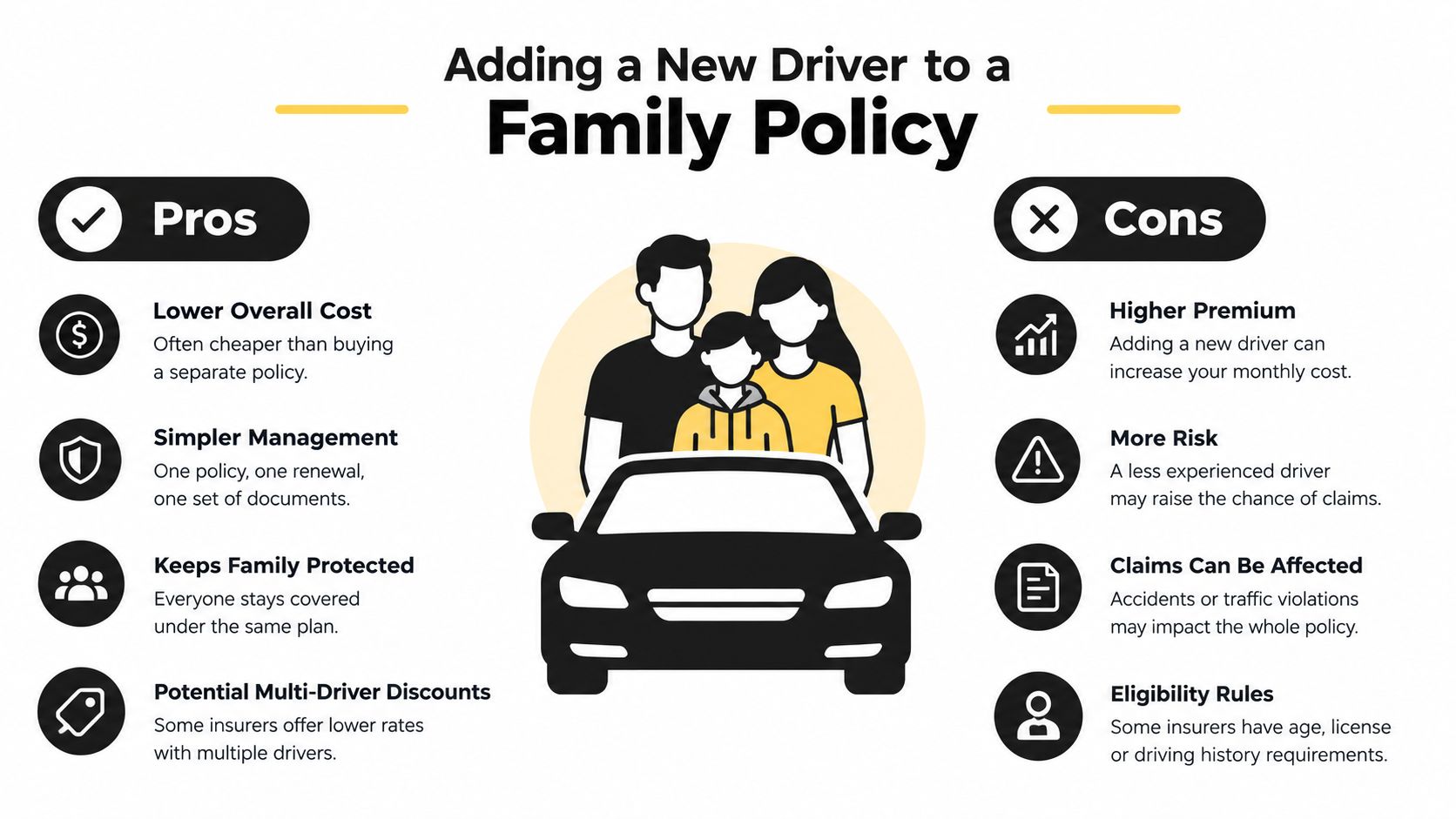
For most teenagers, joining a parent's policy is the first option I recommend. A standalone teen policy often lacks the household's existing discounts, established insurance relationship, and access to multiple vehicles. The family still needs to compare the revised policy price, because adding a new driver can re-rate the entire account.
That re-rating is the structural detail families often miss. The insurer may reassess the household's drivers, vehicles, assignments, garaging address, and usage frequency. The increase isn't limited to a line item labeled with the new driver, especially when multiple licensed drivers live at the address.
Assign the risk honestly
Tell the insurer where the vehicle is kept, who drives it most often, and whether the new driver uses it for school, work, or occasional errands. Don't list a parent as the primary driver of a car that the teenager uses regularly. That can create a coverage problem and undermine the price comparison.
The lowest-risk arrangement may involve assigning the inexperienced driver to an older vehicle rather than a newer or more expensive one. It may also involve limiting access to a vehicle, but the policy must accurately reflect actual use.
Insurers commonly want about three years of continuous U.S. driving experience and insurance coverage before materially lowering rates, according to Insurance.com's guidance for new drivers. That distinction matters for immigrants. Someone may have driven safely in another country for years, yet still be treated as new by a carrier that lacks a verifiable U.S. driving record.
Which policy route fits?
A teenager who lives with parents and drives a household vehicle will usually have the strongest case for joining the family policy. A first-time adult driver should get both comparisons, one as an added household driver and one as the named driver on a standalone policy.
The family policy may still win, but don't assume it will. An adult with a separate residence, separate vehicle, or different usage pattern may be better served by an individual policy. The correct answer depends on the complete household profile, not just the driver's age.
How to Compare Quotes the Smart Way
The cheapest insurer depends on the exact driver, vehicle, address, and coverage target. A 2026 comparison of 20-year-old drivers listed Travelers at $3,411 annually, while new adult drivers averaged about $124 per month compared with about $420 per month for teen drivers. State Farm appeared at $4,378 annually in the same comparison. A familiar brand is not automatically the least expensive choice, and a first-time adult should not use teen pricing as the only benchmark.
California location changes the calculation. Two drivers with the same age, vehicle, and limits can receive different quotes because insurers rate their garaging ZIP codes differently. A Los Angeles profile may price differently from an otherwise identical profile in San Diego. Enter the actual address and vehicle storage location, not a nearby ZIP that produces a lower estimate.
Coverage history matters too. Forbes Advisor reported that a coverage lapse can raise rates by about 17% on average, while 2026 market data showed identical new-driver profiles costing about $1,211 annually in Washington versus $5,339 in Florida with the cheapest insurer. Disclose any lapse accurately. An immigrant with years of safe driving abroad, a first-time adult with no U.S. record, and an SR-22 applicant require different quote checks from a teen joining a family policy.
Compare identical policies
Use this process:
- Prepare the profile. Gather license information, vehicle identification details, garaging address, annual mileage, driving history, current declarations page, and any filing requirements.
- Set one coverage target. Request the same liability limits, deductibles, collision and other-than-collision options, uninsured motorist coverage, and endorsements from every carrier.
- Test one variable at a time. Change the vehicle, deductible, driver assignment, telematics option, or policy structure separately. Otherwise, you will not know what changed the premium.
- Check the actual cost. Review installment fees, required filings, deductibles, exclusions, and limits instead of comparing only the advertised monthly payment.
- Recheck at renewal. The lowest quote today may not remain lowest after household details, vehicle use, or carrier pricing changes.
| Your Situation | Recommended Approach | Why It Works |
|---|---|---|
| Teen on a family policy | Price the teen on the household policy and test vehicle assignment, student, and training discounts | The household structure may cost less than a standalone teen policy |
| First-time adult driver | Compare a standalone policy with being added to a household policy | Adult pricing can differ materially from teen pricing |
| Immigrant without a U.S. driving record | Ask how foreign driving experience is evaluated and compare carriers directly | Some insurers may not credit unverifiable overseas history equally |
| Driver with a lapse | Disclose the lapse and compare carriers using the same limits | Coverage continuity affects underwriting and future re-rating |
| SR-22 case | Request quotes from carriers that handle the required filing and match the same limits | A standard quote may not satisfy the filing requirement |
Review the California auto insurance FAQ for state-specific questions before requesting quotes. The goal is not to collect every available estimate. Compare a small set of accurate, equivalent policies, then repeat the comparison before renewal.
Getting Instant Multilingual Quotes With Mai & Associates
The fastest way to turn this into a decision is to prepare the information once and have a licensed California agency compare the available policy structures. Mai & Associates serves more than 50 California cities from offices in Glendale, Westlake Village, Escondido, and Costa Mesa. The agency can compare rates from multiple top-rated carriers and provide same-day quotes.
Language can affect the quality of an insurance decision. Support is available in English, Spanish, Armenian, Russian, and Vietnamese, which helps families discuss driver assignments, deductibles, liability limits, exclusions, and household coverage without relying on guesswork or incomplete translations.
A consultative agent should do more than read back a premium. Ask the agent to identify coverage gaps, compare a family policy with a standalone policy, test vehicle assignments, review telematics, and coordinate auto insurance with renters insurance or home insurance. If the household owns property in a wildfire-prone area, the same conversation may also involve California FAIR Plan reviews, earthquake coverage options, and wildfire protection strategies. Life insurance may belong in a separate financial discussion, but families can still use the same agency relationship to review broader protection needs.
Use this checklist before contacting an agency:
- Driver profile: License date, prior driving experience, tickets, claims, and any SR-22 requirement.
- Vehicle profile: Ownership or financing status, garaging address, mileage, and regular driver.
- Coverage target: California minimum limits versus higher liability limits, plus physical damage coverage.
- Savings options: Student status, training, low mileage, pay-in-full billing, bundling, and telematics.
- Comparison method: Identical limits and deductibles across every quote.
You can submit the details through the California insurance quote request or call to discuss the situation directly. The goal is a properly matched policy, not a bare number that leaves the new driver underinsured or places inaccurate information on the application.
Mai & Associates compares California auto insurance options for new drivers, including family, standalone, telematics, renters, and home insurance combinations. Visit Mai & Associates for a no-obligation quote online or by phone, with multilingual support and same-day assistance.