Cheap California Insurance Made Simple: Your Guide to Auto, Home, and More
Finding affordable car insurance in California often feels like an uphill battle, but it's more within your reach than you might think. The trick is to understand the unique state rules that actually work in your favor and to know exactly which cost-saving levers to pull. With the right strategy for your auto insurance, you can cut your premiums down to size without giving up the protection you need. This guide will also show how bundling with home, renters, or life insurance can lead to even bigger savings on all your California insurance policies.
It’s Not Just a Myth: Affordable California Car Insurance Is Possible
Let's be honest—looking at car insurance costs in the Golden State can be intimidating. Between the legendary traffic, high repair costs, and millions of drivers sharing the road, it’s easy to think sky-high rates are just a fact of life for California insurance.
But California drivers have a powerful consumer protection law on their side that most other states don't: Proposition 103.
This game-changing, voter-approved law completely reshaped how insurance companies are allowed to set their prices. The biggest takeaway? Unlike almost everywhere else, insurers in California are banned from using your credit score to calculate your rates. Instead, they have to focus on factors you can actually control.
What Really Drives Your Car Insurance Rates in CA
Thanks to these regulations, your premium boils down to three primary factors that reflect your real-world risk as a driver. Insurers are legally required to give these the most weight.
- Your Driving Record: Nothing speaks louder than a clean record. A history free of accidents and tickets is your single most valuable tool for securing a low rate.
- Annual Miles Driven: It's simple logic: the less you're on the road, the lower your risk of getting into an accident. This almost always translates to a lower premium.
- Years of Driving Experience: More time behind the wheel suggests you've seen it all before, making you a lower risk in the eyes of an insurer.
This system puts the power back in your hands. A safe driving history has a much bigger impact on your wallet here than it does anywhere else. In fact, California is the only state where the average cost of auto insurance has actually decreased since 1989. While nationwide costs have jumped by over 43%, California’s have nudged down, largely because of these consumer-first rules.
The bottom line is clear: you are not just a number on a spreadsheet. Your actions and history as a driver are what truly matter, giving you a clear path to savings.
By focusing on safe driving and understanding how to layer on other savings—like discounts and the right coverage levels—you can absolutely find a policy that fits your budget. We'll walk you through the practical steps to lock in affordable California car insurance. We'll also show you how bundling policies (think home insurance, renters insurance, or even life insurance) can unlock even deeper discounts.
Making smart choices about your coverage is the first step toward paying less. For a deeper dive into policy options, check out our complete guide on auto insurance in California.
Why Is California Car Insurance So Expensive?
Ever open your auto insurance bill and feel a jolt of sticker shock? You’re definitely not alone. While finding affordable car insurance in California is absolutely possible, it helps to first pull back the curtain on what actually drives your rates in the Golden State. The price you pay isn't random—it's a carefully calculated number based on a unique set of statewide factors.
At its core, California's high insurance costs come down to density. We have millions of cars on the road, especially in our major cities, which dramatically increases the odds of an accident. It’s a simple numbers game.
Just picture the difference between driving through a quiet Sacramento suburb versus navigating the 405 in Los Angeles during rush hour. The risk levels are worlds apart, and your premium reflects that. This is why where you live is one of the biggest factors in what you pay. We dive deeper into this in our guide to Los Angeles auto insurance.
Claims Cost More Here
It’s not just the traffic. The cost of everything is higher in California, and that includes auto repairs and medical care. Today’s cars are packed with sensors, cameras, and complex technology, so even a minor fender-bender can rack up a surprisingly large repair bill. Insurers have to account for these inflated costs when setting their rates for California insurance.
On top of that, insurance fraud is a persistent, multi-billion-dollar problem in our state. From staged accidents to exaggerated injury claims, these fraudulent activities force insurers to build a buffer into their pricing. Unfortunately, that means honest drivers end up paying a little extra to cover the losses from fraud.
How California's Unique Rules Change the Game
California's insurance market operates under a special set of rules, largely thanks to a law called Proposition 103. This law famously banned insurers from using your credit score to calculate your premium. While that’s great for consumer protection, it forces companies to put a lot more emphasis on other factors.
Key Takeaway: Because insurers can't look at your credit, they lean heavily on three main things: your driving record, how many miles you drive each year, and your ZIP code. This is exactly why moving just a few miles can sometimes cause a huge swing in your insurance rate.
These regulations put you, the driver, in the driver's seat. Your personal driving habits are the single most powerful tool you have for locking in a lower rate. A clean record is truly your golden ticket.
This intense focus on driving history and location helps explain why full coverage auto insurance in California often costs more—about 16 percent above the national average, in fact. When you consider that drivers in L.A. and San Francisco can spend over 100 extra hours a year stuck in traffic, the higher risk and resulting cost start to make a lot more sense. You can see more data on California's average car insurance costs on Experian.com.
One of the Best Ways to Save? Bundling.
Since California insurers are so focused on a few key rating factors, finding other ways to save money is crucial. This is where bundling your policies becomes a game-changer.
When you purchase your auto insurance from the same company that provides your home insurance or renters insurance, carriers see you as a lower-risk, more loyal customer. They’ll often reward you with a significant discount that can make a real dent in your total insurance bill. It’s one of the simplest and most effective strategies for pushing back against California's high base rates.
Now that you understand what drives the costs, you're in a much better position to find the savings you deserve.
Actionable Strategies To Lower Your Insurance Premiums
Knowing why California car insurance costs what it does is a good start, but learning how to take control and actually lower your bill—that's where the real power is. You never have to accept the first quote you get. Instead, let's walk through some proven strategies to find affordable auto insurance in California without giving up the protection you truly need.
The key is to be proactive and informed. From hunting down every last discount to making smart tweaks to your coverage, even small adjustments can add up to big savings. It’s all about making your policy work smarter for you.
Maximize Every Discount You Deserve
Insurance companies have a whole menu of discounts, but they don't always hand them out unless you ask. It’s on you to make sure you’re getting credit for all the ways you’re a safe, low-risk driver.
The biggest one by far is the Good Driver Discount. This is a cornerstone of California insurance law, and if you qualify, it can slash your premium by 20% or more right off the top.
But don't stop there. The opportunities to save multiply fast once you know what to look for:
- Multi-Policy Bundles: This is probably the easiest and most effective way to save. When you combine your auto insurance with your home insurance, renters insurance, or even life insurance through the same company, you can unlock some serious savings. Insurers love the loyalty and reward you for it.
- Good Student Discount: Got a young driver on your policy who’s hitting the books? If they maintain a "B" average or better in high school or college, you can often get a discount of up to 15%.
- Anti-Theft Devices: Factory-installed alarms, tracking systems like LoJack, or even a simple VIN etching on your windows can make your car a less appealing target for thieves. Your reward is a small but well-deserved discount.
- Defensive Driving Courses: Completing an approved defensive driving course can sometimes trim your premium. This is especially useful for mature drivers or anyone looking to clear a point from their record.
Don't be shy. Ask your agent to run a full discount review on your policy—you might be surprised by what you’ve been missing.
Remember, discounts are cumulative. A Good Driver discount combined with a multi-policy bundle and a good student credit can dramatically reduce your overall premium. Stacking these savings is the secret to getting the best possible rate.
Finding all the discounts you're eligible for can feel like a treasure hunt. To give you a head start, here’s a breakdown of some of the most common discounts available to California drivers.
Common California Auto Insurance Discounts
| Discount Type | Potential Savings | How to Qualify |
|---|---|---|
| Good Driver | 20% or more | Maintain a clean driving record for at least three years (no more than one point). |
| Multi-Policy (Bundle) | 5% - 25% | Insure your car along with your home, renters, or life insurance with the same company. |
| Good Student | 5% - 15% | Have a driver under 25 on the policy who maintains a "B" average or better. |
| Multi-Car | 10% - 25% | Insure more than one vehicle on the same policy. |
| Anti-Theft Device | 5% - 15% | Have a factory-installed alarm, passive disabling device, or a vehicle recovery system. |
| Defensive Driving Course | 5% - 10% | Complete a state-approved defensive driving course (often for mature or teen drivers). |
| Low Mileage | Varies | Drive fewer miles than the annual average (typically under 7,500-10,000 miles/year). |
| Professional/Affinity Group | Varies | Be a member of certain alumni associations, professional organizations, or employer groups. |
This isn't an exhaustive list, but it covers the heavy hitters. Always ask your insurance agent if there are any other specific discounts you might qualify for based on your unique situation.
Smartly Optimize Your Coverage Levels
While having bulletproof protection sounds great, not everyone needs every single coverage option, especially if you're driving an older, paid-off car. This is where you can make some strategic cuts without leaving yourself dangerously exposed. The most common place to make an adjustment is with your physical damage coverage.
Collision Coverage is what pays to fix your own car after an accident you cause. Comprehensive Coverage handles just about everything else, like theft, vandalism, fire, or hitting a deer.
Here's a simple rule of thumb: if your car's value is getting low, paying for full coverage might not make financial sense anymore.
For example, say your car is worth $3,000 and you have a $1,000 deductible. The most your insurer will ever pay out is $2,000. If the annual cost for comprehensive and collision is $800, you're paying a huge chunk of the car's value just for that coverage. In that case, you might consider dropping it and "self-insuring" that risk by setting aside some savings for potential repairs.
Another powerful lever you can pull is your deductible. By raising your deductible from, say, $500 to $1,000, you’re telling the insurance company you're willing to handle a bit more of the upfront cost if you file a claim. In return, they'll lower your premium. Just make absolutely sure you have that higher deductible amount available in your emergency fund.
Leverage Your Driving Habits for Savings
Thanks to modern technology, your good driving habits can translate directly into real savings. Many major insurers now offer telematics programs, also known as usage-based insurance. These programs use a smartphone app or a small device you plug into your car to track how you drive.
They typically monitor factors like:
- Hard braking
- Rapid acceleration
- The time of day you drive (avoiding late nights is a plus)
- Total mileage
By consistently showing you're a safe, responsible driver, you can earn discounts based on your actual, real-world habits. This is a game-changer for people who work from home or don't put a lot of miles on their car, as it provides concrete proof to the insurer that your risk is lower than average.
For drivers looking for more ways to save, our team has assembled various resources. You can explore more strategies by checking out our collection of helpful insurance guides that cover everything from policy basics to advanced cost-cutting techniques. Taking these actionable steps puts you in firm control, turning the quest for affordable California car insurance from a challenge into a manageable and rewarding process.
Getting Covered with California's Low Cost Auto Insurance Program
For a lot of folks in California, the price of car insurance is more than just another bill—it's a real financial barrier. When standard policies seem completely out of reach, it can feel like you're stuck. But driving uninsured is never the answer.
That's where California's Low Cost Auto Insurance (CLCA) program comes in. Think of it as a lifeline from the state, created specifically to give income-eligible drivers a way to get the essential coverage they need to be legal on the road.
This isn't some watered-down, third-party plan; it's a legitimate, state-sponsored program. It provides the basic liability coverage required by California law, making sure you're financially protected if you're at fault in an accident. While it won't cover your own car's repairs, it’s a game-changer for drivers who might otherwise be forced to risk it all.
Could You Be Eligible?
The CLCA has some clear-cut rules to make sure the program helps the people it was designed for: low-income drivers with a solid track record behind the wheel.
You’ll need to tick a few boxes to qualify:
- Income Limits: Your household income has to be below a certain level, which is tied to the Federal Poverty Level. These numbers can change, so you'll want to check the most current guidelines.
- Vehicle Value: The car you’re insuring can’t be worth more than $25,000. This keeps the focus on drivers with more modest vehicles.
- Driving Record: A good driving history is a must. Generally, this means no more than one point on your record over the last three years and no serious violations.
- Age and License: You need to be at least 16 years old with a valid California driver’s license.
The whole point of the CLCA is to make basic auto insurance accessible. By looking at income and driving history, it creates a fair shot for those who truly need a more affordable option.
This is especially critical here in California. A federal study found that car insurance in our state eats up a bigger chunk of people's income compared to the national average. This financial squeeze is felt most in many low- and moderate-income communities. You can dig into the full report on insurance affordability from the U.S. Treasury if you're curious.
What Kind of Coverage Do You Get?
It’s really important to understand that the CLCA policy is a basic one. It's designed to meet the state's minimum liability requirements—meaning it covers damage you might cause to others, not to your own car.
Here’s what the standard policy includes:
- $10,000 for injury or death to one person
- $20,000 for total injury or death per accident
- $3,000 for property damage you cause
This chart helps visualize where a program like the CLCA fits into the big picture of finding cheap auto insurance in California.
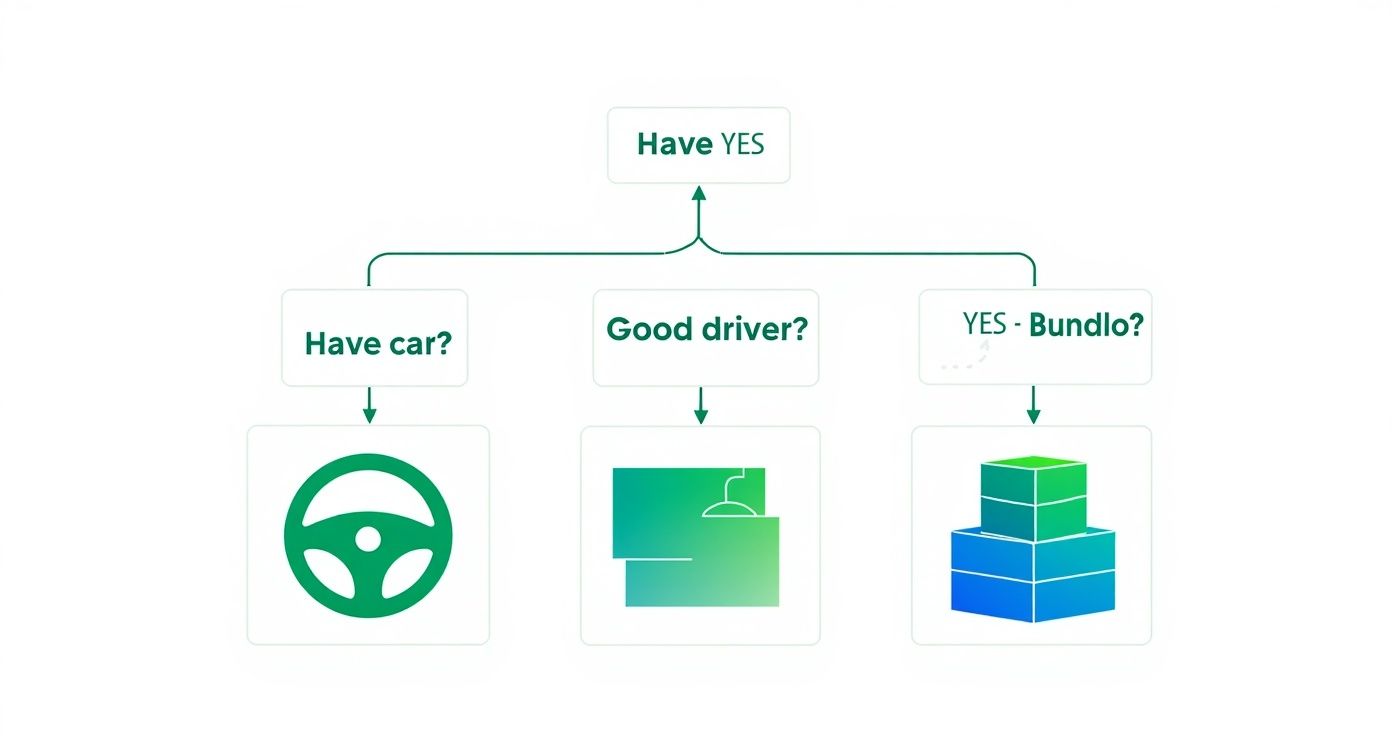
As you can see, a good driving record is your first and best step toward lower rates, which also happens to be a key requirement for the CLCA.
How to Apply and Get Your Policy
Applying for the CLCA program is straightforward, but you have to go through the right channels. You can't just get this from any insurance company. You need to connect with a certified agent or broker who is authorized to offer these specific policies. The official CLCA website is the best place to find a list of certified pros near you.
Before you start, you'll want to get a few documents together to prove you're eligible:
- Proof of Income: Recent pay stubs or your latest tax return will work.
- Vehicle Registration: Your current California registration for the car you want to insure.
- Driver's License: A valid California license for every driver you plan to list on the policy.
Once you have your paperwork in order, reach out to a certified agent. They'll walk you through the application, confirm you meet the criteria, and get you set up with a policy. For many drivers, this program is the most direct path to getting legal and finding genuinely cheap car insurance in California.
How To Compare Quotes And Choose The Right Policy

Getting a bunch of car insurance quotes is the easy part. Now comes the real work: figuring out which one is actually the right fit for you. It’s tempting to just grab the one with the lowest price, but that’s often a mistake. A cheap premium can hide serious gaps in coverage, leaving you on the hook for a massive bill after an accident.
To find the best value, you have to compare your options like a pro. The most critical step? Making sure you're doing an "apples-to-apples" comparison. This means every single quote you look at needs to have the exact same coverage limits and deductibles. If one quote has a $500 deductible and another has a $1,000 deductible, the second one will always look cheaper, but you’re not comparing the same level of protection.
Decoding Your Policy Options
When you get a quote, you'll see a breakdown of coverages on what’s usually called a "declarations page." It can look like a wall of confusing jargon, but you only need to understand a few key terms to know what you’re actually buying.
Here's a quick rundown of the most important parts of any California car insurance policy:
- Bodily Injury Liability: This is the heart of your policy. It covers medical bills and lost wages for other people if you cause an accident. California’s legal minimum was recently bumped up to $30,000 per person and $60,000 per accident, but I almost always recommend higher limits for better financial protection.
- Property Damage Liability: This pays to fix or replace someone else’s car or property—think fences, mailboxes, you name it—that you damage in a crash. The state minimum is $15,000, which can disappear in a flash if you hit a newer vehicle.
- Uninsured/Underinsured Motorist (UM/UIM): Think of this as your personal safety net. It protects you and your passengers if you’re hit by a driver who has no insurance or not enough to cover your medical costs. It’s an optional but highly recommended coverage.
Just meeting the state minimums keeps you legal, but a serious accident can easily blow past those limits, leaving you personally responsible for the rest. That’s why many California drivers wisely opt for higher liability coverage, like $100,000/$300,000, for real peace of mind.
Vetting The Insurance Company
The price of a policy means absolutely nothing if the company behind it is a nightmare to deal with when you need them most. Before you sign anything, spend a few minutes checking out the insurer's reputation.
A great rate from a bad company is a terrible deal. Your goal is to find an affordable policy from a carrier that will be there for you when you actually need to file a claim.
A fantastic, unbiased resource for this is the California Department of Insurance (CDI). They publish consumer complaint data showing which companies get the most complaints relative to their size. A low complaint ratio is usually a good sign that they treat their customers fairly.
Look Beyond The Price Tag
When you're making your final choice, consider the whole package. Does the company have a good mobile app for managing your policy or filing claims? Do they have local agents you can talk to for real, personalized advice?
This is also the perfect time to think about bundling. If you have home insurance or renters insurance, asking that same company for an auto insurance quote can unlock some serious savings. Some carriers even offer discounts for bundling with life insurance. This strategy not only simplifies your finances but is one of the most effective ways to get cheap auto insurance in California without compromising on quality.
Ultimately, choosing the right policy is all about balancing cost, coverage, and your confidence in the insurer.
Ready for a Quote? See How Mai & Associates Can Help
You’ve done the homework. You know what drives California insurance rates, what discounts to look for, and how to fine-tune your coverage. Now it’s time to put that knowledge to work and see what you can actually save.
The fastest way to do that? Let a pro handle the shopping. Instead of you spending hours plugging your information into a dozen different websites, our team at Mai & Associates can do the heavy lifting for you. We specialize in delivering same-day quotes from a whole network of insurance carriers, laying out all your best options in one easy-to-understand comparison. It’s all about finding that sweet spot between solid protection and a price that fits your budget.
We’re Your Neighbors in California
Insurance is personal. It's about protecting your car, your home, and your family. That’s why we have local offices staffed with licensed agents who are part of your community. We get it. And because California is home to so many different cultures, we proudly offer multilingual support to make sure you get clear, straightforward advice you can trust.
Our expertise doesn't stop at auto insurance, either. We can help you build a complete protection plan that covers all the important things in your life.
- Home Insurance: We’ll help you safeguard your biggest investment, especially with California’s unique risks like wildfires and earthquakes in mind.
- Renters Insurance: Protect your personal property and liability if you’re renting an apartment or house.
- Life Insurance: Create a financial safety net to ensure your loved ones are taken care of, no matter what.
Pro-Tip: Bundling is one of the easiest ways to get a major discount. Combining your auto and home policies, for instance, can often lead to significant savings on both. We’ll automatically check for these opportunities for you.
Don't guess about your coverage or keep overpaying for a policy that isn't the best fit. Let our team run a free, no-pressure comparison tailored specifically for you.
See what you can save. Get a personalized insurance quote online today and lock in the peace of mind you deserve.
Your California Auto Insurance Questions, Answered
Let's be honest, insurance can be confusing. To help clear things up, here are some straightforward answers to the questions we hear most often from California drivers.
What’s the Bare Minimum Insurance I Need to Drive in California?
As of 2025, California bumped up its minimum liability requirements. To drive legally, you now need a policy that covers at least 30/60/15.
So, what does that actually mean?
- $30,000 for injury or death to one person in an accident you cause.
- $60,000 for total injury or death to everyone involved in that single accident.
- $15,000 for damage you cause to someone else’s property (like their car, a fence, etc.).
Keep in mind, these are just the state-mandated minimums. A serious accident can easily blow past these limits, leaving you personally on the hook for the rest. That's why most insurance experts, myself included, strongly suggest getting higher limits for real-world financial protection.
Does My ZIP Code Really Change My Car Insurance Rate That Much?
Absolutely. Where you live and park your car is a huge piece of the insurance pricing puzzle, especially when you're looking for cheap auto insurance in California.
Insurance companies look at hyper-local data for things like theft rates, vandalism, and the number of accidents in a given area. A driver in a busy part of Los Angeles with heavy traffic and higher crime stats will almost always face higher premiums than someone living in a sleepy, rural town.
It's wild, but even moving just one ZIP code over can sometimes change your rate noticeably. Insurers are looking at claims history street by street, not just city by city.
Can I Still Get Insurance in California if My Driving Record Isn't Great?
Yes, you can, but it’s going to cost you more. A record with at-fault accidents, DUIs, or a handful of speeding tickets flags you as a high-risk driver.
Some standard insurance carriers might turn you down, but there are others that specialize in what’s called non-standard or high-risk car insurance. The best thing you can do is focus on driving safely from here on out. Once you keep your record clean for three to five years, you'll see your rates start to come down significantly.
Finding that sweet spot between solid coverage and a price you can afford is what it's all about. At Mai & Associates, we take the hassle out of it by shopping the market for you, comparing rates for your auto, home, renters, and life insurance policies.
Get a free, no-pressure quote today and see what we can find for you at https://cahomeauto.com.
Article created using Outrank