Car Oil Leak Causes, Diagnosis, and Insurance Implications
You walk out to the driveway, coffee in hand, and there it is, a dark spot under the car that wasn't there yesterday. Maybe it's a small stain. Maybe it's a fresh puddle. Either way, a car oil leak is not something to shrug off, because the problem is never just the mess on the concrete. It can turn into engine damage, a failed inspection, a driveway liability, and, in California, a coverage headache if you ignore it long enough.
The smartest move is to treat the leak as both a mechanical issue and a financial one. If you want a quick outside reference on auto repair for oil leaks, use it as a sanity check, not as a reason to delay. The job is to figure out where the oil is coming from, whether the car is safe to drive, and whether the damage is starting to cross into insurance territory.
Why That Oil Puddle Under Your Car Demands Attention
A driver notices a stain on Sunday night, wipes it with a paper towel, and decides to “watch it.” By Tuesday, the smell is stronger, the dipstick is lower, and the engine is running hotter than usual. That's how a small leak becomes a real repair bill.
The first mistake is treating oil like it's harmless as long as the car still starts. Oil is the fluid that keeps moving parts alive, and when it escapes, it doesn't politely stop at the ground. It can coat hot parts, drip onto belts, and spread across undertrays where it hides until the problem gets worse.
Practical rule: if the spot is fresh, keep the car parked until you know whether the leak is active and where it's coming from.
In California, this matters beyond the driveway. A leaking car can stain a garage floor, leave residue on a rental property parking area, or create a slippery surface for you, your family, or a guest. If the leak is ignored long enough, the cost stops being just a repair and becomes a chain of avoidable losses.
That's why a car oil leak deserves fast attention, not optimism. You're trying to prevent engine failure, protect your property, and avoid the kind of maintenance dispute that insurance companies don't like. A good repair shop can diagnose the source, but you need the right frame of mind before you hand over the keys.
For a broader maintenance-and-coverage perspective, the discussion on California home and auto protection topics is useful because car problems rarely stay confined to the car. If oil is already pooling where you park, the question isn't whether the stain looks small. The question is how much more expensive it gets if you do nothing.
Common Causes of a Car Oil Leak
Oil leaks usually start with a failed sealing component, not with the oil itself. The problem is almost always a gasket, seal, plug, or hose connection that has aged, loosened, or cracked. That is the part you should target first, because chasing the fluid without finding the failure wastes time and money.
Match the leak location to the likely failure
Location matters because oil often shows up near the part that failed first, even if it drips somewhere else later. Under the engine, the usual suspects are the oil pan gasket or drain plug. Oil higher up on the engine points more toward a valve cover gasket. Oil near the gearbox bell housing often suggests a rear crankshaft seal, while oil around the drive pulleys can indicate a front crankshaft seal. The AA's location-based guidance is useful here, because it ties the visible drip pattern to the part most likely responsible instead of forcing you to guess. The AA's leak-location guide is one of the clearest examples of that mapping.
A leak can also come from the filter housing, drain plug, or oil cooler lines, especially if the oil seems to start near the front or bottom edge of the engine. A broad service summary lists those as common leak points and notes that leaks can begin near the top, bottom, front, or rear of the engine, which is why location beats guesswork. DriveQuip's overview of common leak points makes that mechanical point clearly.
Don't miss the PCV system
The part many drivers skip is the PCV system, and that is a mistake. If crankcase ventilation is blocked, internal pressure builds and can push oil past seals that are still physically intact. One technical source ties crankcase pressure above 1.2 psi to oil being forced past seals and notes that a leak can be misdiagnosed as a main seal problem when the underlying issue is pressure blow-by. Automotoflux's PCV explanation is direct about that failure pattern.
If a shop replaces a seal and the leak comes back fast, push hard on the PCV, breather, and hose condition before approving more parts. A seal change without pressure correction usually means you are paying for the same repair twice.
California drivers should also think beyond the repair bay. A leak can stain a driveway, damage a garage floor, or create a slip hazard in an apartment lot, and those problems can turn into a maintenance dispute long before an insurer cares about the engine itself. For that wider homeowner and auto angle, the guidance at California home and auto protection topics is worth a look because car damage rarely stays limited to the car.
For a shop-level diagnostic lens, Smog check diagnostic services is a useful reminder that proper diagnosis matters more than throwing parts at the symptom. Oil leaks punish lazy guessing.
How to Diagnose an Oil Leak Step by Step
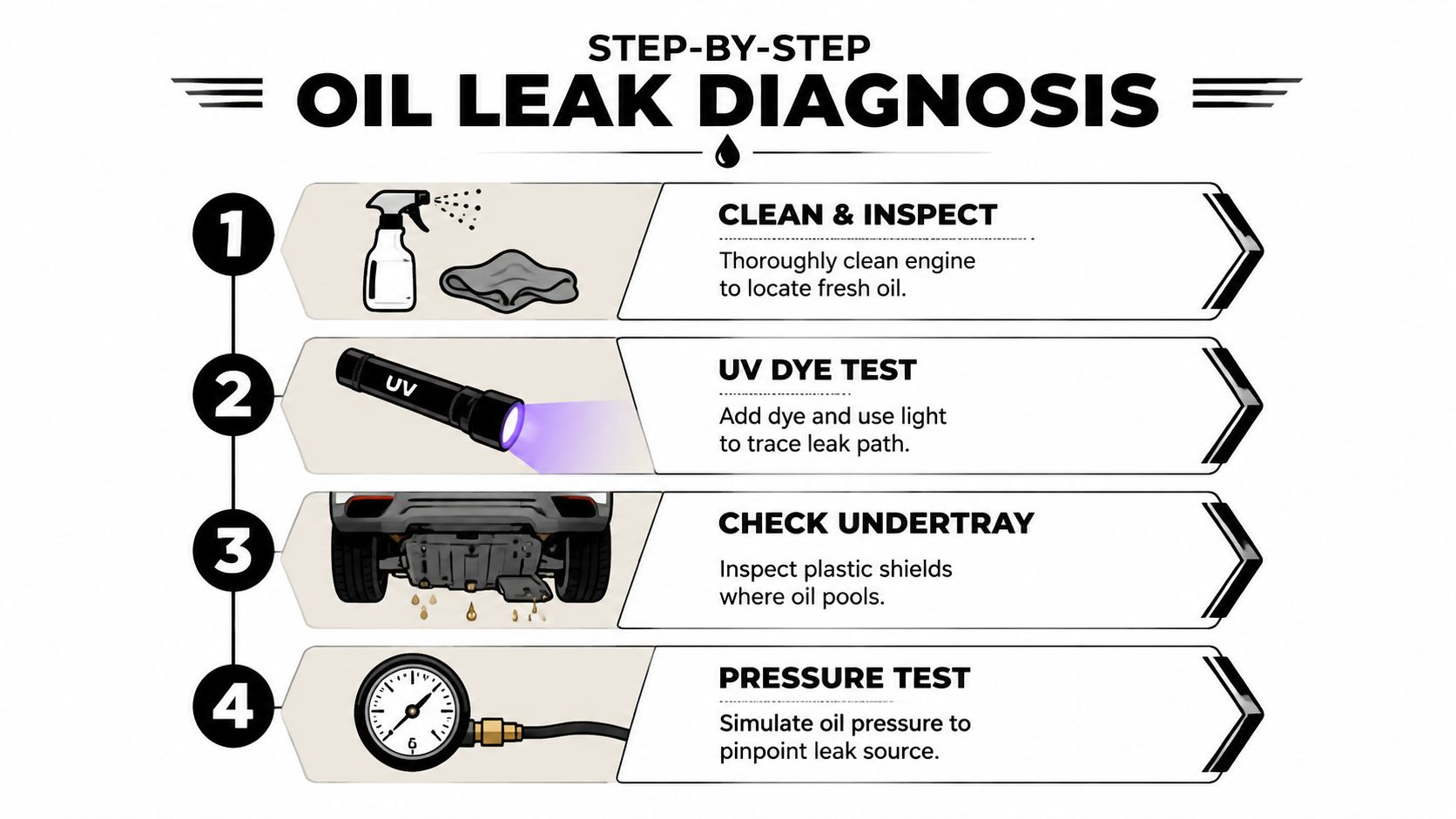
Open the hood with one goal in mind, find the first place oil is escaping. A puddle on the ground is only the final stop. Modern cars hide leaks behind splash shields, plastic covers, turbo plumbing, and tight engine bays, so the stain below the car can point you in the wrong direction if you stop too early.
Clean first, then look for the first wet point
Clean the engine and the underside as well as you can, then drive a short distance and inspect it again. The point is to find the highest fresh wet point, because that is usually much closer to the actual failure than the floor stain. If you follow the drip downward, you can easily accuse the wrong gasket and waste money on parts that were never the problem.
UV dye or powder is the next move when the source still isn't obvious. Use it to trace the leak upward from the newest wet area, not to admire the mess. If oil is collecting on a shield, belt cover, or subframe before it drips, the undertray may be hiding the original source.
Watch for slope-dependent leaks
A lot of drivers get misled when the car leaks only after parking on a slope. That usually means the oil is pooling differently, or the seal is shifting just enough for a weak point to show itself. The parked angle does not create a new problem, it exposes one that is already there.
Oil that appears only nose-up or nose-down is still a real leak. Gravity is just making the weak point easier to see.
That matters in cities, apartment complexes, and steep driveways across California. A car that looks dry on level pavement can leave a stain as soon as it is parked at an incline. If that is your situation, do not let anyone dismiss it as “normal seepage.”
If the leak is still unclear after a clean-and-check cycle, ask the shop to show you the first fresh wet point before they replace anything. That is where the money stays in your pocket. Guessing is expensive, and on newer vehicles, a small leak can travel a long way before it hits the ground.
A proper diagnosis also protects your paper trail. If you want a cleaner record of what was checked and why a repair was approved, the guidance at California home and auto protection topics is useful because maintenance decisions can affect more than the engine itself.
The Smog check diagnostic services reminder applies here too. Good diagnosis beats guesswork every time, especially when an oil leak is hiding under covers and shields.
Temporary Fixes Versus Professional Repair
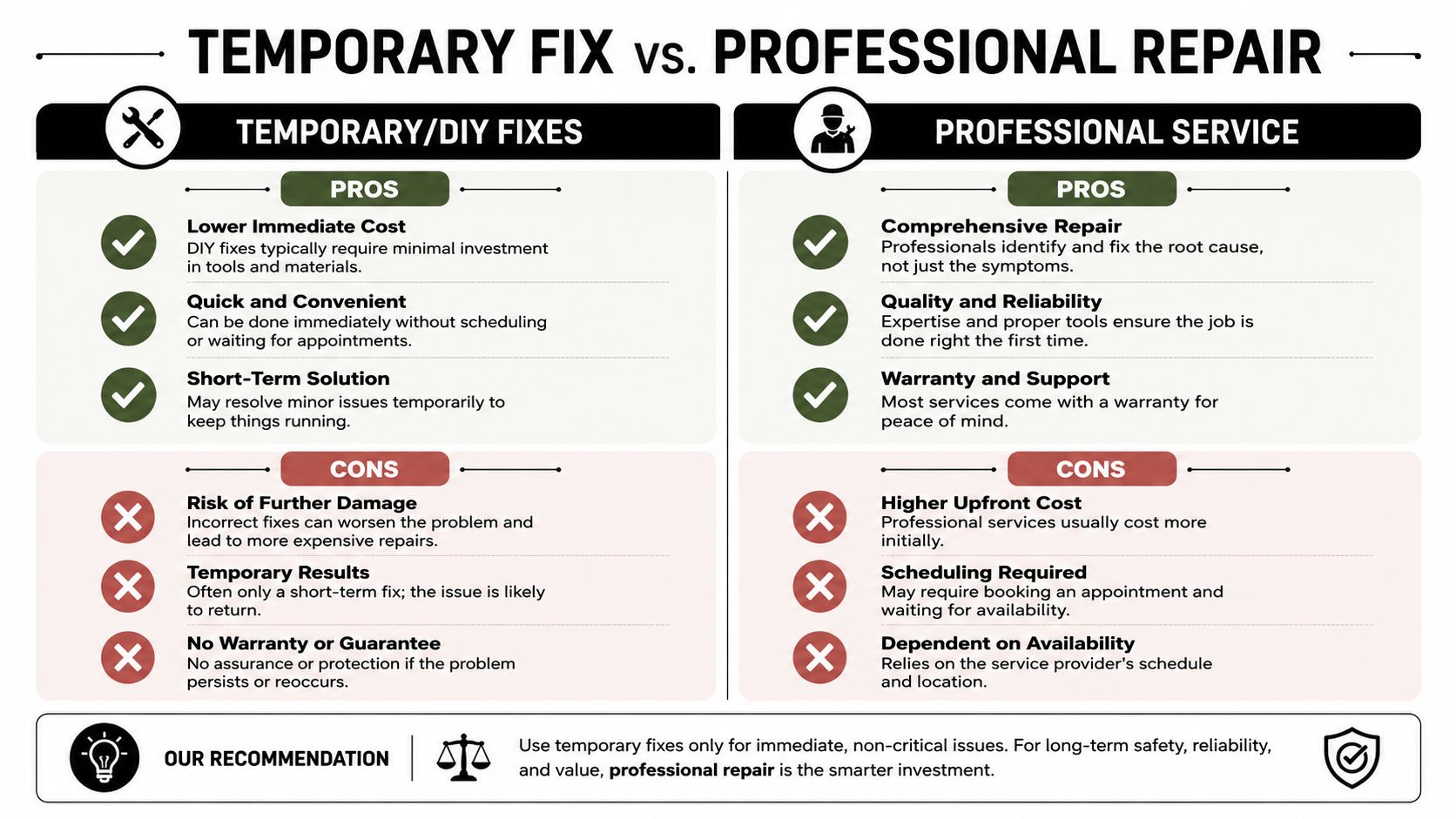
A bottle of stop-leak additive can buy time, but it won't erase a bad seal or a blocked PCV system. I'm fine with temporary measures if the goal is to get the car safely to a shop. I'm not fine with pretending a temporary fix is a repair.
What a stopgap can and can't do
Temporary fixes make sense when you need to move the car a short distance or wait for an appointment. They do not make sense when the leak is active, spreading, or coming back right after a repair. If the leak is caused by pressure buildup, the additive may mask the symptom while the underlying problem persists.
DIY gasket work can also go wrong fast. Over-tightening a drain plug, using the wrong sealant, or disturbing parts without understanding the torque sequence can turn a manageable leak into a bigger one. That's especially true on modern engines where access is tight and one bad move creates more labor later.
When professional repair is the only sensible choice
Professional repair makes sense when the leak involves a rear main seal, a front crank seal, or anything tied to major disassembly. Those jobs are not weekend projects for most drivers. They also require the technician to confirm the root cause, not just replace the wet-looking part.
Here's the practical filter I use:
- Minor external seepage: Get it inspected, monitor it, and repair it before it gets worse.
- Active dripping: Don't wait. Schedule the fix and keep the receipts.
- Repeat leak after repair: Push for a root-cause check, especially the PCV path and surrounding seals.
- Leak plus smoke, burning smell, or oil loss: Stop driving and get it handled immediately.
A complex repair costs more upfront, but false economy is worse. A cheap patch that fails in two weeks costs more than a proper job done once. That's the part drivers regret when they're standing at the service counter a second time.
How Oil Leaks Intersect with California Auto Insurance
A car oil leak starts as a maintenance problem, but it can turn into an insurance headache fast if you ignore it. California auto insurance is built for sudden losses, not for damage that grows because the owner kept driving with a known problem. If an engine fails and the insurer can point to a documented leak that was never fixed, your claim position gets weaker.
Maintenance records are your protection
Keep every record. Save inspection notes, repair invoices, dated photos of the leak, and any message showing when you first reported the issue to a shop. If a claim dispute ever comes up, those records matter more than your memory of when the stain first showed up.
That becomes even more important if the leak causes damage beyond the engine itself. If oil reaches a driveway, garage floor, or someone else's property, the question shifts to what you knew and how long you let it go. If the file is reviewed by a person or moves through an automated claim workflow, clear records still help. The overview on how automation handles auto claims explains why clean documentation often makes the claim process easier to sort through.
Coverage does not replace maintenance
Do not assume your policy will cover a problem you chose to ignore. Insurance is not a substitute for maintenance, and California drivers need to treat it that way. If you know the car is leaking and keep driving anyway, you are handing the insurer a maintenance failure story.
That is the part many drivers miss. The mechanical problem and the policy problem are tied together. Fix the leak early, and you protect the engine, protect the car's value, and reduce the chance that a repair turns into a coverage dispute.
For broader policy context, California auto insurance basics helps explain why coverage works best when the owner also acts like a responsible owner. Keep your records, fix obvious problems, and do not let a known leak sit just because the car still runs.
Environmental and Safety Risks You Should Not Ignore
A leaking engine does more than stain pavement. It puts oil where it does not belong, and that creates real environmental and safety problems fast. Oil that reaches a driveway, garage floor, or street can spread into storm drains, soil, and shared surfaces before anyone notices. That is why chronic leaks deserve immediate attention, not casual monitoring.
Oil contamination is not a small cleanup issue. A slip on a slick garage floor can send someone to urgent care, and hot engine parts can turn a slow leak into a fire concern. California drivers who park at home should treat a leak as a property issue too, because stained concrete, damaged surfaces, and repeated residue can create friction with landlords, neighbors, and anyone sharing the space.
Why this matters at home
Indoor parking makes the problem harder to ignore. Oil dripping onto concrete can soak in and leave a long-lasting mark, and the residue usually keeps spreading every time the car moves. If the leak lands near exhaust components, the risk goes beyond a dirty floor.
California homeowners and renters also need to think about how property condition looks if questions come up around coverage or inspections. If you want a plain explanation of how California home and auto questions are handled, the insurance FAQ resource is a useful place to start. Oil stains will not automatically decide a policy issue, but they do show careless maintenance, and that weakens your position if a claim or review turns into a bigger dispute.
Deal with the stain before it becomes a habit
If you park in a shared driveway, apartment garage, or rental property, clean the spill right away and track down the source. Leaving the stain in place tells everyone around you that the problem is ongoing. It also invites complaints from property managers, neighbors, and anyone who has to walk or drive through the area.
A leak that keeps dripping is never just cosmetic. It means the car is losing oil, the surface is getting contaminated, and the fix has already been delayed too long.
Clean up the spill, find the leak, and repair the source. Anything less leaves you with a slippery surface, a worse maintenance problem, and a mess that can reach beyond your own parking spot.
When to Repair, When to Replace, and How to Plan Ahead
A car that still has value deserves a real repair, and it deserves it now. Let the leak sit, and you invite bigger mechanical damage, more cleanup, and a harder insurance conversation if the car ever becomes part of a claim review. Older vehicles and higher-mileage cars are especially prone to worn seals, gaskets, and hoses, so this is usually normal wear, not a mystery.
If the car is already tired in other ways, be blunt about the math. A small leak is one thing. A major seal job that requires deep teardown is another, especially if the rest of the car is already costing you money.
Use the car's value as the decision point
Start with the repair that fixes the source, not the symptom. If the job is straightforward, do it. If the leak traces back to a major seal that forces heavy disassembly, compare the estimate with the car's current value and its overall condition before you approve anything.
Get a diagnosis that names the actual failure, not just the wet area. A good shop should show you why the leak started where it did and how the oil is escaping. If one mechanic blames a valve cover gasket and another points to a timing cover without evidence, stop and ask for a clearer explanation.
Budget like a maintenance-minded owner
Keep a repair folder with dates, photos, and invoices. That record helps when you sell the car, compare shops, or answer questions from an insurer later. It also makes your maintenance history easier to prove if a dispute ever turns into a coverage issue.
For the insurance side, use the Mai & Associates guides to stay organized and keep your paperwork in order. Do not wait for a policy problem to force your hand on a mechanical issue. Fix the leak, document the repair, and keep the car from dripping money onto the pavement.