California Car Insurance Requirements Explained
In California, you can't legally get behind the wheel without carrying a certain amount of car insurance. It's not optional—it’s the law. This baseline coverage is called liability insurance, and its whole purpose is to cover the costs for other people if you cause an accident. Getting a handle on these car insurance requirements is your first and most important step to driving legally and responsibly in the Golden State, and a key piece of your overall California insurance portfolio, which may also include home insurance, renters insurance, and life insurance.
What Is the Minimum Car Insurance in California?
Think of the state's minimum insurance mandate as a financial safety net. It’s not there to protect you or fix your car, but to ensure that anyone you might accidentally injure or whose property you damage has a way to pay for their recovery. It's a fundamental rule of the road here.
While this is a legal requirement, not everyone follows the rules. A startling 1 in 7 U.S. drivers was uninsured in 2022, which shows just how crucial it is to have your own coverage in place.
The 15/30/5 Rule Explained
California's minimum liability insurance is known by a simple shorthand: the 15/30/5 rule. These numbers aren't just random; they represent specific dollar amounts your insurance company agrees to pay out if you're at fault in a crash.
Here’s a quick look at what that means in plain English.
| California Minimum Liability Insurance Requirements at a Glance |
| :--- | :--- | :--- |
| Coverage Type | Minimum Required Amount | What It Covers |
| Bodily Injury Liability (per person) | $15,000 | Pays for a single person's medical expenses if you injure them in an accident. |
| Bodily Injury Liability (per accident) | $30,000 | The total amount your policy will pay for all injuries in a single accident you cause. |
| Property Damage Liability (per accident) | $5,000 | Covers damage you cause to someone else’s property, like their car or a fence. |
These limits are the absolute bare minimum you need to drive legally. It’s important to remember this coverage is designed to pay for the other party’s bills, not your own.
The Bottom Line: The 15/30/5 rule is your ticket to legally drive on California roads. It covers damages to others when you’re at fault, but it offers zero coverage for your own car repairs or medical bills.
Putting It Into Practice
Let’s imagine a real-world scenario. You glance away for a second and cause a small fender-bender. The driver of the car you hit has some whiplash, and their bumper is crumpled.
This is where your 15/30/5 policy kicks in. The $15,000 limit is available for their doctor visits, and the $5,000 limit is there to fix their car's bumper. This basic level of auto insurance in California satisfies your legal requirement. But with today’s high costs for medical care and car repairs, you can see how quickly these minimums could be used up, potentially leaving you on the hook for the rest.
Why Minimum Coverage Puts Your Finances at Risk
Sure, California's 15/30/5 rule gets you on the road legally, but it's crucial to understand that "legal" is a long way from "financially safe." Think of the state minimum as a flimsy umbrella in a hurricane—it might technically count as rain gear, but it won’t do you much good when the storm really hits.
The reality is that these car insurance requirements are based on laws set years ago. They simply haven't kept up with the times. The cost of a new car bumper, let alone a hospital stay, has skyrocketed, leaving a huge gap between what the minimum policy covers and what an accident can actually cost you.
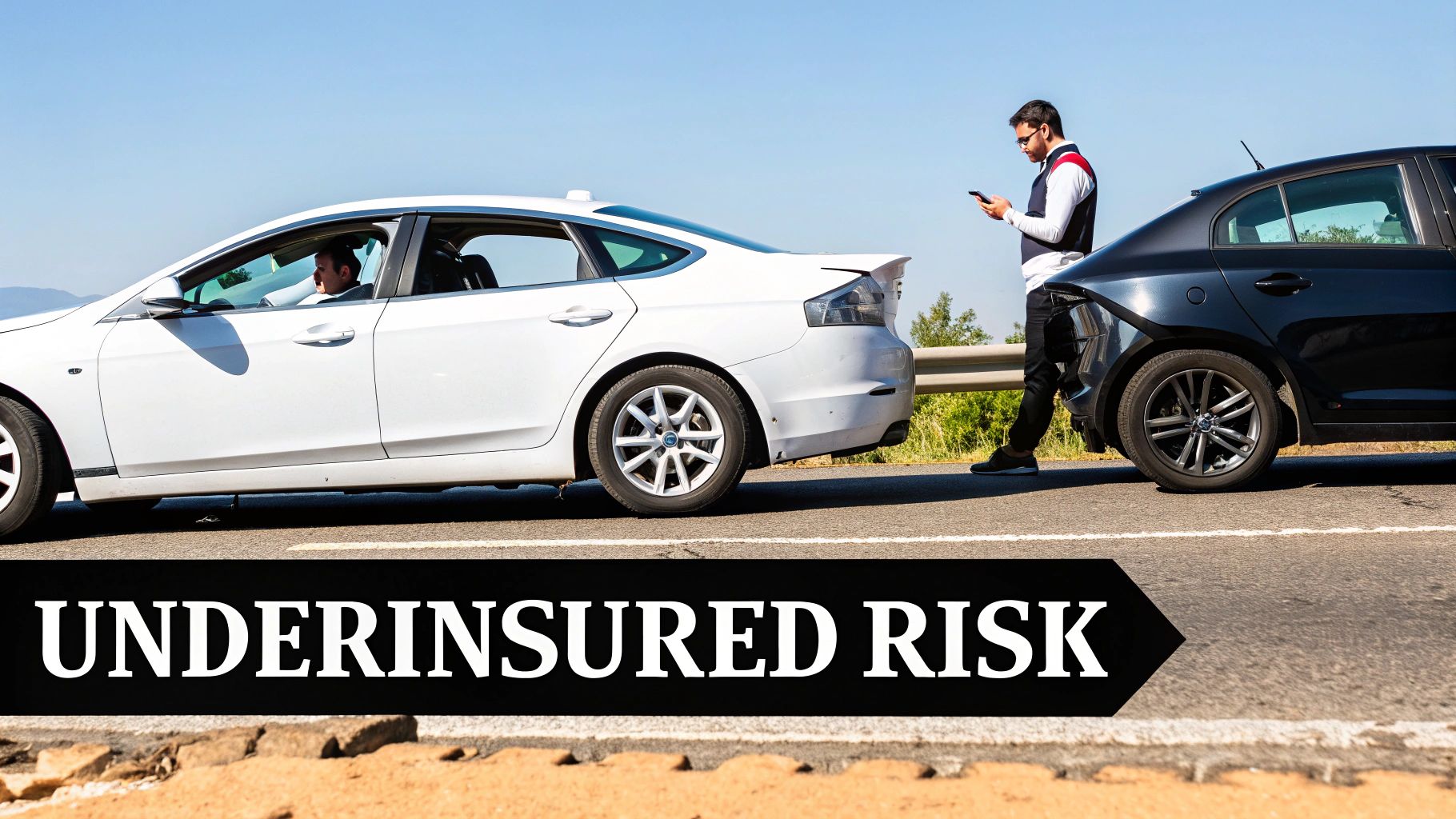
This gap is where your personal finances get dangerously exposed. If you're at fault in a crash and the damages are higher than your policy limits, you are personally on the hook for every dollar of the difference. This is what it means to be underinsured.
The High Cost of a Modern Accident
Let's look at a real-world scenario. Imagine you cause a multi-car pileup on the I-5 during rush hour. You injure two people in another car and also damage a brand-new luxury EV. The costs can spiral out of control in a hurry.
- Medical Bills: One person needs an ER visit, an MRI, and months of physical therapy, adding up to $25,000.
- Second Injury: The other person suffers a broken arm and a concussion, with medical bills hitting $18,000.
- Property Damage: That luxury EV has specialized sensors and a high-tech bumper, and the repair estimate comes back at $14,000.
In this all-too-common situation, your minimum coverage barely makes a dent. Your policy will pay its maximum of $30,000 for bodily injuries and $5,000 for property damage. That leaves a massive shortfall.
Financial Fallout at a Glance:
- Total Medical Costs: $43,000
- Your Policy's Bodily Injury Payout: $30,000
- Your Out-of-Pocket Medical Debt: $13,000
- Total Property Damage: $14,000
- Your Policy's Property Damage Payout: $5,000
- Your Out-of-Pocket Repair Debt: $9,000
Suddenly, you're on the hook for the remaining $22,000. A single accident, even when you were technically following the law, has put your entire financial stability in jeopardy.
What Happens When You Are Underinsured
If you can’t pay that $22,000 out of pocket, the other party’s attorneys will almost certainly take legal action to collect what you owe. This isn't just a minor hassle; it can have severe, long-lasting consequences for your financial life.
The courts have powerful tools to enforce a judgment against you:
- Wage Garnishment: A court can order your employer to take a chunk out of every paycheck and send it directly to the injured party until the debt is paid.
- Bank Levies: The funds in your checking and savings accounts can be frozen and seized to satisfy what you owe.
- Asset Seizure: In serious cases, a lien can be placed on your home or other property, potentially forcing a sale to cover the costs.
These outcomes can turn a simple traffic accident into a financial nightmare that follows you for years. The few dollars you might save each month on a bare-bones policy are nothing compared to the tens—or even hundreds—of thousands you could owe.
Good auto insurance isn't just about being legal. It's about building a firewall between one bad day on the road and your life savings, your home, and your family's future. Choosing higher liability limits is one of the smartest investments you can make in your own financial security.
Beyond the Basics: Other California Insurance Rules You Need to Know
Once you've got the 15/30/5 liability minimums down, you're on the right track. But California's insurance landscape has a few more corners to navigate. These rules aren't just fine print; they're designed to handle real-world situations, like the aftermath of a serious driving violation or the financial chaos caused by a driver with no insurance at all.
Getting a handle on these concepts is what separates a merely legal driver from a truly protected one. Let's break down two of the most important pieces of the puzzle: the SR-22 filing and Uninsured Motorist coverage. They solve very different problems, but both are absolutely critical for many California drivers.
What is an SR-22 Filing?
You’ve probably heard people talk about "SR-22 insurance," but that's not quite right. An SR-22 isn't an insurance policy you can buy. It's actually a certificate, a formal document your insurance company files directly with the California DMV for you.
Think of it as a form of proof on probation. The DMV requires it from drivers considered high-risk to verify they are maintaining active, state-required liability insurance. It’s the state’s way of keeping a closer eye on things.
So, who needs one? The DMV will typically order you to get an SR-22 after a serious offense, such as:
- Getting convicted of a DUI or DWI.
- Causing an accident while you were uninsured.
- Being caught driving on a suspended or revoked license.
- Racking up too many points on your driving record.
If you’re required to have an SR-22, you’ll need to keep it active for a specific period—usually three years. If you let your auto insurance lapse for even a day, your insurer is legally required to notify the DMV, which could get your license suspended all over again.
Your Financial Bodyguard: Uninsured Motorist Coverage
Here's a scenario that plays out every day in California: you're a responsible driver with good insurance, but the person who hits you has none. What happens then? This is precisely where Uninsured/Underinsured Motorist (UM/UIM) coverage proves its worth.
By law, every insurance company in California has to offer you UM/UIM coverage. You can technically reject it in writing, but given the number of uninsured drivers on the road, it's one of the most important coverages you can have.
UM/UIM is your safety net. It steps in to cover your costs when the at-fault driver either has no insurance or has a bare-bones policy that can't cover the full extent of your damages.
It typically breaks down into three parts:
- Uninsured Motorist Bodily Injury (UMBI): This is for you and your passengers. It covers medical bills, lost income if you can't work, and even pain and suffering after being hit by an uninsured driver.
- Underinsured Motorist (UIM): This kicks in when the other driver has insurance, but their liability limits are too low to pay for all your medical bills. Your UIM coverage bridges that dangerous gap.
- Uninsured Motorist Property Damage (UMPD): This helps pay to fix your car when it’s damaged by an uninsured driver who can be identified.
Without UM/UIM, your only real option is to sue the uninsured driver personally. That’s a long, expensive, and often fruitless process.
Always Carry Proof of Insurance
Finally, having insurance isn't enough—you have to be able to prove it on the spot. California makes this pretty easy by accepting several different forms of proof.
You are legally covered if you can show any of the following:
- The classic physical insurance card from your insurer.
- A digital ID card on your smartphone.
- Official paperwork showing the vehicle is owned or leased by a public agency.
- A formal insurance binder, which serves as temporary proof of coverage.
Getting pulled over without proof can lead to hefty fines, even if you’re actually insured. The best practice? Keep a paper copy in your glovebox and a digital version saved on your phone. You’ll be prepared for anything.
For a deeper dive into these and other topics, our complete collection of California insurance guides has you covered.
The Real Cost of Driving Uninsured in California
Driving in California without insurance might feel like a shortcut to saving money, but it’s really just a high-stakes gamble with your entire financial future. The penalties for getting caught are severe, and they escalate quickly. It’s not a matter of if you get caught, but when—and the fallout is always far more expensive than any insurance premium.
Think about a common scenario: you get pulled over for something minor, like a broken taillight. The officer asks for your license, registration, and proof of insurance. The moment you can't produce that proof, the situation spirals. That simple traffic stop instantly becomes a major legal headache with immediate and long-term financial consequences.
Immediate Fines and Penalties
For a first-time offense, the financial hit is immediate and significant. You’re not just getting a slap on the wrist.
Here’s what you can expect:
- A base fine that, once court fees and other penalties are tacked on, can easily land somewhere between $400 and $1,000.
- Your vehicle could be impounded on the spot.
If your car gets towed, the costs start to snowball. You’ll have to pay for the tow itself, daily storage fees, and administrative fees to get it released. Suddenly, you could be out hundreds, if not thousands, of dollars—all on top of the original ticket.
This decision tree shows how different driving incidents, especially those without insurance, can trigger additional requirements like an SR-22.
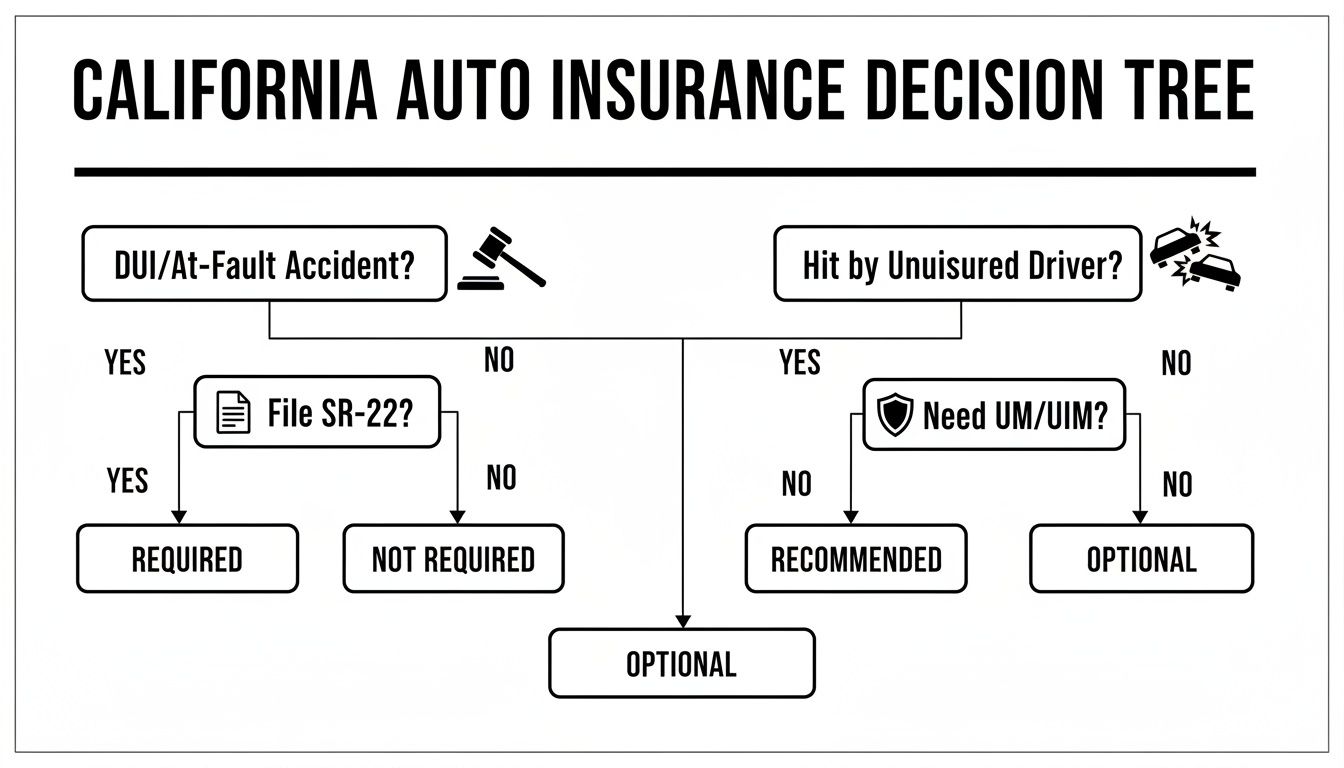
As you can see, an at-fault accident without insurance puts you on the fast track to needing an SR-22, which adds a whole new layer of cost and hassle.
The Long-Term Financial Fallout
The pain doesn’t stop after you pay the fines and get your car back. A conviction for driving uninsured creates a ripple effect that can follow you for years.
The real cost isn’t just the ticket. It’s the lasting damage to your driving record and the sky-high insurance rates you'll face later. You’ll be labeled a high-risk driver, making it much harder and more expensive to get the coverage you need to drive legally.
After a conviction, the DMV will likely suspend your driver's license. To get it reinstated, you'll almost certainly have to file an SR-22 certificate. This "high-risk" label means you'll be paying drastically higher insurance premiums for at least three years.
What Happens in an At-Fault Accident
This is the absolute worst-case scenario. If you cause an accident while uninsured, California’s "No Pay, No Play" rule kicks in. This law severely restricts your ability to recover money from the other driver, even if they share some of the blame. You generally can't sue for non-economic damages, like pain and suffering.
Meanwhile, you are personally on the hook for 100% of the damages you cause. That includes medical bills for anyone you injured and the full cost of repairing or replacing their vehicle. Without an insurance policy to protect you, your personal assets—your savings, your home, even your future wages—are all at risk. The debt from a single accident can be financially ruinous.
When you look at it this way, the cost of a basic liability policy is a tiny fraction of the penalties you face for driving without one. Staying insured isn't just about following the law; it's the smartest thing you can do to protect yourself from a devastating financial blow.
Finding the Right Car Insurance for You
Okay, so you understand California's minimum insurance requirements. That's the first step. Now comes the important part: getting a policy that truly protects you. It might seem like a hassle, but it's really about being prepared and knowing who to ask for help. Let's move beyond just meeting the legal baseline and build a real financial safety net. A robust California insurance plan often involves bundling auto insurance with home insurance or renters insurance for maximum protection and savings.
The whole process kicks off by gathering a bit of information. Insurance companies need these details to figure out your risk level and give you a solid, accurate quote. Having everything ready beforehand just makes the whole thing faster and means you won't get any last-minute surprises on your rate.
Your Quote Checklist: What to Have Ready
Before you even think about shopping around, spend five minutes gathering these key items. It'll make getting a quote a quick and painless process. This is your personal insurance toolkit.
You will need:
- Personal Info: Full name, date of birth, and driver's license number for everyone who will be on the policy.
- Vehicle Details: Grab the Vehicle Identification Number (VIN), make, model, and year for each car you're insuring. It's also good to know the current odometer reading and any special safety features (like anti-lock brakes or alarms).
- Driving History: Be honest about any accidents, tickets, or claims you or any other drivers have had in the last three to five years.
- Current Insurance Info: If you're already insured, have your current policy's "declarations page" on hand. It lists your current coverage limits and helps an agent spot opportunities to find you a better deal.
Once you have this stuff together, you’re set to get a fast, accurate quote for the coverage you actually need.
Why an Independent Agency Makes Life Easier
You could go straight to a big-name insurance company, but that's like only looking at one house when you're buying a home—it really limits your options. Working with an independent agency like Mai & Associates gives you a huge leg up. We aren't tied to a single carrier. Instead, we do the shopping for you, comparing policies and rates from dozens of top-rated companies to find the perfect match for your situation and your wallet.
This is a game-changer, especially if your situation isn't cookie-cutter. Need an SR-22? We know exactly which companies handle those smoothly and affordably. We can get you quotes the same day and offer help in English, Spanish, Armenian, Russian, and Vietnamese, so you'll get clear, personalized advice you can actually understand.
At Mai & Associates, our job is to be your advocate. We cut through the confusing jargon of auto insurance, explain things in plain language, and make sure you feel confident about the protection you’re buying. We are also experts in home insurance, renters insurance, and life insurance in California, helping you build a comprehensive protection plan.
The insurance world is shaped by government rules and big players. For instance, a giant like State Farm controls over 18% of the market, which heavily influences what everyone else charges. That's why having an independent expert on your side—someone who can navigate all the different options—is so valuable.
Protecting Against California's Unique Risks
Living in the Golden State comes with some unique risks that go far beyond a fender-bender on the 405. Wildfires are a perfect example. A fire can destroy your car while it's just sitting in your driveway, and a basic liability-only policy won't pay a dime to replace it.
This is exactly why comprehensive coverage is so important here. It's an optional add-on, but it's what covers your car from things that aren't a collision—like fire, theft, vandalism, or even a flood. For anyone living in or near a high-risk fire zone, comprehensive coverage isn't a luxury; it's a must-have for peace of mind.
A good agent can help you look at your local risks and figure out if adding comprehensive and collision coverage is the right move for you. It's all about building a policy that fits your life here in California. Ready to see what that looks like? You can get an instant insurance quote online and start comparing your options right now.
What’s on the Horizon for California Car Insurance?
The car insurance world isn't static. It's constantly being reshaped by new technology and the changing risks we face on the road. The policy you have today might not look the same in a few years, because a couple of big trends are already changing how insurance companies figure out what to charge.
Two forces are really steering the ship here: the explosion of Electric Vehicles (EVs) and the clever technology behind telematics, often called usage-based insurance. Both are bringing new challenges and opportunities that will directly affect your premiums and coverage choices down the line.
The Electric Vehicle Revolution
You can't drive around California without noticing the surge in EVs. While they're a huge win for the environment, these high-tech cars are built differently. They’re packed with specialized parts, from massive battery systems to a web of integrated sensors, and repairing them can get expensive, fast. This is already starting to change the math behind mandatory auto insurance.
As more people switch to electric vehicles, insurers are re-calculating risk. Global EV sales shot up by about 35% in 2023. Since their repair costs can be roughly 70% higher than regular cars, the industry is bracing for larger claim payouts. You can read the full analysis of the vehicle insurance market to see the data.
What does this mean for you? As EVs become a common sight on our roads, even a simple fender-bender could lead to a much bigger repair bill. Insurance companies have to factor these higher costs into their pricing, which will likely cause premiums to creep up for everyone—whether you drive an EV or a gas-powered car.
The Rise of Usage-Based Insurance
Another trend gaining serious momentum is telematics. Think about it: what if your insurance premium was based on how you actually drive, not just your history? That’s the idea behind usage-based insurance.
A small device in your car or an app on your phone tracks specific habits, like:
- How many miles you cover
- Your typical speed
- How often you brake hard
- What time of day you're usually on the road
With this real-time data, insurers can offer rates that are truly personalized. If you're a safe, low-mileage driver, you could see some serious savings. On the flip side, riskier driving habits might lead to higher costs. This tech is making car insurance requirements much more connected to individual behavior, rewarding good drivers and giving everyone a more accurate picture of their own risk.
Your Top California Auto Insurance Questions Answered
Even when you know the rules of the road, real-life situations can throw you a curveball. This last section is all about tackling those common "what if" questions that pop up for California drivers. We'll give you straight answers to help you handle these scenarios like a pro.
Think of this as your quick-reference guide. Whether you're standing on the dealership lot, dealing with the shock of a fender bender, or thinking about driving for a rideshare app, having the right information is key. Let's clear up any confusion and make sure you're ready for anything.
Do I Need Insurance Before I Buy a Car in California?
Yes, you absolutely do. In California, you can't register a car without proof of insurance, and no dealership will let you drive off their lot until they've seen it. It’s a hard and fast rule.
The smartest move is to get your insurance sorted out before you sign the final paperwork. You can work with an agent to get a policy quoted and ready to activate the second the car becomes yours. This makes for a smooth, legal, and stress-free drive home.
What Happens If an Uninsured Driver Hits Me?
This is exactly why Uninsured Motorist (UM) coverage exists. If you have it, your own insurance company steps up to pay for your medical bills and other related costs, up to your policy's limits. It’s a safety net that protects you when the other driver fails to carry their required coverage.
Without Uninsured Motorist coverage, your only option is to sue the other driver personally. This can turn into a long, expensive legal battle, and trying to get money from someone who couldn't afford insurance in the first place is often a dead end.
Having UM coverage is a financial lifesaver. It ensures that someone else’s mistake doesn’t become your financial nightmare. For more detailed answers to questions like this, head over to our comprehensive California insurance FAQ page.
Can I Use My Personal Car for Uber or Lyft?
This is a common misconception—and a dangerous one. Your standard personal auto insurance policy almost always has an exclusion for "commercial use," which includes driving for rideshare companies.
While Uber and Lyft do provide some insurance for their drivers, it doesn't cover every situation. There are well-known gaps, especially in the time you're logged into the app but still waiting for a ride request. To close this gap and be fully protected, you need a dedicated rideshare or commercial policy. Don't skip this step; talk to your insurance agent before you start driving, or you could face a denied claim and be left holding the bill for an entire accident.
Trying to figure out California's insurance rules can feel overwhelming, but you're not on your own. The licensed professionals at Mai & Associates are here to cut through the confusion and find you the right policy at a great price. Click here to compare rates and get your free, no-obligation quote today!