Simplify Your California Car Insurance Renewal
That renewal envelope usually shows up at the wrong time. You're busy, the premium looks different, and your first instinct is often to pay it and move on.
For California drivers, that can be an expensive habit.
A car insurance renewal is one of the best times to review your protection, question price changes, and fix coverage that no longer fits your life. It also connects to bigger household decisions. If you recently bought a home, started renting, changed vehicles, added a driver, or want to revisit life insurance, renewal is often the cleanest moment to line everything up properly.
Your Renewal Notice Arrived Now What
That packet is not just a bill. It's your decision point.
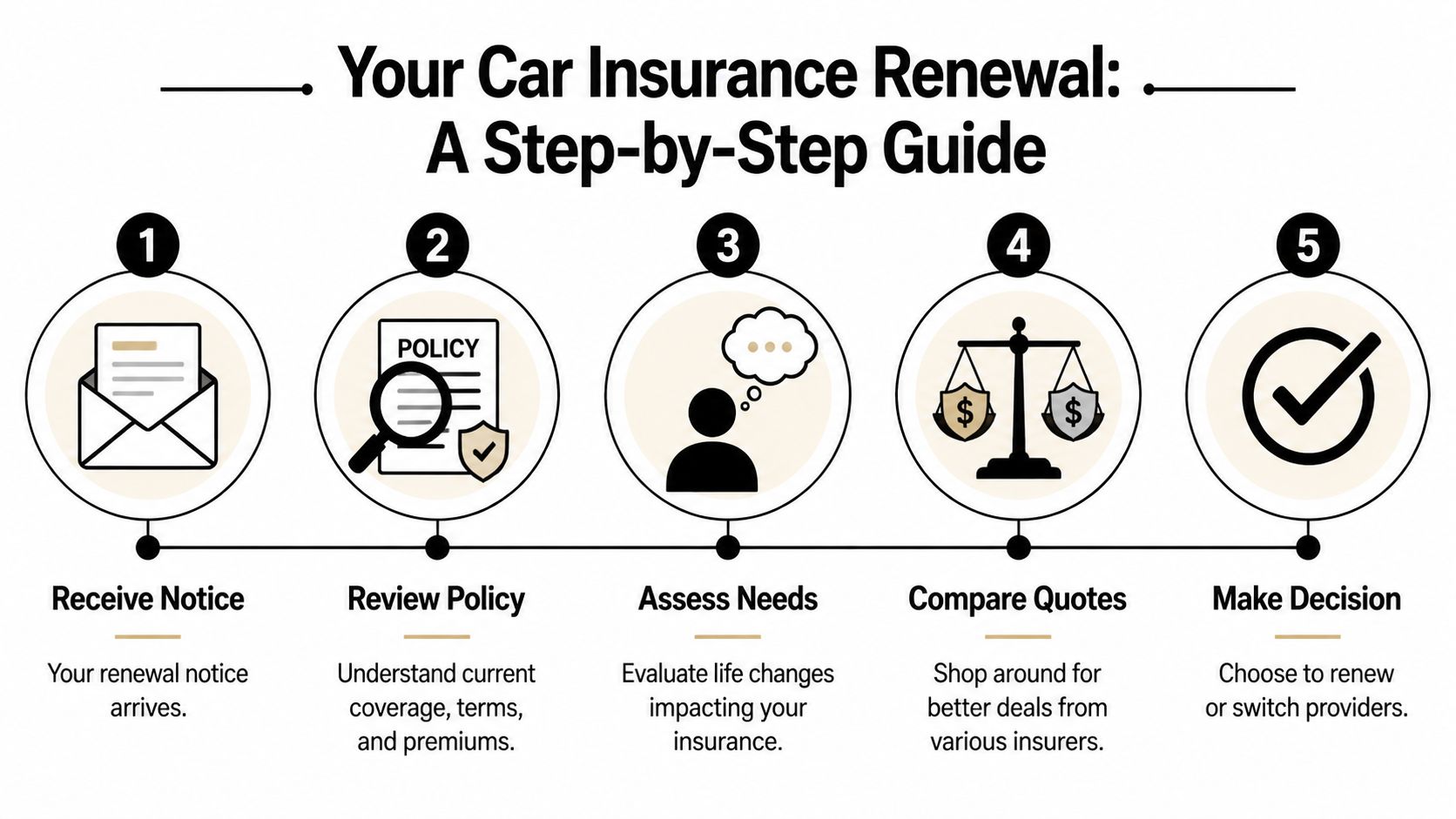
Insurers typically begin the renewal process before your policy expires, and the most useful shopping period is the 45-day renewal window. During that window, you can compare rates, review coverage, and make a change without creating a gap in protection, as explained in The Zebra's overview of the 45-day renewal period.
What to look for first
Open the notice and find four things right away:
- Your expiration date. This drives everything.
- Your new premium. Compare it to what you've been paying.
- Any coverage changes. Don't assume the policy stayed identical.
- Driver and vehicle details. Small errors can cause big issues later.
Many clients focus only on price. Price matters, but the declarations page tells you whether the policy still matches your actual situation. A premium that stayed flat can still hide a problem if your limits are too low or a vehicle is listed incorrectly.
A simple renewal timeline
Use the renewal notice as a short working checklist instead of a pile of paperwork.
- As soon as it arrives: Read the declarations page and confirm names, address, garaging location, vehicles, lienholder information, and listed drivers.
- During the shopping window: Request comparison quotes and ask coverage questions while you still have time to decide.
- Before the effective date: Choose whether to renew, adjust the existing policy, or replace it.
- On the start date of the new term: Confirm payment, proof of insurance, and any lender requirements.
- After the policy is finalized: Save the updated ID cards and declarations page.
Practical rule: Don't treat a renewal notice like routine mail. Treat it like an annual financial review for your auto insurance.
Why auto-renewing can cost you
Auto-renewal feels easy because it is easy. The problem is that convenience can hide missed opportunities.
A car insurance renewal is when coverage should catch up with your life. In California, that matters even more because costs and underwriting pressure can shift based on local conditions, including repair costs, claims trends, and wildfire-related market changes affecting the broader insurance environment. If your household changed this year, a passive renewal can leave you overpaying, underinsured, or both.
Decoding Your Policy and Assessing Your Needs
Before shopping, know what you already have. Most of the important answers are on the declarations page.
A lot of drivers let the policy continue unchanged. That's common, but it creates blind spots. Peakes Insurance notes that 70-80% of policyholders auto-renew without shopping, which can lead to average premium hikes of 15-20% annually even when claim-free, and that coverage gaps from unaddressed life changes affect 25% of renewals.
What the key coverages mean
Focus on the practical coverages first.
- Bodily Injury Liability: This helps pay when you injure someone else in an accident you're responsible for.
- Property Damage Liability: This helps with damage you cause to another person's car or property.
- Uninsured and Underinsured Motorist (UM/UIM): This matters when the other driver doesn't have enough insurance, or doesn't have insurance at all.
- Collision: This covers your own vehicle for crash damage, regardless of fault, subject to your deductible.
- Coverage for Non-Collision Losses: This applies to non-collision losses such as theft, vandalism, falling objects, and some weather-related damage.
If you're reviewing a vehicle that might be close to a total loss threshold after an accident, it helps to understand how valuation disputes can play out. A useful outside reference is these insights from Auto Appraisal Expert on what happens when insurance totals your car.
The renewal checklist I wish more drivers used
Read your policy with your real life in mind, not with last year's assumptions.
- Your commute changed: If you're driving more, driving less, or working from home now, your rating details may need an update.
- A driver joined the household: A spouse, newly licensed child, or family member using the car regularly should trigger a review.
- You changed vehicles: Financing, leasing, or replacing a car often changes the coverage mix that makes sense.
- You moved: In California, location matters. Garaging address affects rating and sometimes carrier appetite.
- You bought a home or started renting: This is often the point to review home insurance or renters insurance alongside auto.
- You want stronger family protection: Renewal is also a natural time to revisit whether life insurance fits your current obligations.
Read the declarations page like a decision document
The declarations page should answer three practical questions:
| Question | What to check | Why it matters |
|---|---|---|
| Who is insured | Named insureds and listed drivers | Missing or incorrect driver details can create claim complications |
| What is covered | Vehicle list, coverage types, deductibles, limits | Lower price means little if key protection was reduced |
| What changed | Premium, endorsements, exclusions, policy dates | Renewal terms may not be identical to the prior term |
If you want a broader California coverage reference while you're reviewing your paperwork, the policy guides at Mai & Associates insurance guides are a helpful place to compare common coverage questions across auto, home, renters, and life insurance.
A renewal works best when you ask, "Does this still fit how I live now?" not "Can I get through this in five minutes?"
Shopping For Better Rates Without Sacrificing Coverage
Once you know what needs to stay, what needs to change, and what can be removed, price shopping becomes much more useful.
The biggest mistake I see is comparing a low premium against a better policy and calling it savings. That's not a real comparison. The only quote that matters is an apples-to-apples quote.
The renewal market leaves a lot of value on the table. LexisNexis Risk Solutions reports an estimated $4.9 billion in overlooked premium annually because many insurers don't proactively capture changes in household and driver risk profiles over time. That cuts both ways. Sometimes a customer's risk has increased and needs an update. Other times the file hasn't been reviewed carefully enough, and the customer misses chances to improve placement or pricing.
Direct shopping versus independent comparison
Both approaches can work. They don't work equally well for every driver.
| Approach | What works | What usually doesn't |
|---|---|---|
| Going direct to one carrier | Fast if you're already sure about coverage and carrier fit | Easy to miss better options elsewhere |
| Shopping on multiple carrier sites yourself | Useful for getting a rough sense of the market | Time-consuming, repetitive, and hard to compare consistently |
| Using an independent agency | Better for side-by-side comparisons across carriers and coverage structures | Less useful only if you insist on one specific insurer no matter what |
The more complicated your household is, the more independent comparison tends to help. That includes multi-car families, mixed driving histories, teen drivers, recent moves, rental properties, homeownership, Fair Plan issues, and people who want to coordinate auto with renters, home, or life insurance.
If you're evaluating a vehicle before renewal, prior records can affect how insurers see risk and value. This guide on the impact of past VIN reports on premiums is worth reading if a car's history may be part of the pricing puzzle.
Ask for discounts the right way
Don't ask, "What discounts do you have?" Ask whether each discount has been checked against your current file.
- Multi-policy review: If you have home insurance, renters insurance, or life insurance needs, ask whether combining policies improves the total household picture.
- Driver profile review: Good driving history, mileage changes, and household driver updates can affect eligibility.
- Vehicle use review: Commute, business use, and storage patterns should match reality.
- Deductible options: A different deductible may lower premium, but only if you'd be comfortable paying it during a claim.
- Payment structure: Some clients prefer the lowest monthly outlay. Others prefer a billing setup that reduces friction and missed payments.
For drivers who want a California-specific place to start the comparison process, this page on California auto insurance options gives a good overview of how different coverage setups can fit different households.
Lower premium is a good result only when the liability limits, UM/UIM, deductibles, and vehicle protections still make sense.
Making the Switch Seamlessly and Avoiding Lapses
Finding a better policy is only half the job. The switch itself has to be clean.
A lapse in coverage can create trouble fast. Even one preventable gap can complicate future pricing, proof of insurance, and peace of mind. The safest approach is simple and disciplined.
Never cancel your old policy until the new one is confirmed active.
The correct order
Do the steps in this order, not your own order.
- Buy the new policy first. Get the declarations page, ID cards, and effective date in writing.
- Match the start date carefully. The new policy should begin when the old one ends, unless a different overlap is needed for a specific reason.
- Confirm payment went through. A policy isn't helpful if the payment method fails immediately.
- Send proof where needed. Update your lender or anyone else who requires evidence of insurance.
- Cancel the prior policy only after confirmation. Ask for written confirmation of cancellation.
Checklist for a Seamless Insurance Switch
| Step | Action Item | Why It's Important |
|---|---|---|
| 1 | Purchase the replacement policy | You need active coverage in place before ending the old one |
| 2 | Verify the effective date on the new declarations page | Dates that don't align can create a gap |
| 3 | Save ID cards and policy documents | You'll need proof for driving, financing, or registration questions |
| 4 | Notify lender or interested party if required | Outdated lender records can create unnecessary issues |
| 5 | Cancel the prior policy and keep written confirmation | This closes the old account cleanly and documents the end date |
Small errors that create big headaches
A switch can go wrong in very ordinary ways. The wrong effective date. An old autopay still running. A financed vehicle with the wrong lienholder listed. A driver assuming email confirmation means everything is finished when the carrier still needs one more item.
If you want to line up a replacement policy before canceling anything, start with a California insurance quote request. It gives you something concrete to compare before you touch the current policy.
Handling Non-Renewals and High-Risk Scenarios
Not every renewal ends with a smooth offer. Sometimes the insurer chooses not to continue the policy, or the available options narrow enough that the situation feels like a non-renewal in practice.
When that happens, speed matters, but clarity matters more. Read the notice carefully, confirm the last day of coverage, and start replacement shopping immediately. Don't assume your options are gone just because the first answer was no.
Why renewals get harder in California
California insurance decisions don't happen in a vacuum. A driver's record matters, of course, but so do market conditions, regional underwriting pressure, and household-level complexity.
For many families, car insurance questions are tied to property questions. A homeowner in a wildfire-prone area may already be juggling private market changes, Fair Plan issues, or a need to separate home and auto placement instead of bundling everything under one roof. That doesn't mean you stop reviewing the full household picture. It means you review it more carefully.
A special note on CLCA and wildfire-area households
California's Low Cost Auto program can be valuable for qualifying drivers, but renewal requires attention. Policygenius notes that drivers in the CLCA program must re-verify income annually, and failure to do so leads to cancellation, with 20% of participants lapsing per 2025 DMV data. The same source also notes that in wildfire-prone regions, pairing auto decisions with a California Fair Plan home policy review requires care to avoid serious coverage gaps.
That combination matters because households often focus on keeping costs down and miss how one policy decision affects another. A low-cost auto setup may solve one problem while leaving weak spots elsewhere if no one reviews the home, renters, or liability picture alongside it.
What to do if you're in a difficult market segment
- Act early: If you've received a non-renewal or expect one, don't wait for the final week.
- Gather clean documents: Keep your current declarations page, driver information, vehicle details, and notice ready.
- Review the entire household: Auto, home insurance, renters insurance, and life insurance decisions often overlap.
- Ask direct questions about gaps: Especially if you live in a wildfire-exposed area or have a Fair Plan policy in the household.
Some of the hardest renewal files aren't impossible. They're just files that need more careful matching between carrier appetite, coverage needs, and timing.
Partnering With Mai & Associates For Your Renewal
A California renewal gets easier when one licensed team can look at the whole picture instead of only one policy.
That matters because most households don't have one isolated insurance problem. They have a car insurance renewal, a question about home insurance or renters insurance, maybe a Fair Plan issue in the background, and a reasonable desire to stop filling out the same information over and over.
Why broker support changes the outcome
There is a practical advantage to broker-led renewal work. Embroker reports that broker-assisted renewals achieve an average of 20-35% in cost reductions versus 5-10% for direct online shopping, and that in California, expert Fair Plan reviews convert 60% of policies back to the more extensive private market.
That doesn't mean every client should expect the same result. It does mean broker comparison gives you a better shot at finding real options, especially when the file is more complicated than a single-car, single-driver household with no property exposure.
Where that help matters most
Mai & Associates is built for California-specific renewal work.
- Multi-carrier comparison: Your information is gathered once, then reviewed across multiple carrier options.
- Multi-line review: Auto insurance can be evaluated alongside home insurance, renters insurance, and life insurance.
- Fair Plan familiarity: Households dealing with wildfire-related property issues need someone who understands how those decisions affect the broader insurance picture.
- Multilingual service: Clear conversations matter when you're reviewing legal and financial documents. Support is available in English, Spanish, Armenian, Russian, and Vietnamese.
- Local California context: Drivers and homeowners in Glendale, Westlake Village, Escondido, Costa Mesa, and many other California communities often need advice specific to their region, not generic national guidance.
What usually works best
The clients who get the most value out of renewal season tend to do three things. They start before the deadline, they share complete information, and they review more than just the auto premium.
That last point matters. A lower car premium may be good, but the stronger result is a better-balanced household insurance plan with fewer gaps and less confusion at claim time.
The best renewal outcome isn't just "cheaper." It's clearer coverage, cleaner coordination, and fewer surprises.
Frequently Asked Questions on Car Insurance Renewal
A few questions come up almost every renewal season.
Do I have to wait until renewal to change my policy
No. You can usually request changes during the policy term.
Renewal is the easiest moment to review everything at once because the policy is already being repriced and reissued. If you've moved, changed cars, added a driver, bought a home, started renting, or want to revisit life insurance, don't wait if the current setup is wrong.
If I shop for quotes, will that automatically change my current policy
No. Getting quotes does not automatically replace your existing policy.
A quote is just an option until you accept it and the new policy is issued. Your current policy remains in force unless it expires, is canceled, or is formally replaced.
What if I missed a payment near renewal
Contact the insurer or your agent immediately. Don't guess and don't assume the grace period is still open.
Missed-payment situations are very time-sensitive. The right next step depends on whether the policy is still active, pending cancellation, or already ended.
Should I always take the lowest premium
No. Take the lowest premium that still gives you the protection you need.
A cheaper quote can be the right move. It can also be a bad move if it strips out useful coverage, lowers limits too far, or leaves deductibles at a level you'd struggle to pay.
Can I switch companies if I also have a home or renters policy
Yes, but review the whole bundle before changing one piece.
Sometimes separating policies improves the result. Other times the better move is to coordinate auto with home insurance or renters insurance for cleaner billing and stronger overall value.
What documents should I keep after renewal
Keep your declarations page, ID cards, payment confirmation, and any cancellation confirmation from the prior carrier if you switched.
If the vehicle is financed or leased, keep anything showing the lender information is correct on the active policy.
Where can I get more California insurance answers
If you want quick answers on common policy issues, billing questions, coverage topics, and renewal concerns, the Mai & Associates FAQ page is a useful next stop.
A calm renewal usually comes down to timing, accuracy, and comparison. Start early, read the documents carefully, and don't let convenience make the decision for you.
If your car insurance renewal is coming up, Mai & Associates can help you compare California auto insurance options, review home insurance or renters insurance for bundle opportunities, and look at life insurance needs as part of the same conversation. Their licensed team works with multiple carriers, understands Fair Plan and wildfire-related issues, and provides multilingual support across California so you can make a clear decision without the usual renewal stress.