California Car Insurance Grace Period Explained
We've all been there—a bill gets lost in the shuffle, an automatic payment fails, or you just plain forget. When it comes to your car insurance, missing a payment due date can feel like a five-alarm fire. But most of the time, there’s a small buffer in place to help you out: the car insurance grace period.
Think of it as a temporary safety net, not a free pass. It's that short window of time, usually between 10 to 30 days, that your insurer gives you to get your late payment in before they pull the plug on your policy. This is your last chance to avoid a potentially disastrous lapse in your California auto insurance coverage.
What a Grace Period Really Means

Let's use an analogy. Imagine your insurance premium is the fuel that keeps your coverage running. If you miss a payment, the engine doesn't just die on the spot. Instead, a warning light flashes on your dashboard—that's your car insurance grace period. It’s your final opportunity to "refuel" by paying what you owe before the whole policy stalls out, leaving you unprotected.
This idea of a grace period isn't unique to auto insurance. It applies to most types of California insurance, whether it's the home insurance protecting your house, the renters insurance for your apartment, or even your life insurance. Getting familiar with these concepts is key to managing your policies well, and our glossary of insurance terms is a great place to get clear, simple definitions.
How it Usually Unfolds in California
While every company handles things a bit differently, the process for California drivers is pretty standard. Here’s a quick rundown of what to expect once a payment deadline for your car insurance slips by:
- You Miss the Due Date: The date for your premium payment passes.
- A Notice Arrives: Your insurance company is legally required to send you a formal "Notice of Cancellation." Don't panic just yet—this document will clearly state the final date they need to receive your payment to keep your policy active.
- The Countdown Begins: The time between your original due date and that final cancellation date is your grace period.
It’s easy to feel stressed when you see a "Notice of Cancellation" in the mail. The table below breaks down what's happening at each stage and what you need to do.
Understanding Your Grace Period Status
| Stage | What It Means | Your Next Step |
|---|---|---|
| Payment Missed | Your premium is officially overdue. The grace period has started. | Check your mail/email for the official notice from your insurer. Find the final payment deadline. |
| Grace Period Active | You still have active coverage, but the clock is ticking. | Make the full payment as soon as possible, well before the deadline listed on the notice. |
| Grace Period Expired | The final deadline has passed. Your policy is now canceled, and you are uninsured. | Contact your agent or insurer immediately to discuss reinstatement or getting a new policy. Do not drive. |
Remember, a grace period is a lifeline, but it's a short one. Once it's gone, so is your coverage.
Why Grace Periods Aren't All the Same
The length of that safety net isn't set in stone. Factors like your payment history, the specific language in your policy, and even your long-term relationship with the insurance company can affect the timeline. Some insurers might offer a bit more flexibility to a long-time customer who's never missed a payment, while others stick to a rigid schedule no matter what.
This is exactly why you should never just assume you have a 30-day window. The only way to know for sure is to check your policy documents or, even better, call your agent. Getting the exact details for your auto insurance, home insurance, or even life insurance policy will save you a world of trouble down the line.
Grace Period vs. Coverage Lapse: The Critical Difference
It's easy to mix these two up, but understanding the difference between a car insurance grace period and a coverage lapse is absolutely essential. Getting them confused can lead to some seriously devastating financial and legal problems, especially for drivers here in California.
Think of the grace period as a final warning shot from your insurer. It’s a short, protected window where your policy is still technically active even though you've missed a payment. A coverage lapse, on the other hand, is the end of the line. It means the grace period is over, your insurer has cancelled your policy for good, and you are officially uninsured. This isn't just a paperwork problem—it's a massive risk that leaves you completely exposed.
The Real Cost of a Coverage Lapse in California
Driving without car insurance in California is illegal, and the state doesn't take it lightly. If you're pulled over during a coverage lapse, you’re not just looking at a simple ticket. You’re facing a domino effect of problems that can haunt you for years.
The consequences hit fast and hard:
- Steep Fines: A first-time offense can quickly cost you hundreds of dollars once you factor in all the court fees.
- Vehicle Impoundment: Police have the power to tow and impound your car on the spot. You'll be on the hook for towing costs and daily storage fees that add up fast.
- License Suspension: The DMV can suspend your driver's license, and you won't be able to legally drive again until you jump through all the hoops to get it reinstated.
Remember, these penalties can happen even if you don't get into an accident. Just being caught on the road without proof of California insurance is enough to start this whole messy process. For more specifics, take a look at our frequently asked questions page, which is tailored for California drivers.
When a Lapse Becomes a Financial Disaster
The legal troubles are bad enough, but the real financial nightmare of a coverage lapse kicks in if you cause an accident. Without an active policy, you are personally responsible for every single penny of the damage.
Let’s paint a picture: You cause a multi-car pile-up on the 405. Without insurance, you are now personally liable for the medical bills of everyone injured, the repair or replacement costs for every damaged vehicle, and the legal fees if you get sued. We’re talking about costs that can easily skyrocket into the tens, or even hundreds, of thousands of dollars.
A single accident can lead to having your wages garnished, liens placed on your property, and even bankruptcy. It’s a life-changing financial disaster that all could have been avoided by simply making that payment during the grace period. This is why it’s so critical to treat that grace period with urgency—it’s your last line of defense.
The Long-Term Cost of a Canceled Policy
Missing your grace period isn't just a minor hiccup that leaves you uninsured for a few days. It's more like a long-lasting financial hangover that can dog you for years. When an insurer cancels your policy for non-payment, they don't just close your file; they flag you as a high-risk driver.
That new label sticks. Because insurance companies share data, a cancellation on your auto insurance policy can send ripples across your other coverages. Suddenly, you might see higher quotes for your home insurance, renters insurance, or even life insurance. It sends a clear signal to the industry that you might be unreliable, and you'll unfortunately pay the price for that perception.
The Struggle to Find New Coverage
Once your policy is canceled, getting insured again becomes a real chore. Many of the standard, big-name carriers might flat-out refuse to cover you. This pushes you toward insurers who specialize in high-risk drivers.
These "non-standard" policies will get you back on the road legally, but they almost always come with a much steeper price tag and less forgiving terms. And this isn't a short-term penalty. A lapse in coverage stays on your insurance history for years, acting as a red flag every time you shop for a new quote.
Here's a sobering look at the numbers: in the first quarter of 2023, about 15 percent of drivers in the U.S. let their coverage lapse. A staggering 30 percent of them said it was because they simply couldn't afford it, thanks to premiums rising nationwide. You can dig into the reasons drivers are feeling the squeeze in this detailed report.
California Specific Consequences
Here in California, the fallout can be even more serious. When the DMV gets word that your insurance has lapsed, they can hit you with an SR-22 certificate requirement. Think of it as a form of proof your insurer has to file for you, verifying you meet the state's minimum liability coverage.
Having to carry an SR-22 is a burden, and it typically lasts for three long years. Here's what that means for you:
- Higher Premiums: Insurers charge a lot more for policies that require an SR-22 filing.
- Limited Options: Your pool of potential insurers shrinks dramatically, as not all companies are willing to file them.
- Constant Monitoring: If you let this new SR-22 policy lapse for even a day, your insurer is required to notify the DMV immediately. That often leads straight to a suspended driver's license.
The best way to sidestep all this financial pain is to be proactive. Talking to your insurance agent before a missed payment snowballs into a cancellation can prevent a temporary setback from becoming a long-term nightmare. To learn more about keeping your coverage solid, check out our comprehensive insurance guides.
What to Do When You Miss an Insurance Payment
That sinking feeling when you realize you’ve missed a car insurance payment is something no driver wants to experience. It’s easy to panic, but what you do in the next few hours and days makes all the difference. For California drivers, a missed payment isn't the end of the world, but you need a solid game plan to get back on track without a hitch.
The absolute first step? Get on the phone with your insurance agent or the carrier's customer service line. Don’t just sit back and wait for a cancellation letter to show up in the mail. A quick, proactive call shows you're on top of it. You can explain what happened, find out exactly how long your car insurance grace period is, and get a firm deadline for when that payment must be received to avoid a lapse.
Your Immediate Action Plan
Once you have that final date, the mission is simple: get the payment in. Pay the full past-due amount, including any late fees they've added on. I've seen too many people wait until the last possible minute, which is just asking for trouble with processing delays.
After you've sent the money, you’re not quite done. A couple of follow-up steps are crucial to make sure you're truly in the clear:
- Confirm Reinstatement: Call your insurer back and get verbal confirmation that your payment was received and your policy is fully active again, with no gap in your coverage.
- Get It in Writing: Ask for an email or official letter stating your policy is paid up and in good standing. This document is your proof of continuous coverage, which can be invaluable if any questions come up down the road.
As you can see, the path you take after a missed payment matters. One direction leads back to safety, while the other can quickly land you in the high-risk category.
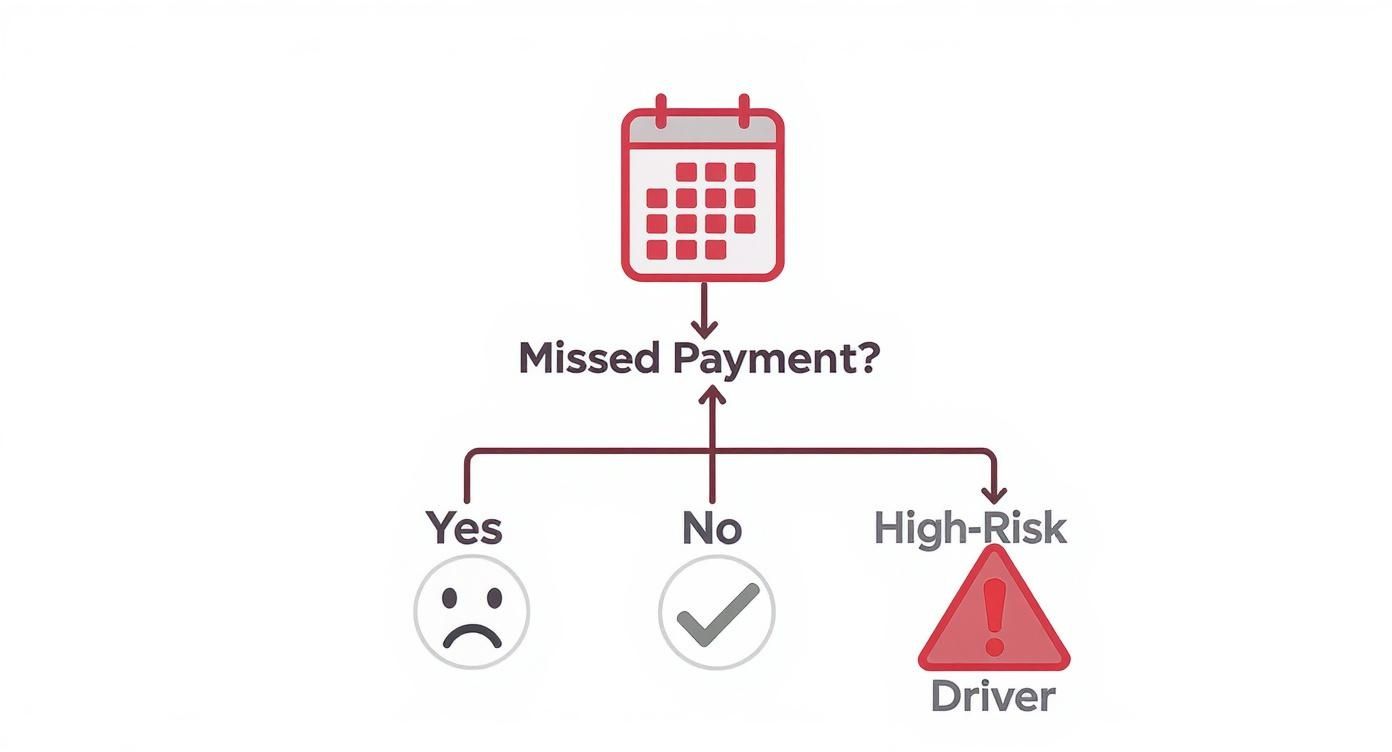
The infographic above lays it out clearly. A simple oversight can start a chain reaction that ends with higher premiums and fewer insurance options for years to come.
This simple table breaks down exactly what you need to do, step-by-step.
Your Missed Payment Action Plan
| Step Number | Action to Take | Why It Matters |
|---|---|---|
| 1 | Contact Your Insurer Immediately | Don't wait. A proactive call helps you understand your grace period and shows good faith, which can prevent immediate cancellation. |
| 2 | Make the Full Payment | Pay the overdue amount plus any late fees to stop the cancellation process and clear your account. |
| 3 | Verify Policy Reinstatement | Get verbal confirmation that your policy is active again with no gap in coverage to ensure you are legally protected. |
| 4 | Request Written Proof | An email or letter is your official record, protecting you from future disputes about your coverage status. |
Following these steps methodically will help you navigate a missed payment with the least amount of stress and risk.
How to Prevent Future Lapses
Of course, the best way to deal with a late payment is to make sure it never happens in the first place. A little organization goes a long way in protecting all your policies, from your auto insurance to your home insurance or renters insurance.
Your payment history is one of the biggest factors insurers look at when setting your rates. A clean record of on-time payments doesn't just keep you covered—it can actually lead to better premiums over time for all your California insurance needs.
Seriously consider setting up automatic payments. Linking your premium to a bank account or credit card is the most foolproof way to avoid missing a due date. If you're not comfortable with autopay, then get friendly with your calendar app. Set multiple reminders—maybe one a week before and another two days before—to give yourself plenty of notice. These small habits are what keep your coverage locked in, protecting you whenever you're on the road.
Navigating Your Insurance Company’s Grace Period Policy
While California law sets the minimum standard for cancellation notices, the real rulebook for your car insurance grace period is written by your insurance company. Think of the state law as the safety net, but your actual policy documents contain the specific details you need to know. There’s no one-size-fits-all answer here; every carrier has its own way of handling late payments.
This is exactly why you can't rely on something a friend told you or what you read on a generic forum. One company might give a long-time customer a bit of breathing room, while another might start the cancellation process the day after a missed due date. A few key things can influence how much flexibility your insurer is willing to show.
What Determines Your Grace Period?
It really comes down to your relationship with the company. They often look at the bigger picture, not just this one missed payment.
- Your Payment History: This is your biggest bargaining chip. If you have a solid history of paying on time, month after month, they're far more likely to be understanding about a one-time slip-up.
- Policy Bundling: Do you have more than just your car insurance with them? When you bundle your auto insurance, home insurance, or renters insurance, you become a more valuable customer, and that loyalty can earn you a little extra leniency when you need it.
- Communication: Don't wait for them to contact you. Calling your agent before the due date passes can make all the difference. It shows you’re on top of it and gives them a chance to work with you on a solution.
A Real-World Example of Insurer Flexibility
We’ve seen firsthand that insurance companies can be surprisingly adaptable, especially during times of widespread hardship. The COVID-19 pandemic is a perfect example.
When millions of people suddenly faced financial uncertainty, many auto insurers stepped up. They extended grace periods, sometimes from the usual 10-30 days to as long as 60 days, to help customers avoid losing coverage. You can find more details about these consumer relief efforts and how they helped policyholders.
This shows that insurers can bend their own rules when the situation calls for it. Knowing this is important when you talk to your provider. It proves that your individual circumstances and your history as a good customer can be powerful tools in keeping your policy active, even if you’ve hit a temporary rough patch.
An Insurance Agent Can Be Your Best Defense Against a Lapse
Let's be honest, keeping track of California insurance rules, payment due dates, and policy details can feel like a full-time job. The good news? You don't have to go it alone. Working with an independent insurance agent, like the team here at Mai & Associates, is one of the smartest ways to avoid a costly gap in your coverage.
Think of an agent as more than just someone who sells you a policy—they’re your advocate. When you have a dedicated agent in your corner, you have a real person who understands the ins and outs of your car insurance grace period. If you do happen to miss a payment, they can often step in and communicate with the insurance company on your behalf. This relationship acts as a crucial safety net, helping to ensure a simple oversight doesn't spiral into a major financial headache.
Finding a Policy That Actually Fits Your Budget
Of course, the best way to prevent a missed payment is to have a policy you can comfortably afford in the first place. This is where working with an independent agent really makes a difference. We don't work for a single insurance company; we work for you.
Our job is to shop the market, comparing options from various carriers to find coverage that fits your life and your budget. We can also help you find significant savings by bundling different policies together, such as:
- Auto Insurance: The essential protection for every California driver.
- Home Insurance: To safeguard your most valuable asset.
- Renters Insurance: For protecting your personal property if you rent.
- Life Insurance: To provide a financial safety net for your loved ones.
When your insurance plan is built to fit your budget from day one, the risk of a late payment drops dramatically. It’s about more than just having a policy; it’s about having peace of mind without financial strain.
Building this kind of partnership is a powerful investment in your financial security. If you're ready to see how we can help you find affordable and reliable protection, you can get a personalized insurance quote from our team today. We'll help you compare rates from California's top carriers to build a plan that truly works for you.
Common Questions About California Grace Periods
It's completely normal to have questions about how a car insurance grace period works. The rules can feel a bit murky, so let's clear up some of the most common concerns California drivers have when a payment deadline is approaching.
These concepts generally apply across the board for most personal California insurance, whether it's for your car insurance, home insurance, or renters insurance. Getting a handle on them is the first step to making sure you're never caught without protection.
How Long Is a Car Insurance Grace Period in California?
This is the number one question we hear, and the answer isn't a simple one-size-fits-all. California law is very specific: your insurer must give you at least a 10-day written heads-up before they can cancel your policy for a missed payment.
But the actual grace period—that window between your due date and when your coverage officially cuts off—is up to your insurance company. Most providers offer somewhere between 10 and 30 days. The only way to know for sure is to check your policy documents or, even better, just call your agent. Never assume you have 30 days; always find out the exact cancellation date for your auto insurance.
Can I Be Charged a Late Fee?
Yes, almost certainly. Even though your coverage is still active during the grace period, your payment is technically late. Insurance companies will typically add a small late fee to your bill.
It's usually not a huge amount, but it’s their way of encouraging on-time payments. You can find the exact fee listed in the terms and conditions of your policy.
Does a Late Payment Affect My Car Insurance Rates?
A single late payment, especially if you catch up quickly within the grace period, probably won't hurt your rates. Insurers are far more worried about actual lapses in coverage than they are about a one-time slip-up.
But be careful. If paying late becomes a habit, your insurance company might start seeing you as a higher-risk customer. That pattern could definitely come back to bite you with higher rates when it's time to renew your car insurance. Your best bet is to always pay on time and keep your record clean.
Can My Claim Be Denied During a Grace Period?
This is where things get serious. Let's say you have an accident during the grace period. As long as you make that overdue payment before the final cancellation deadline, you're in the clear. Your policy is still considered active, and your insurer should cover the claim.
The danger comes if you don't make the payment. If the cancellation date passes, the insurance company will cancel your policy all the way back to the original due date. That means if you had an accident during that time, you'd have no coverage. The claim would be denied, and you'd be on the hook for every penny of the damages.
Trying to figure out policy details and grace periods on your own can be a headache. Having an expert in your corner makes all the difference. The licensed agents at Mai & Associates can walk you through your current policy, help you compare quotes from top California insurers, and find affordable coverage that truly protects you. Get the peace of mind you deserve by visiting cahomeauto.com for a no-obligation quote today.