Your Guide to Car Insurance Full Coverage in California
One of the biggest points of confusion for drivers is the term "full coverage." It sounds like a single, all-encompassing policy you can buy off the shelf, but that's not quite how it works. In reality, it’s an industry shorthand for a combination of coverages that offers significantly more protection than the bare minimum your state requires.
This bundle is designed to protect your car, not just the other guy's. When building a complete financial safety net, many Californians also consider bundling their auto insurance with other policies like home insurance or life insurance for maximum protection and savings.
Understanding Full Coverage Car Insurance in California
Think of it this way: the basic liability insurance California mandates is all about covering your legal responsibility to others if you cause an accident. It pays for their medical bills and their car repairs, up to your policy limits. It’s essential, but it does absolutely nothing to help you fix or replace your own vehicle.
That’s where the "full coverage" concept comes into play. It’s about building a policy that protects your own investment. This package typically starts with your standard liability and then adds two crucial layers of protection on top.
The Key Components
A robust full coverage policy is built from three core parts:
- Liability Coverage: This is the non-negotiable foundation. It covers bodily injury and property damage you cause to other people in an at-fault accident.
- Collision Coverage: This is what pays to repair your car after an accident, whether you hit another vehicle, a guardrail, or a light post. It applies regardless of who was at fault.
- Comprehensive Coverage: Often called "act of God" coverage, this handles just about everything else. It covers damage from non-collision events like theft, vandalism, fire, hail, or even hitting a deer.
With full coverage, you're protected from a whole range of expensive headaches. The protection covers everything from a total loss in a major crash down to smaller, frustrating incidents—like figuring out the cost to replace a car door handle after a break-in attempt.
Simply put, full coverage is what stands between you and a massive, unexpected expense. It’s the financial safety net that ensures you’re not left paying thousands out of pocket to repair your car—or worse, replace it entirely.
Navigating all the options for your auto insurance, home insurance, and life insurance can feel overwhelming, especially in a market as unique as California. That's why having a local expert on your side is so important. As we detail in our complete guide to auto insurance in California, a knowledgeable agent can make all the difference.
At Mai & Associates, our licensed agents are specialists in the California insurance market. We help drivers from Glendale to Escondido build the right policy for their unique needs and budget. We're here to help you understand your choices, compare quotes, and secure the protection you truly need.
One of the most common terms you'll hear when shopping for car insurance is "full coverage." But here's a little secret from inside the industry: "full coverage" isn't actually a single, official type of policy you can buy. It's really just a convenient shorthand for a policy that bundles together three distinct, essential protections.
Think of it this way: a basic, state-minimum policy is like having just a spare tire—it'll keep you legal, but it won't help much in a serious situation. A full coverage policy is like having the whole car, fully equipped with airbags, a solid frame, and an alarm system. Each part does a different job to keep you safe.
Let's break down how these core coverages work together.
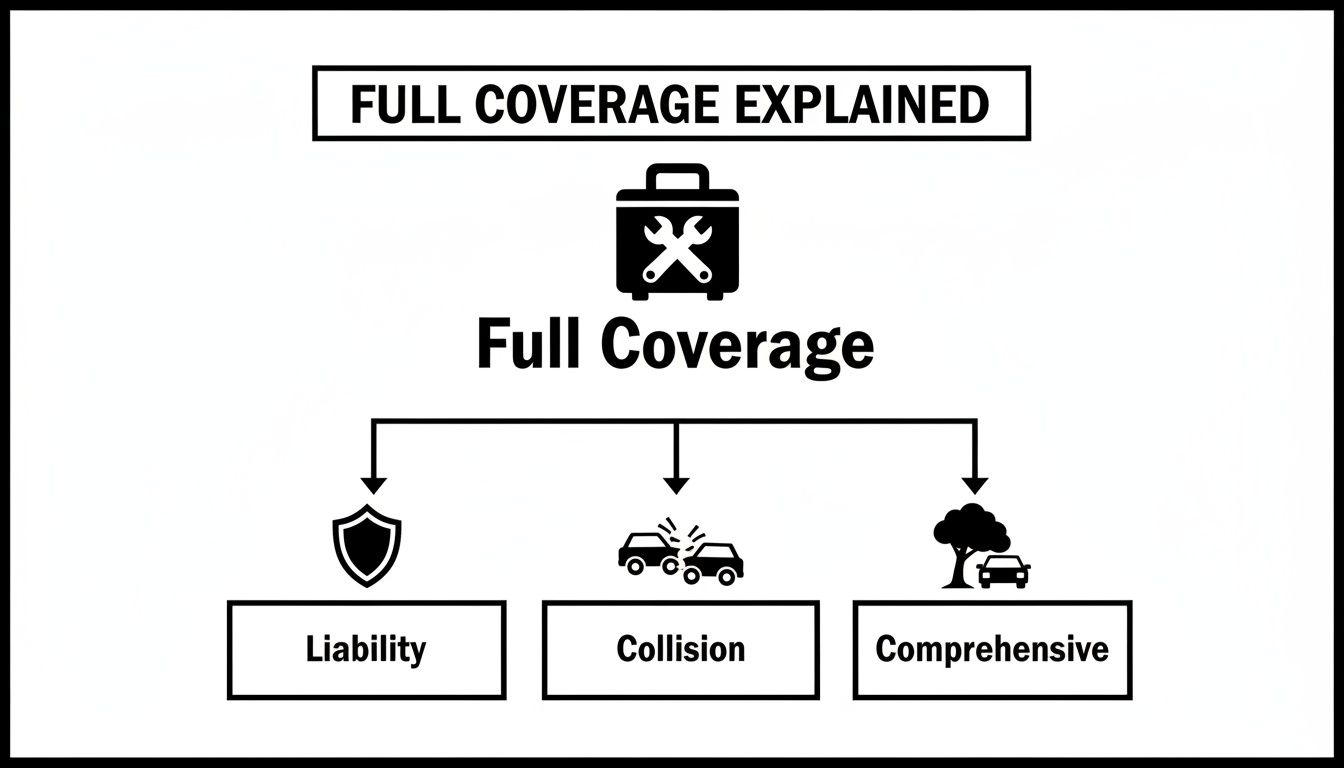
As you can see, a strong policy is built by layering these three critical protections on top of each other.
Liability Coverage: Your Financial Shield
Liability coverage is the absolute foundation of any car insurance policy in California—in fact, it's the part that's legally required. Its job isn't to fix your car or pay your medical bills; its purpose is to protect your assets if you're found responsible for an accident that hurts someone else or damages their property.
It’s split into two crucial parts:
- Bodily Injury Liability (BI): If you cause a crash that injures other people, this covers their medical bills, lost income, and even their pain and suffering.
- Property Damage Liability (PD): This pays to repair or replace whatever you hit, whether it's someone's car, a storefront, or a backyard fence.
While California requires every driver to have liability insurance, the state minimums are alarmingly low. One bad accident can easily lead to damages far beyond those minimums, and you'd be on the hook to pay the rest out of your own pocket.
Collision Coverage: Protecting Your Own Car in a Crash
Here's where we take a big step beyond the basics. Collision coverage is what pays to repair or replace your vehicle after an accident. It covers damage from hitting another car or an object, like a guardrail, a telephone pole, or even a nasty pothole.
The key thing to know about collision coverage is that it applies no matter who was at fault. If you back into a post, it's covered. If another driver runs a red light and hits you, you can use your own collision coverage to get your car fixed right away instead of having to fight and wait for their insurance company to pay up.
Real-World Example: Let's say you're navigating a tight parking garage in Costa Mesa, misjudge a turn, and scrape your car's side against a concrete pillar. With collision coverage, you’d simply file a claim, pay your deductible, and let your insurance handle the rest of the repair bill. Without it, you're paying for those thousands of dollars in damages yourself.
Comprehensive Coverage: For All the Non-Collision Mishaps
The final piece of the car insurance full coverage puzzle is comprehensive coverage. This is your protection against a whole range of bizarre and unexpected events that have nothing to do with a typical crash. It's for the damage that can happen when you're not even driving.
Think of it as the "life happens" coverage. It typically includes:
- Theft or vandalism
- Fire
- Damage from falling objects, like a tree limb during a storm
- Floods, hail, earthquakes, and other weather events
- Hitting an animal, like a deer
For those of us in California, this coverage is incredibly valuable. With the real risks of wildfires, flash floods in some areas, and vehicle theft in cities, comprehensive is what stands between you and a total financial loss if your car is stolen or damaged by a natural disaster.
Essential Add-Ons for Truly Complete Protection
While Liability, Collision, and Comprehensive are the big three, a truly solid policy often includes a couple of other key coverages. These fill in some critical gaps and provide peace of mind for anyone shopping for California insurance.
Uninsured/Underinsured Motorist (UM/UIM) Coverage Frankly, this is one of the most important coverages a Californian can have. It protects you if you're hit by a driver who has no insurance (uninsured) or has a cheap policy with limits too low to cover your medical bills (underinsured). With so many uninsured drivers on our roads, this can be an absolute financial lifesaver.
Medical Payments (MedPay) Coverage MedPay helps cover medical or funeral costs for you and your passengers after an accident, regardless of who is at fault. It gives you immediate access to funds for things like health insurance deductibles and copays, so you don't have to wait for the insurance companies to decide who's to blame.
All these insurance terms can feel a bit overwhelming at first. If you want to get crystal clear on any of the definitions, our detailed California insurance glossary is a great resource to have bookmarked.
How Much Full Coverage Car Insurance Costs in 2026
When you're thinking about upgrading to car insurance full coverage, one question usually floats to the top: how much is this going to cost me? It’s a fair question. While full coverage offers peace of mind that basic liability just can't match, that monthly premium has to fit into your budget.
The price you're quoted isn't just a number pulled out of a hat. It's the result of a complex calculation, a story told through data about you, your car, and where you live. Insurance companies are essentially risk managers, and your premium is their way of measuring how likely it is you'll need to use the policy. Once you understand what they're looking at, you can start to find ways to manage your own costs.
Your Driving Record and History
This is the big one. Your history behind the wheel is the single most important factor in what you'll pay for auto insurance. A clean record with no accidents, tickets, or DUIs tells an insurer you’re a safe bet. They love safe bets, and they reward them with the best rates.
On the other hand, a history of at-fault accidents or moving violations sends up a red flag, and your premium will reflect that. Even one speeding ticket can bump up your rate, while a major violation like a DUI can make it skyrocket and stay that way for years.
Your Vehicle and Its Features
The car you choose to drive has a massive impact on your insurance bill. It’s not just about how fast it can go; insurers look at a handful of very specific details:
- Make and Model: It’s simple math. A luxury sedan or a high-performance sports car costs a lot more to fix or replace than a standard family car, so it costs more to insure.
- Vehicle Age: Newer cars generally have a higher value, which means a bigger potential payout for the insurance company. This often translates to a higher premium.
- Safety Ratings: Does your car have top-tier safety ratings and anti-theft gear? Insurers take notice and often give you a discount.
- Repair Costs: They even look at how much parts cost for your specific model and how easy they are to find. An imported car with rare parts will always be pricier to cover.
The car’s backstory matters, too. For example, understanding salvage titles is critical, as a vehicle with that kind of history comes with its own set of rules and costs for coverage.
Your Location in California
Where you park your car at night is almost as important as how you drive it. A driver living in a crowded city like Los Angeles will nearly always pay more for California insurance than someone in a quiet, rural town. That's because more people and more cars mean a higher risk of accidents, theft, and vandalism.
Insurers get incredibly granular, using your specific ZIP code to analyze neighborhood statistics on everything from crime rates and traffic patterns to the frequency of weather-related claims.
It's essential to understand that insurance costs are not static; they are influenced by broader economic trends. Even with a perfect driving record, you may see your rates change due to factors completely outside your control.
To put California's rates in perspective, it helps to look at the bigger picture. The cost of full coverage car insurance in the U.S. has hit a national average of $2,256 annually—or about $208 per month—as of 2026. While your rate in California will be unique, this national figure shows just how much auto insurance costs have been climbing, jumping over 92% in the last decade. You can find out more about how repair costs and claims frequency affect national insurance rates.
Your Personal Profile and Usage
Finally, insurance carriers look at a few personal details and how you actually use your car. Factors like your age and marital status can play a role, though California has regulations that limit how some of this information can be used.
Your annual mileage is a key piece of the puzzle. If you have a long daily commute, you’re on the road more, which naturally increases your chances of an accident compared to someone who works from home. The less you drive, the less you generally pay.
With so many moving parts, it’s obvious that just getting one quote won’t cut it. The only real way to know you’re getting a fair price is to compare personalized offers from a few different carriers. You can easily get an instant insurance quote to see exactly how these factors add up for you and find a policy that protects you without breaking the bank.
When Do You Really Need Full Coverage?
Trying to decide between basic liability and what we call car insurance full coverage often feels like a balancing act between your budget and your peace of mind. The lower price tag on a liability-only policy is definitely tempting, but it can leave you in a serious financial bind if something goes wrong.
The real question isn't just about what it costs today, but about what you could lose tomorrow. For some people, and for certain cars, full coverage isn't just a "nice to have"—it's an absolute must. Think of it this way: when your car is more than just a way to get around, but a major financial investment you're still paying for, the risk of skipping comprehensive and collision protection is just too high.

Knowing when you fall into that category makes the decision a whole lot easier. It's the kind of practical, straightforward advice we give our clients at Mai & Associates every single day when discussing their auto insurance, home insurance, or life insurance needs.
If You Finance or Lease Your Vehicle
This is the big one. If you have a loan or a lease on your car, the decision has already been made for you. Full coverage is non-negotiable.
Because you don't own the car outright just yet, the bank or leasing company that holds the title has a major financial stake in it. To protect their investment, your loan agreement will almost certainly require you to carry both collision and comprehensive coverage for the entire life of the loan.
- The Lender Gets Paid First: If your car is totaled, the insurance check goes directly to the lender to pay off your remaining loan balance before you see a dime.
- They'll Force-Place Insurance: You have to show them proof that you're covered. If you let your policy lapse, the lender has the right to buy insurance for you—usually at a much, much higher rate—and tack the cost right onto your monthly payments.
The bottom line is simple: if you have a car payment, you need full coverage. It protects the lender’s asset and keeps you from violating your financing agreement, which could lead to steep penalties or even getting your car repossessed.
If Your Car Is New or Valuable
The second most important reason to choose full coverage car insurance is the sheer value of your car. If you're driving a brand-new vehicle, a high-end luxury model, or a classic car that would cost a fortune to replace, running with only liability is a massive gamble.
Just ask yourself this one simple question: "If my car was stolen or totaled tomorrow, could I comfortably write a check to replace it?"
If the answer is a hesitant "no," then full coverage is your financial safety net. It’s what stands between you and a devastating financial loss. The extra premium you pay is a small price for the peace of mind that comes with protecting a $30,000, $40,000, or $50,000+ asset.
When Full Coverage Might Be Optional
On the flip side, there comes a point where paying for full coverage might not make sense anymore. The decision almost always boils down to your car's age and its current market value.
It might be time to consider dropping down to liability-only if:
- You Own the Car Outright: The title is in your name, and no bank is telling you what to do.
- The Car's Value Is Low: The vehicle is older and its actual cash value (ACV) has dropped significantly.
- The Cost Outweighs the Benefit: A good rule of thumb we share with clients is the 10% rule. If your annual premium for full coverage costs more than 10% of your car's value, it's probably time to make a change. For example, paying $1,200 a year to fully cover a car that's only worth $3,000 just isn't a smart financial move. The most you could ever get back from a claim, after paying your deductible, simply doesn't justify the ongoing cost.
Proven Strategies to Lower Your Full Coverage Premium
While full coverage car insurance is your best defense on the road, the price tag isn't set in stone. Many California drivers don't realize just how much control they have over their premiums. By making a few smart moves and understanding what insurance companies look for, you can get the protection you need without overpaying.
Think of it as actively managing your own risk profile. From your driving habits to the fine print in your policy, every little detail is an opportunity to save. Let's walk through some of the most effective ways to lower your bill while keeping your coverage solid.
Adjust Your Policy and Coverage
One of the most direct ways to influence your insurance cost is to tweak the policy itself. A simple change to your deductible, for example, can make a real difference in your monthly payments.
A deductible is simply the amount you agree to pay out-of-pocket on a collision or comprehensive claim before your insurance company starts paying.
- Higher Deductible, Lower Premium: When you choose a higher deductible—say, jumping from $500 to $1,000—you're telling the insurer you're willing to handle more of the initial cost of a claim. They see this as lower risk for them, and in return, they give you a lower premium.
- Lower Deductible, Higher Premium: On the flip side, a lower deductible means the insurance company is on the hook for more money sooner, so they charge you more for the policy.
It's all about finding the right balance. Before you raise your deductible, just be honest with yourself: could you comfortably write a check for that amount tomorrow if you had to?
The goal is to find a sweet spot where the premium savings are worthwhile, but the deductible isn't so high that it would cause financial hardship. An agent can help you run the numbers to see what makes the most sense for your budget.
Leverage Every Available Discount
Insurance companies have a whole menu of discounts, but they don't always serve them up automatically. More often than not, you have to ask. This is where partnering with an agency like Mai & Associates really pays off, because we know exactly which discounts to hunt for with each carrier.
Some of the most common discounts available to California drivers include:
- Good Student Discount: A great perk for parents. If you have a young driver on your policy who keeps a "B" average or better in high school or college, you can often get a nice price break.
- Low Mileage Discount: Perfect for remote workers, those with a short commute, or anyone who just doesn't drive much. If you stay under a certain number of miles per year, many insurers offer significant savings.
- Good Driver Discount: This is a big one in California. A clean driving record—free of accidents and tickets for a few years—is one of your best tickets to a lower premium.
- Defensive Driving Course: Completing an approved defensive driving class can often shave a little more off your bill. Every bit helps!
Bundle Your Policies for Maximum Savings
This is arguably the single most powerful strategy for cutting your insurance costs: bundling. It just means buying multiple types of insurance (like auto and home) from the same company. Insurers love loyal customers and reward them with a multi-policy discount that can be as high as 25%.
At Mai & Associates, this is one of our specialties. We're experts at helping Californians combine their policies to unlock major savings. You can bundle your auto insurance with:
- Home Insurance: This is the classic combo and usually offers the biggest discount.
- Renters Insurance: An incredibly easy and affordable way to qualify for a discount on your car insurance.
- Life Insurance: It's less common, but bundling life insurance can also protect your family while saving you money.
When you bundle, you're not just saving money; you're also simplifying your life with a single point of contact for your insurance needs. We're always sharing new tips and strategies for California residents, so feel free to visit our blog to learn more about optimizing your insurance.
Partner with Mai & Associates for Better California Insurance
Trying to find the right car insurance full coverage policy in California can be a real headache. Between all the different carriers, the confusing industry jargon, and prices that seem to change on a whim, it's tough to know if you’re actually getting a good deal or if you're properly protected. That’s where having an expert on your side can make a world of difference.

Instead of you having to spend hours on the phone getting quotes one by one, we do the heavy lifting for you. At Mai & Associates, we shop the market on your behalf, giving you instant rate comparisons from dozens of California's most trusted insurance carriers.
Your Advocate for Auto, Home, and Life Insurance
Think of us as your single point of contact for all things insurance. We specialize in bundling different policies together, which is one of the best ways to unlock significant savings while strengthening your overall protection. Our team lives and works here, so we get the unique challenges Californians face—from wildfire risks impacting homeowners to the ever-changing auto insurance market.
We offer no-pressure, consultative reviews to help you find the right fit for your needs:
- Auto Insurance: Whether you're after a comprehensive full coverage policy for your new vehicle or just the state-required minimums, we’ll track down the best option.
- Home Insurance: We help you protect your biggest investment. We have deep experience with properties in high-risk areas and can even help navigate the California Fair Plan.
- Renters Insurance: Get affordable and essential coverage for your personal belongings and liability.
- Life Insurance: Let us help you put a financial safety net in place to protect your family’s future.
With offices in Glendale, Westlake Village, Escondido, and Costa Mesa, our licensed, multilingual agents provide the kind of personalized support you just can't get from a massive, faceless company. We take the time to actually listen, understand your budget, spot potential gaps in your coverage, and make sure your policy truly fits your life.
Don't get stuck with a generic, one-size-fits-all policy. Let our team of California insurance specialists find you the comprehensive protection you deserve at a price you can afford. We make sure you get the right car insurance, without all the hassle.
Frequently Asked Questions About Full Coverage
Digging into the specifics of car insurance full coverage always brings up good questions. We hear these a lot from California drivers, so let's clear things up with some straightforward answers.
Does Full Coverage Mean I Am Covered for Everything?
It's a common misconception, but no, the term "full coverage" doesn't mean you're covered for literally everything. Think of it as a powerful bundle that combines liability with both collision and comprehensive protection, not a blank check for any car-related expense.
A full coverage policy still has its limits. For example, it won't pay for:
- Routine maintenance like oil changes, brake pads, or new tires.
- Personal belongings stolen from your car (your home insurance or renters insurance policy usually handles this).
- Damage you intentionally cause to your own vehicle.
The best practice is always to read your policy's declaration page. It’s the only way to know for sure what is and isn't included.
Can I Remove Full Coverage After Paying Off My Car?
Absolutely. Once that car loan is paid off, the car is 100% yours. No lender can force you to keep collision and comprehensive coverage anymore.
The real question becomes a financial one: should you? Before dropping it, ask yourself if you could comfortably pay to repair or replace your car out of your own pocket if it were totaled or stolen tomorrow. If it's an older car with a low market value, switching to liability-only might save you money. But if your car is still a significant asset, keeping full coverage is the smartest way to protect your investment.
How Do California Wildfire Risks Affect My Rate?
This is a huge factor for many of us in California. Living in a high-risk wildfire area mainly impacts the cost of your comprehensive coverage. Since comprehensive is what protects your car from non-accident events like fire, insurers see a higher risk of a total loss claim for vehicles parked in those zones.
This is a crucial detail for countless California drivers and homeowners. At Mai & Associates, we focus on California-specific risks. We can help you find carriers that offer competitive rates for both your auto insurance and home insurance, even if you live in an area prone to wildfires.
Is It Cheaper to Use an Agency Like Mai & Associates?
It often is—and it almost always saves you a ton of time and hassle. Think about it: a single insurance company can only offer you its own products. An independent agency, on the other hand, works for you. We shop your policy with dozens of top-rated carriers for auto insurance, home insurance, and life insurance. Our job is to find the perfect blend of price and protection for your specific situation.
At Mai & Associates, we do the shopping so you can do the saving. Let our licensed California agents find you the best rates for your auto, home, and life insurance needs. Get your free, no-obligation quote today.