Car Insurance for Multiple Drivers in CA

You're trying to keep one family car cheap, and the policy keeps getting more expensive every time someone new starts driving it. That's the trap with car insurance for multiple drivers, the price doesn't just reflect extra access, it can secretly drag the whole household into a higher-risk rating if you set it up wrong.
The right move in California is to treat the policy like a shared financial contract, not a casual permission slip. If you list the wrong people, skip a regular driver, or assume permissive use covers everything, you can end up with a claim fight, a higher premium, or both.
Understanding Car Insurance for Multiple Drivers
A family policy works well only when the insurer knows exactly who is using the car. The common mistake is thinking a car can be treated like a household pool with unlimited borrowing. In practice, many policies use a named-driver model, where only the people listed on the policy are covered to drive the vehicle, and the named driver gets the same level of cover as the main driver. Some named-driver policies can even exclude permissive use entirely, which means an unlisted borrower may have no protection at all under that contract. The Zebra's explanation of named-driver policies makes this structure clear.
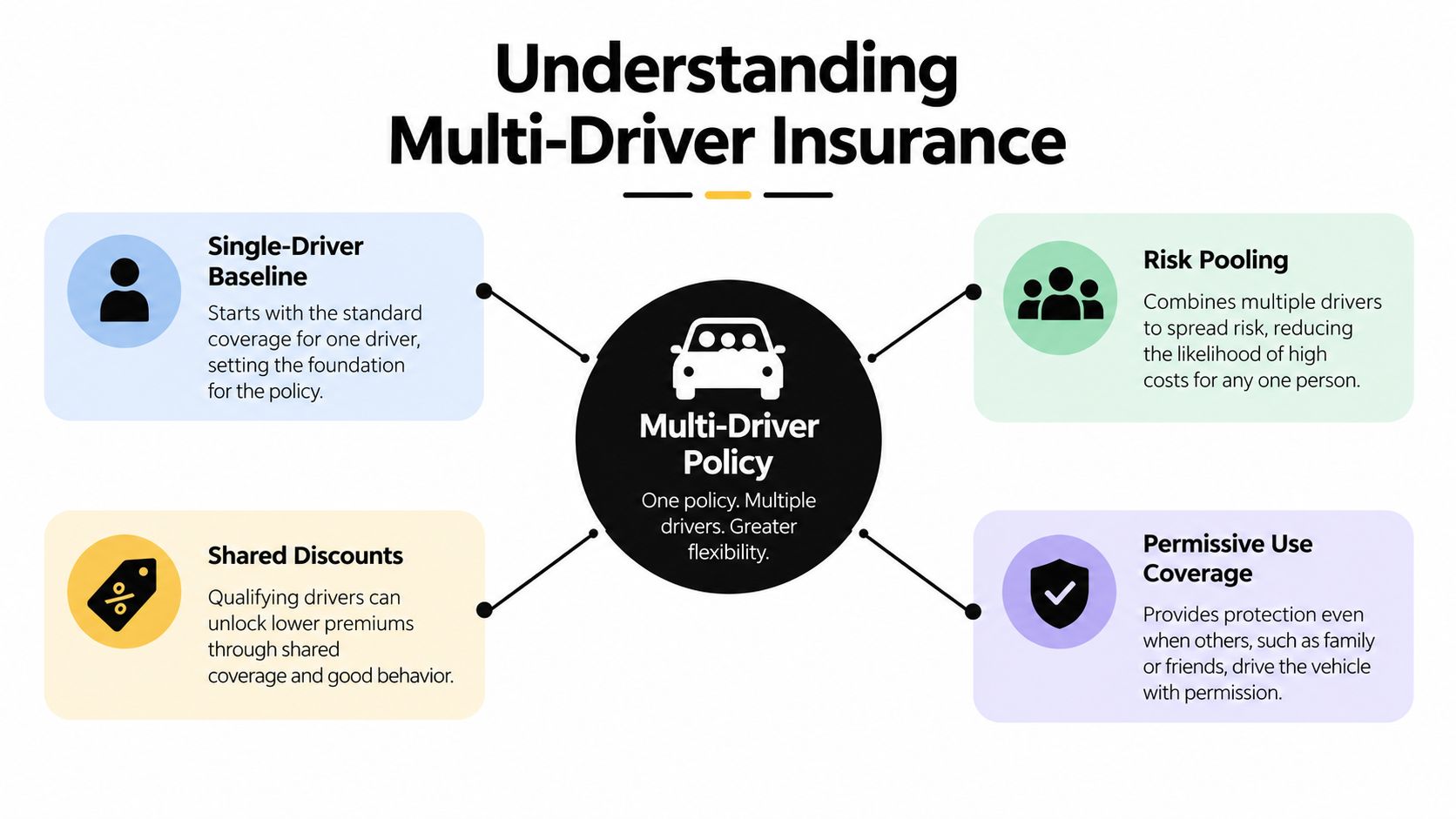
Named drivers versus permissive use
Permissive use is the loose, occasional-borrowing rule. Named-driver coverage is the strict version, where the insurer expects the regular users to be explicitly listed. That difference matters because a claim can turn on whether the person behind the wheel was a one-off borrower or a predictable driver who should've been disclosed.
Practical rule: If someone uses the car like it's theirs, list them. If they borrow it rarely, verify that your policy actually allows that kind of use before you assume you're covered.
This is also where policy wording gets people into trouble. If an insurer's terms are written loosely, families may think a borrowing situation is covered when the contract says otherwise. That's why some households bring in insured vs carrier language disputes help when policy language gets blurry, especially after a claim has already started.
The safest way to think about multi-driver coverage is simple. The insurer is underwriting a defined driver set, not a vague household convenience. If your teen, spouse, roommate, or adult child regularly drives, the policy should reflect that reality.
For a basic consumer checklist, the California home and auto FAQ is a useful place to sanity-check what your declarations page is actually saying.
Comparing Policy Types and Coverage Options
Whether to add a driver is only part of the choice. It's whether you should share a policy at all, or split risk across separate policies so one person's record doesn't contaminate everyone else's pricing.
Shared household policies versus separate policies
A standard household policy usually makes sense when the drivers live together, share the car often, and have reasonably similar risk profiles. A named-driver-only structure makes more sense when the insurer wants strict control over who can touch the keys. Shared policies for non-household members are trickier, because some insurers allow them and others expect everyone on the policy to live at the same address. That's the edge case people ignore with roommates, caregivers, college students, and adult children who split time between homes. The Zebra's shared auto insurance guidance captures that gap well.
| Multi-Driver Policy Structures Compared | Permissive Use | Best For |
|---|---|---|
| Standard household policy | Usually allowed for occasional borrowing | Families with regular shared use |
| Named-driver-only policy | Often excluded or tightly limited | Higher-risk households that need strict control |
| Shared policy across non-household drivers | Depends on the carrier | Roommates, caregivers, or split-address drivers |
What the cheapest quote can hide
The lowest upfront premium isn't always the smarter policy. If one driver has a poor record, a separate structure can protect the clean driver from being dragged into the same pricing bucket. That's the cross-subsidy risk many overlook: the clean record doesn't stay clean if the policy is rated against the household's worst driver.
Use your California auto insurance guide as a reference point when you compare structures, but don't stop at the price line. Read who's covered, who's excluded, and whether the policy matches how the car is used in daily life.
If the household use pattern is messy, separate policies can be the smarter move. If the use pattern is stable, shared coverage can still work, but only when the named drivers accurately reflect who actually drives.
How Insurers Calculate Multi-Driver Premiums
Insurers do not price a multi-driver policy by averaging everyone's behavior. They usually rate it off the highest-risk or principal operator profile, which means the most expensive driver in the household can set the tone for the entire policy. That's why adding a younger or more violation-prone driver can raise the premium even if that person only drives on weekends. NAIC's consumer auto tool lays out that logic plainly.
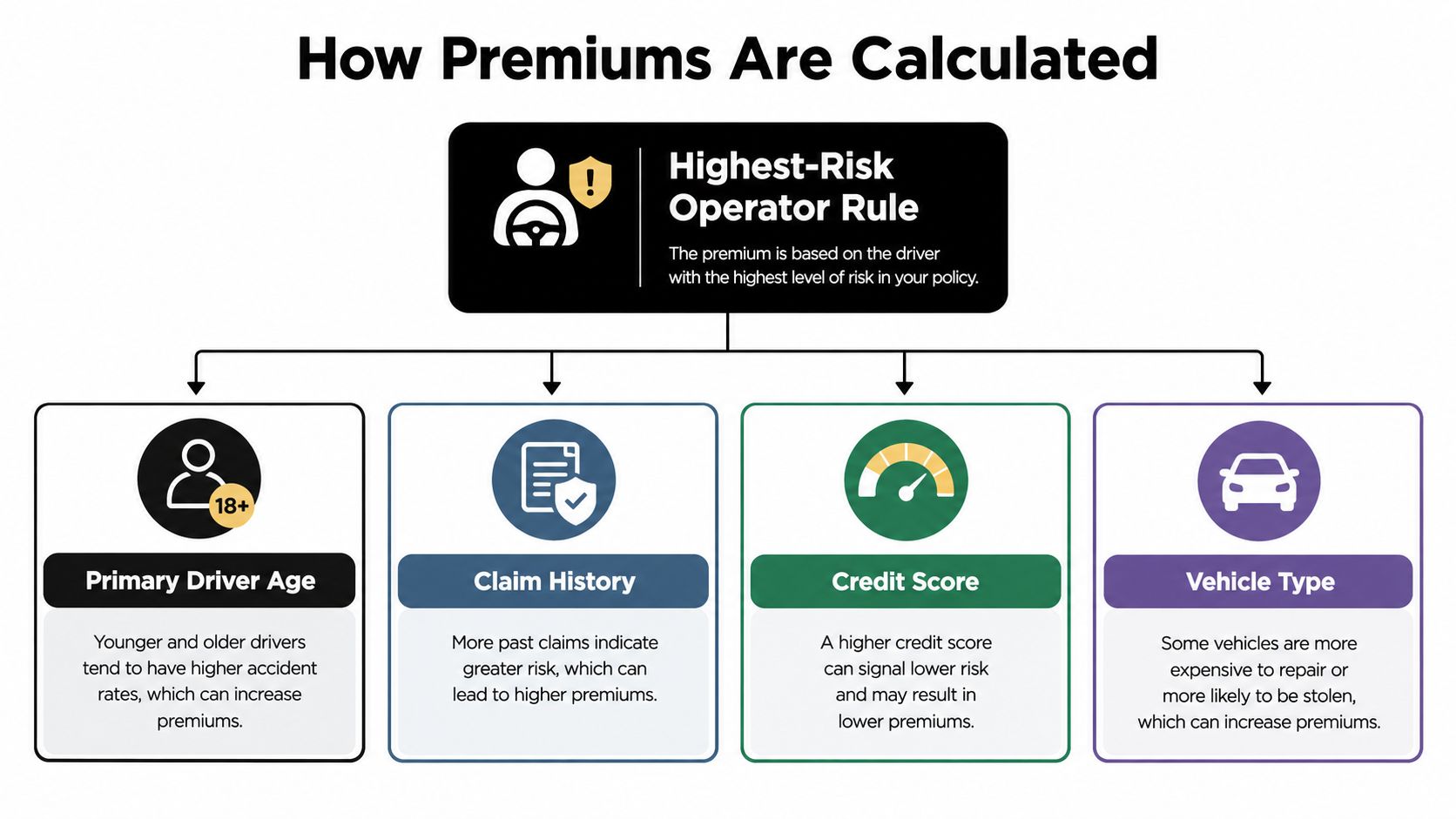
The factors that drive the rating
The carrier looks at the usual underwriting inputs, driving history, years of experience, age, mileage, territory, and sometimes credit-based factors where allowed. It may also rate the person who uses the vehicle most, or the youngest and riskiest driver in the home. That creates a real pricing consequence for families bringing in a teen, a recent immigrant driver, or someone with a recent at-fault crash, the whole vehicle can reprice upward because standard personal auto underwriting can't cleanly isolate every trip.
Bottom line: A household can't hide a risky driver behind “they barely drive.” If the driver belongs to the household and uses the car regularly, the policy will usually feel that risk somewhere in the premium.
Where telematics changes the conversation
Usage-based insurance changes the math because it measures how each person drives. That matters in multi-driver homes where one person is cautious and another is the one who brakes hard, speeds, or drives at night. State Farm's guidance on usage-based car insurance for multiple drivers shows why this approach is more relevant than broad household assumptions when several people share the same car, especially as these programs become more visible in 2026. State Farm's usage-based insurance guidance
Telementrics won't rescue every household. But if the surcharge comes from one young or inexperienced driver who's careful behind the wheel, a driver-level program can be more rational than a flat household rating. In plain English, don't accept a household-wide penalty if the data can support a narrower view.
Navigating California Auto Insurance Rules and Pitfalls
California households get burned when they treat permissive use like a standing permission slip. It isn't. Independent consumer guidance says permissive use usually means occasional borrowing, and many policies describe that as fewer than about 12 uses per year for a single borrowed driver. If someone is driving the car regularly, they should usually be listed, not casually covered under a borrowed-car assumption. Insurance.com's permissive-use guidance
The unlisted-driver problem
The biggest risk in California is misclassification. If a roommate, caregiver, college student, or adult child regularly drives the car but isn't listed, the carrier may contest the claim or decide the policy was rated on bad information. That's not a technicality, it's the difference between a valid claim and a fight over whether the driver should've been disclosed in the first place.
Use the California auto insurance page when you're checking your setup, because California households often have split-driving patterns that don't fit neat, single-driver assumptions. A kid away at school, a parent who only drives on weekends, or a caregiver who handles appointments twice a week all create a coverage question that needs a direct answer.
What California families should watch closely
If the car is shared, don't rely on vague assumptions about “family use.” Ask the carrier whether every regular driver must live at the same address, whether permissive use is capped, and whether a newly added driver will change the premium immediately. Then confirm the answer in writing, because that's where disputes get resolved.
California also has a broader insurance environment that rewards precision. Homeowners who can't get standard coverage sometimes end up in the California FAIR Plan, which is a separate last-resort story for property insurance, but the lesson is the same. The state's insurance market punishes sloppy risk placement, and auto policies are no exception.
Maximizing Multi-Driver and Multi-Car Discounts
There's a simple truth here, and most families ignore it until the bill shows up. The goal isn't just to add drivers, it's to build an insurance portfolio that absorbs the extra risk without overpaying for it.
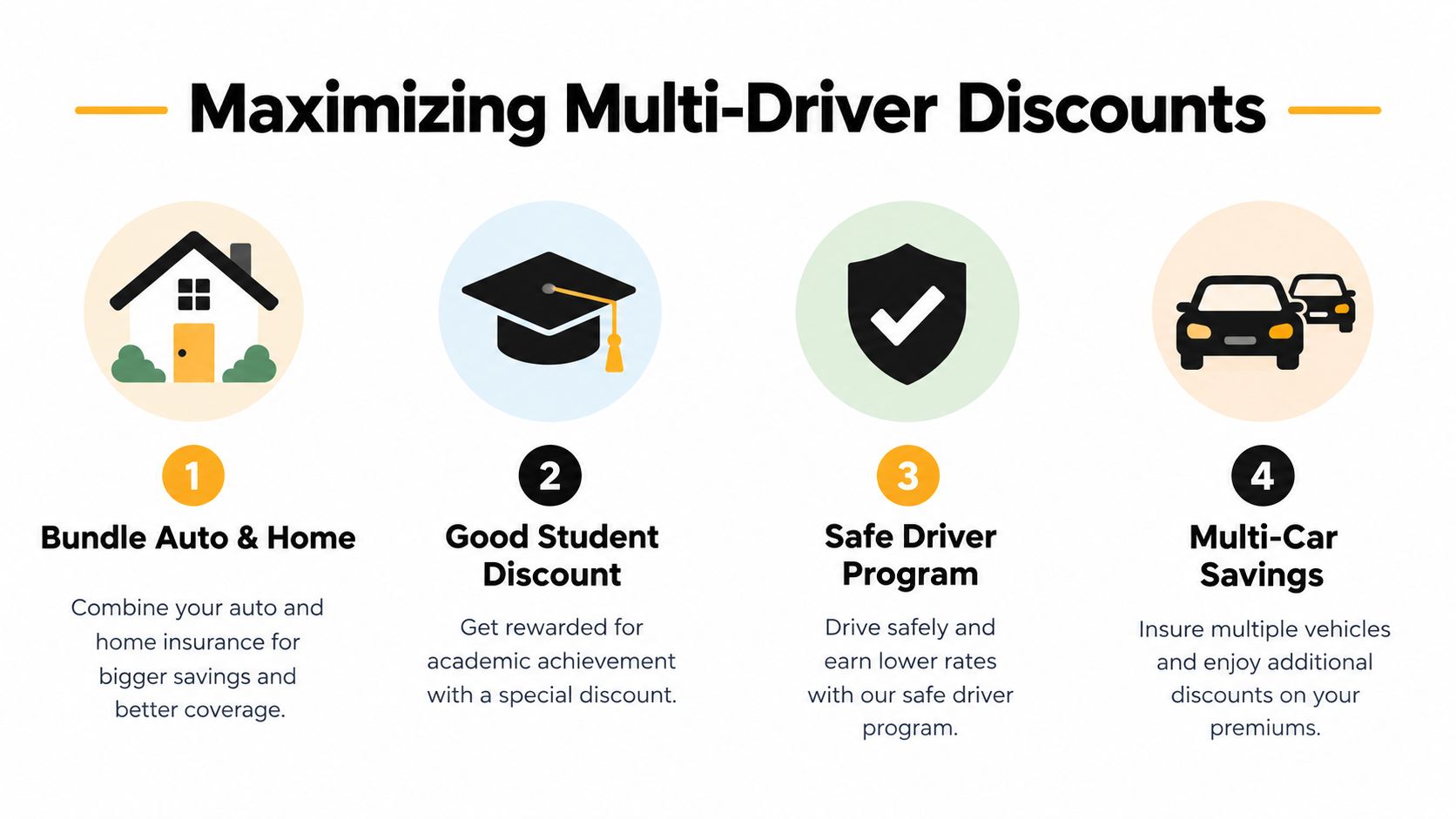
Discounts that actually matter
The most useful savings usually come from the obvious places. Multi-car pricing can help when the household has more than one vehicle. Bundling can also lower the total household spend when auto is paired with California home insurance, renters insurance, or even life insurance through the same carrier, because the company is now insuring more of the household's risk profile at once.
The California Department of Insurance notes that renters policies commonly cover personal contents, loss of use, personal liability, and medical payments to others, with personal liability coverage generally set at a minimum of $100,000 in California. California Department of Insurance renters guidance That matters because the household that protects its assets properly is often the same household that can quote auto more intelligently.
If you own property in a high-fire area, the California FAIR Plan can cover basic fire-related protection, and the state says extra coverages such as windstorm, hail, riot, aircraft, vehicles, volcanic eruption, and vandalism can be added for extra premium. California FAIR Plan residential guidance The point isn't to turn this into a homeowners article, it's to say that California families should treat auto, home, renters, and life coverage as one strategy, not separate purchases made in isolation.
Direct advice: Don't chase a discount if it weakens the claim picture. A bundle that saves a little but leaves a coverage gap is a bad deal.
Actionable Steps to Insure Your Household
Start with the drivers, not the quote. Write down who drives each vehicle, how often they drive it, and whether anyone borrows it regularly enough to need to be listed. If the answer is “often,” stop calling it permissive use and treat it like a named-driver issue.
- Identify the principal operator. The insurer will often rate the policy off the highest-risk or main user, so assign that before you shop.
- List regular users. Spouses, teens, roommates, caregivers, and adult children who drive often should be disclosed.
- Separate occasional borrowing from regular access. Borrowing a car once in a while is not the same as daily household use.
- Check your declarations page. Confirm liability limits, deductibles, and who's named on the policy.
- Test telematics if the household is mixed-risk. If one driver is clearly safer than the rest, usage-based pricing may fit better than a flat household rating.
- Compare bundle options after the driver list is clean. If you're also reviewing home, renters, or life coverage, ask for the total household cost, not just the auto price.
When you're ready to quote, use this California quote page and make sure you're comparing the same driver set across every carrier. A quote is only useful if the policy setup is honest.
Best practice: Quote the policy the way the car is actually used. If the driver list is wrong, every price you get back is misleading.
California homeowners in wildfire-prone areas should also verify that their liability and property setup doesn't leave them underinsured elsewhere in the household. The auto policy is one piece of the risk puzzle, but it should still stand on clean, accurate driver data.
Securing Comprehensive Coverage with Mai & Associates
Mai & Associates is built for households that need auto, home, renters, and life insurance reviewed together, not in separate silos. They compare rates from multiple carriers, work across more than 50 California cities, and provide support in English, Spanish, Armenian, Russian, and Vietnamese, which matters when a family needs the policy explained clearly the first time.
Their consultative approach fits this topic because multi-driver coverage is rarely just about the cheapest sticker price. It's about identifying who should be listed, where a separate policy makes more sense, and how to line up auto with the rest of the household's protection without paying for cross-subsidy you don't want.
If you're juggling teens, roommates, a second car, or a mix of home and renters coverage, a clean review beats guesswork. Mai & Associates can help you compare carrier options and tighten the policy structure before you commit to the wrong setup.
If your household has multiple drivers and the policy still feels messy, get a clean comparison before the next renewal. Visit Mai & Associates to review your auto, home, renters, or life coverage together and see whether your current setup is saving you money.