Car Insurance for 20 Year Olds: Your 2026 Guide to California Rates
Let's be honest—the first time you see a car insurance quote as a 20-year-old in California, the sticker shock is very real. It can feel downright unfair. For a basic minimum liability policy, you're likely looking at around $2,900 a year. If you need full coverage? That number can easily jump to over $7,400.
So, what gives? The main reason comes down to statistics. Insurance companies see drivers your age as a higher risk simply because you have less experience behind the wheel. Finding affordable California insurance is a challenge, but this guide will show you how.
Why Your Car Insurance Is So Expensive at 20
If you're wondering why your quotes are so much higher than your parents', it's not personal. It's all about risk assessment.
Think of it this way: a bank is more cautious about giving a large loan to someone with no credit history. In the same way, an insurance carrier sees a driver under 25 as a statistical unknown. Without a long, proven track record of safe driving, they have to assume a higher likelihood of you getting into an accident and filing a claim.
This risk-based pricing is the heart of the insurance industry. Companies rely on massive amounts of data that, year after year, show younger drivers are involved in more accidents. They price your policy to offset that potential cost.
The Numbers Behind the High Premiums
The data doesn't lie. Across the country, full coverage policies for 20-year-olds average between $3,329 and $4,067 annually. One study found the average cost to be $3,739 per year. That's a staggering $1,844 more than the national average of $1,895 for a 40-year-old driver.
This gap all comes back to experience—or lack thereof. If you’re still trying to understand all the moving parts that determine your rate, exploring the reasons for why is my car insurance so high can give you a clearer picture and some actionable steps to take.
Minimum vs. Full Coverage: A Cost Breakdown
In California, you have to decide between the state-mandated minimum liability or a more robust full coverage policy. For a young driver, the price difference for car insurance is significant.
Minimum Liability Coverage: This is the bare-bones policy required by law. It only pays for injuries and property damage you cause to other people. It does nothing to cover repairs for your own car, leaving you on the hook financially if your vehicle is damaged.
Full Coverage: This is a package that includes liability plus two crucial additions: collision and comprehensive. Collision covers your car's repairs after an accident (even if you're at fault), while comprehensive handles non-crash events like theft, fire, vandalism, or storm damage.
Key Takeaway: If you have a car loan or lease, your lender will almost certainly require you to carry full coverage. They need to protect their investment in the vehicle until you've paid it off completely.
To put this in perspective, here’s a snapshot of what a typical 20-year-old driver might pay.
Average Annual Car Insurance Costs for a 20-Year-Old
This table shows the stark contrast in premiums between a basic policy and one that fully protects your vehicle.
| Coverage Level | Average Annual Premium (20-Year-Old) | Average Monthly Premium (20-Year-Old) |
|---|---|---|
| Minimum Liability | ~$2,900 | ~$242 |
| Full Coverage | ~$7,450 | ~$621 |
While those figures can be intimidating, remember that they are just averages. Your actual rate is unique to you. The key is to understand what factors you can control. This guide will walk you through exactly how to lower those costs and find affordable car insurance for a 20 year old in California—and even show you how to get extra savings by bundling policies like auto insurance and renters insurance.
What Factors Determine Your Insurance Premium
When it comes to your car insurance premium, your age is definitely a big piece of the puzzle. But it's far from the only one. Insurance companies look at a whole range of details to figure out your final price. Think of it less like a fixed price tag and more like a custom quote built just for you.
Getting a handle on these factors is the key to finding ways to lower your cost. It’s not just about when you were born; it’s about your driving habits, the car you've chosen, and even your specific street address in California. Each detail helps the insurance carrier predict how likely you are to file a claim, which is the foundation of how they calculate rates.
Let's pull back the curtain on what really matters.
Your Personal Profile and Driving Record
Your history behind the wheel is, without a doubt, one of the biggest influences on your premium. A clean record with no accidents or tickets is your single best tool for getting a better rate. It tells an insurer that you're a lower-risk driver.
On the flip side, even one speeding ticket can seriously bump up your costs, especially as a young driver. It plays into the statistical risk that carriers associate with less experienced drivers.
Insurers also look at personal details that correlate with risk, and this can feel a bit unfair. For instance, statistics consistently show that young men are involved in more accidents than young women. Because of this, a 20-year-old man often pays more—an average of $3,561 per year for full coverage, while a 20-year-old woman pays closer to $3,127. That 12% difference works out to about $36 more each month for male drivers, all based on broad demographic data.
Here are the other key personal factors they'll look at:
- Driving History: This is the big one. At-fault accidents, moving violations, or a DUI on your record will send your rates soaring. A clean slate is your best friend.
- SR-22 Filing: If a court or the DMV has ordered you to file an SR-22 in California, get ready for a significant price hike. This certificate, often required after a major violation like a DUI, flags you as a high-risk driver to all insurance companies.
- Credit History: Unlike in some other states, California insurers are allowed to use a credit-based insurance score when setting your rate. A solid credit history can suggest financial responsibility and might just earn you a lower premium.
The Car You Drive Matters
What you're driving is just as important as how you drive it. The make and model of your car directly impact your insurance bill. Carriers analyze everything from the car’s market value and typical repair costs to its safety ratings and how often it gets stolen.
This is exactly why insuring a dependable used sedan is almost always cheaper than covering a flashy new sports car.
Just picture two different 20-year-olds. One has a 2017 Honda Civic, and the other just bought a brand-new Ford Mustang. The Mustang's higher price tag, expensive parts, and powerful engine make it a much bigger financial risk for the insurance company, which means a much higher premium for its owner.
Pro Tip: Before you fall in love with a car, get an insurance quote for it. That "dream car" might come with an insurance payment that completely wrecks your budget. A more practical choice could keep your total monthly expenses manageable.
Your California Location
Believe it or not, where you park your car at night can have a huge impact on your insurance rate. Premiums can swing wildly from one California ZIP code to the next. Insurers are constantly analyzing local data on traffic congestion, accident frequency, car theft rates, and even claims related to severe weather.
This flowchart really gets to the heart of why rates are so high for young drivers.
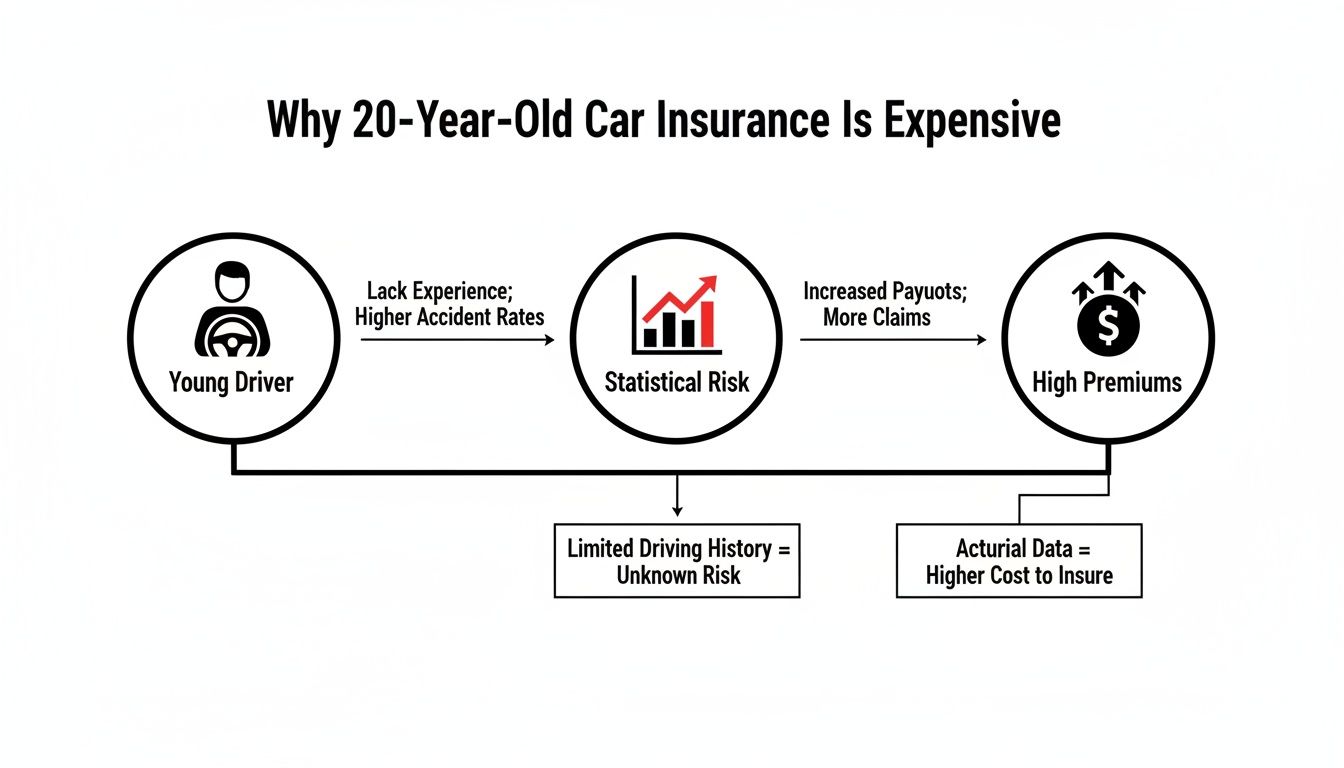
The path from "Young Driver" to "Statistical Risk" and then to "High Premiums" clearly shows the straightforward logic that insurance carriers follow when pricing your policy.
For example, a 20-year-old living in a crowded, high-traffic city like Glendale will almost always pay more than someone in a quiet suburb like Westlake Village. More cars and more crime in an urban area mean more risk, which translates to higher premiums for everyone who lives there. This is why getting specific, local quotes is so important. An agency like Mai & Associates, which understands the unique risk profiles of over 50 California cities, can help you find the best rate for your neighborhood and see if bundling your auto insurance with a renters insurance policy can unlock even more savings.
Choosing the Right Auto Insurance Coverage
Picking out your first auto insurance policy can feel overwhelming. It’s a bit like looking at a menu in a foreign language—you know you need to order, but what’s essential and what’s just an expensive extra? Let's break it down so you can build a policy that actually protects you without breaking the bank.
Think of your car insurance for a 20 year old as a financial safety net. The goal is to build one strong enough to catch you if something goes wrong on the road, but tailored so you're not overpaying. The whole process starts with the one thing you can't skip: California's legal minimum.
Understanding California's Minimum Liability
California law requires every single driver to carry liability insurance. This is the absolute floor, the bare minimum you need to legally operate a vehicle. But what does it actually cover?
Simply put, liability insurance only pays for damage you cause to other people and their property. It’s split into two main buckets:
- Bodily Injury Liability: If you’re at fault in an accident and someone else gets hurt, this helps pay for their medical bills and related costs.
- Property Damage Liability: This covers the cost to repair or replace the other driver’s car, or anything else you might have damaged, like a fence or a storefront.
The key thing to understand here is the massive gap it leaves. Minimum liability does absolutely nothing for your own car or your own injuries. If you cause a wreck with only minimum coverage, you’re on your own to pay for your car repairs and medical bills.
When Full Coverage Is a Smart Investment
This is where the term "full coverage" comes into play. It’s not an official type of policy, but it’s what we in the industry call a policy that includes liability plus two crucial additions: Collision and Comprehensive.
Key Insight: Full coverage is what protects your car. It's the difference between getting a check to fix your vehicle after a crash or having to pay for it entirely out of pocket.
Here’s what these two coverages add:
- Collision Coverage: This is your protection for accidents. It pays to repair your car whether you backed into a pole, got rear-ended, or were in a multi-car pileup. It kicks in regardless of who is at fault.
- Comprehensive Coverage: This handles just about everything else—all the non-crash chaos. Think theft, vandalism, a tree branch falling on your roof, hitting a deer, or fire.
If you have a car loan or you're leasing, your lender will absolutely require you to have both. They have a financial stake in your car and need it protected. If you own your car outright, especially an older one, it becomes a judgment call: is what the car is worth more than what you'd pay for the added coverage over time?
Essential Add-Ons For California Drivers
Beyond the big two, there are a couple of other coverages that offer huge peace of mind for a relatively small price, and I almost always recommend them for young drivers in California.
Uninsured/Underinsured Motorist (UM/UIM) Protection is, without a doubt, one of the most important. California has a staggering number of drivers on the road with no insurance at all. If one of them hits you, this coverage becomes your primary safety net, paying for your medical bills and sometimes even your car repairs. Without it, you could be left holding the bag for an accident you didn't even cause.
Medical Payments (MedPay) is another fantastic, low-cost option. It helps cover immediate medical costs for you and your passengers after an accident, no matter who was at fault. It's perfect for handling things like health insurance deductibles and copays right away.
As you finalize your policy, you’ll also need to consider your liability limits. The state minimums are dangerously low and often won't be enough to cover a serious accident. Opting for higher limits, like 50/100/50 ($50k for single-person injury, $100k for total injuries, $50k for property damage), is a smart move to protect your future assets and earnings from a lawsuit. It's also important to know the finer details, like whether you pay a deductible if not at fault in California. For a deeper dive on this, our comprehensive guide to auto insurance in California is a great resource.
Actionable Strategies to Lower Your Insurance Costs

Seeing that first insurance quote as a 20-year-old can be a shock. But don't let the sticker price discourage you. You have far more power to bring that number down than you might think. It's all about knowing which levers to pull when looking for California insurance.
For most young drivers, the single biggest money-saver is to remain on their parent's policy. Insurers see this as a safer bet, and when you factor in the multi-car discount that almost always applies, the savings can be huge compared to going it alone.
But whether you're on a family plan or getting your own policy, plenty of other tactics can make your coverage much more affordable. You just have to be a little proactive.
Hunt for Every Available Discount
Think of insurance discounts as rewards for being a low-risk driver. The catch is, companies don’t always shout them from the rooftops, so you often have to ask. It's like using coupons—a few small discounts can add up to serious savings on your final bill.
"Discounts are the fastest way to see an immediate reduction in your premium. From good grades to safe driving courses, each one you qualify for directly lowers your bill. It pays to ask your agent for a full review of every possible discount."
Make a quick checklist of the common discounts and see how many you can tick off. Even a 5% or 10% discount makes a real dent in your payments over a year.
Here are the heavy hitters for a 20-year-old in California:
- Good Student Discount: This is a big one. If you keep a "B" average (a 3.0 GPA) or higher in school, most insurers will reward you with a hefty discount. It's one of the easiest ways to prove you're responsible.
- Defensive Driving Course: Spending a weekend on a state-approved defensive driving course shows your insurer you’re committed to safety. In return, you can get a discount that often lasts for three years.
- Student Away at School: Heading off to college more than 100 miles from home without your car? Make sure your parents tell their insurance company. This can trigger a significant discount since you won't be driving nearly as much.
- Low Mileage Discount: If your car is mostly for short trips and you drive less than the California average (usually under 7,500 miles a year), you could qualify for a low-mileage discount.
Leverage Technology and Bundling
Beyond the classic discounts, there are some modern, tech-savvy ways to save. Two of the most powerful are telematics programs and bundling your policies.
A telematics program (also called usage-based insurance) is your chance to prove you're a safe driver with data. You use a small device or a phone app that tracks your actual driving habits—things like braking, speed, and what time you drive. Good, consistent driving can earn you a personalized discount based on how you drive, not on statistics about other 20-year-olds.
Another incredibly simple strategy is bundling. If you're renting an apartment, you need renters insurance anyway. By getting your auto insurance and renters insurance from the same provider, like Mai & Associates, you can often unlock a multi-policy discount that lowers the cost of both. You can also ask about bundling life insurance or home insurance for even greater savings.
Make Smart Choices with Your Vehicle
Finally, the car you drive plays a massive role in what you'll pay. It’s a simple formula: a safe, reliable, and less expensive car will always be cheaper to insure than a flashy sports car or a big luxury SUV.
Insurers look at safety ratings, crash-test results, and even how often a certain model is stolen. Cars that perform well in these areas are considered less risky, and that means a lower premium for you. Before you even buy a car, it's a smart move to get quotes for a few different models to see exactly how your choice will impact your wallet.
Finding the Best Car Insurance Quotes in California

Alright, you've done the homework on which coverages you need and which discounts to look for. Now comes the part that actually saves you money: shopping around.
Getting the best car insurance for a 20 year old isn't about grabbing the first cheap policy you see; it's about finding the best value. The difference in premiums between insurance companies can be shocking, so comparing quotes is an absolute must.
Think about it—you wouldn't buy a new laptop without checking prices at a few different stores. Car insurance is the same, but the stakes are much higher. A few minutes of comparison shopping can easily save you hundreds of dollars a year.
To get going, you'll want to have a few pieces of information ready. This makes the whole process faster and ensures the quotes you get are genuinely accurate.
What You Need for an Accurate Quote
Insurers need specific details to give you a real price, not just a vague estimate. The more precise you are, the more you can trust the numbers they give you.
Here’s a quick list of what you’ll want to have on hand:
- Personal Info: Your full name, birth date, and California address.
- Driver’s License Number: This is how they check your official driving record.
- Vehicle Information Number (VIN): The car's unique 17-digit ID. It tells them the exact year, make, model, and factory features.
- Vehicle Details: The car's current odometer reading and any safety features it has, like an anti-theft system or automatic emergency braking.
- Driving History: Be honest about any tickets or accidents you've had in the last 3-5 years. They'll find out anyway!
Comparing Your Options: Going Direct vs. Using an Independent Agency
Once your documents are in order, you have two main ways to hunt for quotes. You can go directly to each insurance carrier one by one, or you can team up with an independent insurance agency like Mai & Associates.
Going direct involves visiting the websites of companies like Progressive, Geico, or State Farm and filling out their quote forms individually. It works, but it’s a grind. You'll find yourself entering the same information over and over, and then you’re on your own to figure out which policy offers the best deal.
The real advantage comes from working with an independent agency. An agent works for you, not for a single insurance company. They do all the comparison shopping on your behalf, using their expertise to match you with the right carrier for your specific situation.
For example, an agent knows from experience which companies are more lenient about a speeding ticket or which ones offer the best rates for a Honda Civic versus a Ford Mustang. They navigate these industry quirks for you, saving you a massive amount of time and often finding deeper savings than you could on your own. This is where expertise really pays off.
An independent agent also understands the huge impact your zip code has on your premium. In California, where we serve clients in over 50 cities, rates can swing wildly from one town to the next. Having a local expert who knows the California insurance market is crucial.
At Mai & Associates, we act as your personal insurance advocate. We don't just find a cheap auto policy; we look at the whole picture, including potential bundles with home insurance, renters insurance, or even life insurance to maximize your savings.
Ready to see what an expert can do for you? You can get an insurance quote from Mai & Associates in just a few minutes and let us handle the hard part.
Your Questions on Young Driver Insurance Answered
Stepping into the world of car insurance as a 20-year-old can feel overwhelming. You know you need it, but getting straight answers to your specific questions is tough. We hear from young drivers in California all the time, so we've put together answers to the questions that come up most often.
Let's dive right in with a big one: that milestone birthday everyone looks forward to. While the change to your premium isn't some magic switch that flips at midnight on your 21st birthday, it is a genuine turning point.
How Much Does Insurance Go Down When I Turn 21?
Don't expect your rates to get cut in half, but turning 21 does bring a small, noticeable discount. Insurance carriers see this as the first step into a slightly lower risk category. You can typically expect a rate reduction somewhere between 5% and 15%, though this depends on your specific insurance company and your driving history.
The really significant age-related price drop comes when you turn 25. That's when you officially graduate from the highest-risk demographic in the eyes of insurers. Until then, every birthday helps chip away at your premium, especially when you keep your driving record squeaky clean.
Can I Get Car Insurance with Just a Permit at 20?
This is a situation we see all the time. In California, if you're 20 and only have a learner's permit, you generally can't purchase your own, separate car insurance policy. Insurers require a valid driver's license to write a standalone policy.
Of course, you still have to be insured to drive legally. The solution is to be added as a "permitted driver" to an existing policy—almost always a parent's or guardian's. This is the standard way to make sure you have the required liability coverage while you're practicing.
Will One Speeding Ticket Really Raise My Insurance That Much?
For a 20-year-old driver, the answer is a hard yes. A single speeding ticket will hit your premium much harder than it would for a 40-year-old with a long, clean history. To an insurer, that ticket confirms the statistical risk they already associate with your age group.
Key Insight: For a young driver, one speeding ticket can jack up annual premiums by 20% to 30% or even more. That one mistake could easily cost you hundreds of dollars every year for the next three to five years until it drops off your record.
This is exactly why keeping a clean driving record is the single most powerful tool you have for keeping costs down. It’s your way of proving to insurers that you’re a safer bet than their stats might suggest.
Is Staying on My Parents' Policy Always Cheaper?
For the vast majority of 20-year-olds, the answer is yes—staying on a family policy is almost always the most affordable route. The savings come from multi-car discounts and the fact that the policy's overall risk is balanced out by the more experienced drivers. It's usually a huge win.
However, it's not a universal rule. There are a few scenarios where it might not be the best or cheapest option:
- You Own a High-Performance Car: If you buy an expensive sports car, adding it to your parents' policy could send their rates through the roof, sometimes making it more expensive for the whole family.
- You Have a Poor Driving Record: If you've racked up a few tickets or an at-fault accident, your presence on the family policy could become a major financial headache. In that case, it might actually be cheaper for everyone if you get your own separate, high-risk policy.
- You've Moved Out for Good: Once you establish your own permanent residence, most insurance companies will require you to get your own policy.
The only way to know for sure is to compare the numbers. Get a quote for your own policy and stack it up against the cost of being added to your parents' plan. For more detailed answers, you can always check out our full FAQ page for California drivers.
At Mai & Associates, we specialize in helping young drivers make sense of these exact situations. We’ll help you compare quotes and find the right balance of coverage and cost, whether it's for your auto insurance, home insurance, renters insurance, or life insurance. Get your no-obligation quote today at https://cahomeauto.com.