Car Insurance for 18 Year Old in California: Save on Your Premium Today
That first car insurance quote as an 18-year-old is often a real shocker. You see the price and immediately think, "Is that a typo?" It’s not—but understanding why your rate is so high is the first step toward figuring out how to bring it down. As experts in California insurance, we'll guide you through the essentials of auto, home, and renters insurance to help you make informed decisions.
Why Is Car Insurance So High for 18 Year Olds?
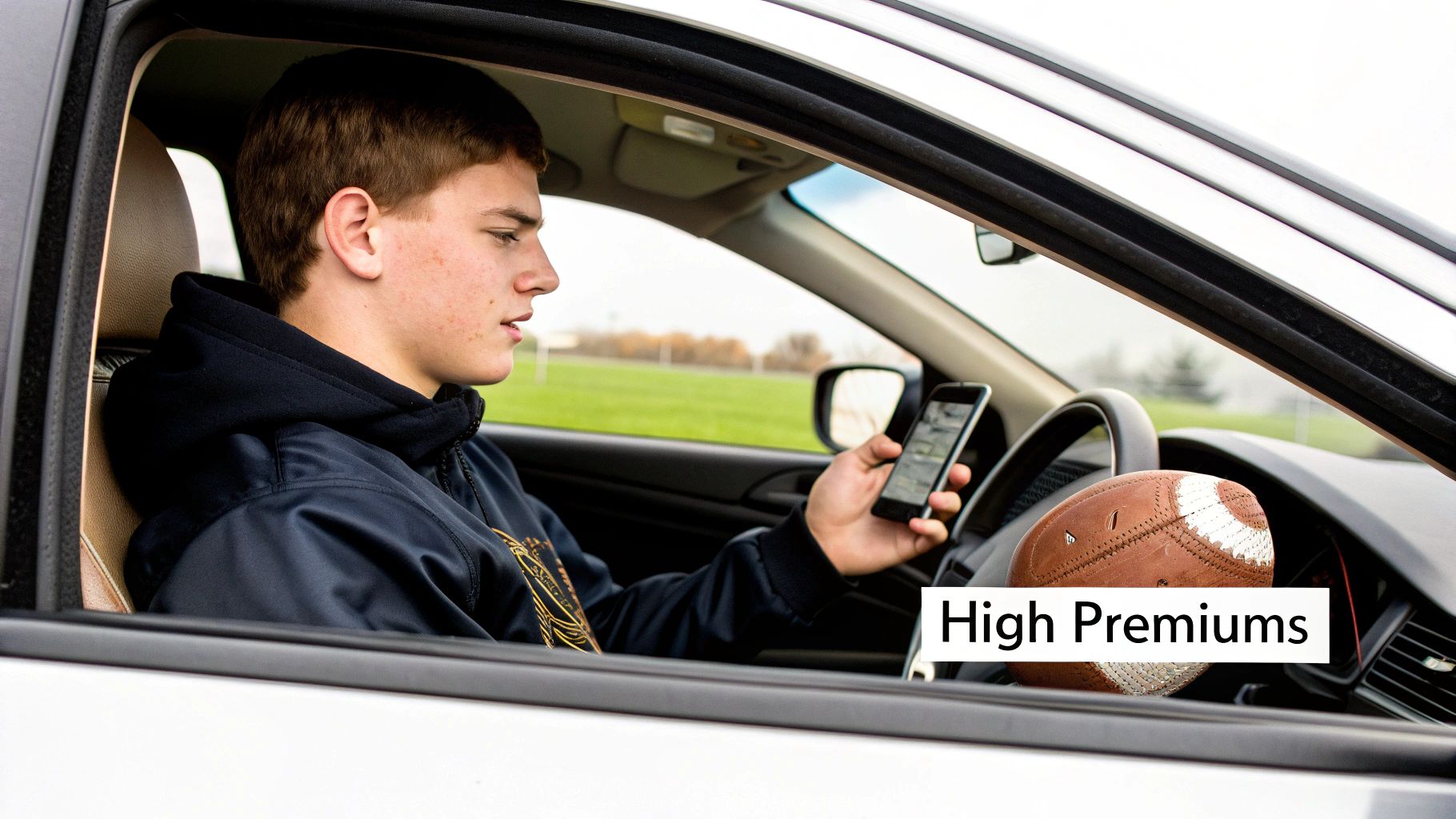
Shopping for car insurance for an 18 year old can feel a bit unfair. That high premium isn't a personal judgment on your driving skills. Instead, it’s a number calculated from decades of data covering millions of drivers.
Think of it like a rookie quarterback fresh out of the draft. He might have a cannon for an arm and know the playbook inside and out, but he hasn't seen a real NFL blitz yet. He lacks the years of in-the-pocket experience to read complex defenses instinctively. Because of that, he's seen as a higher risk for turnovers. In the same way, an 18-year-old driver knows the rules of the road but doesn't have the seasoned judgment that only comes from navigating thousands of real-world miles.
The Role of Statistics in Setting Rates
At its core, insurance is a game of numbers, and for new drivers, the stats can be a tough pill to swallow. Insurers use massive datasets to predict how likely someone is to file a claim, and the data consistently shows that drivers under 20 are involved in far more accidents.
This higher statistical risk is the main reason for the higher cost. Nationwide data reveals that drivers aged 18 to 19 are involved in 730 crashes per 100 million miles driven. That’s a significant improvement over 16- and 17-year-olds, but it's still way higher than for drivers who have been on the road longer. As a result, teen drivers often pay about 127% more for coverage than their middle-aged counterparts. You can find more details on how rates change with age over at Moneygeek.com.
An insurance premium for a young driver is essentially a prediction based on group behavior. It's not about how well you drive today, but about how likely someone in your demographic is to get into an accident.
Key Factors That Increase Premiums
So, what specific things are driving up the cost of auto insurance for young adults in California? A few key factors come together to create that high premium.
- Limited Driving History: This is the big one. You simply haven't been on the road long enough to build a track record of safe, claim-free driving. To an insurer, you're an unknown variable.
- Ongoing Brain Development: It’s just biology. Scientists have shown that the prefrontal cortex—the part of the brain that handles impulse control and risk assessment—doesn't fully mature until our mid-20s. Insurance companies factor this into their risk models.
- Higher Accident Frequency: As the stats show, young drivers are just in more accidents, from small fender-benders to more serious collisions. Every single one of those incidents represents a potential payout for the insurer.
When you combine these factors, you get a profile that insurance carriers see as high-risk. But here’s the good news: this is just your starting point. Your rates won’t stay this high forever, and there are plenty of things you can do right now to find more affordable car insurance.
Decoding Your California Auto Insurance Options
Let's be honest, an auto insurance policy can feel like it's written in another language. It’s full of terms that don't mean much until you suddenly need them after an accident. For a new driver, figuring out what these terms actually mean is the first step toward building a policy that has your back.
Think of your insurance policy like a toolkit. You've got the essentials that the law says you have to carry, but the best toolkits have extra gear for those specific, unexpected problems. We'll build your policy the same way, layering different types of protection to create a solid financial safety net. This principle applies whether you're looking at car insurance or home insurance.
The Foundation: What California Law Requires
First things first, California requires every driver to have Liability Coverage. This is the absolute bare-minimum, non-negotiable part of your policy. It's important to remember that this coverage isn't for you—it's for the other person.
Liability Coverage is your financial shield. If you're at fault in an accident, it pays for the other driver's vehicle repairs and their medical bills. This protects you from being sued and having to pay those costs out of your own pocket.
You'll often see California's minimum liability limits written as 15/30/5. Here’s what that means in plain English:
- $15,000 for injury or death to one person.
- $30,000 for injury or death to more than one person in a single accident.
- $5,000 for damage to someone else's property (like their car).
Meeting this minimum keeps you legal, but that's about it. A serious accident can blow past these limits in a heartbeat. Imagine you cause a crash that totals a $40,000 SUV. Your $5,000 property damage limit covers the first slice, but you're on the hook for the remaining $35,000. That's why nearly every experienced driver opts for much higher limits.
Building a Stronger Policy: Protecting Your Own Car
Once you've got liability covered, it's time to add protection for you and your car. These coverages are technically optional, but if you have a car loan or a vehicle you can't afford to simply replace, they're pretty much essential.
Collision Coverage: This is what pays to fix or replace your car if it's damaged in a crash with another vehicle or an object, like a fence or a light pole. It doesn't matter who was at fault. If you hit a patch of black ice and slide into a guardrail, Collision is what gets your car back on the road.
Comprehensive Coverage: Think of this as the "life happens" coverage. It protects your car from just about everything besides a collision. This includes theft, vandalism, fire, hitting a deer, or damage from a storm. If a hailstorm dings up your hood or a thief smashes your window, Comprehensive is there to help.
To make these concepts even clearer, here’s a quick-glance table breaking down the most common coverages.
California Car Insurance Coverage Explained
Understanding the different pieces of an auto policy is the best way to ensure you're not paying for things you don't need or, worse, missing a coverage you desperately will. This table lays out the key players.
| Coverage Type | What It Covers | Is It Required in California? |
|---|---|---|
| Bodily Injury Liability | Medical bills and lost wages for others in an accident you cause. | Yes, $15,000/$30,000 minimum. |
| Property Damage Liability | Repairs to the other person's car or property in an accident you cause. | Yes, $5,000 minimum. |
| Collision | Repairs or replacement for your car after a collision, regardless of fault. | No, but usually required for a car loan. |
| Comprehensive | Repairs or replacement for your car from non-collision events like theft, fire, or vandalism. | No, but usually required for a car loan. |
| Uninsured/Underinsured Motorist | Your medical bills (and sometimes car repairs) if you're hit by a driver with no or too little insurance. | No, but highly recommended. |
| Medical Payments (MedPay) | Your and your passengers' medical bills after an accident, regardless of fault. | No, but very useful. |
Choosing the right mix is all about balancing your budget with your need for financial security.
Smart Add-Ons for Real-World Scenarios
Finally, there are a couple of other coverages that we almost always recommend. They fill critical gaps left by the main policies and address some very common, and very expensive, risks you'll face on California roads.
- Uninsured/Underinsured Motorist (UM/UIM): What happens when the person who hits you has zero insurance, or just the state minimum? Your bills could be huge. This coverage steps in to pay for your injuries and, depending on the policy, your car repairs. With so many uninsured drivers out there, this is a real lifesaver.
- Medical Payments (MedPay): This helps pay medical bills for you and your passengers right away, no matter who was at fault for the accident. It's great for covering health insurance deductibles and co-pays without having to wait for a settlement.
Building the right policy is a balancing act, but it all starts with knowing what you're buying. For an even deeper dive, feel free to check out our complete guide to auto insurance in California, which gets into even more detail.
Staying on a Parent's Policy vs. Getting Your Own
One of the biggest questions for any 18-year-old driver is whether to get your own car insurance for 18 year old policy or just hop onto your parents' plan. This isn't just about saving a few bucks each month—it's a decision that impacts your financial future, who's responsible in an accident, and how quickly you build your own financial independence.
There’s no single right answer here. Let's walk through the pros and cons of each path so you can figure out what makes the most sense for you and your family.
The Case for Joining a Parent's Policy
For most families, adding a new 18-year-old driver to an existing policy is the go-to move, and for good reason. It's almost always the cheapest and fastest way to get covered.
The main advantage is simple: you get to benefit from your parents' long, clean driving record. They've likely been insured for decades, building up loyalty discounts and a history of safe driving. By joining their policy, you're essentially borrowing that good reputation, which helps soften the sticker shock of insuring a young, high-risk driver. Many families save even more by bundling their auto insurance with home insurance or renters insurance.
A crucial detail to remember is car ownership. Here in California, if you still live at home and your parents' names are on the car's title, joining their policy is often your only choice. Insurers need the policyholder to have an "insurable interest" in the vehicle, meaning they have a financial stake in it.
However, sharing a policy means sharing the risk. If you get into an accident, it’s not just your problem—it could cause the entire family's premium to skyrocket at renewal time. That financial ripple effect is a serious conversation to have with your parents.
When a Standalone Policy Makes More Sense
On the flip side, getting your own policy is a huge step toward becoming financially independent. Sure, the monthly payments will be higher at first—there's no sugarcoating that. But think of it as a long-term investment in yourself.
By starting your own policy, you begin building your own insurance history from day one. Every year you drive accident-free, you're proving to insurers that you're a responsible driver. That positive track record will unlock much better rates as you get into your early 20s. This independent history is valuable for all future California insurance needs, including renters insurance or life insurance down the line.
A standalone policy also creates a clean financial line in the sand. If you have an accident, it only impacts your premium, not your parents'. This is often the necessary route if you own the car outright or if you've moved out of the house.
To get a better sense of the choices you'll face, this decision tree shows the basic path to building a policy.
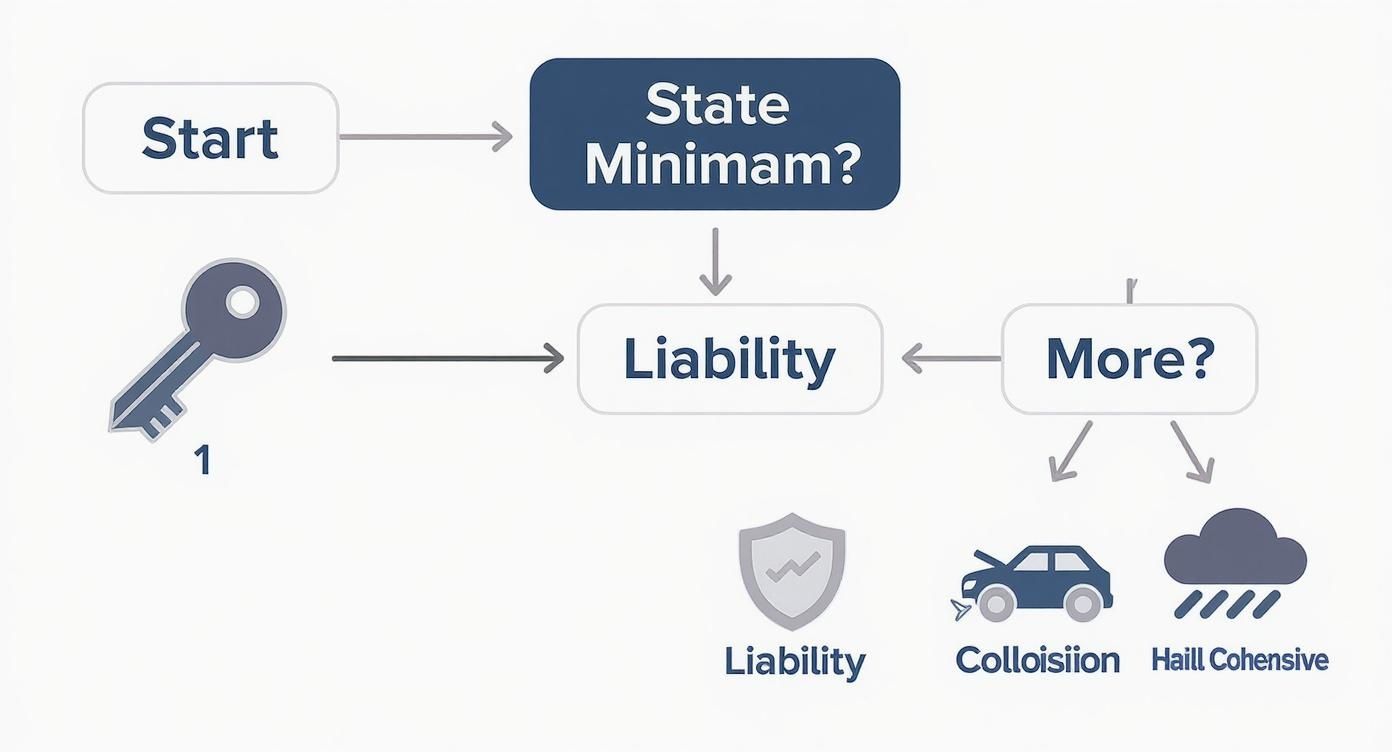
As the infographic lays out, your first big decision is whether to go with California's bare-bones minimum liability or opt for more robust protection like Collision and Comprehensive coverage.
Joining a Parent's Policy vs. Getting Your Own
Let's put it all together. The choice really boils down to balancing today's costs against tomorrow's goals.
There's a statistical reason why insuring a young driver is so expensive. According to the National Safety Council, drivers aged 16 to 19 represent just 3.7% of all licensed drivers but are involved in a whopping 8.7% of all crashes. You can dig into more of these age-related driving statistics from the National Safety Council to see why insurers view this age group as a major risk.
This table breaks down the key differences to help you and your parents weigh the options.
| Factor | Staying on a Parent's Policy | Getting Your Own Policy |
|---|---|---|
| Initial Cost | Almost always lower, thanks to multi-car discounts and parental driving history. | Significantly higher because you're starting from scratch as a new, high-risk driver. |
| Long-Term Impact | Delays building your own insurance history, which can mean paying higher rates later on. | Starts building your personal insurance history immediately, leading to lower rates sooner. |
| Liability | Your driving record directly impacts the entire family's premium if you have an accident. | Your driving record only affects your own policy and premium. You are solely responsible. |
| Independence | You're financially tied to your parents' policy and their decisions about coverage. | You have full control over your coverage, payments, and financial responsibility. |
| Best For | Drivers living at home whose parents own the car and want the most affordable option now. | Drivers who own their own car, live independently, or want to start building their insurance history. |
Ultimately, this is a decision that requires an open and honest conversation with your parents. You'll need to decide together which path best aligns with your living situation, your budget, and your goals for financial independence.
Proven Ways to Lower Your Car Insurance Premiums

Seeing that first insurance quote as an 18-year-old can definitely be a shock. But here’s the good news: that initial number is just a starting point. It's not set in stone.
You actually have a good amount of control over your final premium. By being smart and proactive, you can show insurance companies that you're a safe, responsible driver and unlock some serious savings. Let's walk through the most effective ways to bring that cost down here in California.
Leverage Your Success in the Classroom
Believe it or not, your hard work in school can pay off on your insurance bill. Carriers have crunched the numbers and found a solid link between good grades and safe driving habits. It turns out that students who are disciplined with their studies tend to be more careful on the road.
This is where the Good Student Discount comes in, and it's a big one. It can often knock 10-15% right off your premium. To qualify, most California insurers will want to see that you:
- Maintain at least a "B" average or a 3.0 GPA.
- Rank in the top 20% of your class.
- Score in the top 20% on a standardized test like the SAT or ACT.
All you typically need to do is send your agent a copy of your latest report card or an official transcript. It’s one of the easiest and fastest ways to get an immediate price drop.
Become a Smarter, Safer Driver
Beyond your report card, you can earn more discounts by actively improving your driving skills. Insurance companies love to see drivers invest in their own safety education because it directly lowers the chances of them having to pay out a claim.
Completing a state-approved defensive driving course is a fantastic way to both sharpen your skills and lower your premium. These courses teach you much more than basic driver's ed—you'll learn advanced techniques for spotting hazards, reacting to sudden dangers, and handling tricky road conditions. Once you finish, you get a certificate to hand over to your insurer for a nice discount. For a deeper dive into other ways to protect yourself, feel free to explore our collection of helpful California insurance guides.
Choose Your Vehicle Wisely
The car you drive plays a huge role in what you pay for insurance. It’s not just about you; carriers look at the car’s safety record, how much it costs to fix, and how often it gets stolen. For an 18-year-old, the right car choice can literally save you thousands of dollars a year.
Think of it this way: insuring a brand-new sports car is like insuring a high-stakes bet. It's fast, expensive to fix, and statistically more likely to be in a high-speed crash. A sensible, four-door sedan with top safety ratings, on the other hand, is a much safer bet for the insurer.
Here’s why a more modest car is a smarter financial move:
- Lower Repair Costs: Parts for a common sedan are way cheaper and easier to find than for a performance car.
- Better Safety Ratings: Cars loaded with safety features like anti-lock brakes, multiple airbags, and stability control earn better insurance rates.
- Lower Theft Risk: A boring family sedan is far less attractive to car thieves than a shiny new sports car.
Here's a pro tip: Before you even think about buying a car, get an insurance quote for it first. This one simple step can save you from getting stuck with a car that has an impossibly high insurance premium.
Prove Your Safe Driving with Technology
Today, one of the best ways to slash your auto insurance premium is through a telematics program. These programs use a small device you plug into your car or a smartphone app to track your real-world driving habits.
Programs like Drive Safe & Save look at real data points, including:
- Hard Braking: How often you’re slamming on the brakes.
- Rapid Acceleration: How often you’re flooring it from a stop.
- Time of Day: Avoiding late-night driving, which is statistically the riskiest time to be on the road.
- Mileage: The less you drive, the lower your risk.
By sharing this information, you're letting the insurance company base your rate on your actual driving, not just on statistics for your age group. If you consistently drive safely, you can earn some of the biggest discounts available. It’s the ultimate way to prove you deserve a lower rate.
Navigating Special Rules for Young California Drivers
Turning 18 in California is a huge milestone. For most, it means the strict passenger and nighttime rules of your provisional license are finally a thing of the past. But even with full adult driving privileges, there are still a few specific situations that can throw a curveball at your driving record and, by extension, your insurance.
While you've graduated from the toughest parts of the Graduated Driver's License (GDL) program, the need for safe driving doesn't go away. A serious traffic violation can trigger consequences you might not even know exist, like something called an SR-22, which dramatically changes the game for car insurance for an 18 year old.
Understanding the California SR-22 Requirement
So, what exactly is an SR-22? It's not insurance itself. The best way to think of it is as a special "report card" that your insurance company files directly with the California DMV for you. This form is official proof that you're carrying the state's minimum required liability coverage.
It’s the DMV’s method for keeping tabs on drivers they now consider high-risk. The SR-22 filing basically tells the state, "Hey, we've got this driver covered. They are meeting their financial responsibility."
An SR-22 is proof of financial responsibility. It's a state-mandated certificate that forces a driver to prove they have active insurance after a major violation, ensuring they remain continuously covered.
A judge or the DMV will order you to get an SR-22 for pretty serious offenses. We're talking about things like:
- Getting convicted of a DUI.
- Causing an accident while driving without any insurance.
- Being caught driving on a suspended license.
- Racking up too many points on your driving record in a short period.
How an SR-22 Impacts Your Insurance
If you find yourself needing an SR-22, the first step is to let an insurance provider know. Not every company is willing to file them, but at Mai & Associates, we have experience guiding drivers through this exact process. Once we file the certificate, the clock starts: you’ll need to keep that insurance policy active without any breaks, usually for three years.
Now for the tough part: expect your rates to go up. A lot. It's not the SR-22 form itself that costs money; it's the major violation behind it that flags you as a high-risk driver. Insurers have to adjust your premiums to reflect that new level of risk.
Keeping your policy active is absolutely critical. If your coverage lapses—even for a single day—your insurance company is legally obligated to inform the DMV right away. That action will almost certainly lead to your driver's license being suspended, digging you into a deeper legal and financial hole. Successfully making it through your entire SR-22 period without a lapse is your ticket back to a clean slate and, eventually, more affordable insurance rates.
Getting Your Free Car Insurance Quote with Mai & Associates
Alright, you've done the homework. You know why insurance costs what it does for an 18-year-old and you've got a solid list of ways to bring that price down. Now for the easy part: getting a real-world quote.
Our whole approach at Mai & Associates is to cut through the confusion and make this process simple. We want you to feel confident you're getting the right coverage at the best possible price, without all the usual runaround. We are a full-service California insurance agency, ready to assist with your auto, home, and life insurance needs.
Your Simple Quote Checklist
Think of this as your pre-flight check. Before we can find you the best rates, we just need a few things to get started. Having these handy will make everything go much faster.
- Your California Driver's License: This is the starting point for confirming your identity and driving record.
- The Vehicle Identification Number (VIN): This is the car's fingerprint—a unique 17-digit code that tells us the make, model, year, and built-in safety features.
- The Car's Registration: This just confirms ownership and other key vehicle details.
Once you have those three items, you're all set. The next step is to reach out, and we'll take it from there.
The big advantage of working with us is that we're independent agents. We don't work for one insurance company; we work for you. That means we shop the entire market, comparing rates from dozens of top carriers to find every last discount you're eligible for.
Getting a quote is straightforward and completely transparent. When you're ready, just start by requesting a free California auto insurance quote on our website.
One of our licensed agents will then personally reach out. We'll walk you through your quote in plain English, explaining what each coverage actually does and how your deductibles work. This is the perfect time to ask questions and make sure the policy is a perfect fit for both your needs and your budget.
We’ll help you decide on the right liability limits, figure out if you need collision coverage, and explore any other protections that make sense for you. Finalizing the policy is as simple as giving us the green light, and we’ll get you covered and back on the road.
Frequently Asked Questions
Jumping into car insurance for the first time can feel like learning a new language. It's totally normal to have a ton of questions. Let's walk through some of the most common ones we get from 18-year-old drivers and their families right here in California.
Does an 18-Year-Old Need Their Own Car Insurance?
It really depends on who owns the car. If you're 18, living at home, and just driving your parents' car, you can usually just be listed as a driver on their policy. Easy enough.
But, if you buy your own car and the title is in your name, then yes, you'll need to get your own separate car insurance for 18 year old policy. Ownership is the key factor here.
Can an 18-Year-Old Buy a Car and Get Insurance?
Absolutely. Hitting 18 makes you a legal adult in California, which means you have the power to sign contracts. That includes buying a vehicle and getting an insurance policy to go with it.
Just remember the golden rule: you can't legally drive that shiny new car off the dealer's lot until you have proof of insurance. At the very least, you need to have California's minimum liability coverage in place first.
What Happens to My Insurance When I Go to College?
This is a great question, and the answer changes based on whether you're taking a car with you.
- Taking a car to school? Your insurance has to stay active. You'll also need to let your insurance company know your new address, since where you live (and park your car) can change your rates.
- Leaving the car at home? You might be in luck. Many companies offer a "student away at school" discount, especially if your college is more than 100 miles from home. They know you won't be driving much, so they cut you a break on the premium. Don't forget to consider renters insurance for your dorm or apartment belongings.
Does an 18-Year-Old Pay More for Insurance Than a 16-Year-Old?
Believe it or not, you'll generally pay less. While all young drivers face higher-than-average rates, those two extra years of experience make a real difference to insurers.
An 18-year-old with a couple of years behind the wheel is seen as less of a risk than a brand-new 16-year-old driver. Insurance companies reward that driving history, even if it's a short one. For even more answers, feel free to check out our full California insurance agency FAQ page.
Ready to see how affordable your coverage can be? The licensed agents at Mai & Associates are here to help you compare quotes from top carriers and find every possible discount. We make it easy to secure the right protection for your auto, home, and renters insurance needs. Start your free, no-obligation quote today at https://cahomeauto.com.