Car Insurance and Renters Insurance Quotes in California

You're sitting at the kitchen table with a lease renewal in one hand and an auto renewal notice in the other. The car premium jumped, the landlord wants proof of renters insurance, and every online quote form asks the same questions in a slightly different way. In California, housing status, ZIP code, wildfire exposure, coverage limits, and carrier underwriting can all change the result before anyone looks at your driving habits.
The answer isn't to accept the first “cheap” price or chase a bundle discount blindly. Use a controlled quote process, compare identical coverage, and review the California-specific gaps that can turn a low premium into a costly claim.
What to Gather Before You Request Any Quotes
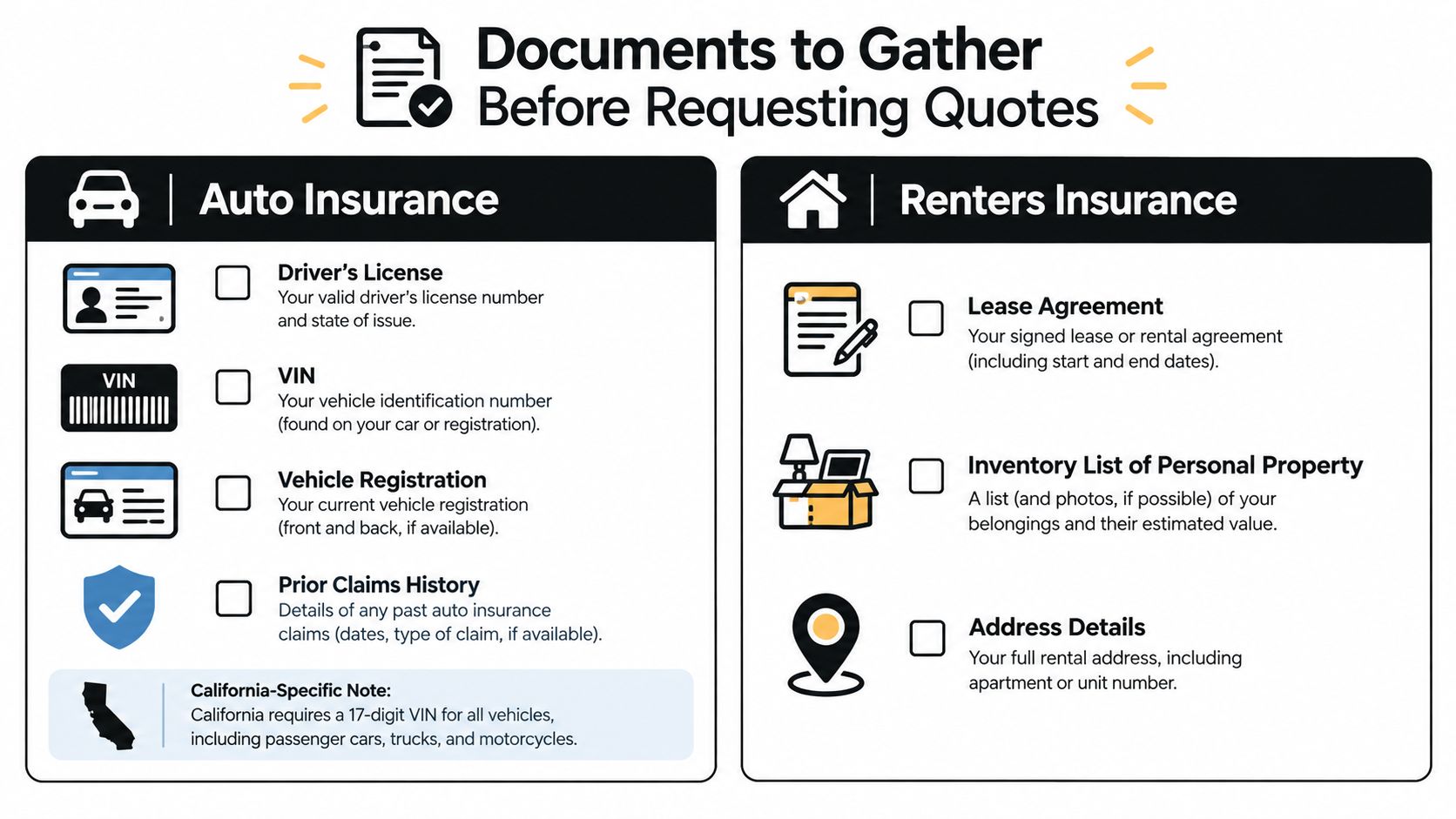
A quote goes faster when you treat it like an application packet, not a casual price check. Gather the documents for auto insurance first, then prepare the information for renters insurance. The objective is simple: every carrier should evaluate the same household, vehicle, address, and coverage assumptions.
Auto insurance documents and driver details
Have each driver's license available, along with the vehicle identification number, registration, and the year, make, model, and trim. The VIN matters in California because insurers use it to identify the exact vehicle, equipment, safety features, and repair profile. Add the garaging address, estimated annual mileage, commuting or business use, and whether the vehicle is financed or owned outright.
If a lender has a financial interest in the vehicle, gather the lienholder's name and address. A financed car generally requires full and collision coverage, and the lender must appear correctly on the policy. Upload or photograph your current declarations page, then list prior accidents by date and fault status, DUI history, license suspensions, coverage lapses, and any telematics program you're willing to use.
A current Good Driver Discount certificate can affect eligibility, so don't assume the carrier already has it. Also disclose any assigned-risk or Fair Plan auto history instead of allowing a quote form to guess.
Renters insurance information
For the rental, prepare the landlord's name, the complete property address, floor or unit number, monthly rent, building story count, construction type, and security features such as deadbolts, alarms, or monitored systems. Estimate the replacement value of your personal property room by room. Include electronics, furniture, clothing, tools, jewelry, musical instruments, and business equipment.
Check the lease before requesting prices. It may require a particular liability limit, such as 100/300, or named-perils coverage for contents. Keep a recent utility bill photo and the lease agreement nearby because both can speed address and occupancy verification.
Practical rule: Never compare renters insurance quotes until personal-property limits, liability limits, deductibles, and replacement-cost treatment are identical.
A structured moving and storage record can also help you document possessions and coverage needs. The mover insurance documentation workflow is useful when you're building an inventory before a move. For California policy guidance and quote preparation, keep the California home and auto insurance guides available.
How to Pull Same-Day Multi-Carrier Quotes the Right Way
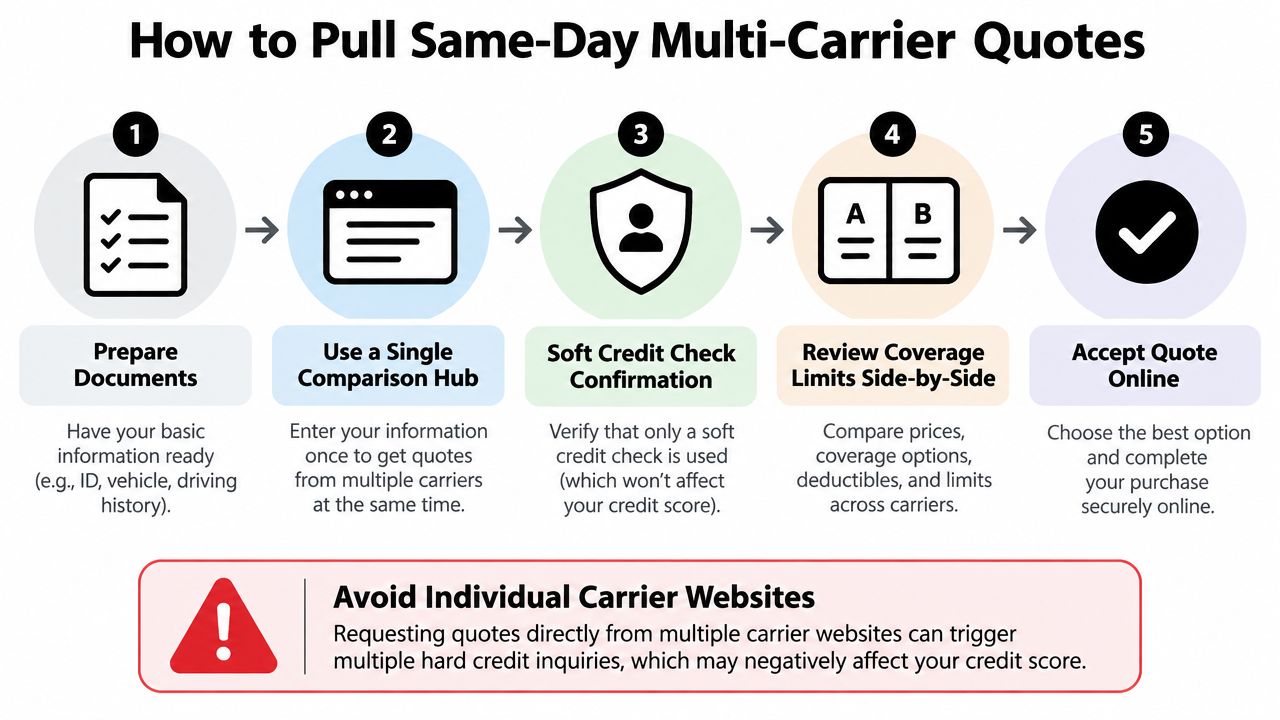
The fastest clean comparison happens in one afternoon, with one prepared profile and locked coverage terms. Don't visit a dozen carrier websites and enter slightly different information each time. That creates inconsistent results and can expose your contact details to lead-generation networks.
Start with one controlled quote session
Use a comparison hub or licensed agency that can access multiple carriers. Before submitting anything, ask whether the process uses a soft inquiry or a hard application, whether your information is shared with insurers or brokers, and whether marketing calls, emails, and texts are part of the exchange. A soft-pull engine generally doesn't move your score, while hard applications can create separate inquiry records. Don't rely on a comparison site's label without reading its privacy terms.
Use a dedicated email address and your California area code. Disable call-tracking redirects where the site allows it, and avoid consent boxes that authorize broad partner marketing. Consumer Reports has documented privacy concerns involving quote sites that collect driving, vehicle, and personal information before sharing it with insurers or brokers, which can produce unwanted follow-up calls and messages.
Lock the coverage architecture first
Set the same terms for every quote:
- Liability: Use California's legal baseline, 30/60/15, or choose higher limits if your assets, income, or driving exposure justify them. California's requirements became $30,000 per person for bodily injury, $60,000 per accident, and $15,000 for property damage on January 1, 2025, according to the California insurance legislative report.
- Uninsured motorist: Match the structure to your liability selection instead of allowing one carrier to omit it.
- Physical damage: Enter collision and other physical damage deductibles in dollars, not vague “standard” settings.
- Transportation: Specify the rental reimbursement amount and duration.
- Vehicle finance features: Ask about gap coverage and new-car replacement eligibility separately from standard physical damage coverage.
Request every quote during the same session so your profile remains stable. Save a screenshot of the quote summary, declared drivers, deductibles, optional coverages, fees, and the full discount stack. A rigorous methodology should standardize ZIP code, limits, deductibles, and risk assumptions before comparing prices, as described in insurance quote methodology guidance.
For a direct California quote request, use the online insurance quote page. Treat each result as a starting point until you confirm the insurer, coverage form, payment schedule, and binding requirements.
What Actually Drives Your California Auto and Renters Rates
California auto premiums respond first to the risk attached to the vehicle, driver, and garaging location. Your ZIP code places the car in a rating tier shaped by collisions, theft, repair costs, traffic density, and wildfire exposure. A lapse longer than sixty days, an at-fault accident surcharge that commonly remains relevant for three years, driving-record points, and business use for delivery or gig work can move the quote sharply.
The state's low-mileage rules also matter because regulatory changes in 2025 altered how insurers evaluate lower-use drivers. Collision labor and parts costs add pressure in California body shops, especially for newer vehicles with sensors and specialized repair procedures. A financed SUV with full coverage and teen drivers belongs to a completely different pricing category from an older sedan carrying liability-only coverage.
Renters insurance is usually far less expensive than auto insurance, but the policy design still determines whether it protects your actual life. California estimates for standard renters policies cluster around $175 to $204 per year, depending on coverage design. One benchmark uses $20,000 in personal property coverage, $100,000 in liability, and a $500 deductible, so a lower quote may offer less protection. See the California renters insurance guide before treating a premium as comparable.
The variables that deserve scrutiny
Claims history follows the policyholder, not merely the apartment address. A renter who changes buildings can carry prior claims into the next application, while two neighbors can receive different prices because their property limits, deductible, occupancy, or claims records differ.
| Rate Driver | Auto Impact | Renters Impact |
|---|---|---|
| Garaging ZIP code and wildfire exposure | Often substantial, because location affects collision, theft, repair, and fire risk | Can materially change eligibility, pricing, and available coverage |
| Driving record and at-fault accidents | Strong effect, particularly after a chargeable accident | Usually no direct effect unless the renter is also an auto applicant |
| Coverage architecture | Liability-only is cheaper than full coverage, while deductibles and optional benefits change the result | Personal-property limit, liability ceiling, deductible, and loss-of-use terms determine value |
| Vehicle type and finance status | A financed, costly-to-repair SUV needs broader physical damage protection than an older sedan | No vehicle impact, but valuable belongings may require endorsements |
| Claims history | Follows the driver and policy history | Follows the policyholder, not just the rental address |
| Business or gig use | Can require business-use classification and raise the premium | Home-based business property may need separate treatment |
The important comparison is not “Which insurer has the lowest number?” It's “Which insurer priced the same risk with the same protection?”
Bundling Versus Standalone Policies and When Each Wins
Bundling is useful, but the discount headline is not the decision. Independent bundle research places renters insurance around $135 to $155 per year, while full-coverage auto comparisons ran around $2,005 to $2,094 per year. The same research found that pairing renters and auto coverage can reduce car insurance costs by about 5% to 10%, while recent analyses commonly place renters bundle savings near 5%. Review the underlying premium, not just the advertised percentage, using the auto and renters bundle analysis.
A bundle can be attractive because the renters policy is inexpensive relative to auto insurance, and billing becomes easier. But a 10% discount on an expensive auto policy can still cost more than a lower standalone auto quote from another carrier. The only reliable test is total annual cost with matching deductibles, limits, fees, and payment terms.
Compare the household total
| Scenario | Bundle Annual Cost | Standalone Annual Cost | Savings Gap | Recommended Path |
|---|---|---|---|---|
| Sacramento renter with clean driving record | Auto premium plus renters premium, less the quoted multi-policy discount | Separate auto and renters premiums from specialist carriers | Use the actual quote totals, not the discount headline | Choose the bundle only if both policies match coverage and claims terms |
| Driver with recent at-fault accident | Bundling-friendly carrier may price the auto line more favorably | A specialist renters carrier may offer stronger contents treatment | The auto base rate can outweigh a larger-looking renters discount | Compare a bundle first, then test separate renters coverage |
| Renter with high-value electronics | Bundle may offer convenience but restrictive property sublimits | Renters specialist may price scheduled property and replacement cost more clearly | Better contents protection can justify a higher standalone premium | Favor the specialist if the bundle leaves valuables underinsured |
| Household seeking simpler billing | One account and aligned renewal dates | Separate billing and claim relationships | Administrative convenience has value, but it isn't coverage | Bundle only after confirming claim treatment and deductible rules |
Ask whether one claim affects the bundle discount, whether a second claim changes eligibility, and whether the policies share a deductible in any defined situation. Do not assume “multi-policy” means every line is priced competitively.
The discount is not the savings. The combined premium after coverage corrections is the savings.
A California driver who wants to test auto-only pricing can review the California auto insurance options. Get standalone quotes before accepting a bundle, especially when the renter owns expensive electronics, has a clean driving record, or needs specialized property endorsements.
Red Flags That Should Make You Reject a Cheap Quote
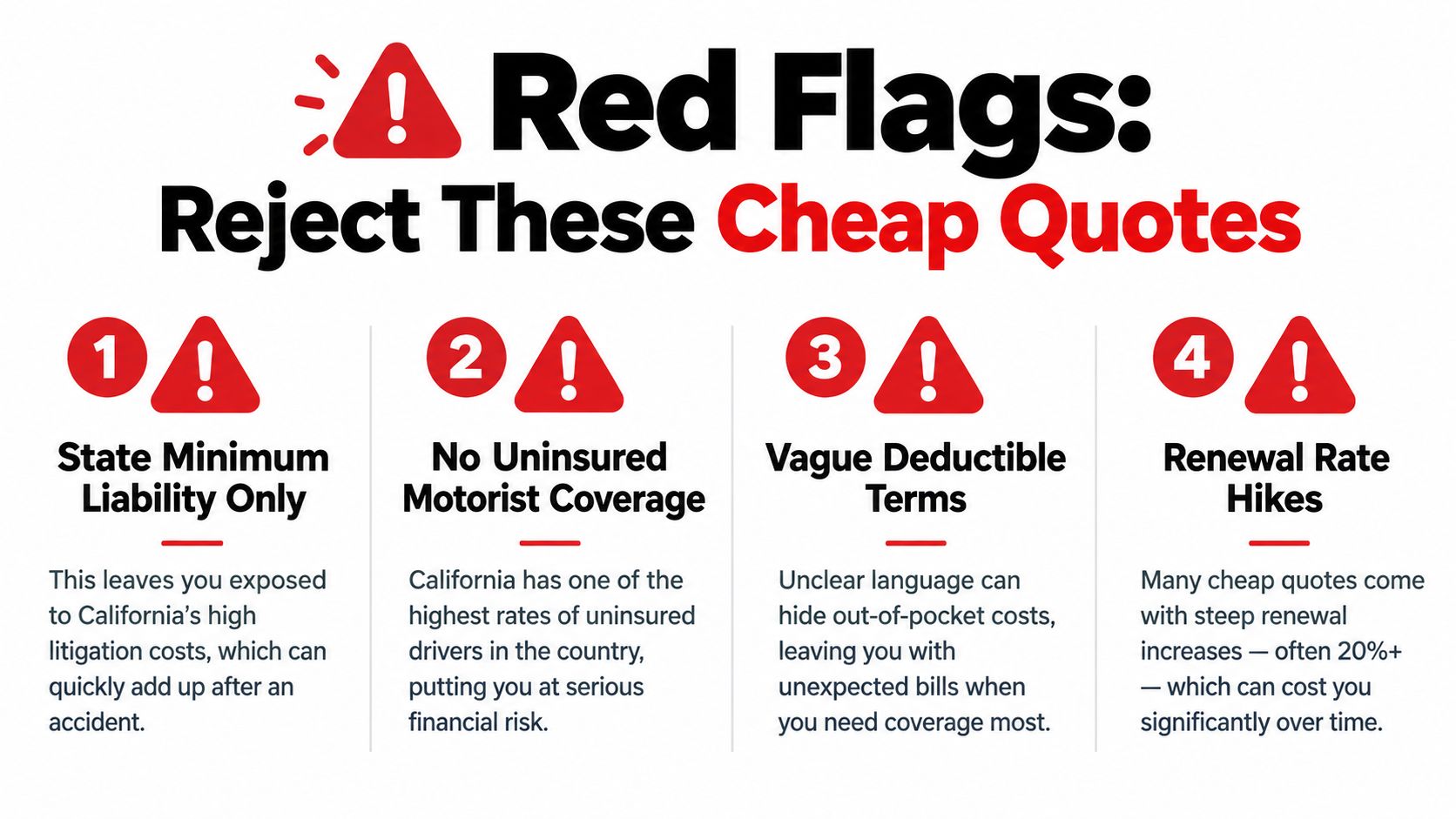
The lowest quote often wins because it strips away protection. State minimum liability may satisfy the legal requirement, but it may leave your income and assets exposed after a serious accident. Ask for a higher-limit alternative before deciding that the baseline price is a bargain.
California's required limits are now 30/60/15, and full coverage or collision coverage doesn't satisfy the state's financial responsibility requirement. That distinction matters. A quote showing full coverage can still fail to provide the required liability protection if the liability section is incomplete or misunderstood.
Read the quote like a declarations page
Reject or pause any quote with these problems:
- Only state minimum liability: Request higher limits and compare the added premium. Don't let a low liability figure define the entire purchase.
- No uninsured motorist coverage: Ask why it's absent, whether it was rejected, and what limits are available.
- Unclear carrier status: Confirm whether the insurer is admitted and subject to the California Department of Insurance framework, or whether it operates through surplus lines with different protections and complaint channels.
- Unitemized fees: Review the declarations page and payment schedule for policy, installment, broker, or administrative charges. Never bind before you understand every added cost.
- Vague deductibles: “Collision included” means little unless the deductible appears in dollars.
- Unexplained inquiry activity: Ask what credit or insurance-score inquiry occurred and whether the aggregator shared your information with partners.
- Missing optional coverage details: Rental reimbursement, gap protection, new-car replacement, roadside assistance, and custom equipment must appear as selected or declined.
Comparison websites can also display different “best prices” because platforms use different aggregation rules, underwriting filters, quote thresholds, and data sources. Filed-rate data and real-time partner quotes measure different things, so validate the final offer before binding.
Before you accept, ask one question: If I had a claim tomorrow, can I explain exactly what this policy pays, what I pay first, and which exclusions could leave me exposed? If you can't answer, the quote isn't ready to bind.
Wildfire Risk Fair Plan Reviews and Renters Coverage Gaps
Wildfire exposure changes the quote conversation before premium becomes the main issue. Insurers evaluate the property ZIP code, access, construction, surrounding vegetation, and claim exposure. In higher-risk areas, admitted insurers may non-renew, leaving homeowners to investigate the California FAIR Plan while renters must examine their own contents, liability, and temporary-housing terms.
The FAIR Plan is not broad homeowners insurance. The California Department of Insurance describes basic residential coverage as limited to fire, lightning, internal explosion, and smoke. Optional extended coverage can add windstorm, hail, explosion, riot or civil commotion, aircraft, vehicles, and volcanic eruption, while vandalism or malicious mischief may be added for an extra premium. Renters shouldn't assume a landlord's FAIR Plan solves the tenant's problem. The landlord's policy protects the building interest, not the renter's belongings or personal liability.
Review smoke, evacuation, and vehicle protection
Smoke coverage deserves specific attention. California hearing materials describe policy language requiring direct physical loss and define smoke damage around visible soot, ash, or smoke odor detectable without specialized equipment. That makes a renters policy's exclusions, proof requirements, and claims handling important, particularly after a nearby fire creates smoke or ash without obvious flames inside the unit. Review the California FAIR Plan residential coverage explanation and ask the agent to explain the actual policy form.
Use this checklist before binding:
- Contents valuation: Choose actual cash value or replacement cost knowingly. Depreciation can change the amount available after a loss.
- Off-premises property: Ask how belongings stored elsewhere or moved during evacuation are treated and what limits apply.
- Loss of use: Confirm whether temporary relocation benefits apply after a covered loss and whether a mandatory evacuation order alone triggers payment.
- Vehicle protection: Other-than-collision coverage is the part to examine for fire-related vehicle damage. Ask about evacuation instructions, storage, towing, and any rental-car reimbursement.
- Fair Plan coordination: Homeowners should identify what the FAIR Plan covers and which broader risks require a separate companion policy. Renters should request a standalone renters quote rather than assuming the building's insurance extends to them.
ZIP-code underwriting can make the next renters quote look very different from the last one. Compare the coverage form and wildfire exclusions before comparing price.
When a Licensed California Agent Beats a Self-Service Website
Self-service quote engines work well for a straightforward household with one or two standard vehicles, ordinary personal property, and a clean insurance history. They become less useful when the application contains exceptions an algorithm cannot explain.
Call a licensed agent when you have more than two cars, valuables above $25,000, an SR-22, a non-owner auto situation, a recent lapse, or a move into a Fair Plan ZIP code. These cases require interpretation, not just data entry. A website may not pull motor vehicle reports in real time for every driver, interpret a C-61 certificate, or surface carrier-specific California discounts such as a newly approved good-driver override.
Where human review earns its place
An agent can test separate carriers for auto and renters instead of assuming one company deserves both policies. They can also coordinate an umbrella liability strategy across the household, explain how a lapse affects eligibility, and identify whether a renters policy's property sublimits fit electronics, jewelry, tools, or business equipment.
Complexity also includes communication. Multilingual households need policy language explained accurately, not translated through a generic form. A licensed professional can clarify what the carrier requires before coverage starts, what documents are missing, and which exclusions matter in a wildfire-prone ZIP code.
Mai & Associates is a practical escalation path for California households that have reached the limits of self-service shopping. The agency offers auto, renters, home, and life insurance quotes, supports online and phone requests, and handles California FAIR Plan reviews, earthquake options, and wildfire protection questions. It also provides support in English, Spanish, Armenian, Russian, and Vietnamese.
Mai & Associates can compare car insurance and renters insurance quotes across California while checking limits, deductibles, bundle terms, and wildfire-related gaps. Visit Mai & Associates to request a no-obligation quote and speak with a licensed agent about the coverage you need.