Unlock Savings: Car and Renters Insurance Bundle
You're probably dealing with the same mess a lot of California renters deal with. One bill for car insurance. Another for renters insurance. Two login portals. Two renewal dates. Two chances to miss a notice and overpay. In a state where housing costs are already high and insurance markets can get tight fast, that setup usually costs more money and creates more friction than it should.
A car and renters insurance bundle is often the cleanest fix. Put both policies with one carrier, line up the coverage properly, and you can save money while making your insurance easier to manage. That's the simple version.
The California version is more complicated. Wildfire zones can limit your options. Earthquake damage usually sits outside a standard renters policy. And if the California FAIR Plan is part of your property protection picture, the usual bundling advice from national articles starts to fall apart. If you want real savings, you need to look at the discount and the coverage gaps at the same time.
Are You Overpaying for California Auto and Renters Insurance
If you have separate policies with separate companies, there's a good chance you're paying for convenience in the worst possible way. You're doing more work while the carriers collect more premium. That's backwards.
Individuals don't start out trying to build a clunky insurance setup. They buy car insurance when they get a vehicle. Later they move into an apartment and grab renters insurance because the landlord requires it. The two policies end up in different places, and then they stay there out of habit. That habit gets expensive.
In California, the problem gets worse because your insurance decisions aren't happening in a calm market. Car insurance rates matter more when every monthly bill already feels heavy. Renters insurance choices matter more when your building, neighborhood, or ZIP code comes with wildfire concerns or other restrictions. If you haven't reviewed both policies together, you're probably missing an easier way to cut costs.
What to do first
Start with a simple review:
- Pull both declarations pages: You need the current carrier, limits, deductibles, listed drivers, and address details in front of you.
- Check renewal timing: If one policy renews soon, that's your best opening to shop the bundle.
- Compare your setup against a combined quote: A bundled quote only matters if the coverage matches what you already have, or improves it.
If you haven't looked at your California car coverage lately, review the basics before comparing package options through this guide to California auto insurance options.
Practical rule: Don't judge your insurance by the monthly payment alone. Judge it by total annual cost, coverage quality, and how easy it'll be to use when something goes wrong.
A bundle isn't automatically the best deal. But in California, ignoring bundling is one of the fastest ways to miss a savings opportunity that's sitting right in front of you.
Understanding How Insurance Bundling Works
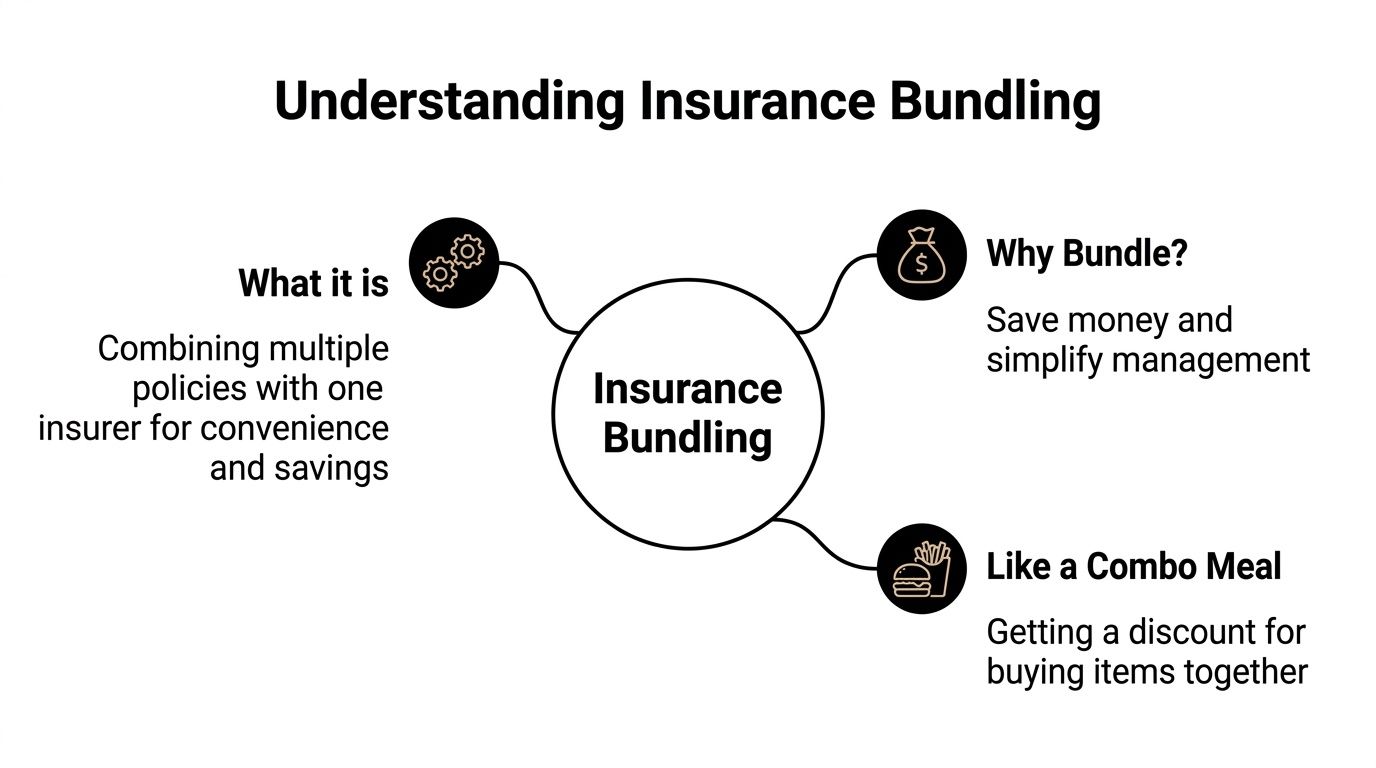
Think of bundling like ordering a combo meal instead of buying each item separately. You still get the burger. You still get the fries. You still get the drink. They don't become one product. You just buy them together from the same place, and the total price is often better.
Insurance works the same way. A multi-policy discount usually means you buy your auto insurance and renters insurance from the same carrier. The insurer keeps the policies separate for coverage purposes, but prices them together for account-level savings and easier administration.
What a true bundle looks like
A real bundle usually includes these features:
- One carrier: Both policies sit with the same insurance company.
- One account view: You can usually manage both policies through one portal or service team.
- One service relationship: When you need changes, billing help, or claim guidance, you're not bouncing between companies.
That's different from having two separate policies bought through the same agent but placed with different insurers. That setup can still be useful, but it's not the same as a true car and renters insurance bundle.
Why that distinction matters
The discount comes from keeping multiple policies with one insurer. The convenience does too. When the same company sees your vehicle risk and your renters exposure together, it's easier to line up coverage, renewals, and account changes.
That same logic matters to property owners as well. If you rent out a property or want a clearer picture of how coverage differs by occupancy type, this breakdown on understanding property insurance for landlords gives helpful context on where homeowners and landlord policies split.
Bundling doesn't merge your protections into one giant policy. Your auto policy still covers vehicle-related loss. Your renters policy still covers your belongings, personal liability, and related living issues covered under that contract.
That sounds basic, but plenty of buyers misunderstand it. They assume “bundle” means broader coverage by default. It doesn't. It means coordinated purchasing and management. The quality of the bundle still depends on the actual policy terms.
Key Advantages of a Combined Insurance Policy
The discount gets the attention. Fair enough. Saving money is the point. But that's not the only reason I like bundled policies for California renters who drive.
The stronger argument is that a good bundle can lower cost, reduce admin headaches, and help you avoid dumb coverage mistakes that only show up after a loss.
Savings matter, but check the math
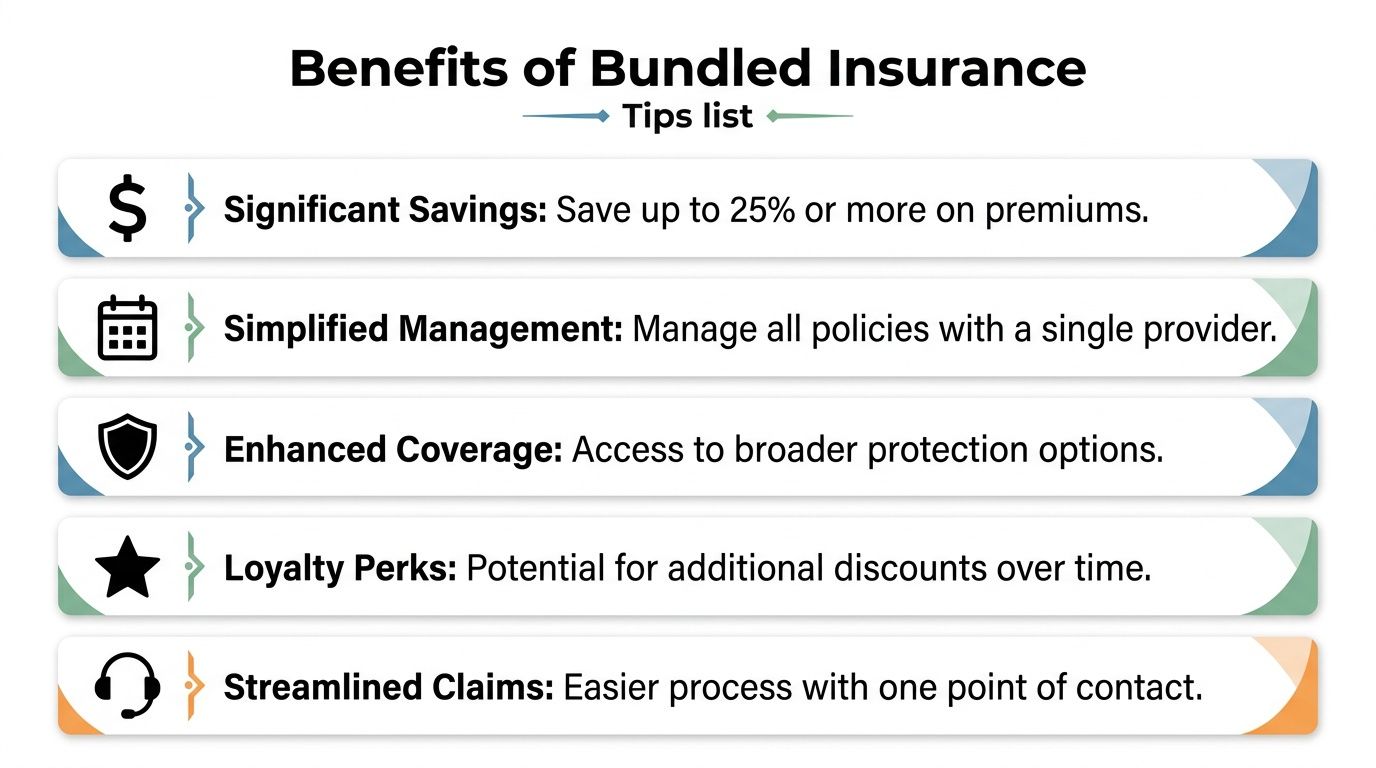
This is the part most shoppers care about first, and they should. According to industry analysis, consumers who bundle their auto and renters insurance policies can save an average of 5% to 25% on their combined premiums annually (Insurance Information Institute).
That range is meaningful, especially in California, where auto insurance can take a big bite out of your monthly budget. But don't stop at the headline. A bundle only wins if the carrier isn't making hidden cuts to useful coverage to manufacture the discount.
One bill is underrated
People underestimate how much money they lose from disorganization. Miss a payment. Overlook a renewal. Forget to update an address after a move. Leave an old vehicle on a policy too long. These are ordinary mistakes, and they cost real money.
A combined policy setup often gives you:
- Fewer moving parts: One account, one billing rhythm, fewer chances to miss something.
- Easier reviews: You can look at your car insurance and renters insurance at the same time instead of treating them like separate worlds.
- Cleaner renewals: It's simpler to spot a premium jump when both policies are under one roof.
Better coverage coordination
This is the benefit that almost nobody talks about enough.
When one carrier or one servicing team reviews both policies together, it becomes easier to catch weak spots. Maybe your auto liability is stronger than your renters liability, or vice versa. Maybe your deductible choices make no sense as a pair. Maybe you have expensive electronics, bikes, instruments, or jewelry in the apartment and a bare-bones renters policy that won't hold up well when you need it.
That's where a bundle can become a smarter insurance decision, not just a cheaper one.
Agent insight: The cheapest bundle on the screen often isn't the best one. The best one is the quote that protects your car, your stuff, and your liability without forcing you to patch holes later.
Claims and service can be less chaotic
A single incident can trigger more than one policy issue. If your car is damaged and personal property connected to that event is also involved, a one-carrier setup can reduce handoffs and confusion. It won't turn two coverages into one, but it can make the process less annoying.
The biggest advantage is practical. You have one company to call, one account to access, and fewer chances for one insurer to point at another and tell you to start over.
Special Insurance Considerations for California Renters
California renters can't shop insurance the way renters in calmer markets do. Your ZIP code, wildfire exposure, building type, and even the carrier's appetite for certain neighborhoods can all shape whether a bundle is easy, expensive, or not available at all.
That's why generic advice falls short here.

Wildfire risk changes the playing field
Even if you're a renter and don't own the building, wildfire risk can still affect your insurance options. Carriers look at location risk when they price and underwrite renters coverage. In some areas, that can narrow the list of insurers willing to write the policy at all. If the renters side gets hard to place, the bundle becomes harder too.
That doesn't mean you should skip shopping. It means you need to be realistic. In California, the best bundle is sometimes the best available combination of price, carrier stability, and usable coverage, not some fantasy quote from a broad national ad.
For renters trying to sort through location-specific options, this resource on California renters insurance coverage is a useful place to review what a policy should do.
Earthquake losses usually require separate protection
This is one of the most common misunderstandings I hear. A standard renters policy generally doesn't turn into earthquake coverage just because it sits inside a bundle. If your personal property concern includes earthquake damage, you need to ask about separate earthquake protection or endorsements where available.
Don't assume “all-risk” language or a polished quote proposal means earthquake is in there. In California, you verify this point directly and in writing. If you skip that step, you're guessing.
The California FAIR Plan doesn't fit the usual bundle model
The FAIR Plan is often part of the conversation for higher-risk California property situations. It exists as an insurer of last resort for property coverage when standard market options are limited. That matters because people hear “property insurance” and assume it can be packaged neatly with auto the same way a standard renters policy can. Often, it can't.
If a FAIR Plan-related structure is involved in your overall property protection picture, your setup may require layered coverage or separate policy coordination rather than a clean one-carrier auto-and-renters package. That doesn't make the arrangement bad. It just means the normal bundling playbook doesn't apply the same way.
Liability questions deserve more attention
Renters insurance isn't just about stolen laptops and damaged furniture. Liability matters too. If you want a plain-English discussion of where renters liability can come into play, Mattiacci Law on renters insurance claims is worth reading.
Here's the practical takeaway:
- Ask whether wildfire exposure affects availability
- Confirm earthquake treatment specifically
- Don't assume FAIR Plan-related property needs will bundle neatly with auto
- Review liability, not just personal property
California renters need local judgment, not canned advice. The right policy structure depends on where you live, what risks you face, and whether the carrier will still be a good fit at renewal.
A Step-by-Step Checklist to Finding Your Bundle
Shopping for a car and renters insurance bundle doesn't need to be complicated. It needs to be organized. If you gather the right information first and compare quotes the right way, you'll make a better decision and waste a lot less time.
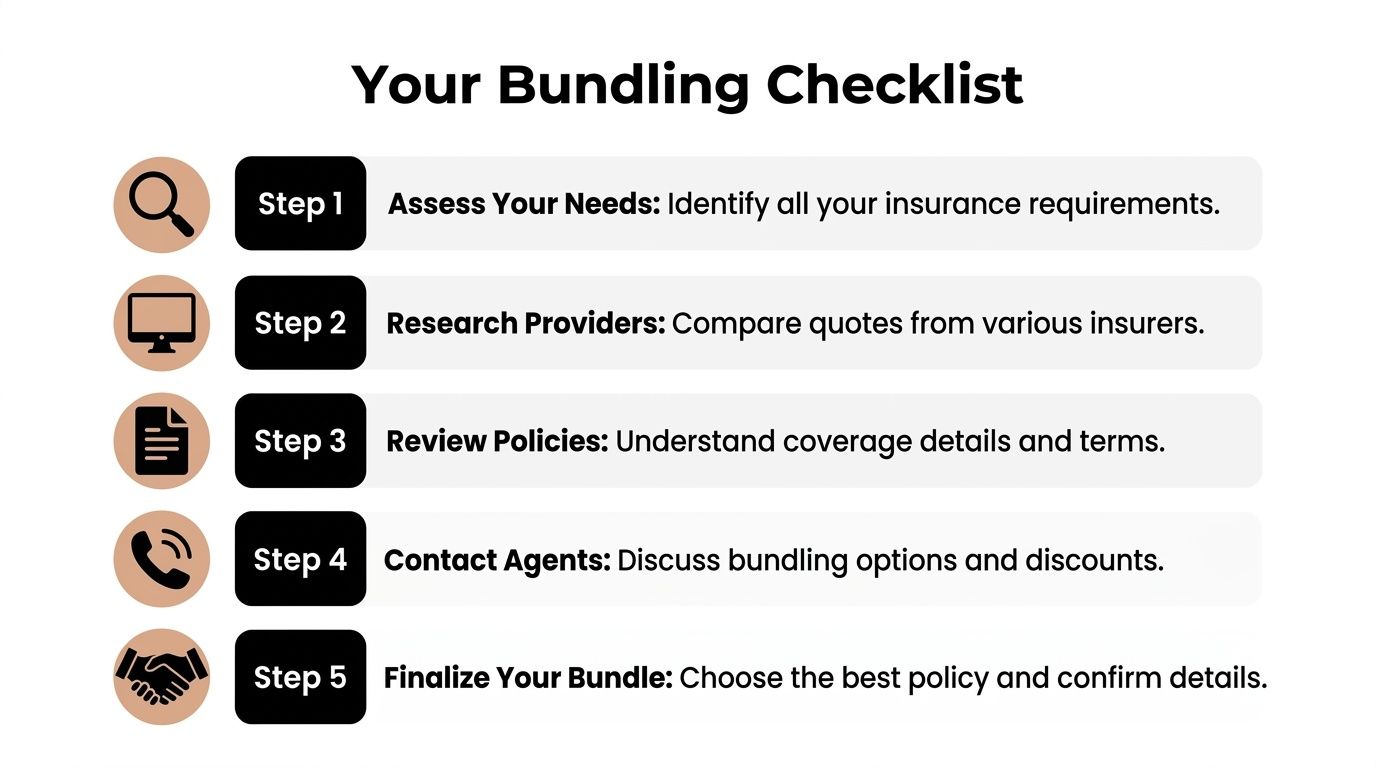
Step 1 Gather your documents
Before you ask for quotes, pull together the items that drive quote accuracy.
You'll usually want:
- Current declarations pages: For both auto and renters insurance
- Driver information: License details and driving history disclosures
- Vehicle details: VIN, garaging address, lienholder info if applicable
- Rental details: Apartment address, occupancy details, and any landlord insurance requirements
- Property notes: High-value items you may want scheduled separately
If you quote from memory, you'll get sloppy comparisons. That's how people think a bundle is cheaper, then find out the coverage isn't even close.
Step 2 Decide what you actually need
Don't start with price. Start with exposures.
Ask yourself a few blunt questions. Do you drive a lot in heavy California traffic? Do you have savings or income you'd want to protect if someone sued you after an auto accident? Do you own electronics, jewelry, bikes, tools, instruments, or collectibles that would hurt to replace out of pocket? Are you relying on a bare minimum renters policy just to satisfy a lease?
Those answers shape the quote. If you want a fast starting point for side-by-side options, request a California insurance quote comparison and review the offers against your actual needs.
Step 3 Shop multiple carriers
Many become complacent and overspend. They call their current auto insurer, ask for renters insurance, and assume the first bundle quote must be competitive. Sometimes it is. Sometimes it's not.
Use a process that lets you compare multiple carriers on the same coverage assumptions. Keep the liability limits, deductibles, and endorsements aligned as closely as possible. Otherwise, you're not comparing prices. You're comparing different products.
Step 4 Ask sharper questions
A good quote conversation should answer more than “What's my premium?”
Ask things like:
- What exactly makes this a bundle discount
- Are the liability limits on both policies appropriate
- What exclusions or sublimits matter most for my apartment and belongings
- How are claims handled if an incident touches both policies
- What happens to pricing if I cancel one policy later
Checklist mindset: If a quote looks great but nobody has explained the deductibles, liability limits, and exclusions, you don't have a deal. You have a guessing problem.
Step 5 Compare on an apples-to-apples basis
Put the quotes side by side. Then compare:
| Coverage point | Quote A | Quote B | What to watch |
|---|---|---|---|
| Auto liability | Match | Match | Lower limits can fake savings |
| Collision and comprehensive | Match | Match | Deductibles change the price fast |
| Renters personal property | Match | Match | Weak limits can leave you short |
| Renters liability | Match | Match | Don't ignore lawsuit exposure |
| Extra item coverage | Included or not | Included or not | Important for jewelry and electronics |
The best bundle is the one you can afford, understand, and rely on after a loss. That's the standard.
Real-World Savings and Hidden Gaps to Watch For
A lot of shoppers want a quick table with city examples. I get why. It feels concrete. But unless you're comparing actual quotes with the same coverage terms, any city-by-city dollar figure is just decoration. California pricing changes too much by driver, address, vehicle, claim history, and carrier appetite to pretend otherwise.
So here's the honest version.
Sample Annual Savings Car and Renters Insurance Bundle in California 2026
| City | Separate Policies (Annual Cost) | Bundled Policy (Annual Cost) | Annual Savings |
|---|---|---|---|
| Los Angeles | Varies by driver, vehicle, address, and coverage | Varies by carrier and bundle eligibility | Often available, but quote-specific |
| San Francisco | Varies by driver, vehicle, address, and coverage | Varies by carrier and bundle eligibility | Often available, but quote-specific |
| Escondido | Varies by driver, vehicle, address, and coverage | Varies by carrier and bundle eligibility | Often available, but quote-specific |
That may look less exciting than a table full of made-up numbers. Good. Insurance decisions should be built on real quotes, not fantasy examples.
The cheapest bundle can still be the wrong bundle
I see three mistakes over and over.
First, people chase the lowest premium and accept weak liability limits. That's a bad trade. Saving money upfront doesn't help much if an accident leaves you exposed.
Second, they focus on the auto policy and barely read the renters policy. That leads to weak personal property protection, low liability coverage, or missing endorsements for items that matter to them.
Third, they assume expensive items are fully covered because they bought renters insurance. Often, that's not how it works. Jewelry, electronics, instruments, collectibles, and specialty gear may need added protection or scheduled coverage.
What to review before you say yes
Use this quick buyer-beware list:
- Check liability strength: Auto and renters liability should make sense together.
- Review sublimits: Special item categories may have tighter limits than you expect.
- Ask about endorsements: If you own valuable property, standard coverage may not be enough.
- Read deductibles carefully: A lower premium with a deductible you can't comfortably handle isn't a win.
A bundle only saves money if it still works on your worst day. If the policy can't carry the claim, the discount was the least important part of the deal.
Your Bundling Questions Answered
Can you bundle if you have a poor driving record
Yes, sometimes. A driving record can affect eligibility, price, and carrier options, but it doesn't automatically eliminate the possibility of bundling. The question is whether the insurer wants both risks under one account at a price that still makes sense.
What happens if you cancel one policy in the bundle
Usually, the remaining policy gets repriced without the multi-policy discount. That can make the leftover policy more expensive than you expected. Before you cancel auto, renters, or any related coverage, ask how the carrier recalculates the account.
Is bundling always the cheapest option
No. It's often competitive, and it's often more convenient, but not always the lowest total cost. Some drivers get a better auto deal with one carrier and a better renters policy elsewhere. The smart move is to compare the bundled option against separate quotes with matching coverage.
Can you bundle life insurance too
Sometimes, yes. Some carriers allow broader account relationships that include life insurance along with auto, renters, home insurance, or other personal lines. If you're already reviewing your car insurance and renters insurance, it's a good time to ask whether life coverage belongs in the conversation too.
For more answers to common policy questions, review the agency's California insurance FAQ.
A good car and renters insurance bundle can absolutely save money and simplify your life. In California, though, the right answer depends on more than a discount. Wildfire exposure, earthquake gaps, liability choices, and carrier fit all matter. If you only shop by price, you can still end up underinsured.
If you want a California-specific review of your auto insurance, renters insurance, home insurance, or life insurance, Mai & Associates is a strong place to start. Their licensed team offers same-day quotes, multilingual support in English, Spanish, Armenian, Russian, and Vietnamese, and practical guidance for Californians dealing with wildfire risk, earthquake coverage questions, and California Fair Plan complications. If you want customized options instead of generic advice, talk to them and compare real coverage side by side.